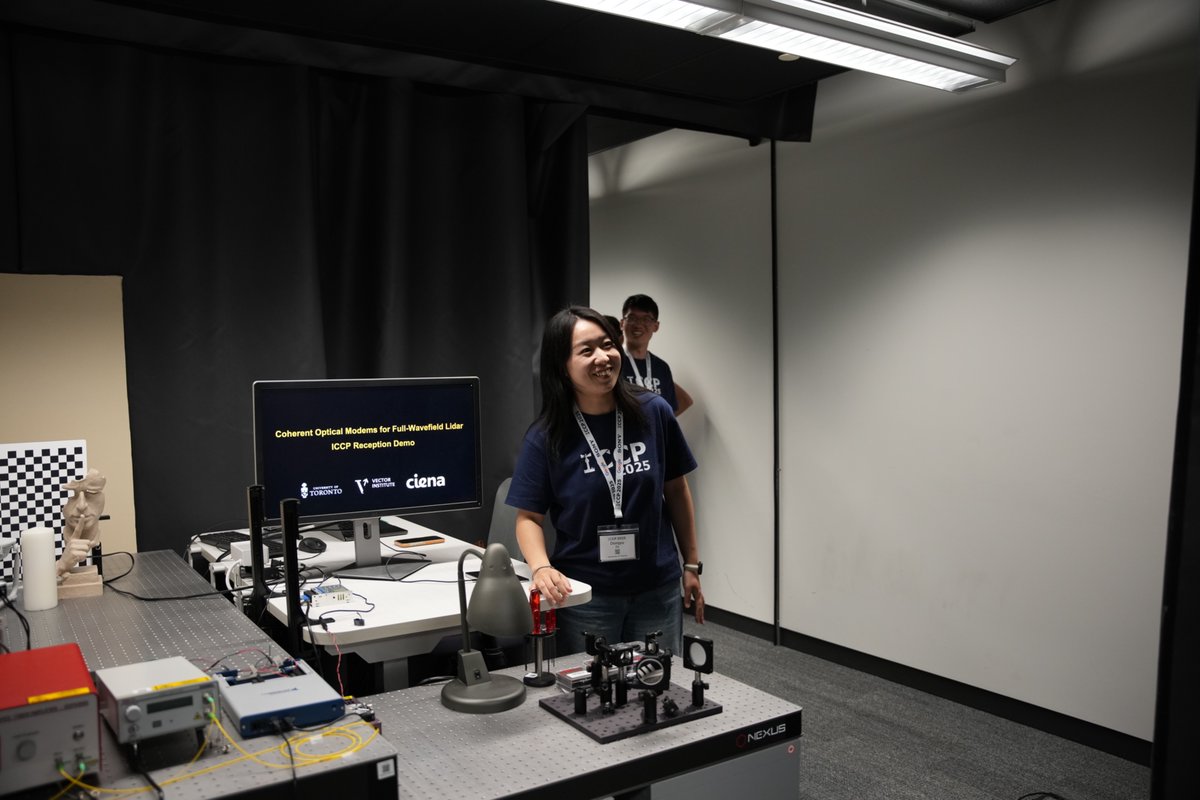
🚀Excited to share our Optica work! New lidar system simultaneously recovers location, speed, and material properties! (🔗https://t.co/AuLlIgyrLT)
Thanks to all collaborators @AndrewEJXie, Parsa Mirdehghan, Brandon Buscaino,@SeungHwanBaek8, Kiriakos Kutulakos, and @DaveLindell
📢📢📢 Velox 🚀: Learning Representations of 4D Geometry and Appearance
In our #CVPR2026 paper, we introduce a method for learning a native 4D representation, useful for many downstream tasks, such as video-to-4D, 3D tracking, cloth simulation, and others!
🌐: https://t.co/MCkCMEftoJ
📝: https://t.co/iLKgrprXlO
📢 Check out Lyra 2.0: large-scale generative worlds with a 3D-consistent video diffusion model. Optionally, feed-forward 3DGS and/or mesh reconstructions.
Great work by @TianchangS, @xuanchi13, and the rest of the crew. Grateful for my time with all of these brilliant people 🙏
Introducing Nexels: Neurally-Textured Surfels for Real-Time Novel View Synthesis with Sparse Geometries
Nexels render in real-time at high quality without needing millions of primitives.
Site: https://t.co/mazzRQzhLV
Paper: https://t.co/R23NdVzsVb
Code: https://t.co/Hq3zUfAnxM
📢 Lyra: Generative 3D Scene Reconstruction via Video Diffusion Model Self-Distillation
Got only one or a few images and wondering if recovering the 3D environment is a reconstruction or generation problem? Why not do it with a generative reconstruction model!
We show that a camera-conditioned video diffusion model can be transformed into a generative reconstruction model that directly outputs a high-quality 3D Gaussian Splatting representation through self-distillation, without requiring real-world training data.
Check out our results in the video (wait for dynamic scenes in the second half!) :
Project Page: https://t.co/pKtry0BdOL
Code and Models: https://t.co/p4zVBrMKU5
Paper: https://t.co/ZuMM1LCP82
Every lens leaves a blur signature—a hidden fingerprint in every photo.
In our new #TPAMI paper, we show how to learn it fast (5 mins of capture!) with Lens Blur Fields ✨
With it, we can tell apart ‘identical’ phones by their optics, deblur images, and render realistic blurs.
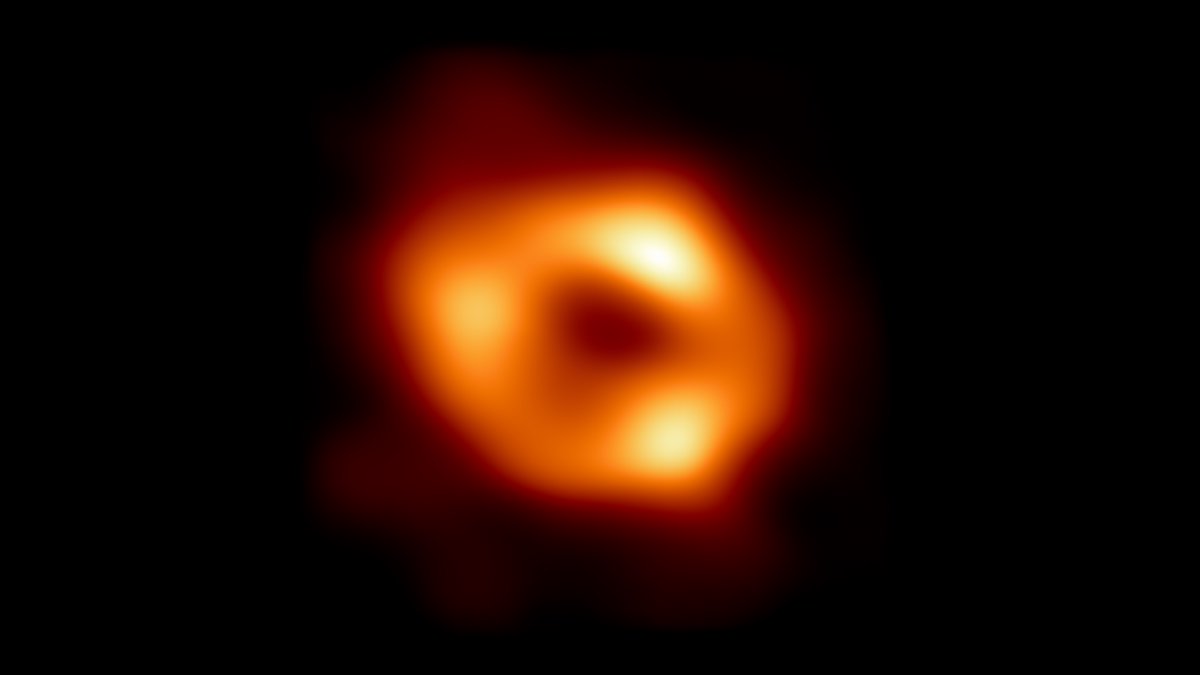
We finally have the first look at our Milky Way black hole, Sagittarius A*. It’s the dawn of a new era of black hole physics. Credit: EHT Collaboration. #OurBlackHole#SgrABlackHole
Link: https://t.co/Ax7ECRVg8A