Hello everyone, I’m a PhD student at Lancaster University, UK. I am seeking Early Career Researchers (ECRs) to participate in my PhD study on ECRs Use of Twitter... Can you please consider signing up https://t.co/fTqy1kVHnL #phdchat#AcademicChatter#AcademicTwitter#ecrchat
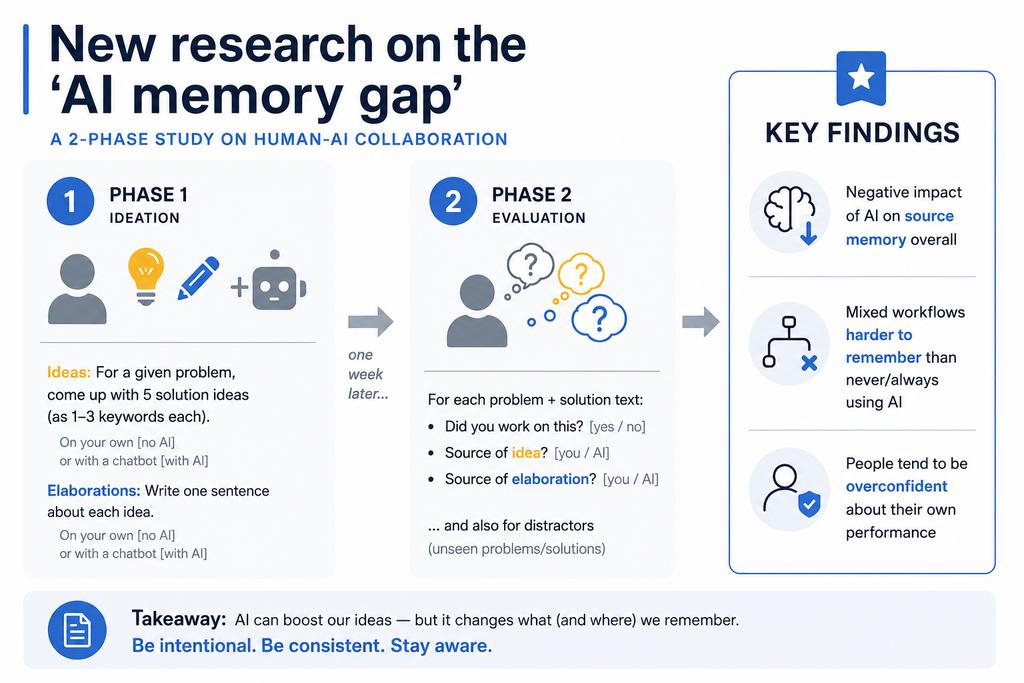
Do people remember whether they used AI to help them come up with ideas and sentences? If the idea was generated by AI, but they elaborated on it themselves, people disproportionately thought they came up with the idea unaided.
A study published by Zindulka et al (2026) found an "AI memory gap", or what in the world of false memory research we would call "source confusion".
Their method:
Phase 1:
184 participants were presented with various ideas (e.g. List practical ways a mid-sized company could reduce employee susceptibility to phishing emails) and were asked to come up with five ideas for each (as 1-3 keywords per idea), with or without assistance by a chatbot (alternating across problems). They then wrote down these ideas (1 sentence per idea), again with or without AI.
Phase 2:
1 week later, participants again saw the ideas again, and each task page displayed the original problem statement and a solution (elaboration) text created by the participant in Phase 1. They were also shown descriptions/ideas that didn't exist in task 1 (distractors).
Participants first indicated whether they remembered working on the displayed solution, and if they did: (1) Whether they came up with the underlying idea on their own or with AI support, (2) How confident they were in that attribution, (3) Whether they wrote the text on their own or with AI support, and (4) How confident they were in that second attribution. If they did not remember working on the displayed solution at all, they skipped the attribution questions and proceeded to the next memory task.
The key findings: AI had a negative impact, mixed workflows were particularly difficult, and people tended to be overconfident in their own performance. Participants were most accurate when no AI was involved at all. Accuracy was lowest when AI provided the idea but participants elaborated themselves.
False memory: approximately one quarter of distractors were falsely attributed as known.
Thanks @mhallsworth for the recommendation!
Are we actually directing educational technology, or are we just caught in its net?
For over a century, the prevailing assumption has been that technology is merely an instrument—a passive resource deployed by human hands. But today’s generative and agentic artificial intelligence systems have shattered that illusion. They are no longer passive tools; they are active co-participants in the architecture of learning.
In our new article, "Redefining Educational Technology: A Critical Collaborative Inquiry," we argue that current frameworks suffer from a profound silence regarding these autonomous systems. We propose a fundamental shift: viewing educational technology not as a toolkit, but as an orchestration of entangled human-technological systems.
The goal isn't to fix a static definition, but to spark a critically reflexive dialogue about where agency truly lies in modern education.
@openpraxis_icde
👉 Read the open-access paper here: https://t.co/XDkoSRxN3K
This week I’ve worked on a ROAM strategy for first drafts. It’s a strategy about readers, objectives action and impressions and draws on Bernhoff s Writing without Bullshit. https://t.co/II76r2YudU
Incredibly happy to announce that the paper, written with @ruetxe and Francisco Lara, “The super moral status of artificial superintelligence” has been published in Philosophical Studies @SpringerPhil https://t.co/3nPIYBmr3L
New #openaccess publication!
“#ChatGPT and the fate of the #undergraduate#essay in the #humanities: interpreting initial responses from Stellenbosch University” by Ava van Huyssteen, Bernard Dubbeld & Lloyd Hill, Dept of Sociology & Social Anthropology https://t.co/hYJ4IBtx43
There are many simple things we can do to make the AI discourse less confusing and more productive, like not using "vibe coding" as an umbrella term to refer to all AI-assisted software development. https://t.co/0GLL0tXI6S
@Left_Hegelian@jatella I have started properly ready Dewey 2 years now by way of Pragmatism but now going on to other areas. I find him very relatable and enjoyable :). I am utterly surprised how much I am enjoying his work. Is that a sign that it is not good because a lot of it seems so relatable ...
Interviewing is key for much qualitative research. But how can it be adapted to make research more reproducible, well-founded, & cumulative?
Ch.9 of “Doing Open Social Science” outlines a path to better practice. Free from https://t.co/mybOGM4YER
Or https://t.co/mybOGM4YER
@SIUChasmite@pensandpoison As a very very late comer to literature, I cannot come to see how one can read literature in a vacuum so to speak or even how one can get literature (at least the sort I read) divorced from the context they emerged... someone please share some of that sort for me please