With a single five-minute video, a graduate-school dropout who hunts for faked data in academic studies can stop a star scholar's career in its tracks. https://t.co/XON7Jn1LLU
Introducing a limited preview of GPT-5.6 Sol, our next generation frontier model, as well as GPT-5.6 Terra, a balanced model for efficient, everyday work, and GPT-5.6 Luna, a fast and affordable model for high-volume work.
https://t.co/OoM83SyISN
There’s a big misconception about how GLM 5.2 was trained. Yes, they distilled Claude and GPT 5.5 — but distillation is not how they matched Opus quality. Distillation only fixed the cold start problem in RL.
RLing an agentic coding model isn’t rocket science. In simplified terms:
1. RL needs trajectories — rollouts where the model actually completed a task in some env
2. No successful trajectory on a task = zero gradient = you can’t RL it. This is the cold start problem
3. Distillation solves it. You seed your model with knowledge from a smarter one (Claude, GPT) on tasks it can’t do yet
4. Now it produces positive trajectories on those tasks
5. RL on those trajectories and hill climb agentic coding
6. At that point you no longer need to distill and can solely hill climb RL to better models
This is an interesting curve. I’d argue it’s harder to get to Opus 4.8 from scratch than to go from Opus 4.8 → Fable/Mythos tier.
GLM 5.2 is already producing positive trajectories, so they have plenty to RL on — they’ll keep climbing to Mythos quality without distilling any further. They no longer need American models.
Surprise: Chinese LineShine supercomputer takes the #1 spot on the #Top500 and #HPCG lists!
First time since a while that spot is taken by a homogeneous CPU machine. So is heterogeneity here to stay?
CPUs with HBM and tensor cores (e.g., ARM SME). Congrats Yutong and folks.
Our latest economic research introduces a framework for tracking Claude Code as it scales.
Who is using Claude Code, and what are they using it for? How is the value of tasks changing? And how much does domain expertise shape whether a session succeeds?
https://t.co/IjjwQvrESo
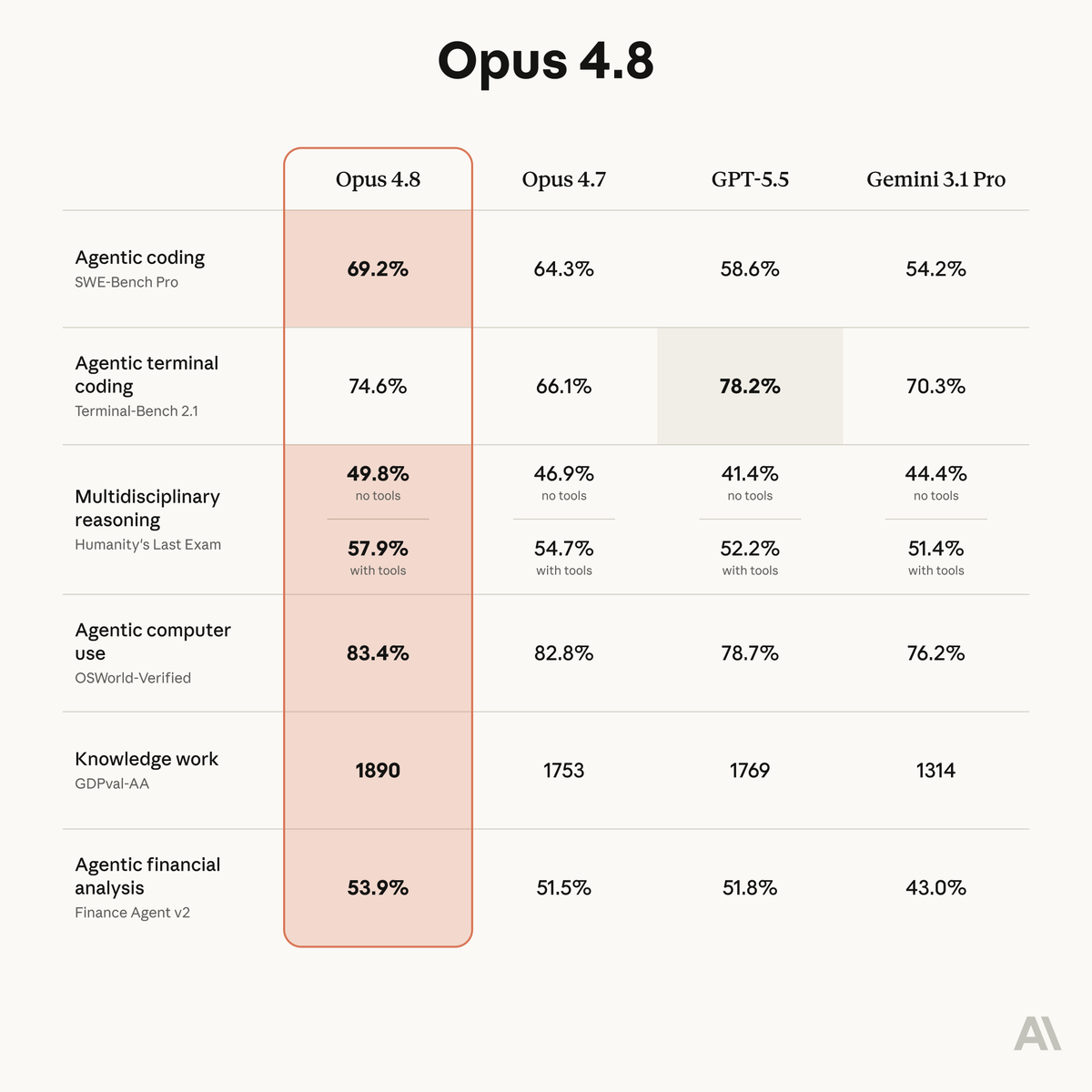
Introducing Claude Opus 4.8: it builds on Opus 4.7 with sharper judgment, more honesty about its own progress, and the ability to work independently for longer than its predecessors.
Available today at the same price.
Today, we share a breakthrough on the planar unit distance problem, a famous open question first posed by Paul Erdős in 1946.
For nearly 80 years, mathematicians believed the best possible solutions looked roughly like square grids.
An OpenAI model has now disproved that belief, discovering an entirely new family of constructions that performs better.
This marks the first time AI has autonomously solved a prominent open problem central to a field of mathematics.
Personal update: I've joined Anthropic. I think the next few years at the frontier of LLMs will be especially formative. I am very excited to join the team here and get back to R&D. I remain deeply passionate about education and plan to resume my work on it in time.
Introducing Gemini Omni 🔮........ Omni is our new model that can create anything from any input — starting with video (think Nano Banana but for video). Available in the Gemini App, Flow, and YouTube, with API support coming soon!