Kevin Warsh’s hawkish tone was confirmed yesterday, and the market sold off. But I don’t see this as a crisis at all.
Even if the Fed shifts toward a tighter policy stance, I do not believe U.S. investment in AI will stop. Fed rate decisions may create short-term noise, but there is something far more important than the next rate hike: as Kevin Warsh himself noted, AI represents a historic turning point.
And at that turning point, the United States and China are competing to win the AI race.
We have seen something similar before, not that long ago: the Cold War between the United States and the Soviet Union.
The U.S.-Soviet arms race was one of the clearest historical examples of competition that went beyond ROI. It was not simply about high military spending. For decades, it followed an action-reaction dynamic: once one side acquired a new capability, the other felt compelled to match or surpass it.
When the Soviet Union tested its first atomic bomb in 1949, the United States moved toward the much more powerful hydrogen bomb. The Soviets followed. Then came ICBMs, SLBMs, nuclear submarines, strategic bombers, MIRVs, and missile defense systems.
The result was extraordinary.
The U.S. nuclear stockpile peaked at 31,255 warheads in 1967.
The Soviet Union continued expanding its arsenal afterward, reaching roughly 40,000 warheads by 1986. That same year, the global nuclear stockpile peaked at around 70,300 warheads.
But the most important point is this:
The competition continued even after both sides already possessed enough nuclear firepower to destroy each other many times over.
From a purely economic perspective, that is deeply inefficient.
But the logic of the U.S.-Soviet competition was different.
The question was no longer:
“Do we already have enough?”
It became:
“Is there any chance the other side could gain an advantage over us?”
That single concern — What if the other side gains military superiority? — was enough to justify the continued allocation of enormous amounts of capital and resources.
This is where the parallel with AI becomes interesting.
Under normal capital allocation, the logic looks something like this:
Investment → Returns → ROI calculation → Determine the next level of investment
But the Cold War arms race worked more like this:
The rival invests → Strategic threat increases → We invest → The rival invests even more
In other words, returns did not determine spending.
The rival’s spending determined your spending.
If the United States were only asking,
“Will all this CAPEX on AI data centers actually generate an adequate ROIC?”
then eventually investment could slow.
But if China continues investing at the national level in compute, power, semiconductors, and AI models — and if AI increasingly comes to be viewed as the foundation of economic power, military power, information superiority, and technological dominance — then the question changes.
It is no longer:
“Will this AI CAPEX make money?”
It becomes:
“If China has this level of compute capability, can the United States afford not to?”
Once that happens, economic ROI is no longer the only constraint on CAPEX.
There is, however, one important difference.
Nuclear weapons were almost purely national-security assets. AI infrastructure, by contrast, can generate real revenue and productivity gains.
So AI is not simply a repeat of the Cold War arms race.
A more accurate way to think about it is this:
AI is a commercially productive industry with a geopolitical arms race layered on top of it.
That combination may prove even more powerful.
I believe the current competition between the United States and China for AI supremacy is beginning to resemble, in important ways, the arms race between the United States and the Soviet Union during the Cold War.
AI 에이전트의 ‘ChatGPT 모먼트’가 시작된 걸지도 모르겠습니다.
Meta의 Muse가 출시 12일 만에 미국 앱스토어 1위에 올랐습니다.
같은 기간 미국과 캐나다 iOS 다운로드는 180만 건.
ChatGPT 모바일 출시 초기의 130만 건보다 빠릅니다.
다운로드 숫자보다 사람들이 AI를 사용하는 방식이 바뀌고 있다는 점이 더 중요해 보입니다.
ChatGPT가 만든 첫 번째 변화는
“사람들이 검색 대신 AI에게 질문하기 시작한 것”이었습니다.
Muse가 만들려는 다음 변화는
“사람들이 직접 하던 일을 AI에게 맡기기 시작하는 것”입니다.
검색하고, 비교하고, 폼을 작성하고,
예약하고, 구매하고, 실패하면 다시 시도합니다.
한 번 묻고 한 번 답하는 AI에서 목표 하나를 주면 끝날 때까지 여러 번 추론하는 AI로 넘어가는 겁니다.
AI의 다음 성장은 단순히 사용자가 많아지는 것만이 아니라, 사용자 한 명이 소비하는 추론량 자체가 폭증하는 방향일 수 있습니다.
ChatGPT가 AI를 대중화했다면,
Muse는 어쩌면 Agent를 대중화하는 첫 번째 ‘GPT Moment’가 될 수도 있습니다.
그래서 지금부터는
“AI를 몇 명이 쓰느냐”만 볼 게 아니라
AI에게 얼마나 많은 일을 맡기기 시작했느냐를 봐야합니다.
Same thing as always. Make call, stock goes down for a bit, get clowned on relentlessly, buy more, stock rips, clowners are themselves beclowned. Rinse/repeat.
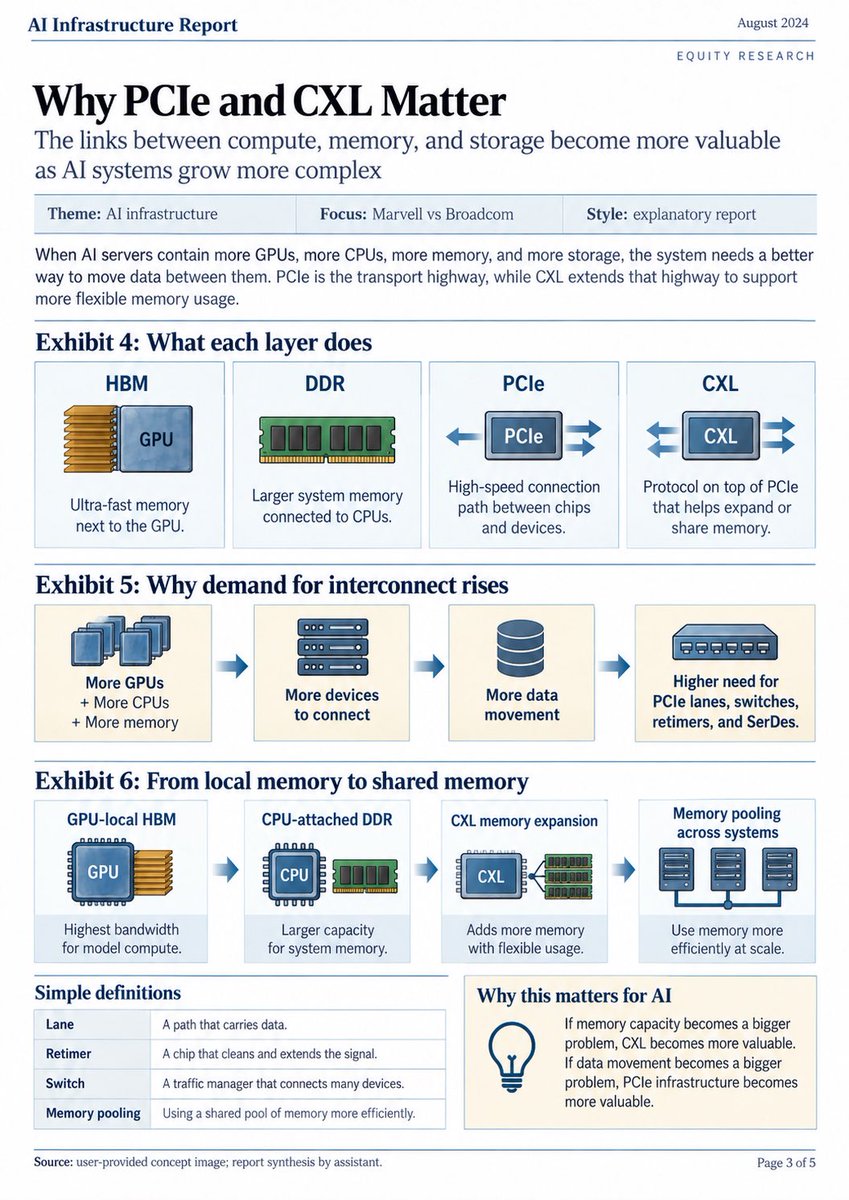
CPU 쇼티지가 난다는 건 공공연한 사실이었습니다. 매번 다 알려주는 젠슨 황이 자사의 CPU 베라를 독립적으로 구매하는 고객들이 폭발하고 있다고 너무 성공적인 라인이라고 GTC에서 밝히기도 했죠.
사람들은 왜 이제서야 알아챈걸까요? 그건 에이전트들이 이제 슬슬 선구적인 개념이 아니라 대중들의 피부에 와 닿아가기 때문입니다.
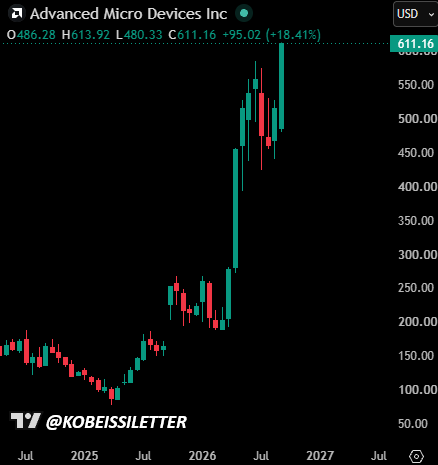
BREAKING: Advanced Micro Devices stock, $AMD, officially crosses above $1 trillion in market cap for the first time in history.
This puts the stock up +30,400% over the last 10 years.
$10,000 invested in AMD in 2016 would be worth $3,050,000 today.
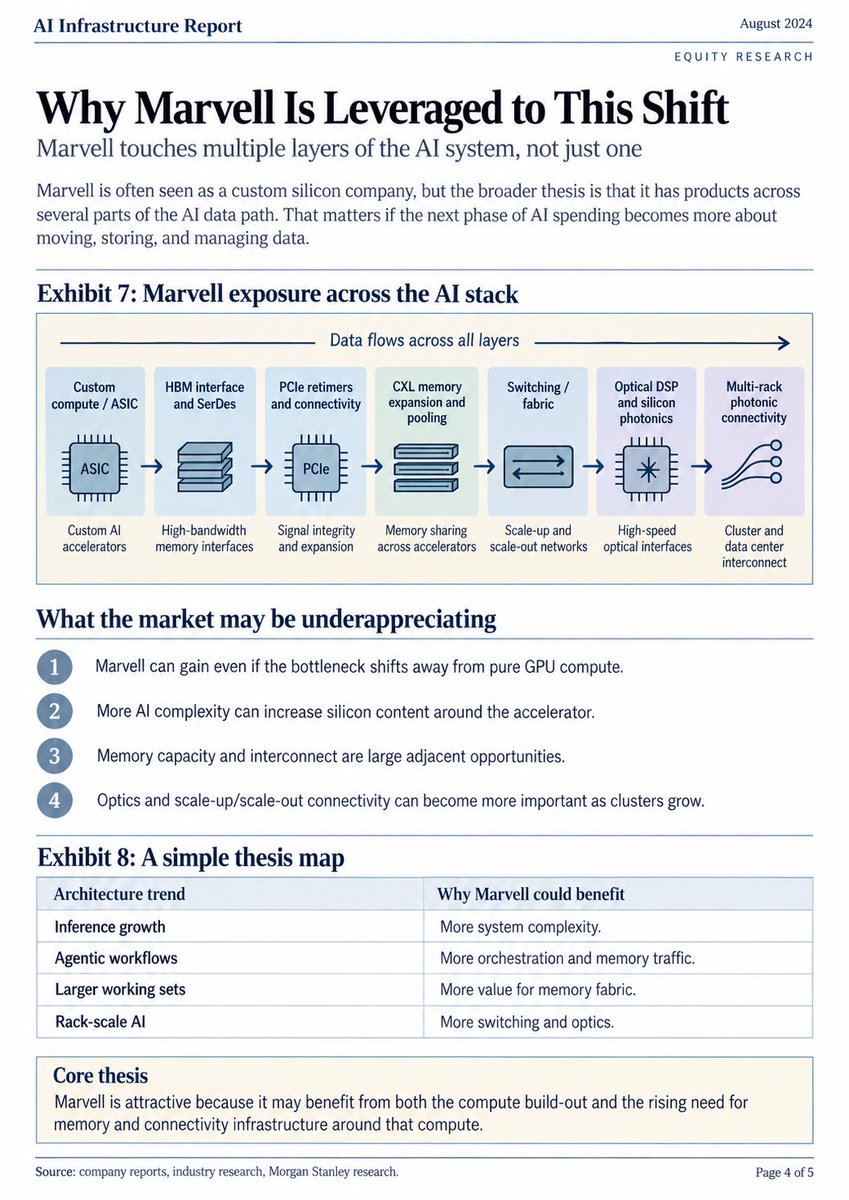
📌 $MRVL, 1.6T는 끝이 아니다. 3.2T 연결을 겨냥했다
마벨이 ECOC에서 선보일 광기술 데모를 발표했습니다. 레인당 400G부터 800G, 1.6T ZR·coherent-lite까지...
특히 레인당 400G 기술은 3.2T로 넘어가기 위한 준비입니다.
제가 보는 포인트는 다음 속도에서도 마벨의 칩이 필요한 자리를 이어갈 수 있느냐입니다. 데이터센터가 더 많은 데이터를 옮기려면 속도를 높이면서 전력 부담도 줄여야 하니까요. 이번 발표는 마벨이 그 다음 세대에도 제품을 공급하려고 준비 중이라는 근거입니다.
다만 데모가 곧 수주는 아닙니다. 기술의 다음 단계는 보여줬고, 투자자가 기다릴 다음 소식은 고객 채택과 양산 일정입니다. 신제품 이름보다 그 두 가지가 매출 전망을 바꿉니다.
받)DMZ 폭발 사건 요약
• DMZ는 정해진 길로 매일 지나다님
• 이 길은 지뢰 제거 작업이 끝난 길
• 최근 북한이 계속 MDL 남쪽을 침범해 지뢰를 심었음
• 지뢰가 터진건 북한의 지뢰 매설 가능성 높음
• 이 사실은 정부가 침묵했던 걸 미국이 대신 뉴스로 알렸음(지뢰매설)
• 곤란한 정부/국방부도 침묵으로 대응 중
• 대인지뢰에 간부 3명 부상 사건발생
• 군간부는 지뢰 위치를 모를 수 없는 핵심 군인
결론
적국인 북한의 도발을 방관한 결과 안보구멍 발생
추가
DMZ에 적군 한명만 넘어와도 인근 부대 비상사태 발령
군인들 휴가통제 당할 정도의 위기상황
*어떻게 이렇게 대한민국 안보가 무너질수가있지?
그런 와중에 대통령은 해외 순방가고 아? 도망간건가?
대기업 때려치우고 김밥천국 먹으며 아시안게임 금메달 딴
레전드 한국인
축구 K4리그 뛰다가 족구로 전향하고 대기업 생산직 다니던 선수임
근데 아시안게임에 테크볼 종목 생긴다는 소식 들림
그거 듣자마자 다니던 안정적인 대기업 바로 사표 쓰고 퇴사함
한 번도 제대로 안 해본 종목인데 국가대표 선발전에 무작정 도전함
비인기 종목이라 협회 지원 1도 없어서 선수촌 입촌도 못 함
결국 훈련장이랑 숙소 전부 사비 털어서 해결하고 끼니는
김밥천국으로 때움
그렇게 이 악물고 6개월 동안 피 토하게 연습함
그리고 본선 나가서 8경기 동안 단 한 세트도 안 내주고 전승 우승함
바닥에서 맨땅에 헤딩으로 금메달 목에 건 진짜 인간 승리
스토리
< 네오클라우드에 대한 젠슨 황의 생각 >
Q: 하이퍼스케일러 대신 다수의 네오클라우드를 지원하는 이유는?
- 하이퍼스케일러는 1년에 한 번 계획을 세우지만 시장 변동성이 커서 그 계획이 거의 항상 틀림 → 지역별로 기민하게 움직이는 네오클라우드가 자기 지역의 토지, 전력, 건물을 확보하는 데 더 유리함
- 여러 국가가 자국 전력을 자국 기업에만 주려는 흐름이 생기면서 이게 전략적 자산이 됐음 → 호주(Fermas)와 동남아(IOH) 네오클라우드, 그리고 네비우스 등을 더해 기가와트 단위로 확장 중임