Diffusion (or flow) makes for excellent policies, but training them with RL is notoriously hard: BPTT is unstable, RL over diffusion blows up the horizon. In our new paper, we show how we can optimize flow matching actors by using "one weird trick" -- "approximate" the Jacobian of the flow denoising process with the identity matrix. 👇
Just watched this AI-generated short film and yeah… anyone still saying AI can’t create something watchable is seriously behind.
This isn’t “AI makes trash” anymore, this is real storytelling, and real potential.
The people actually using these tools already know: AI isn’t replacing creativity, it’s leveling it up. Studios aren’t ignoring it – they’re evolving with it.
Watch this and tell me AI hasn’t come a long way.
🎉 After one year of teamwork, we are excited to release our 3D foundation model — LingBot-Map!
Unlike DA3/VGGT, LingBot-Map is a purely autoregressive model for streaming 3D reconstruction ⚡
It achieves ~20 FPS on 518×378 resolution over sequences exceeding 10,000 frames — and beyond 🚀
Two key insights behind LingBot-Map:
🔑 Keep SLAM's structural wisdom: build Geometric Context Attention with long-context modeling while maintaining a compact streaming state
🔑 Make everything end-to-end learnable — no optimization, no post-processing
Let's check out our demos 👇
We built a real-time multiplayer game generated entirely by a neural network.
MultiGen is a real-time multiplayer diffusion game engine that supports an arbitrary number of players (not just 2!) through a shared memory-based world model.
Project website: https://t.co/wM06xSa9FI
1/5 🧵
What if your video generator could refine itself—at inference time?
❌No new models. ❌No retraining. ❌No external verifier.
💡 Introducing Self-Refining Video Sampling
By reinterpreting a pretrained generator (Wan2.2, Cosmos) as a denoising autoencoder, we enable iterative self-refinement at inference time ➡️dramatically improving physical realism and achieving over 70% human preference!
🧵
I wrote an interactive article explaining the geometric intuition behind Rectified Flows.
I visually explain why flow-models tend to learn curved trajectories, why this is bad for sampling latency, and a relatively simple technique for mitigating it.
Check it out! Link 👇
Farewell, Rotary Position Embedding (RoPE). We foresee that RoPE will no longer be utilized in future LLMs.
Something significant has already been revealed; the answer is within this image. Stay tuned! 🚀
What if next-token prediction wasn't a single forward pass, but a tiny optimization problem?
Introducing: nanoEBM a tiny transformer that learns to think harder by doing gradient descent on its own predictions.
You can start training on your Mac now - it comes < 400 lines
From live video to 3D avatar in seconds. This #SIGGRAPH2025 paper from Adobe Research reconstructs a realistic head avatar on the fly, with no pre-cached data, and adapts seamlessly to facial motion for VR, animation, and online communication. 🔗 https://t.co/6yKkyUXV9t
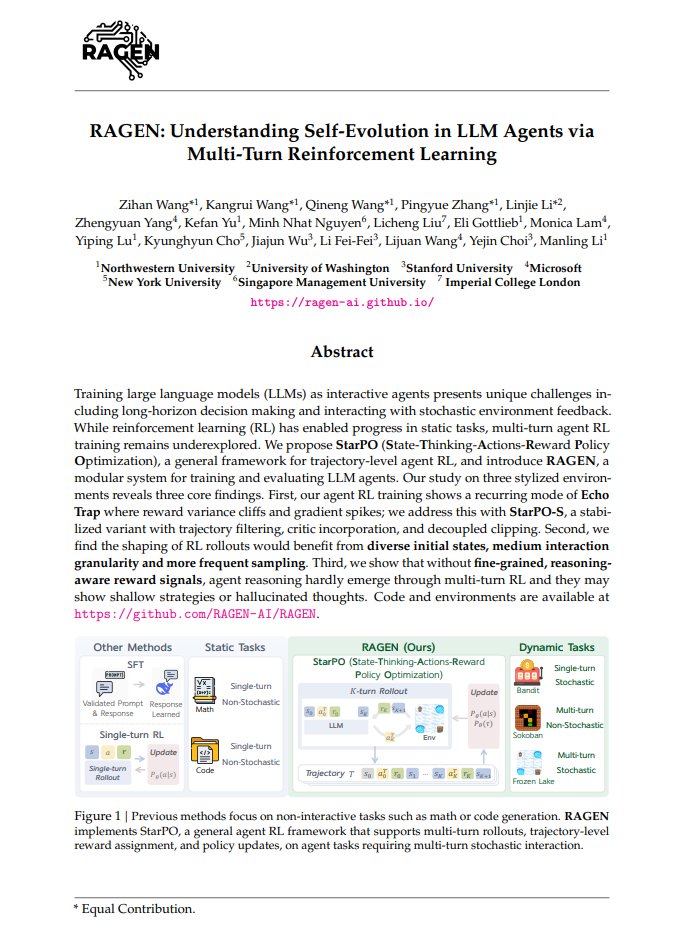
Why does your RL training always collapse?
In our new paper of RAGEN, we explore what breaks when you train LLM *Agents* with multi-turn reinforcement learning—and possibly how to fix it.
📄 https://t.co/mPOV6Zoer4
🌐 https://t.co/tYP03WLpGA
1/🧵👇
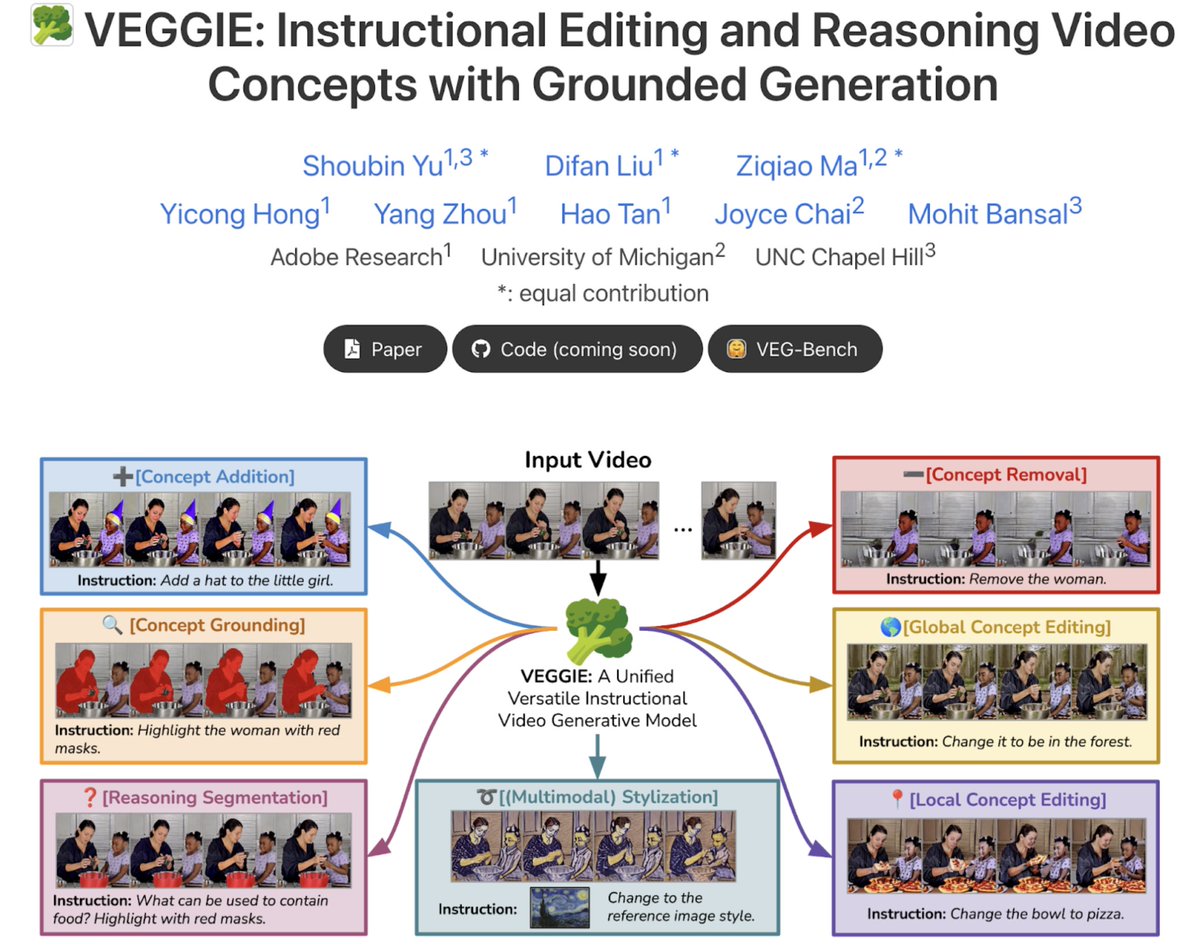
🚨 Introducing VEGGIE 🥦—a unified, end-to-end, and versatile instructional video generative model.
Current video editing methods struggle with:
1. Understanding direct user instructions
2. Handling diverse editing skills in one model
3. balancing multiple training objectives.
VEGGIE solves these via:
1. Multimodal LLM for instruction understanding & reasoning
2. Video Diffusion Model for instruction-aligned edits.
3. End-to-end optimization using only diffusion loss.
VEGGIE supports 8 skills, from object addition/removal/changing, background change & stylization to concept grounding & reasoning segmentation, outperforms SoTA methods, and exhibits zero-shot multimodal instructional & in-context video editing.
https://t.co/e9zQclApTQ
🧵
I've been excited about this for a while: a simple architectural change to the residual connection that allows arbitrary overlapping of computation of one layer and the communication of another layer, leading to ~30% speedup in TP! More on MoE and expert parallel to come soon!
VideoJAM is our new framework for improved motion generation from @AIatMeta
We show that video generators struggle with motion because the training objective favors appearance over dynamics.
VideoJAM directly adresses this **without any extra data or scaling**
👇🧵