What if your video generator could refine itself—at inference time?
❌No new models. ❌No retraining. ❌No external verifier.
💡 Introducing Self-Refining Video Sampling
By reinterpreting a pretrained generator (Wan2.2, Cosmos) as a denoising autoencoder, we enable iterative self-refinement at inference time ➡️dramatically improving physical realism and achieving over 70% human preference!
🧵
🎼 Can we turn music into readable code?
Excited to share Decomposer, a post-training framework for symbolic music decompilation!
Given MIDI, Decomposer recovers an executable program in Strudel that reconstructs the music while exposing patterns, harmony, rhythm, and voices as editable code.
🧵 [1/5]
I'll be presenting Self-Refining Video Sampling with @Jaehyeong_Jo at #ICML2026.
Come chat with us about physically plausible video generation!
🗓 Tue, Jul 7 | 2:00 PM–3:45 PM
📍 HALL A #2512
Paper: https://t.co/YvDo6wLXXG
Page: https://t.co/k0sQanRymR
What if your video generator could refine itself—at inference time?
❌No new models. ❌No retraining. ❌No external verifier.
💡 Introducing Self-Refining Video Sampling
By reinterpreting a pretrained generator (Wan2.2, Cosmos) as a denoising autoencoder, we enable iterative self-refinement at inference time ➡️dramatically improving physical realism and achieving over 70% human preference!
🧵
Can we make head avatars more interactive?
Check out our work, Avatar Forcing, at #CVPR2026.
🗓 Sat, Jun 6 | 11:45 AM–1:45 PM
📍 ExHall F #357
Paper: https://t.co/o9Z5zXCCCJ
Page: https://t.co/FXf9XWCyo0
Code: https://t.co/Glle3jBRb0
Can MLLMs actually track what's happening in a video?
Introducing VSTAT 🎯, our new benchmark for visual state tracking.
The tasks are simple: count cups, read typed words, count page flips. Humans solve them easily. MLLMs don't.
https://t.co/dgqhqeVuSv
🧵 [1/11]
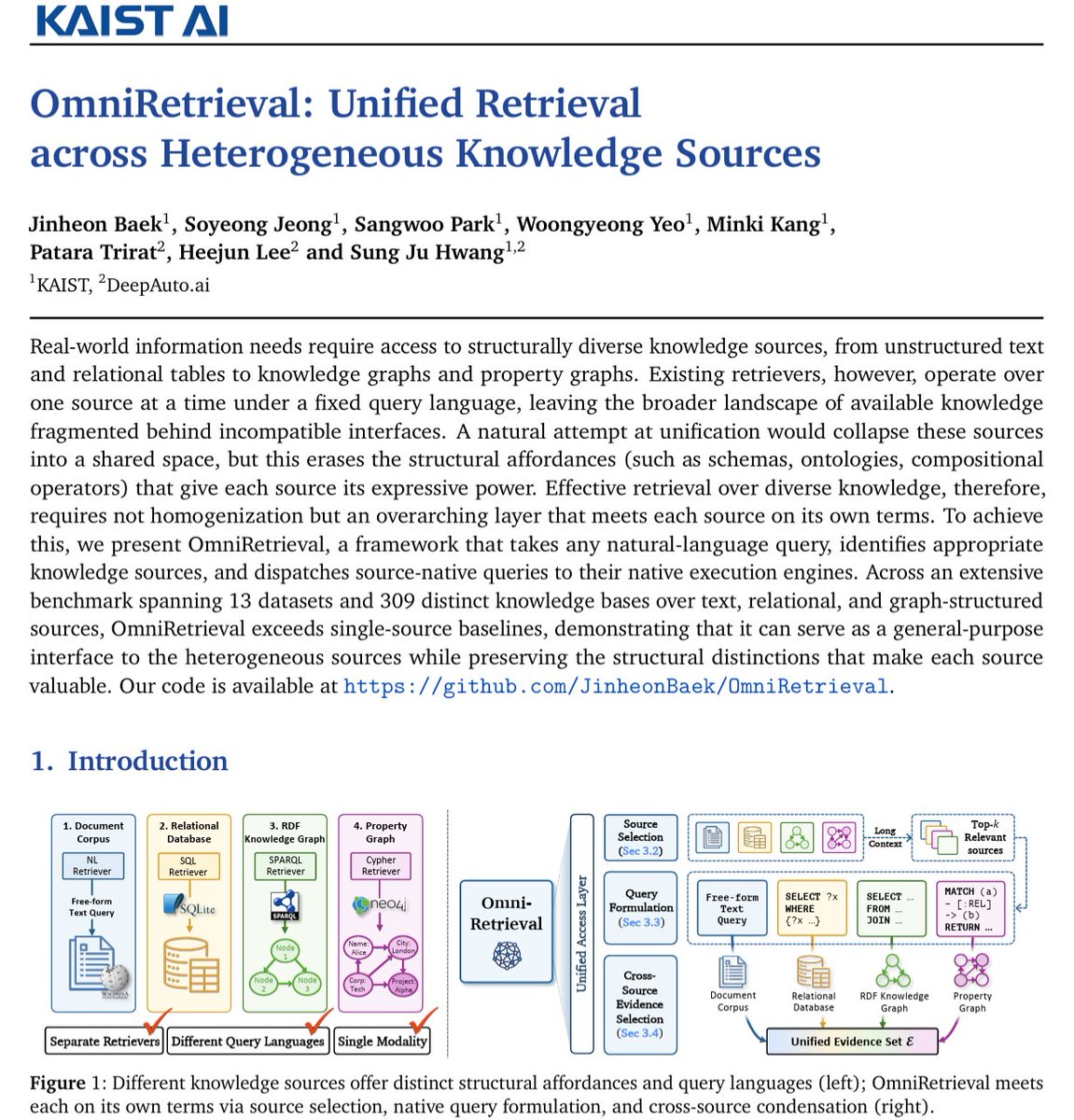
What if your retriever could speak every language your data speaks? 🌐
Your answer might live in a document 📄, a SQL table 🗃️, an RDF knowledge graph 🔗, or a property graph 🕸️, and OmniRetrieval reaches into all of them, meeting each source in its own native query language instead of flattening everything into one lossy space.
Paper: https://t.co/dI6IvBwfWW
Excited to introduce 🧑🎓𝗟𝗲𝗮𝗿𝗻 𝗳𝗿𝗼𝗺 𝗪𝗲𝗮𝗸𝗻𝗲𝘀𝘀𝗲𝘀 (LearnWeak)!
A framework that automatically specializes small CUAs for specific domains by 🎯𝘁𝗮𝗿𝗴𝗲𝘁𝗶𝗻𝗴 𝘁𝗵𝗲𝗶𝗿 𝗼𝘄𝗻 𝗳𝗮𝗶𝗹𝘂𝗿𝗲 𝗽𝗮𝘁𝘁𝗲𝗿𝗻𝘀 in data generation and training.
🧵(1/7)
🚀 Releasing ✨AXPO✨ an RL method to lift agentic reasoning models past their next scaling tier.
Be it math, perception, or search, AXPO fixes the structural blind spot 'just add tools' recipes leave untouched.
8B beats 4x larger 32B baseline on Pass@4.
from NVIDIA 🧵 (1/7)
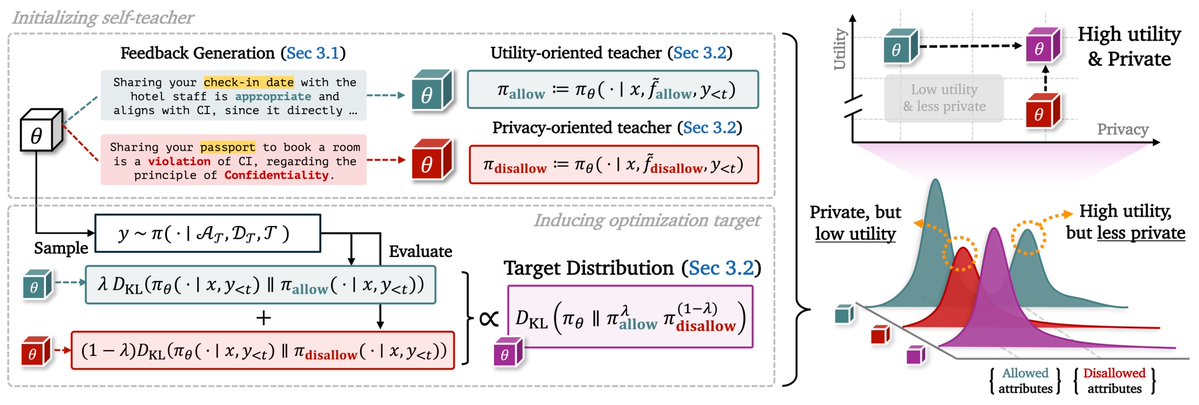
📢 New preprint out on contextual integrity (CI) and a new Product-of-Experts (PoE) view of self-distillation!
Introducing SelfCI, a novel self-distillation framework that operationalizes CI by optimizing for the intersection of task utility and minimal disclosure.
🧵👇
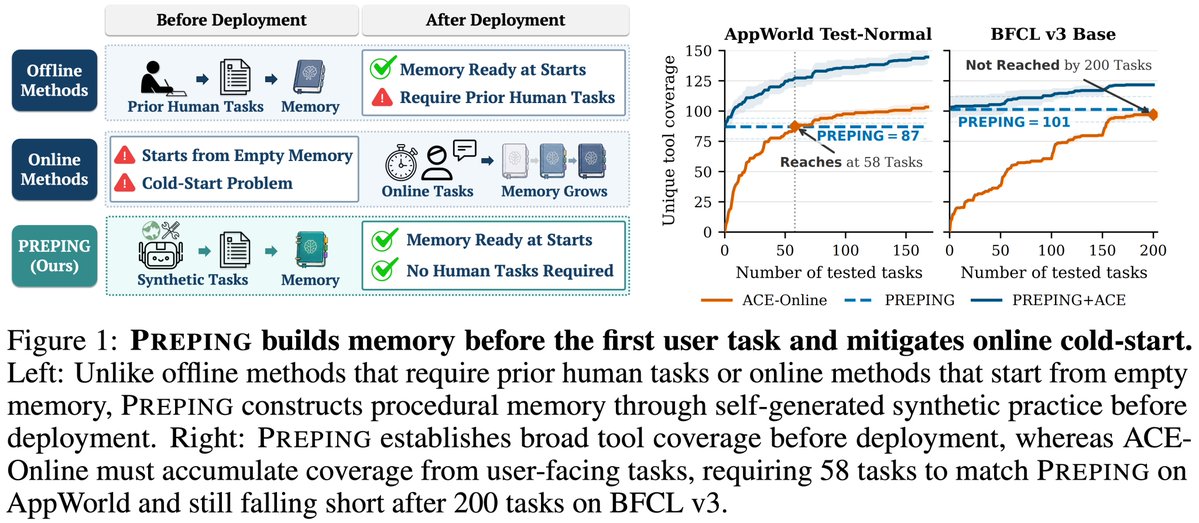
Can LLM agents build memory before seeing any user task?
Memory is usually built from human tasks or deployment interactions. New tool environments often have neither, creating cold-start gap.
Introducing PREPING: building agent memory without tasks.
https://t.co/bTV24GP4qc
Training robot foundation models faces two key hurdles: how to get enough data to train an effective model, and how to make sure that new skills can be acquired quickly. The team at @RhodaAI believes that the answer is training Direct Video Action models from web data.
Web data is plentiful, to the point where Rhoda can train their base model on hundreds of years of video data. And then, with the addition of robot data, they can quickly adapt it to new tasks with as little as 20 hours of in-domain data, performing complex, multi-step manipulation tasks with their purpose-built video foundation model. @tongzhou_mu@ericryanchan and @changanvr joined us to talk more about their approach.
Watch Episode #79 of RoboPapers, with @micoolcho, @chris_j_paxton, and @DJiafei, to learn more!
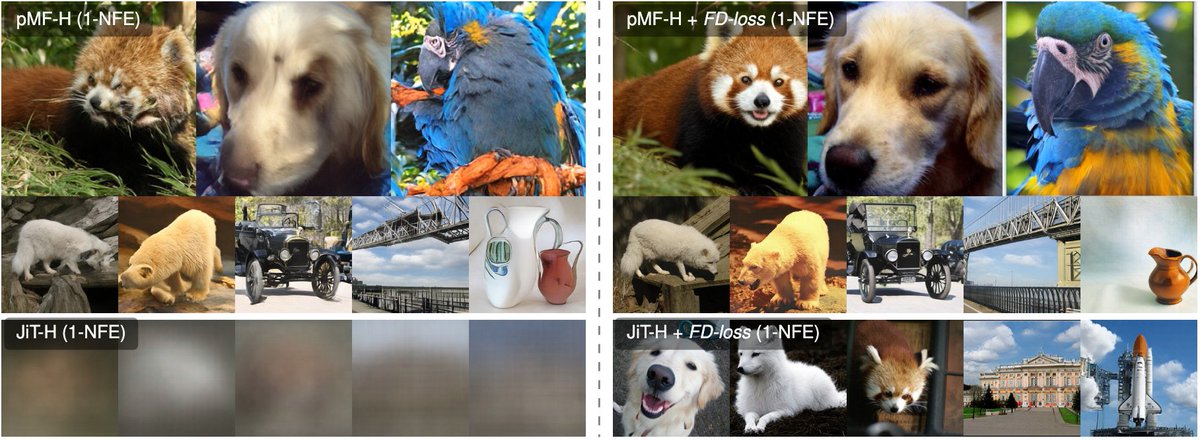
Two months ago, I vaguely posted a number: 0.9 FID, one-step, pixel space.
Now it is 0.75, and can be even lower.
Many wonder how.
I thought it might end as a small FID prank: simple and deliberate.
It started with one question: can FID be optimized directly, and what does it reveal?
Introducing FD-loss.
💻 🧠 Does SWE memory help ML programming tasks in coding agents?
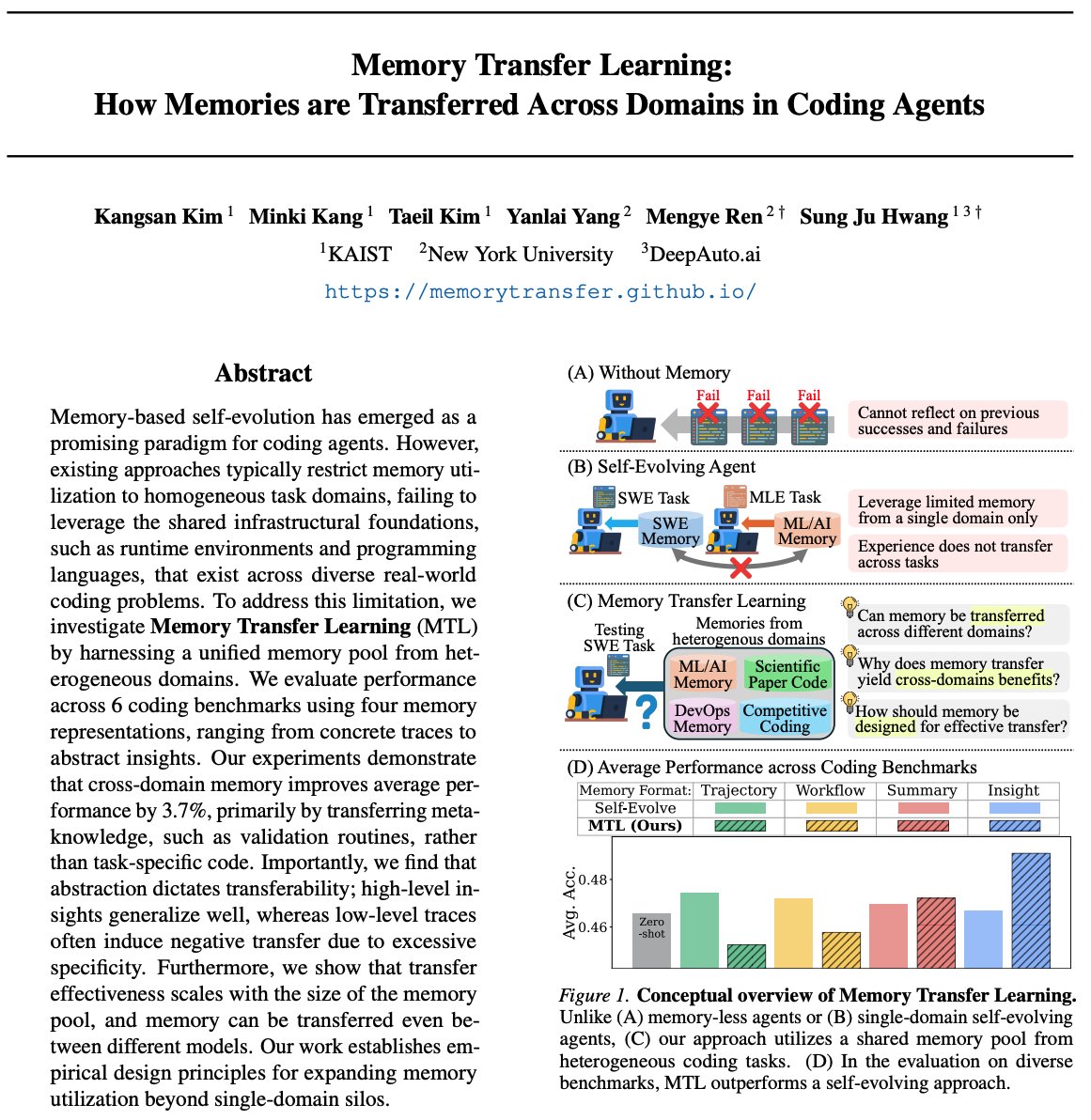
Super excited to introduce 𝗠𝗲𝗺𝗼𝗿𝘆 𝗧𝗿𝗮𝗻𝘀𝗳𝗲𝗿 𝗟𝗲𝗮𝗿𝗻𝗶𝗻𝗴, a framework that leverages cross-domain coding memory, enabling agents to reuse experiences beyond task boundaries and improve memory utilization.
MTL improves coding agent by 𝟯.𝟳% 𝗼𝗻 𝗮𝘃𝗲𝗿𝗮𝗴𝗲 over a zero-shot baseline across six benchmarks.
💡Key Insights
1. 𝐌𝐞𝐦𝐨𝐫𝐲 𝐓𝐫𝐚𝐧𝐬𝐟𝐞𝐫 𝐖𝐨𝐫𝐤𝐬!
Memory Transfer Learning significantly improves coding agent performance and outperforms self-evolving methods in effectiveness and efficiency.
2. 𝐓𝐫𝐚𝐧𝐬𝐟𝐞𝐫𝐚𝐛𝐥𝐞 𝐤𝐧𝐨𝐰𝐥𝐞𝐝𝐠𝐞 𝐢𝐬 𝐦𝐨𝐬𝐭𝐥𝐲 𝐦𝐞𝐭𝐚-𝐦𝐞𝐦𝐨𝐫𝐲
Transferable knowledge exists across distinct task types, and its primary form is meta-memory encoding procedural and behavioral guidance, not domain-specific knowledge
3. 𝐀𝐛𝐬𝐭𝐫𝐚𝐜𝐭𝐢𝐨𝐧 𝐢𝐬 𝐚 𝐤𝐞𝐲 𝐝𝐫𝐢𝐯𝐞𝐫 𝐨𝐟 𝐞𝐟𝐟𝐞𝐜𝐭𝐢𝐯𝐞 𝐭𝐫𝐚𝐧𝐬𝐟𝐞𝐫
More abstract and generalized memory representations yield higher transfer effectiveness by avoiding brittle implementation anchoring.
Project Page: https://t.co/OxF7d9WRQ3
@KAIST_AI@nyuniversity
A Design Space for Live Music Agents 🎷🎹🥁 #CHI2026
What does it take for AI to truly jam with you? We surveyed 184 live music agents across AI, HCI, and Computer Music fields to map the design space, and where it's headed.
🗓️ Talk: Fri Apr 17, 12:15PM · P1 Room 132
📄 Paper: https://t.co/vNfdqrdV23
🔗 Interactive demo: https://t.co/XD1lP5pGCB
Super excited to share that one of my favorite papers, “When Thoughts Meet Facts: Reusable Reasoning for Long-Context LMs,” has been accepted to #ACL2026 Findings! 🎉
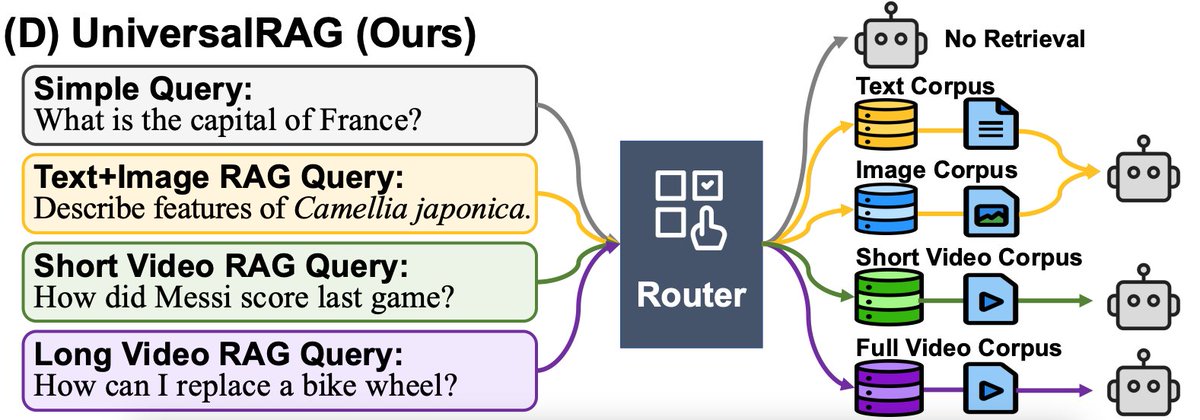
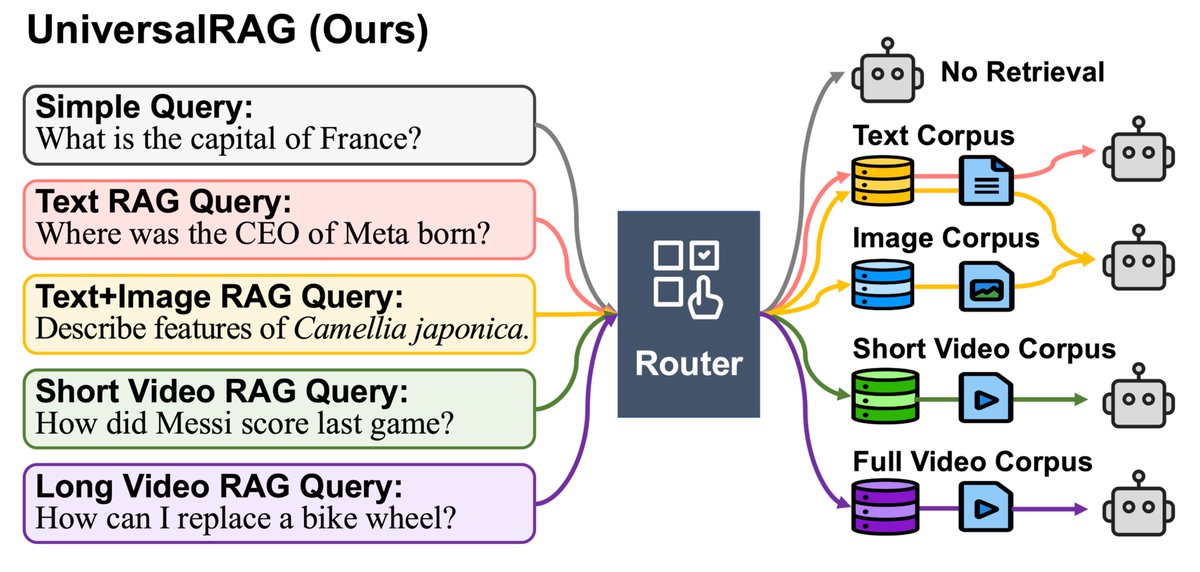
🎉 Happy to share that UniversalRAG has been accepted to the #ACL2026 main conference!
We introduce the first any-to-any multimodal RAG framework that integrates diverse modalities and granularities into a unified workflow via modality-aware routing.
🔗 Link: https://t.co/WHdxzgaTBQ
🔍 Is a single embedding space really enough for multimodal RAG?
Excited to share that UniversalRAG has been accepted to the #ACL2026 main conference! 🥳
We introduce the first any-to-any multimodal RAG framework, enabling retrieval across diverse modalities and granularities.
To bring generalist intelligent robots to the real world, we have to overcome the data scarcity problem.
At Rhoda, we are solving it by reformulating robot policies as video generation.
Today, we introduce the Direct Video-Action Model (DVA)
Most imagination-based world models learn representations by reconstructing pixels.
But reconstruction may not be the right objective for control.
In our new paper we explore a different idea:
👉 predict the next embedding instead of reconstructing observations.
Introducing NE-Dreamer.
Project page: https://t.co/X7FACBbE67
Paper: https://t.co/jcOtY40XFa
Code: https://t.co/Uq0dqQDFV6
Computer use models shouldn't learn from screenshots.
We built a new foundation model that learns from video like humans do. FDM-1 can construct a gear in Blender, find software bugs, and even drive a real car through San Francisco using arrow keys.
How to enable dexterous hands with manipulation capabilities that work across diverse objects, tasks, scenes, camera views, and external perturbations?
Excited to share Dex4D, a method for generalizable sim-to-real dexterous manipulation via a task-agnostic point track policy and video generation planners!
NO parallel grippers, NO teleop!
Project page: https://t.co/D5KvaVT9GX
🧵👇 0/10
#Robotics #EmbodiedAI #Manipulation #AI #ComputerVision