@probaaron@FaytuksNetwork Reminder: Kalshi does not offer markets that settle on death. If Ali Khamenei dies, the market will resolve based on the last traded price prior to confirmed reporting of death. If that price is unclear, the Outcome Review Committee will determine a fair market value.
@amytam01 Master level AI research focused on manufacturing safety. also involved in an agentic research trading startup. I have just finished a sophomore summer internship at a TAMP (Turnkey Asset Management Program). Your post was definitely meaningful to me. Considering a lot of paths!
@amytam01 Hi Amy, this resonated with me and I’m here to tell my story (can’t DM because not verified). I’m in my junior year of undergrad with a Quantitative Economics major been building relationships with professionals in the QuantFi world. I currently have a job at my Uni doing…
Vector databases might be the wrong abstraction for document retrieval.
A new open-source approach called PageIndex just hit 98.7% accuracy on a financial benchmark, beating traditional RAG by 30+ points. No embeddings. No chunking. No vector DB.
The insight: when a 10-K says “see Note 15 for debt details,” vector search has no idea what that means. It retrieves whatever text looks similar to your query, not whatever text actually answers it. Similarity and relevance are different things.
PageIndex builds a hierarchical tree from document structure, then uses LLM reasoning to traverse it. The model asks “where would an expert look?” instead of “what text looks similar?”
The math is stark. Traditional RAG systems hover around 60-70% on FinanceBench. That 30-point gap represents every time vector search found semantically similar text but missed the actual answer buried in an appendix or cross-referenced table.
What makes this interesting: the infrastructure is simpler, not more complex. No vector DB to maintain. No embedding pipeline. No chunking decisions. Just a tree and reasoning.
Vector search was the best we had when LLMs couldn’t reason well enough to navigate document structure. Now they can. The techniques we built around their limitations are becoming the bottleneck.
For simple use cases, vector RAG still wins on speed and simplicity. But for professional documents requiring multi-step reasoning, treating structure as signal instead of noise changes everything.
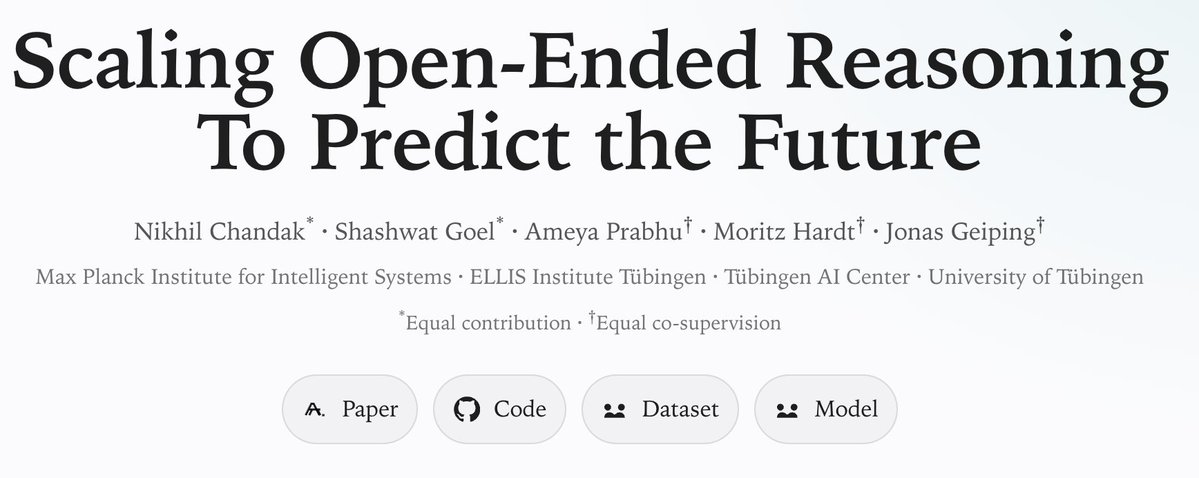
Excited to announce the OpenForecaster project, we train models at reasoning predict the future.
We won't get to AGI by maxxing STEM exam and coding benchmarks. That's not what most humans reason about in their day to day.
Instead, we reason about uncertainty to make decisions, using our world-model of how society evolves. Yet, there weren't any large-scale datasets to train AI for this form of reasoning. Until now.
We release OpenForesight, a training dataset of 52k forecasting questions, made from global news. Our recipe is fully automated, and can be repeated for more, newer data at low cost.
Using it, we RL trained an 8B model, and it became competitive with much larger models like GPT-OSS-120B across benchmarks and metrics.
And we want to keep building on this, in public. Our paper with full details, dataset, code etc. in 🧵
Blog: https://t.co/UhxbxmM4Te
🚨 BREAKING: Google Research just dropped the textbook killer.
Its called "Learn Your Way" and it uses LearnLM to transform any PDF into 5 personalized learning formats. Students using it scored 78% vs 67% on retention tests.
The education revolution is here.
That's pretty crazy when you think about it
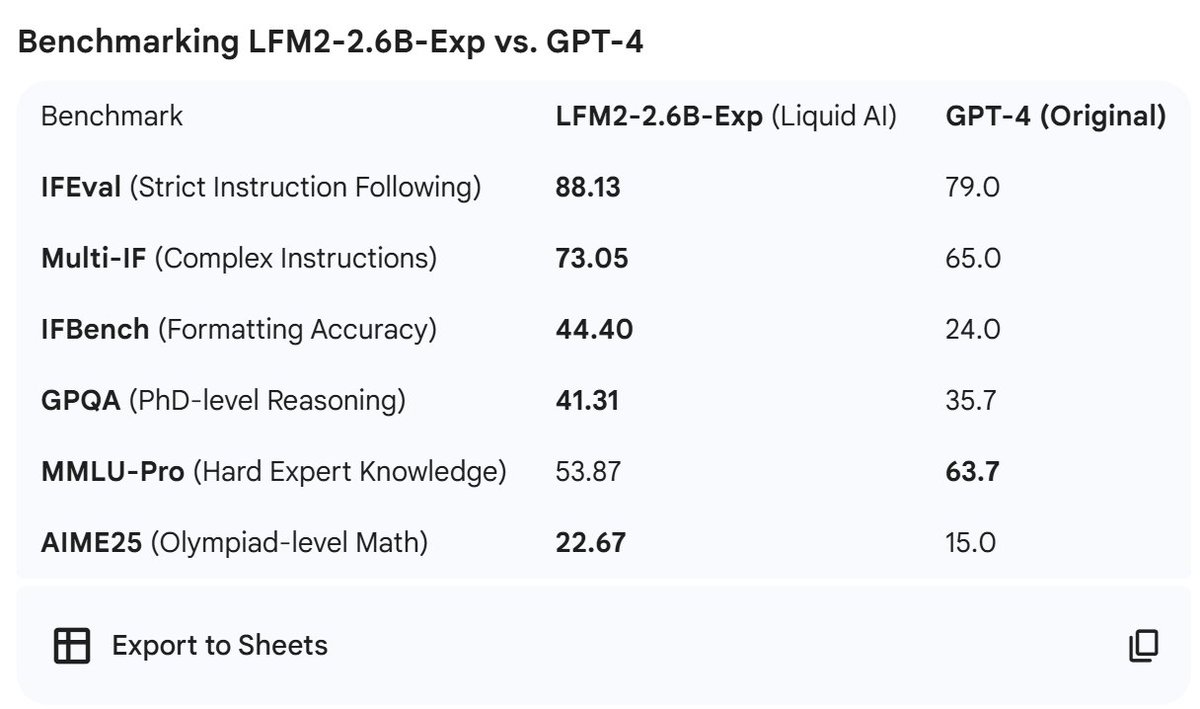
One of the biggest “wow” moments with ChatGPT was the update from GPT-3.5 to GPT-4.
And now this open-source model with only 2.6B parameters that can run locally on your phone... is BETTER than the original GPT-4.
Unbelievable.
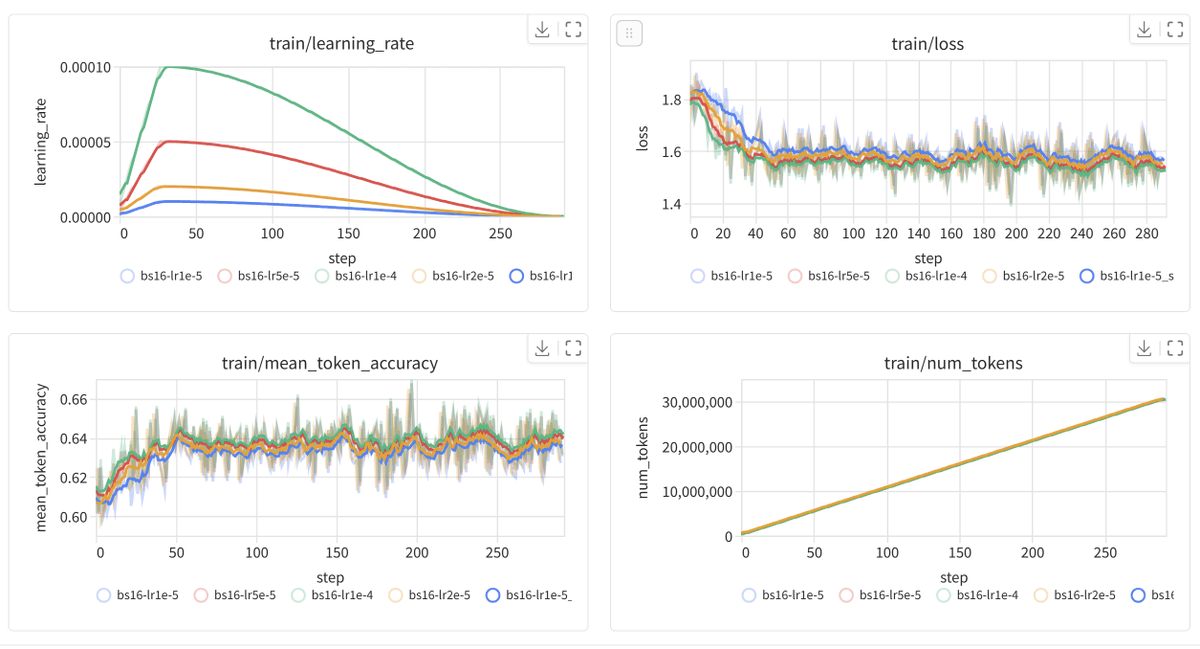
The HuggingFace team just got Claude Code to fully train an open LLM.
You just say something like:
“Fine-tune Qwen3-0.6B on open-r1/codeforces-cots.”
Claude handles the rest.
▸ Picks the best cloud GPU based on model size
▸ Loads dataset (or searches if not specified)
▸ Launches job: test or main run
▸ Tracks progress via Trackio dashboard
▸ Uploads checkpoints and final model to Hugging Face Hub
Predictive Markets Free +ev :
1/2
If you’re algorithmically programming trades on kalshi or poly market, maybe you’re looking for snipes or arbitrages, when possible try to avoid the underdog.
Check out University College Dublins research on the Favorite-Underdog Bias.