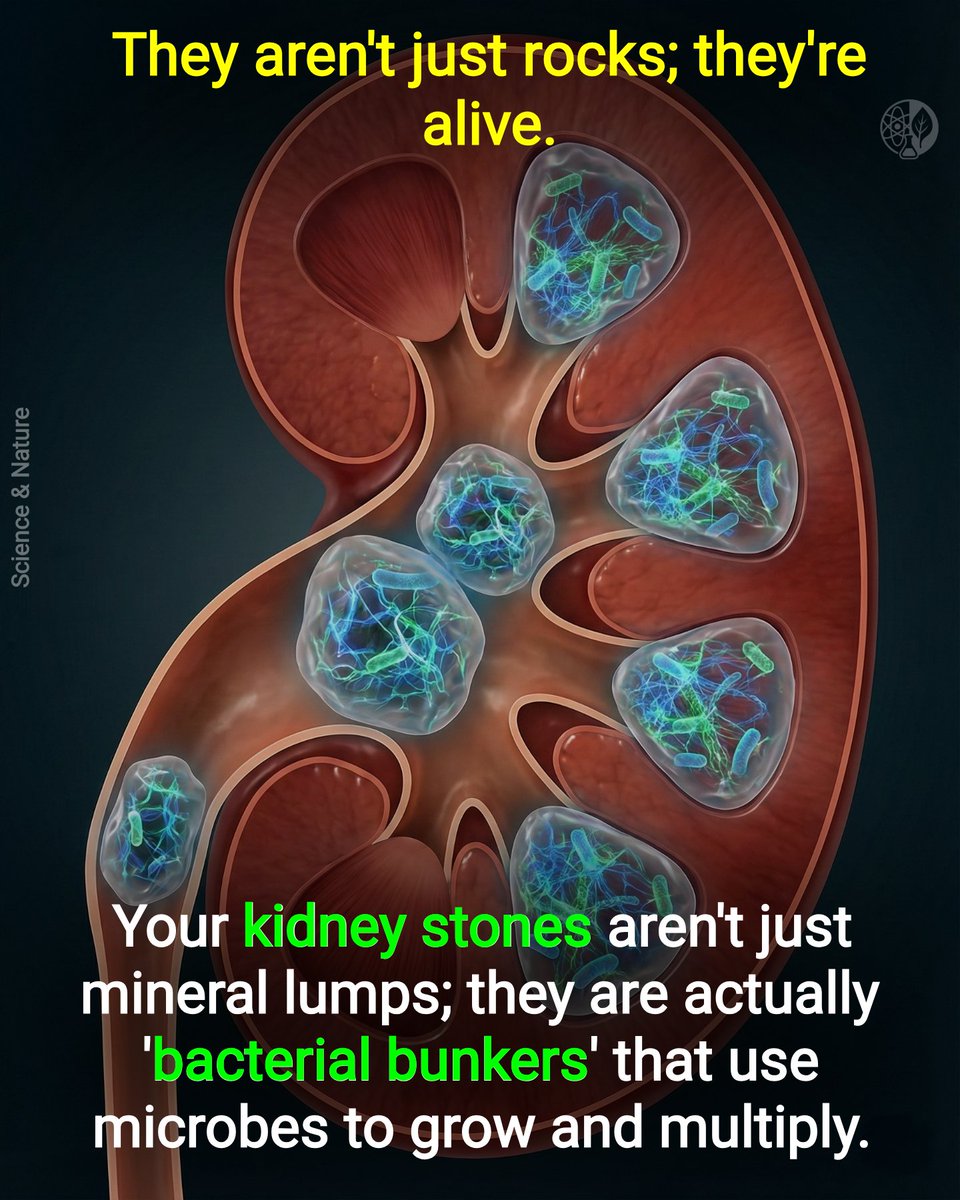
For decades, doctors believed the most common kidney stones (calcium oxalate) were lifeless lumps formed purely by chemistry—minerals building up in the kidney.
A groundbreaking study published this month (Jan 2026) by UCLA Health has proven this wrong.
Using high-tech fluorescence microscopy, researchers discovered that these stones actually contain live bacteria and fungal-like biofilms "entombed" inside them. The bacteria act as a scaffolding (nidus), allowing the minerals to crystalize and grow layer by layer.
This solves a long-standing medical mystery: Why do patients sometimes get severe infections (sepsis) after stone-breaking treatments (lithotripsy), even when their urine was sterile? The answer: breaking the stone releases the bacteria trapped inside.
This could revolutionize treatment, shifting focus from just diet changes to targeting the hidden microbiome within the kidney.
Journal Reference: Wong, Gerard C. L. et al, Intercalated bacterial biofilms are intrinsic internal components of calcium-based kidney stones, Proceedings of the National Academy of Sciences (2026). DOI: 10.1073/pnas.2517066123.
#MedicalBreakthrough #Microbiology #KidneyHealth #UCLAHealth #NewDiscovery