How to become a better server-side/Cloud/DevOps engineer using iximiuz Labs?
Based on my own experience and hearing back from hundreds of engineers who actually achieved their learning goals, a sequence that has traditionally led to the most solid understanding and the most transferable knowledge is:
Linux → Networking → Containers → {Kubernetes, Cloud}
Jumping straight into learning the higher-level components, such as AWS VPC, Security Groups, Internet Gateways, or even Kubernetes, is not uncommon, but in my experience, it often results in longer mastering time and the need to "re-learn" from scratch after switching from AWS to Azure or from Kubernetes to Nomad or AWS ECS.
In contrast, when you first learn about LANs (L2 broadcast domains, typical switch topologies, etc.), then L3 routing, iptables, and NAT, understanding what VPC and Security Group actually are becomes much easier.
One more great thing about this approach is that focusing on fundamentals makes the knowledge transferable sideways, too.
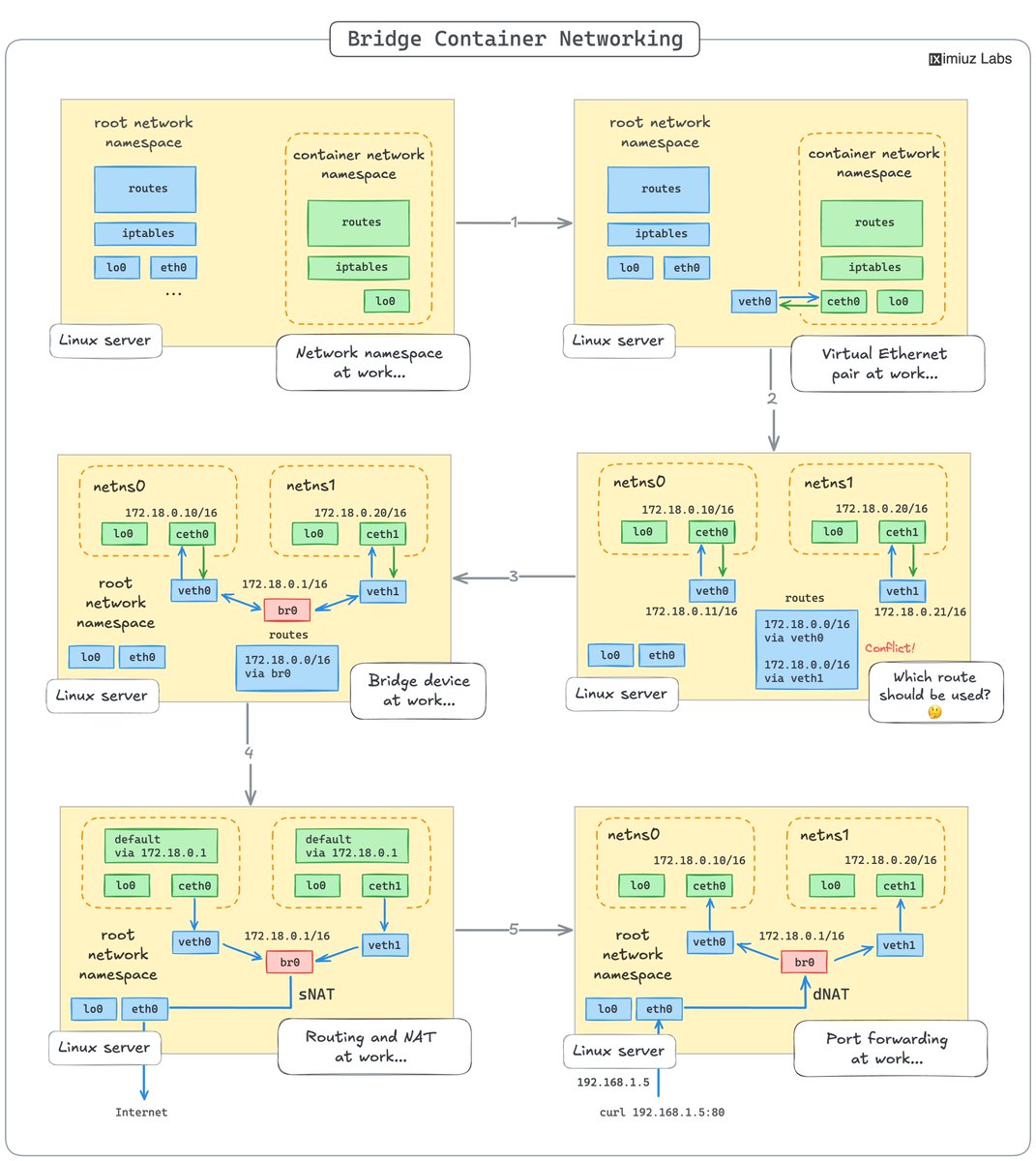
For instance, container networking (Docker's typical bridge network) and Kubernetes' Node and Pod networking rely on the same L2 broadcast domains, L3 routing, and iptables concepts from above, even if some of the primitives will be virtualized (e.g., a Linux bridge is a virtual switch and a network namespace is an analog of an isolated network node).
This is why at iximiuz Labs, we focus on the fundamentals of the server-side tech and avoid covering topics like "5 ways to configure AWS NAT Gateway in 2026" 🤦♂️
Where to start with iximiuz Labs as a Linux/DevOps beginner?
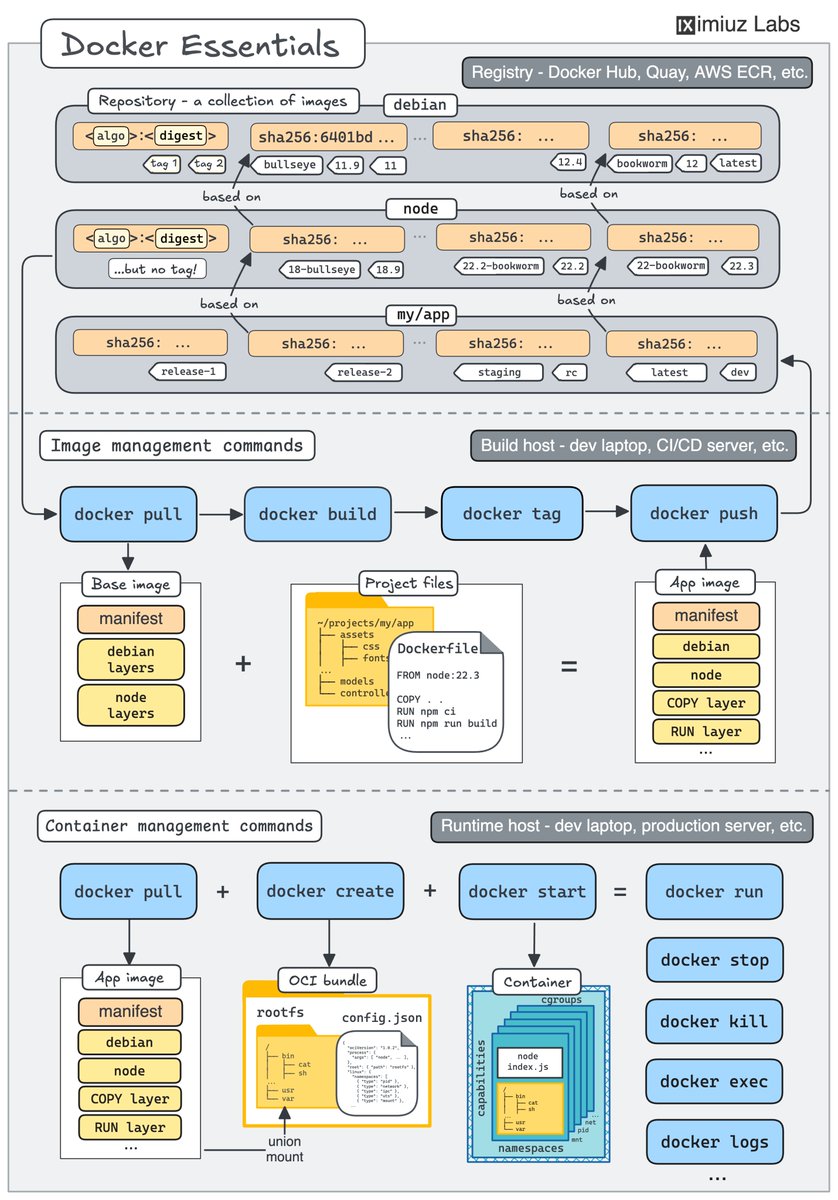
At the moment, for a Linux/DevOps beginner, the best place to start is the hands-on Docker roadmap https://t.co/r6Mjmbc39r. I recommend trying to solve challenges there, starting from the top, and always following the links to the theoretical materials that most challenges include. And of course, don't forget to check the Solution tab if you get stuck or even if you've solved the challenge - there might be an alternative or simpler way, and the editorial solution may shed some extra light on what’s going on under the hood.
Another beginner-friendly piece is the L2 Networking Fundamentals course, augmented by these L3 challenges:
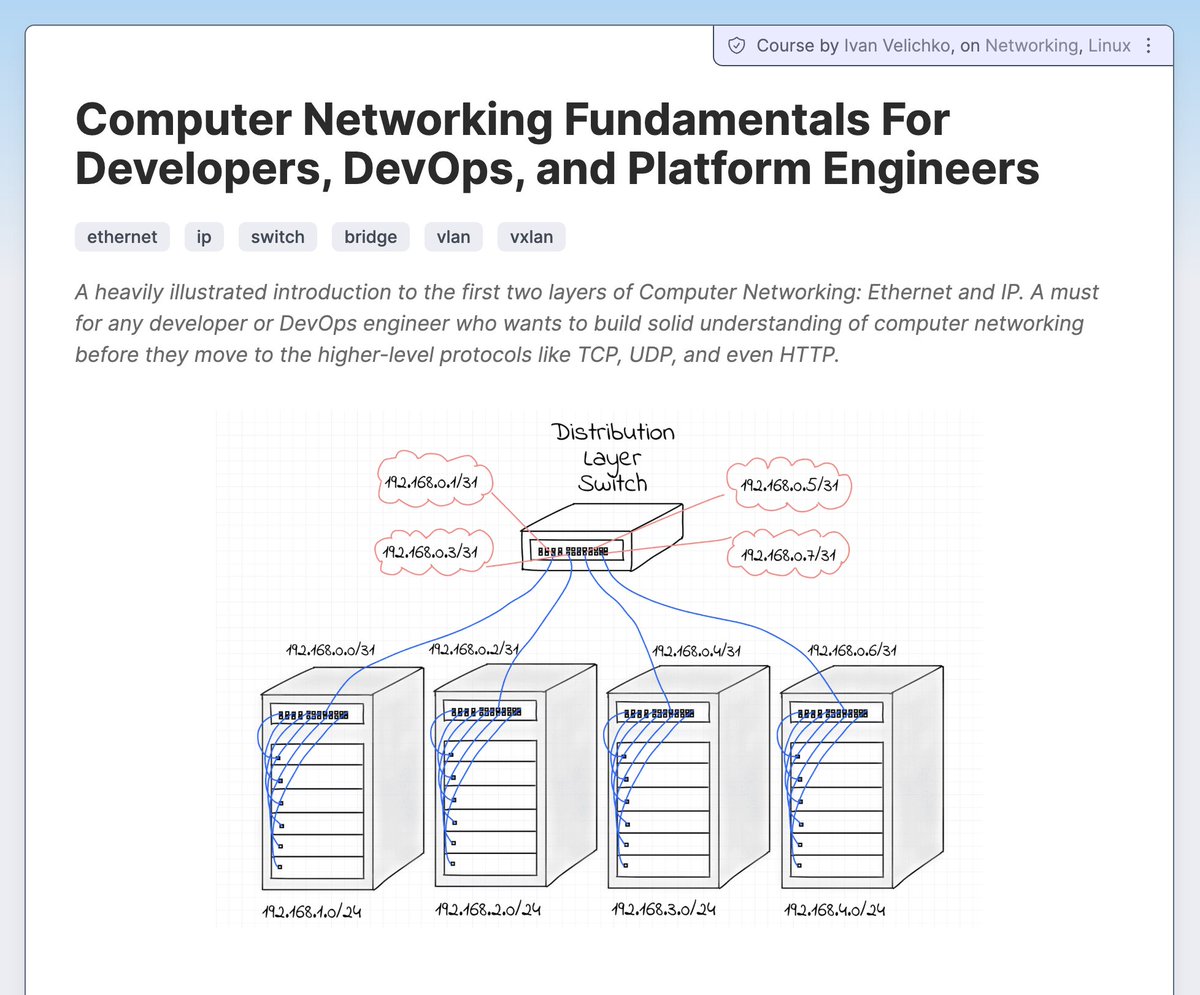
- [course] Computer Networking Fundamentals For Developers, DevOps, and Platform Engineers https://t.co/Cm4NTgcjK9
- [challenge] Configure Routes to Connect Two Private Networks https://t.co/GJdRclwHyf
- [challenge] Enable Internet Access for a Private Network with a NAT Gateway https://t.co/m09PEMvSoc
The above networking materials can be taken before, after, or in parallel with the Docker roadmap.
After getting through a couple of dozen Docker challenges and studying the networking fundamentals materials, it's a great time to take the Container Networking from Scratch tutorial https://t.co/UF2QkOBIjb.
The applicability of the knowledge you'll get from it is much broader than just Docker bridge networks - it's the foundation everyone needs before approaching the more complex Kubernetes networking model, and it'll also come in handy while learning other virtualization tech (e.g., Firecracker, QEMU, VirtualBox VMs, Lima, Kata Containers, etc.).
While going through the above materials, you'll get to solve many practical Linux problems. Some in the form of complementary challenges, some as subtasks of Docker or networking challenges. In any case, you'll become much more fluent and confident in using the terminal and operating servers.
Finally, I want to emphasise that iximiuz Labs is not a single course but a holistic learning and experimentation platform. One of the key features of iximiuz Labs is its Playgrounds https://t.co/x9Q3BQUIK8. In essence, they are remote, preconfigured Linux VMs that are ideal for practicing Linux, networking, Docker, or Kubernetes in a safe, controlled environment. Most of the platform's learning materials embed a playground on the side to help you practice what you've just read, but you can (and should) use standalone playgrounds for your learning tasks, too.
A typical example: while studying system design, you may want to explore the traditional 3-tier architecture of web applications, and the best way to do it is to actually deploy an API server, a database, and a client app with your own hands using your own or some well-known examples like https://t.co/pmY1Ige06V
How to become a better server-side/Cloud/DevOps engineer using iximiuz Labs?
Based on my own experience and hearing back from hundreds of engineers who actually achieved their learning goals, a sequence that has traditionally led to the most solid understanding and the most transferable knowledge is:
Linux → Networking → Containers → {Kubernetes, Cloud}
Jumping straight into learning the higher-level components, such as AWS VPC, Security Groups, Internet Gateways, or even Kubernetes, is not uncommon, but in my experience, it often results in longer mastering time and the need to "re-learn" from scratch after switching from AWS to Azure or from Kubernetes to Nomad or AWS ECS.
In contrast, when you first learn about LANs (L2 broadcast domains, typical switch topologies, etc.), then L3 routing, iptables, and NAT, understanding what VPC and Security Group actually are becomes much easier.
One more great thing about this approach is that focusing on fundamentals makes the knowledge transferable sideways, too.
For instance, container networking (Docker's typical bridge network) and Kubernetes' Node and Pod networking rely on the same L2 broadcast domains, L3 routing, and iptables concepts from above, even if some of the primitives will be virtualized (e.g., a Linux bridge is a virtual switch and a network namespace is an analog of an isolated network node).
This is why at iximiuz Labs, we focus on the fundamentals of the server-side tech and avoid covering topics like "5 ways to configure AWS NAT Gateway in 2026" 🤦♂️
Where to start with iximiuz Labs as a Linux/DevOps beginner?
At the moment, for a Linux/DevOps beginner, the best place to start is the hands-on Docker roadmap https://t.co/r6Mjmbc39r. I recommend trying to solve challenges there, starting from the top, and always following the links to the theoretical materials that most challenges include. And of course, don't forget to check the Solution tab if you get stuck or even if you've solved the challenge - there might be an alternative or simpler way, and the editorial solution may shed some extra light on what’s going on under the hood.
Another beginner-friendly piece is the L2 Networking Fundamentals course, augmented by these L3 challenges:
- [course] Computer Networking Fundamentals For Developers, DevOps, and Platform Engineers https://t.co/Cm4NTgcjK9
- [challenge] Configure Routes to Connect Two Private Networks https://t.co/GJdRclwHyf
- [challenge] Enable Internet Access for a Private Network with a NAT Gateway https://t.co/m09PEMvSoc
The above networking materials can be taken before, after, or in parallel with the Docker roadmap.
After getting through a couple of dozen Docker challenges and studying the networking fundamentals materials, it's a great time to take the Container Networking from Scratch tutorial https://t.co/UF2QkOBIjb.
The applicability of the knowledge you'll get from it is much broader than just Docker bridge networks - it's the foundation everyone needs before approaching the more complex Kubernetes networking model, and it'll also come in handy while learning other virtualization tech (e.g., Firecracker, QEMU, VirtualBox VMs, Lima, Kata Containers, etc.).
While going through the above materials, you'll get to solve many practical Linux problems. Some in the form of complementary challenges, some as subtasks of Docker or networking challenges. In any case, you'll become much more fluent and confident in using the terminal and operating servers.
Finally, I want to emphasise that iximiuz Labs is not a single course but a holistic learning and experimentation platform. One of the key features of iximiuz Labs is its Playgrounds https://t.co/x9Q3BQUIK8. In essence, they are remote, preconfigured Linux VMs that are ideal for practicing Linux, networking, Docker, or Kubernetes in a safe, controlled environment. Most of the platform's learning materials embed a playground on the side to help you practice what you've just read, but you can (and should) use standalone playgrounds for your learning tasks, too.
A typical example: while studying system design, you may want to explore the traditional 3-tier architecture of web applications, and the best way to do it is to actually deploy an API server, a database, and a client app with your own hands using your own or some well-known examples like https://t.co/pmY1Ige06V
Where should I start with iximiuz Labs as a Linux/DevOps beginner?
I've answered this question quite a few times in DMs lately, so I figured I should post my refined recipe publicly, too.
At the moment, for a Linux/DevOps beginner, the best place to get started will likely be the hands-on Docker roadmap https://t.co/r6Mjmbc39r. Try solving challenges there, starting from the top, and always follow the links to the theoretical materials that most challenges include. And of course, don't forget to check the Solution tab if you get stuck or even if you've solved the challenge - there might be an alternative or simpler way, and the editorial solution may shed some extra light on what's going on under the hood.
Another beginner-friendly piece is the L2 Networking Fundamentals course https://t.co/Cm4NTgcjK9, augmented by these L3 challenges https://t.co/GJdRclwHyf and https://t.co/m09PEMvSoc. It can be taken before, after, or in parallel with the above roadmap.
After getting through a couple of dozen Docker challenges and studying the networking fundamentals materials, it's a great time to take the Container Networking from Scratch tutorial https://t.co/UF2QkOBIjb. The applicability of the knowledge you'll get from it is much broader than just Docker bridge networks - it's the foundation everyone needs before approaching the more complex Kubernetes networking model, and it'll also come in handy while learning other virtualization tech (e.g., Firecracker, QEMU, VirtualBox VMs, Lima, Kata Containers, etc.).
While going through the above materials, you'll get to solve many practical Linux problems. Some in the form of complementary challenges, some as subtasks of Docker or networking challenges. In any case, you'll become much more fluent and confident in using the terminal and operating servers.
Finally, I want to emphasise that iximiuz Labs is not a single course but a holistic learning and experimentation platform. One of the key features of iximiuz Labs is its playgrounds https://t.co/x9Q3BQUIK8. In essence, they are remote preconfigured Linux VMs that are perfect for practicing Linux, networking, Docker, or Kubernetes in a safe and controlled environment. Most of the platform's learning materials embed a playground on the side to help you practice what you've just read, but you can (and should) use standalone playgrounds for your learning tasks, too.
A typical example - while studying system design, you may want to explore the traditional 3-tier architecture of web applications, and the best way to do it is to actually deploy an API server, a database, and a client app with your own hands, as in this excellent example by Adam Leskis https://t.co/zD0k0w9hOJ
Happy learning!
Madam Secretary Hillary Clinton,
If you are convinced that torture is taking place at CECOT, El Salvador is ready to cooperate fully.
We are willing to release our entire prison population (including all gang leaders and all those described as “political prisoners”) to any country willing to receive them.
The only condition is straightforward: it must be everyone.
This would also greatly assist journalists and your favorite NGOs, who would then have thousands of former inmates available for interviews, making it far easier to find additional voices critical of the Salvadoran government (or willing to confirm whatever conclusions are already expected).
Surely, if these testimonies reflect a systemic reality, a much larger pool of sources should only reinforce the claim, and many governments should be eager to offer protection.
Until then, we will continue prioritizing the human rights of the millions of Salvadorans who today live free from gang rule.
Respectfully,
Nayib Bukele
Grok for Education: xAI is thrilled to announce a partnership with El Salvador and @nayibbukele to bring personalized Grok tutoring to every public-school student in the country — over 1 million children. The world’s first nationwide AI tutor program. https://t.co/SB1CCwDLfQ
My students are FORBIDDEN to touch Kubernetes before they do this:
They need to get a solid foundation in Linux first.
Pallava wanted to jump straight to Kubernetes. Heart in the right place. Strategy would've destroyed him. Here's why.
Pod won't start? Error says storage mount failure. Without Linux mount knowledge, you're guessing. With Arch experience, you know exactly where to look.
Container crashes need process management, file systems, permissions, networking knowledge. That's all Linux. Kubernetes just orchestrates what Linux already does.
I asked Pallava: Cloud or Kubernetes? His heart said Kubernetes. Perfect. We're going there. Through Linux first.
Thomas debugging GPT partition errors? That's the same thinking you'll use when StatefulSets fail in production. Same mental model. Different tool.
Install Arch. Break things. Debug partitions. Fight systemd. This isn't delaying Kubernetes. This IS learning Kubernetes.
Cloud is easy. Kubernetes is just orchestration. Linux is where skills live. Master Linux, everything else becomes effortless.
Build the foundation that makes advanced topics feel natural. Skip fundamentals, struggle forever. Your choice.
In the mid-2000's I played a lot of video games. Most notably Halo 2 and Halo 3. I had achieved the highest ranks possible in many playlists.
For my Halo nerds, I was a 50 in Lone Wolf, Doubles, Team Slayer, Team Sniper, and SWAT. I was a 47 in MLG.
As I became more and more competitive it was semi-common to encounter cheaters. It was primarily people abusing the P2P networking system they implemented (as the kids called it, lag switching). It eventually transformed into people doing DdoS attacks (Distributed Denial of Service Attacks) using popular tools at the time like Cain & Abel (for getting computer addresses in the game lobby) and silly botnet stuff like "XR Booter" and "Biozombie".
I became enamored with the concept of DdoS attacks. I eventually had a small little botnet (I was very dangerous, I had over 20 infected machines) and was cheating in Halo as well. However, while many of the degenerate filth I associated with at the time continued to do DdoS attacks and lame shit, I became much more interested in the internals of botnets and computer networking.
As a teenager I then took the initiative to self-teach myself introductory computer networking stuff. I mostly focused on the TCP/IP stack. I thought it was fascinating. Eventually however, I became more curious on the "booters" themselves and how they fundamentally operated.
After reading through forums and conversing with hundreds of noobs, such as myself, I eventually came to the realization I would need to learn to code to truly understand how these "booters" worked. On FreeNode someone convinced me to grab a physical copy of C Primer Plus ... so, I did.
I got the book and suffered. It was insanely boring. I fucking hated it. I hated the "exercises". I hated debugging. The if-else and while-loop conditional statements annoyed me. Data structures seemed intense. The entire concept of the stack and dynamic memory allocation seemed like alien technology.
However, I persisted because I was determined to understand what the fuck this "booter" stuff was doing.
Was I good at coding? No.
Did I learn fast? No.
Am I high-IQ 1337? No.
Eventually after struggling, kicking my feet, and being self-dragged through the mud I actually finished the book. During this time StackOverflow didn't exist. ChatGPT didn't exist. My only help was forums and schizos on IRC.
When I finished my book I decided to lock in and dive into malware. My goal (initially) was to make my own "booter". Yeah, I struggled unironically for like, 2 years, self-teaching myself networking and C to make a shit fucking DdoS botnet.
I did some web searching and found a place called "VxHeaven". On there I found tons of papers and source code for malware. I was blown away. Everyday after school I went to VxHeaven and read papers on malware. I took notes, I read papers, I tried copy-pasting source code to understand how it worked.
After more struggling I completed some small malware projects. They were never released into the wild because as I learned more I stopped caring about the applicability of malware. I instead exclusively wanted to focus on the "potential" of malware. I wanted to explore malware and ... just do weird stuff on the computer. I didn't want to hurt people. I didn't want to play video games anymore. All I wanted to do was code weird stuff and learn more. Many of my "peers" at the time thought I was lame for this.
Anyway, I was a super hardcore loser and stopped writing malware and instead switched up to just regular programming. I didn't think it was possible to do malware stuff as a career.
Around 2018, or 2019, I decided to make a website that archived malware source code, samples, and papers. I did it for myself because I wanted to emulate what VxHeaven did. I didn't expect anyone to give a fuck about me or my project. However, much to my surprise, it has exploded in popularity.
Am I a faster learner? No.
Do I have a good memory? No.
I have to re-read stuff like 300 times. I suck at stuff. My only saving grace is, despite being ridiculously dumb, I am absurdly persistent in things I am interested in. This persistence and willingness to fail over and over, yet continue trying, has some how lead me to having a relatively successful career and relatively success website and social media presence
tldr video games, tried hard, failed, I'm dumb, kept doing stuff, some how success. Mostly luck and failing a bunch
Side projects ARE the project.
In college, I was grinding so hard on side projects that they eventually paid for my college, became my thesis, and got me my job after college.
When I was interviewing, one of my most common questions was "So what are you working on at home?" That would annoy some, and yet excite others with the chance to be seen.
I believe certain creative people have a need to "get it out", and if you can't do it fully in your day job, you need to work on stuff at home.
You need to try new language features you aren't allowed to use at work yet. You've got to try new libraries outside your regular dependencies. Heck, learn Rust, I don't care. But growth happens "outdoors".
Learn Linux, networking, containers, and Kubernetes by solving hands-on problems 🛠️
A curated collection of over 100 carefully crafted challenges - with interactive checks, clear diagrams, and helpful theoretical references.
Like LeetCode but for DevOps https://t.co/ZTwhoT3YZx
Terraform is the one skill that separates DevOps engineers who click through consoles from those who deploy infrastructure in seconds.
I've just completed my comprehensive "Terraform Handbook for DevOps Engineers" and
I'm giving it away for free.
How to get it:
✓ Follow me (for DM access)
✓ Retweet this post
✓ Comment "Terraform"
And I'll send you the ebook in DM.
P.S. It might take some time to go through all the comments, so wait until tomorrow. Also DM me if I miss
Defensively, he's in My Hall of Pretty Good any day of the week. This dude has a rocket launcher on his right shoulder. Gold Glover (I never got one), WS ring, and caught 15 years in the show.
Maybe he didn't do much with the bat, but he gave everything he had behind the plate everyday. His teams had success, and his pitchers loved him. I loved him and still do. He's the best.
Considering the catching position's physical and mental demands, that's Hall of Pretty Good career in my book.
I'm voting for him when he comes up.
He forgot to mention that George springer is a cheater
He forgot to mention the booing was mostly from Toronto fans
He forgot to mention it took him 5 minutes to decide whether or not springer would stay in he game
Schneider is and always will be the mariners son.


![iximiuz's tweet photo. How to become a better server-side/Cloud/DevOps engineer using iximiuz Labs?
Based on my own experience and hearing back from hundreds of engineers who actually achieved their learning goals, a sequence that has traditionally led to the most solid understanding and the most transferable knowledge is:
Linux → Networking → Containers → {Kubernetes, Cloud}
Jumping straight into learning the higher-level components, such as AWS VPC, Security Groups, Internet Gateways, or even Kubernetes, is not uncommon, but in my experience, it often results in longer mastering time and the need to "re-learn" from scratch after switching from AWS to Azure or from Kubernetes to Nomad or AWS ECS.
In contrast, when you first learn about LANs (L2 broadcast domains, typical switch topologies, etc.), then L3 routing, iptables, and NAT, understanding what VPC and Security Group actually are becomes much easier.
One more great thing about this approach is that focusing on fundamentals makes the knowledge transferable sideways, too.
For instance, container networking (Docker's typical bridge network) and Kubernetes' Node and Pod networking rely on the same L2 broadcast domains, L3 routing, and iptables concepts from above, even if some of the primitives will be virtualized (e.g., a Linux bridge is a virtual switch and a network namespace is an analog of an isolated network node).
This is why at iximiuz Labs, we focus on the fundamentals of the server-side tech and avoid covering topics like "5 ways to configure AWS NAT Gateway in 2026" 🤦♂️
Where to start with iximiuz Labs as a Linux/DevOps beginner?
At the moment, for a Linux/DevOps beginner, the best place to start is the hands-on Docker roadmap https://t.co/r6Mjmbc39r. I recommend trying to solve challenges there, starting from the top, and always following the links to the theoretical materials that most challenges include. And of course, don't forget to check the Solution tab if you get stuck or even if you've solved the challenge - there might be an alternative or simpler way, and the editorial solution may shed some extra light on what’s going on under the hood.
Another beginner-friendly piece is the L2 Networking Fundamentals course, augmented by these L3 challenges:
- [course] Computer Networking Fundamentals For Developers, DevOps, and Platform Engineers https://t.co/Cm4NTgcjK9
- [challenge] Configure Routes to Connect Two Private Networks https://t.co/GJdRclwHyf
- [challenge] Enable Internet Access for a Private Network with a NAT Gateway https://t.co/m09PEMvSoc
The above networking materials can be taken before, after, or in parallel with the Docker roadmap.
After getting through a couple of dozen Docker challenges and studying the networking fundamentals materials, it's a great time to take the Container Networking from Scratch tutorial https://t.co/UF2QkOBIjb.
The applicability of the knowledge you'll get from it is much broader than just Docker bridge networks - it's the foundation everyone needs before approaching the more complex Kubernetes networking model, and it'll also come in handy while learning other virtualization tech (e.g., Firecracker, QEMU, VirtualBox VMs, Lima, Kata Containers, etc.).
While going through the above materials, you'll get to solve many practical Linux problems. Some in the form of complementary challenges, some as subtasks of Docker or networking challenges. In any case, you'll become much more fluent and confident in using the terminal and operating servers.
Finally, I want to emphasise that iximiuz Labs is not a single course but a holistic learning and experimentation platform. One of the key features of iximiuz Labs is its Playgrounds https://t.co/x9Q3BQUIK8. In essence, they are remote, preconfigured Linux VMs that are ideal for practicing Linux, networking, Docker, or Kubernetes in a safe, controlled environment. Most of the platform's learning materials embed a playground on the side to help you practice what you've just read, but you can (and should) use standalone playgrounds for your learning tasks, too.
A typical example: while studying system design, you may want to explore the traditional 3-tier architecture of web applications, and the best way to do it is to actually deploy an API server, a database, and a client app with your own hands using your own or some well-known examples like https://t.co/pmY1Ige06V](https://pbs.twimg.com/media/HAo-01mbQAA5zH_.jpg)
![iximiuz's tweet photo. How to become a better server-side/Cloud/DevOps engineer using iximiuz Labs?
Based on my own experience and hearing back from hundreds of engineers who actually achieved their learning goals, a sequence that has traditionally led to the most solid understanding and the most transferable knowledge is:
Linux → Networking → Containers → {Kubernetes, Cloud}
Jumping straight into learning the higher-level components, such as AWS VPC, Security Groups, Internet Gateways, or even Kubernetes, is not uncommon, but in my experience, it often results in longer mastering time and the need to "re-learn" from scratch after switching from AWS to Azure or from Kubernetes to Nomad or AWS ECS.
In contrast, when you first learn about LANs (L2 broadcast domains, typical switch topologies, etc.), then L3 routing, iptables, and NAT, understanding what VPC and Security Group actually are becomes much easier.
One more great thing about this approach is that focusing on fundamentals makes the knowledge transferable sideways, too.
For instance, container networking (Docker's typical bridge network) and Kubernetes' Node and Pod networking rely on the same L2 broadcast domains, L3 routing, and iptables concepts from above, even if some of the primitives will be virtualized (e.g., a Linux bridge is a virtual switch and a network namespace is an analog of an isolated network node).
This is why at iximiuz Labs, we focus on the fundamentals of the server-side tech and avoid covering topics like "5 ways to configure AWS NAT Gateway in 2026" 🤦♂️
Where to start with iximiuz Labs as a Linux/DevOps beginner?
At the moment, for a Linux/DevOps beginner, the best place to start is the hands-on Docker roadmap https://t.co/r6Mjmbc39r. I recommend trying to solve challenges there, starting from the top, and always following the links to the theoretical materials that most challenges include. And of course, don't forget to check the Solution tab if you get stuck or even if you've solved the challenge - there might be an alternative or simpler way, and the editorial solution may shed some extra light on what’s going on under the hood.
Another beginner-friendly piece is the L2 Networking Fundamentals course, augmented by these L3 challenges:
- [course] Computer Networking Fundamentals For Developers, DevOps, and Platform Engineers https://t.co/Cm4NTgcjK9
- [challenge] Configure Routes to Connect Two Private Networks https://t.co/GJdRclwHyf
- [challenge] Enable Internet Access for a Private Network with a NAT Gateway https://t.co/m09PEMvSoc
The above networking materials can be taken before, after, or in parallel with the Docker roadmap.
After getting through a couple of dozen Docker challenges and studying the networking fundamentals materials, it's a great time to take the Container Networking from Scratch tutorial https://t.co/UF2QkOBIjb.
The applicability of the knowledge you'll get from it is much broader than just Docker bridge networks - it's the foundation everyone needs before approaching the more complex Kubernetes networking model, and it'll also come in handy while learning other virtualization tech (e.g., Firecracker, QEMU, VirtualBox VMs, Lima, Kata Containers, etc.).
While going through the above materials, you'll get to solve many practical Linux problems. Some in the form of complementary challenges, some as subtasks of Docker or networking challenges. In any case, you'll become much more fluent and confident in using the terminal and operating servers.
Finally, I want to emphasise that iximiuz Labs is not a single course but a holistic learning and experimentation platform. One of the key features of iximiuz Labs is its Playgrounds https://t.co/x9Q3BQUIK8. In essence, they are remote, preconfigured Linux VMs that are ideal for practicing Linux, networking, Docker, or Kubernetes in a safe, controlled environment. Most of the platform's learning materials embed a playground on the side to help you practice what you've just read, but you can (and should) use standalone playgrounds for your learning tasks, too.
A typical example: while studying system design, you may want to explore the traditional 3-tier architecture of web applications, and the best way to do it is to actually deploy an API server, a database, and a client app with your own hands using your own or some well-known examples like https://t.co/pmY1Ige06V](https://pbs.twimg.com/media/HAo-rJkXAAA40RZ.png)
![iximiuz's tweet photo. How to become a better server-side/Cloud/DevOps engineer using iximiuz Labs?
Based on my own experience and hearing back from hundreds of engineers who actually achieved their learning goals, a sequence that has traditionally led to the most solid understanding and the most transferable knowledge is:
Linux → Networking → Containers → {Kubernetes, Cloud}
Jumping straight into learning the higher-level components, such as AWS VPC, Security Groups, Internet Gateways, or even Kubernetes, is not uncommon, but in my experience, it often results in longer mastering time and the need to "re-learn" from scratch after switching from AWS to Azure or from Kubernetes to Nomad or AWS ECS.
In contrast, when you first learn about LANs (L2 broadcast domains, typical switch topologies, etc.), then L3 routing, iptables, and NAT, understanding what VPC and Security Group actually are becomes much easier.
One more great thing about this approach is that focusing on fundamentals makes the knowledge transferable sideways, too.
For instance, container networking (Docker's typical bridge network) and Kubernetes' Node and Pod networking rely on the same L2 broadcast domains, L3 routing, and iptables concepts from above, even if some of the primitives will be virtualized (e.g., a Linux bridge is a virtual switch and a network namespace is an analog of an isolated network node).
This is why at iximiuz Labs, we focus on the fundamentals of the server-side tech and avoid covering topics like "5 ways to configure AWS NAT Gateway in 2026" 🤦♂️
Where to start with iximiuz Labs as a Linux/DevOps beginner?
At the moment, for a Linux/DevOps beginner, the best place to start is the hands-on Docker roadmap https://t.co/r6Mjmbc39r. I recommend trying to solve challenges there, starting from the top, and always following the links to the theoretical materials that most challenges include. And of course, don't forget to check the Solution tab if you get stuck or even if you've solved the challenge - there might be an alternative or simpler way, and the editorial solution may shed some extra light on what’s going on under the hood.
Another beginner-friendly piece is the L2 Networking Fundamentals course, augmented by these L3 challenges:
- [course] Computer Networking Fundamentals For Developers, DevOps, and Platform Engineers https://t.co/Cm4NTgcjK9
- [challenge] Configure Routes to Connect Two Private Networks https://t.co/GJdRclwHyf
- [challenge] Enable Internet Access for a Private Network with a NAT Gateway https://t.co/m09PEMvSoc
The above networking materials can be taken before, after, or in parallel with the Docker roadmap.
After getting through a couple of dozen Docker challenges and studying the networking fundamentals materials, it's a great time to take the Container Networking from Scratch tutorial https://t.co/UF2QkOBIjb.
The applicability of the knowledge you'll get from it is much broader than just Docker bridge networks - it's the foundation everyone needs before approaching the more complex Kubernetes networking model, and it'll also come in handy while learning other virtualization tech (e.g., Firecracker, QEMU, VirtualBox VMs, Lima, Kata Containers, etc.).
While going through the above materials, you'll get to solve many practical Linux problems. Some in the form of complementary challenges, some as subtasks of Docker or networking challenges. In any case, you'll become much more fluent and confident in using the terminal and operating servers.
Finally, I want to emphasise that iximiuz Labs is not a single course but a holistic learning and experimentation platform. One of the key features of iximiuz Labs is its Playgrounds https://t.co/x9Q3BQUIK8. In essence, they are remote, preconfigured Linux VMs that are ideal for practicing Linux, networking, Docker, or Kubernetes in a safe, controlled environment. Most of the platform's learning materials embed a playground on the side to help you practice what you've just read, but you can (and should) use standalone playgrounds for your learning tasks, too.
A typical example: while studying system design, you may want to explore the traditional 3-tier architecture of web applications, and the best way to do it is to actually deploy an API server, a database, and a client app with your own hands using your own or some well-known examples like https://t.co/pmY1Ige06V](https://pbs.twimg.com/media/HAo-pfLaEAIs7Yf.jpg)







![iximiuz's tweet photo. How to become a better server-side/Cloud/DevOps engineer using iximiuz Labs?
Based on my own experience and hearing back from hundreds of engineers who actually achieved their learning goals, a sequence that has traditionally led to the most solid understanding and the most transferable knowledge is:
Linux → Networking → Containers → {Kubernetes, Cloud}
Jumping straight into learning the higher-level components, such as AWS VPC, Security Groups, Internet Gateways, or even Kubernetes, is not uncommon, but in my experience, it often results in longer mastering time and the need to "re-learn" from scratch after switching from AWS to Azure or from Kubernetes to Nomad or AWS ECS.
In contrast, when you first learn about LANs (L2 broadcast domains, typical switch topologies, etc.), then L3 routing, iptables, and NAT, understanding what VPC and Security Group actually are becomes much easier.
One more great thing about this approach is that focusing on fundamentals makes the knowledge transferable sideways, too.
For instance, container networking (Docker's typical bridge network) and Kubernetes' Node and Pod networking rely on the same L2 broadcast domains, L3 routing, and iptables concepts from above, even if some of the primitives will be virtualized (e.g., a Linux bridge is a virtual switch and a network namespace is an analog of an isolated network node).
This is why at iximiuz Labs, we focus on the fundamentals of the server-side tech and avoid covering topics like "5 ways to configure AWS NAT Gateway in 2026" 🤦♂️
Where to start with iximiuz Labs as a Linux/DevOps beginner?
At the moment, for a Linux/DevOps beginner, the best place to start is the hands-on Docker roadmap https://t.co/r6Mjmbc39r. I recommend trying to solve challenges there, starting from the top, and always following the links to the theoretical materials that most challenges include. And of course, don't forget to check the Solution tab if you get stuck or even if you've solved the challenge - there might be an alternative or simpler way, and the editorial solution may shed some extra light on what’s going on under the hood.
Another beginner-friendly piece is the L2 Networking Fundamentals course, augmented by these L3 challenges:
- [course] Computer Networking Fundamentals For Developers, DevOps, and Platform Engineers https://t.co/Cm4NTgcjK9
- [challenge] Configure Routes to Connect Two Private Networks https://t.co/GJdRclwHyf
- [challenge] Enable Internet Access for a Private Network with a NAT Gateway https://t.co/m09PEMvSoc
The above networking materials can be taken before, after, or in parallel with the Docker roadmap.
After getting through a couple of dozen Docker challenges and studying the networking fundamentals materials, it's a great time to take the Container Networking from Scratch tutorial https://t.co/UF2QkOBIjb.
The applicability of the knowledge you'll get from it is much broader than just Docker bridge networks - it's the foundation everyone needs before approaching the more complex Kubernetes networking model, and it'll also come in handy while learning other virtualization tech (e.g., Firecracker, QEMU, VirtualBox VMs, Lima, Kata Containers, etc.).
While going through the above materials, you'll get to solve many practical Linux problems. Some in the form of complementary challenges, some as subtasks of Docker or networking challenges. In any case, you'll become much more fluent and confident in using the terminal and operating servers.
Finally, I want to emphasise that iximiuz Labs is not a single course but a holistic learning and experimentation platform. One of the key features of iximiuz Labs is its Playgrounds https://t.co/x9Q3BQUIK8. In essence, they are remote, preconfigured Linux VMs that are ideal for practicing Linux, networking, Docker, or Kubernetes in a safe, controlled environment. Most of the platform's learning materials embed a playground on the side to help you practice what you've just read, but you can (and should) use standalone playgrounds for your learning tasks, too.
A typical example: while studying system design, you may want to explore the traditional 3-tier architecture of web applications, and the best way to do it is to actually deploy an API server, a database, and a client app with your own hands using your own or some well-known examples like https://t.co/pmY1Ige06V](https://pbs.twimg.com/media/HAo-2r9XUAAJhqI.jpg)