A mistake that cost me 5 years: Thinking preparation was progress. Reading every book. Taking every course. Planning every detail. Meanwhile, someone dumber than me started badly and figured it out. Preparation feels productive but it's often just fear dressed up as strategy. You learn to swim by getting in
the water, not by studying water.
When you're building an application, different parts need to communicate - both within the app and with the outside world.
This is made possible by APIs - and REST has become a popular way to architect your APIs.
Here, @KraneOliver teaches you key REST API principles by walking you through building an Express movie app.
https://t.co/6lGuAXLkg7
My frontend code usually consist of 3 layers:
1. my service layer
2. my hook layer
3. my component layer
1. Service layer: defines endpoints, makes HTTP requests, handles auth tokens, headers, transforms backend data formats into UI-friendly shapes
e.g: `productService.ts`
2. Hook layer: manages component state/side effects, calls service layer and handles loading/error states, handles caching, refetching logic, optimistic updates, can use Tanstack Query, SWR, or plain useState/useEffect
e.g: `useProducts()`
3. Component layer: renders UI based on data from hooks, handles user interactions (clicks, form inputs), no direct API calls or complex business logic
e.g: `ProductPage.tsx`
Let's say I want to implement a search feature for products page:
1. Service layer:
- makes GET request to /api/products/search
- accepts search query and filter parameters
- returns raw data
- transforms API response into consistent format
example: "productService.ts"
2. Hook layer:
- manages search query state (Tanstack useQuery etc)
- debounces search input
- tracks loading state
- handles error states and retry logic
- caching search results with Tanstack
- returns: { products, loading, error, searchTerm, setSearchTerm, filters, setFilters, clearSearch }
3. Component Layer:
- renders search input field
- calls setSearchTerm() on input change
- displays loading spinner while loading === true
- shows product results grid from "products" array
- shows "No results" message when products.length === 0
- displays error message if error exists
The beauty is that each layer stays focused: services don't know about React, hooks don't know about UI, components don't know about APIs.
The open source community offers devs many opportunities to collaborate, learn, & grow.
Contributing to OSS helps you develop skills, get key experience when job hunting, and so on.
If you want to dive in, this course will teach you how to get involved.
https://t.co/EYRfb2WVB0
Running your Node.js applications locally is pretty straightforward. But running them in the cloud is a bit more complicated.
This is where containers come in - they make your apps portable and predictable.
In this guide, Manish walks you through containerizing and deploying your Node apps.
https://t.co/zIk3vYa94r
@alat_ng Wema bank needs to do better with support. I authorized a transfer and my account was instantly restricted. Crickets so far.
Should’ve used my GTB account instead. Wema has been okay-ish these past few days so I decided to go with them. Huge mistake
@alat_ng is frustrating my life. Wema bank needs to do better with support. I authorized a transfer and my account was instantly restricted.
Should’ve used my GTB account instead. Wema has been okay-ish these past few days so I decided to go with them. Huge mistake
Western liberalism, once heralded as the pinnacle of political modernity, is now facing a profound crisis of legitimacy. Its failures are not merely contingent missteps but structural betrayals of its own emancipatory promise. It is failing everywhere in the West, tragically.
Low-key websites I quietly rely on
1) https://t.co/FDnurfhwge
Gives you a brutally clear learning path for roles like frontend, backend, DevOps, etc
No fluff, just “learn this → then this → then this”.
2) https://t.co/1xhB1Us0oz
An online playground to quickly test HTML, CSS, JS without setting up anything locally
Perfect for quick experiments and debugging ideas
3) https://t.co/d80zVxq6TY
A collection of reusable React hooks with real use cases
Saves time and helps you avoid rewriting the same logic again and again
4) https://t.co/UgqeLiqese
Concise cheat sheets for languages, frameworks, and tools. Ideal when you forget syntax and don’t want to read a 20-minute blog
5) https://t.co/OehnjnfVix
Turns messy JSON into a clean visual tree
Makes understanding large APIs and configs way easier than staring at raw text
6) https://t.co/mcMPeqEFWJ
Lets you generate and preview color palettes instantly
Useful when you want decent UI colors without guessing or copying blindly
7) https://t.co/9yEsuJrWCB
Build, test, and debug regex step by step with explanations Honestly, the fastest way to stop hating regex
8) https://t.co/7eM95WZ8cJ
Shows how big an npm package really is before you install it
Helps you avoid bloating your app with “tiny” libraries
9) https://t.co/Za87baZsBk
Tells you which CSS/JS features actually work across browsers Essential before using shiny new features in production
10) https://t.co/YeYh94AX4R
Google’s own diagnostics tools for DNS, email, headers, and network issues
Surprisingly useful for debugging real-world problems
👉 Which one of these do you already use and which one did you not know existed?
A MUST READ!!!!
As an AI automation beginner (n8n specifically), you'll get so much value from this article and almost everything you need to start. Though I have'nt touched AI agents yet, this will tell you everything you need to start shipping and core nodes you should master.
If you want to be a top-tier backend engineer in 2026, here’s the path I’d recommend - in roughly the order I’d take it:
1. Data Structures & Algorithms (properly)
Not for LeetCode tricks, but to build real intuition: caches, queues, heaps, indexes, bloom filters, rate limiters. You should be able to implement the basics without panic.
2. Operating Systems fundamentals
Processes vs threads, memory management, virtual memory, syscalls, file descriptors, scheduling. Backend performance issues are often OS issues in disguise.
3. Networking & Distributed Systems basics
TCP vs UDP, HTTP/1.1 vs HTTP/2 vs HTTP/3, DNS, load balancing, retries, timeouts, backpressure. If you don’t understand networks, you don’t understand backends.
4. Databases (deep, not wide)
Pick one SQL database (Postgres) and go deep:
indexes, query planners, MVCC, isolation levels, WAL, replication.
Then learn why NoSQL exists, not just when to use it.
5. Consistency, Transactions & Failure Models
CAP, consensus (Raft/Paxos at a conceptual level), idempotency, exactly-once vs at-least-once, saga patterns. This is where many “senior” engineers fall apart.
6. A systems language (Go or Rust)
Go: concurrency, networking, cloud-native systems
Rust: safety, performance, correctness
Most modern infra and backend platforms are written in one of these.
7. Concurrency & Parallelism (in practice)
Thread pools, async runtimes, event loops, actor models, work queues.
Learn how things break under load, not just how they work on paper.
8. Observability & Production Debugging
Metrics, logs, traces, SLOs, alerting, profiling.
Learn to debug memory leaks, latency spikes, and cascading failures at 3am.
9. Cloud & Infrastructure fundamentals
Containers, Kubernetes basics, autoscaling, service discovery, CI/CD.
You don’t need to be a DevOps expert, but you must understand the platform your code runs on.
10. Security fundamentals
AuthN vs AuthZ, TLS, secrets management, common attack vectors, threat modeling. Backend engineers are security engineers whether they like it or not.
The pattern here is simple:
Easy backend jobs are over. CRUD alone won’t cut it.
Strong fundamentals let you move fast, reason under pressure, and design systems that survive reality - not just pass interviews.
There are no shortcuts anymore.
But if you build these skills seriously, even if you stumble, you’ll come out dangerously competent.
Remove these verbs from your CV
❌Managed
✅Supervised
❌Ran
✅Executed
❌Conducted
✅Carried Out
❌Utilized
✅Leveraged
❌Wrote
✅Authored
❌Handled (Ability to manage)
✅Controlled
❌Was part of
✅Participated
❌Contributed to
✅Collaborated
❌Gained experience in
✅Acquired proficiency in
❌Managed
✅Directed
❌Responsible for
✅Oversaw
❌Worked (Organized)
✅Orchestrated
❌Did
✅Accomplished
❌Helped
✅Facilitated
❌Made
✅Crafted
Reasons to Remove the Verbs Marked "❌"
1. They don't clearly convey the specific actions or achievements.
2. They don't highlight the candidate's proactive role or achievements effectively.
3. They don't differentiate the candidate from others.
4. Some verbs are still in passive tone
5. Fail to provide a clear picture of what was achieved
Reasons to Use the Verbs Marked "✅"
1. They clearly convey the candidate's role and actions.
2. They make the candidate appear more dynamic and results-oriented.
Need assistance with your CV? Feel free to reach out!
Send a mail to [email protected]
Exclusive Offer
-Special discounted offer reserved exclusively if you send your current CV via our mail [email protected] with subject 'REVAMP'
#IkoKaziKE
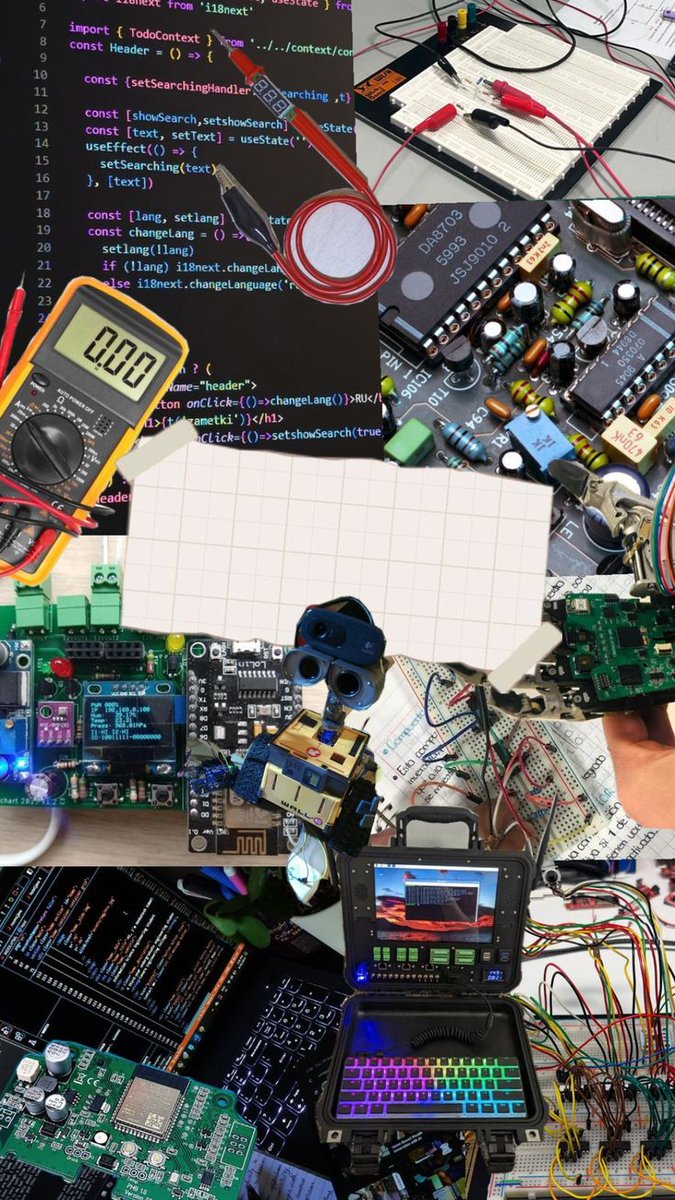
if you’re in software, pivot to electronics.
because the next decade isn’t about writing apps. it’s about wiring intelligence into matter.
software is saturated.
electronics is starving for talent.
chips, sensors, power electronics, motor drivers, RF, embedded systems, PCB design;
these are the foundations of every real-world intelligent machine being built right now.
the future is physical:
robots, drones, autonomous vehicles, industrial automation, medical devices, energy systems, wearables, smart infrastructure.
every one of them needs people who understand electrons, not just abstractions.
software gives you leverage.
electronics gives you capability.
combine both and you become unstoppable.
learn circuits.
learn embedded.
learn signal flow.
learn microcontrollers.
learn power systems.
learn how to put intelligence directly into hardware.
the world is reindustrializing.
there’s a new frontier opening.
don’t miss the wave.
Those looking for hands-on DevOps projects to strengthen their skills should explore the repository below. It offers end-to-end, real-world scenarios to practice CI/CD, Kubernetes, Terraform, AWS, and more.
https://t.co/UxyCHMWJzs
Sharing moments shouldn’t depend on the phone you have. Starting today with the Pixel 10 family, Quick Share now works with AirDrop, making secure file transfers between Android phones and iPhones more seamless. This builds on our commitment to cross-OS compatibility to bridge the gap between ecosystems.
We built this feature with security top of mind from day one.
Learn more ↓
https://t.co/I6iarYxQvL