HELLO, CHEEKY! WHAT ARE YOU DOING THERE, CHEEKY? YOU'RE A FUNNY WAN. YOU CANNAE JUST LIE THERE LIKE THAT, CHEEKY. YOU'RE A FUNNY WAN. WHAT YOU DOING? WHAT ARE YOU DOING? YOU'RE A FUNNY WAN. INT YE? ARE YOU JUST GONNAE LIE THERE AW DAY? WHAT YOU DOING, BOBBI? BOBBI BOBBI.
wish there was more cat-themed menswear. most of the stuff i've seen (that i like) are from the japanese brand kapital. they've done embroidered cat chambray work shirts, cat sweaters, cat bandanas, and a trucker cap that says "Denim Men Loves Cats."
Imagine being one of those astronauts looking down at Earth, and discovering that you don't feel anything.
You'd have to pretend.
I wonder if any of them are like that.
Cheers to you my old silly grandad, I’m missing you a ton right now. A glass of ouzo or southern comforts if you ever want to cheers to him. Hope this reaches his crowd of oomfies, he loved you all, almost as much as his vintage animations 💗 @3Dgifartist
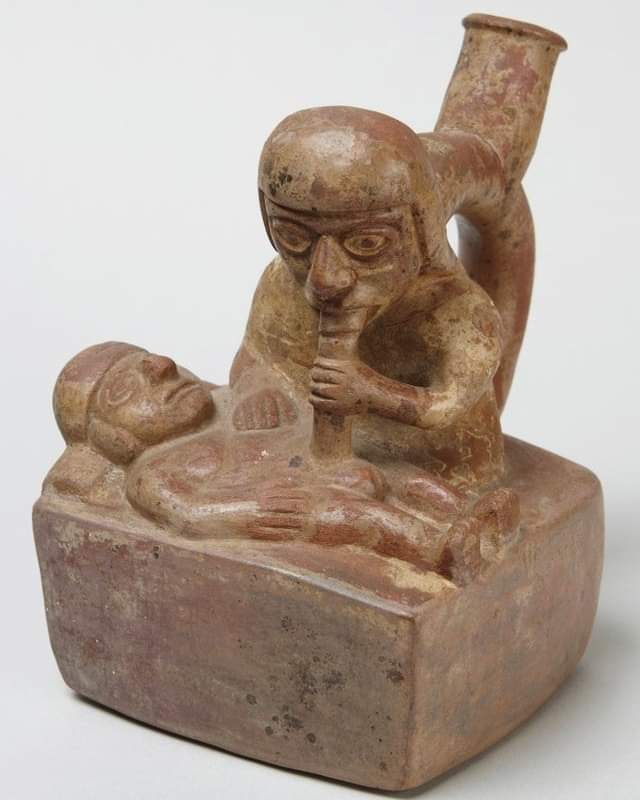
The Moche were a mysterious civilization who ruled the northern coast of Peru beginning 2,000 years ago. The Moche lacked written language, but were incredibly skilled in pottery and ceramics which they used to communicate ideas and express their lives by depicting detailed scenes of hunting, fighting, sacrifice, ceremonies, and sexual encounters in startlingly explicit detail. Little was known about the Moche civilization until 1980s when archaeologists began uncovering monuments and tombs containing detailed murals, and incredible ceramics that depicted detailed scenes of hunting, fighting, sacrifice, ceremonies, and
explicit sexual encounters. The erotic pottery left behind by the Moche represent one of the most detailed accounts of sexual customs ever left by ancient people. This last item, the so called “Sex Pots”, have been the subject of much research and study of sexual values in pre-Columbian Peru.
Of the thousands of ceramic vessels that have been recovered from Moche tombs, at least 500 of them display sexually explicit imagery, typically rendered as free-standing three-dimensional figures on top, or as part of, a vessel. Moche Sex Pots are actually functional clay post, with hollow chambers for holding liquid and stirrup-shaped spouts for pouring, often in the form of a phallus. They depict men, women and animals engaging in a variety of sexual acts, the most common of which is anal sex. Many of pottery bottles thus symbolized the emission of sexual fluids and would probably have been used in ceremonies and rituals. When Spanish invaders discovered them, the unabashed depiction of sodomy and masturbation so affronted their Christian belief that they had the posts smashed.
The anal sex in particular is reproduced over and over, in a variety of styles, indicating that it was produced by different artists over a long period of time. To remove any doubt that may arise in minds of the viewer regarding the gender of the penetrated figure, the artist often carved the genitalia carefully, despite their small scale, so as to demonstrate that it is the anus, not the vagina that is being penetrated. Scenes of vaginal penetration are itself extremely rare. Sometimes, accompanying the couples, one can see an infant suckling onto the breast of the female while she is having sex. There are also figures depicting women administering fellatio or masturbating. Some depict male skeletons masturbating, or being masturbated by living women.
“These pots clearly reflect very different notions of sex and reproduction from ones that prevail in the West, and, because of this, a lot of researchers have had trouble making sense of them,” writes UNEARTHING.
The Larco Museum (Museo Larco) in Lima, Peru, displays the largest collection of pre-Columbian erotic pottery. According to Museum, it presents “a conception of sexuality and eroticism inextricably linked to an integrated understanding of the world and its animating vital forces. In the Andean worldview, life is made possible through a generative encounter (tinkuy) between opposite complementary forces (yanantin). Female and male bodies are an expression of this duality.” The images below all come from their collection.
📷 : Stirrup vessel with fellatio scene; Peru, Moche civilization, 300-600 AD. (Larco Museum, Lima 🇵🇪)
#archaeohistories
hating snow because you “have to drive in it” proves that the car owner mindset destroys your innate connection to nature and shatters any sense of wonder you may have at the phenomenon of existence. owning a car depletes your soul
Barbarism is actually when you have to watch a loved one painfully die and can’t do anything to arrange for a dignified death because the law requires you to let them suffer to the very end.