A San Francisco startup says it just turned mercury into real gold, and their own math says gold is one of the cheapest things their machine can make. Aim it at a different metal and it makes a cancer drug ingredient worth tens of billions of dollars a gram.
Here's how it works. When you fuse two kinds of hydrogen, deuterium and tritium, every single reaction kicks out a neutron moving at 14.1 MeV, which is absurdly fast. Fire one into mercury-198 and it knocks another neutron loose on the way through, so two come out and you're left with mercury-197. Give that a few days and it decays into gold-197, the only stable kind of gold there is. The whole trick needs neutrons above about 6 MeV, and regular nuclear reactors barely make those, while fusion makes one every time it fires.
Now swap the mercury for radium-226. Same reaction, one neutron in and two out, and you end up with radium-225, which decays into actinium-225. Novartis is building its next prostate cancer drug around actinium-225, and it's so scarce it sells by the millicurie, roughly $1,200 to $2,500 apiece. Price it by the gram and you're into the tens of billions of dollars, for a material so radioactive nobody could safely hold a gram of it anyway.
Marathon's team actually put a dollar value on a single fusion neutron in a paper this year. Use it to make electricity and it's worth about $3 × 10⁻²⁰. Gold comes in at $2.6 × 10⁻²⁰, basically a wash. Molybdenum-99, which goes into about 80% of nuclear medicine scans, is worth $2.6 × 10⁻¹⁷ a neutron. Actinium-225 is worth about $10⁻¹⁰, around 3 billion times what the electricity's worth.
That's why fusion people should care. Every fusion company you've heard of is chasing electricity, and selling electricity only pays once the plasma puts out something like 10 to 22 times the energy you pump in to heat it. The best result so far, at JET in England, was about a third. Add gold on the side and Marathon's math says you break even around 3x. For molybdenum-99, the number is 0.001x.
So a machine that gives back one-thousandth of the energy you feed it can still make money, as long as the neutrons hit the right metal.
By their numbers, a 3 megawatt machine running way below breakeven could cover the whole world's supply of molybdenum-99, which today comes from splitting uranium in a handful of research reactors. Today's experimental fusion machines already beat the gain that job needs.
Their second post basically says this out loud. Marathon now describes itself as an isotope company for radiopharma. Their chart shows roughly 390 targeted radiotherapy trials. Pluvicto, the prostate cancer drug Novartis launched at $42,500 a dose, did $1.9 billion in sales last year.
Gold still matters to them, just later. It's about a $700 billion a year market, and Marathon's paper figures it could soak up around 2 terawatts of fusion capacity, which is roughly the scale where fusion actually moves the grid. So the plan is to sell cancer isotopes out of small machines now and use gold to pay for the giant ones, years before electricity can pay for itself.
@WallStreetApes Most of tow truck guys are mafia.
Everybody know that.
You just making bullshit cuz ur an idiot.
If we had better Americans they can get the job otherwise how come sending everyone.
I promise you - they can't keep up.
SlowBooks Pro is already better than QBO / QBS /QBW32.EXE idc which one you name it - pound for pound
SlowBooks Pro trods all over the ashes of Quickbooks.
Let this industry die - stop paying money to these evil corporate conglomerates - stop buying ito the hype and popularity of SaaS solutions that lock you into endless deterioration of what you started with.
I love watching everyone try to make millions on bookkeeping while SlowBooks Pro keeps adding dozens of users a day. Over 500 daily calls back to the server every day from unique IP's - the snowball has started. This industry is cooked.
Why?
Because SlowBooks Pro is free ... Forever
@WallStreetApes Bro no need to share stupid posts just for getting more answers etc
All halaal beef producing by same Texas Cattle Farmers. They just hire one guy at the beginning for $12/hour to show how to cut the animal that’s it. I work for short amount of time in a cattle farm
BREAKING: Grok Bot can now run your back office like an $11,245-a-month operations manager.
Connect your CRM, inbox and Slack and use these 10 prompts to hire it:
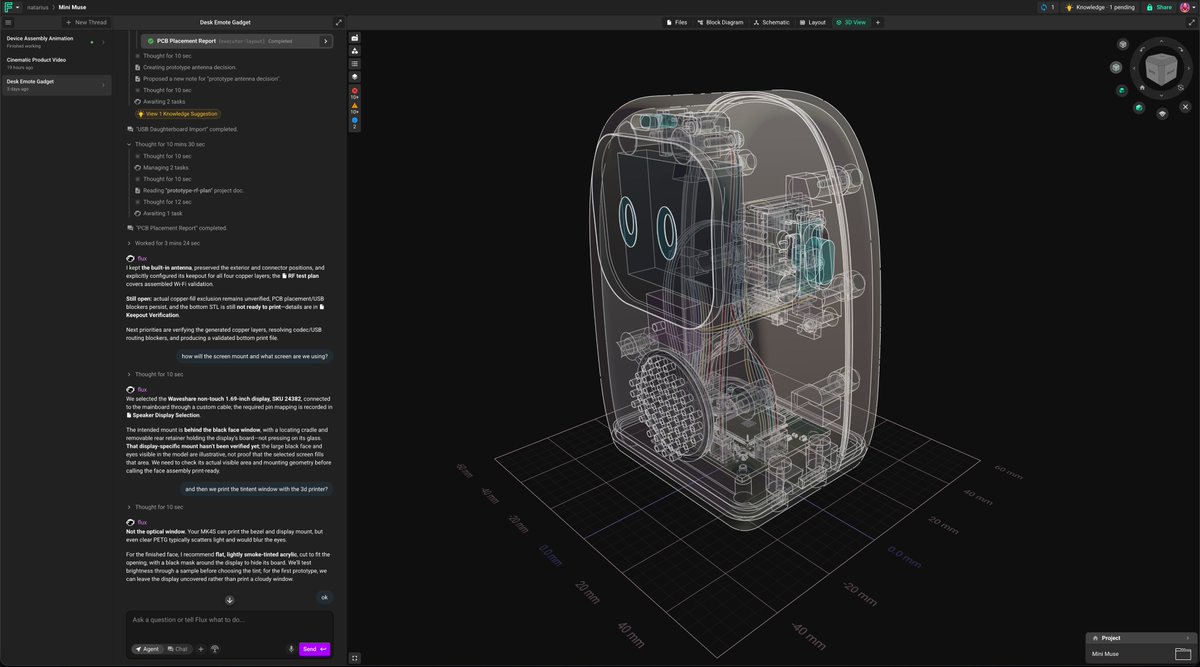
Computer can create an interactive 3D preview of a design and export the model as an editable CAD file.
It can also make changes in FreeCAD and record a video of the edits.
People ask me how @BuildWithFlux is different from using Claude for hardware design.
Flux operates at the level of an engineer, not a CAD copilot.
It can design the electronics, PCB, enclosure and firmware. It can simulate the device, source parts, verify manufacturability, write the documentation and do much of it in parallel.
But the biggest difference is the level of abstraction.
With Claude, you're still the engineer. You break the problem down, orchestrate the tools, provide context, verify the work and figure out what to do next.
Flux has the hardware-specific environment, tools, context, verification and execution harness already built in, and knows how to effectively use them.
You can describe a consumer electronics device and spend the next ~20 prompts mostly answering clarification questions while Flux does the engineering.
And underneath the agent is a complete AI-native CAD/EDA environment spanning electronics, mechanical design, simulation and manufacturing.
You just don't have to operate it.
No bouncing between CAD, EDA, simulation, firmware and documentation tools.
The goal isn't AI-assisted CAD.
The goal is to make the CAD disappear.
4 hours since Muse Gadgets was announced - the response has been amazing. Welcome to everybody joining our Discord and hanging out. Thank you for your pull requests (we merged some already), and for sharing the gadgets you built! Some of my favs 👇
Tried out another cozy game idea with Opus 5
This is the result after 5 hours
Managed to get a working economy, assignable tasks for villagers, and plenty of things to build
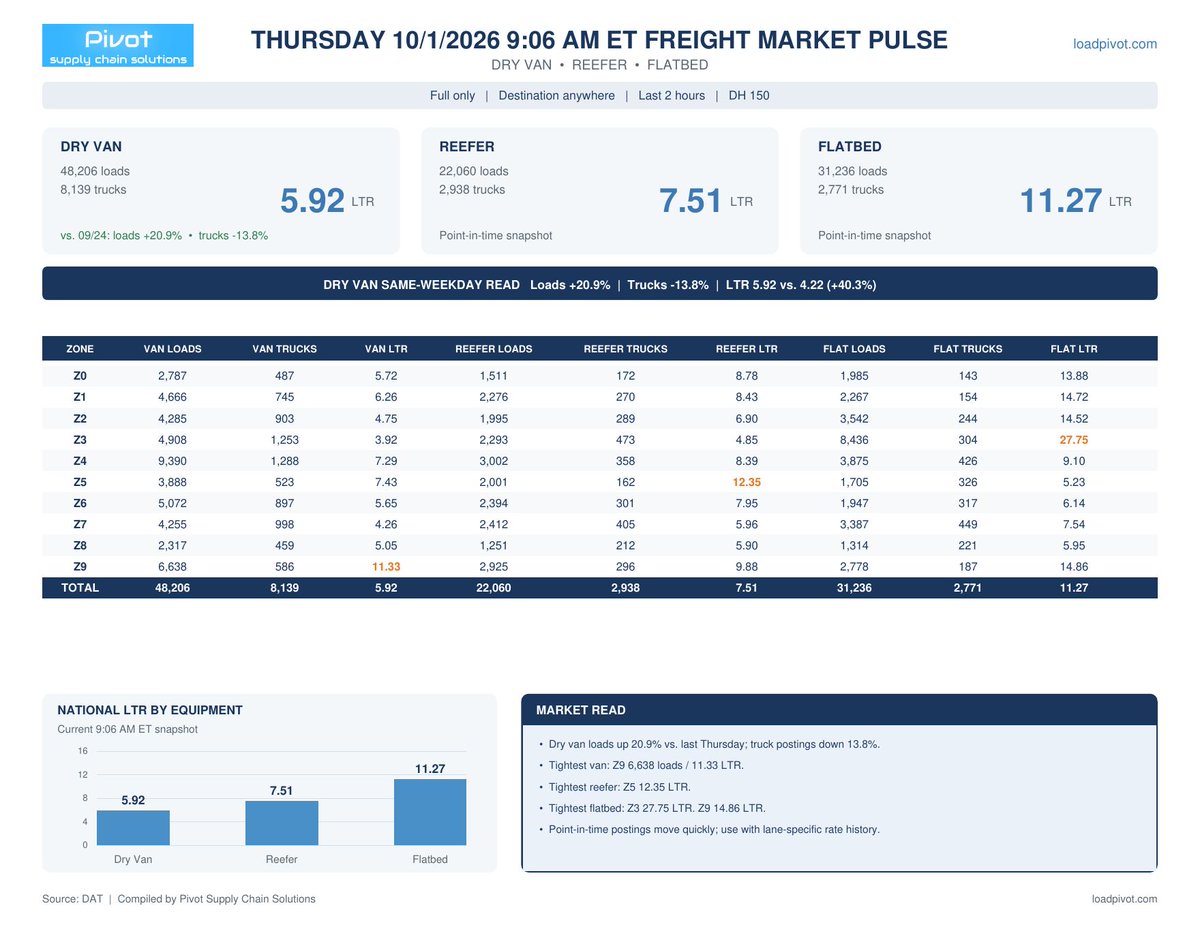
Freight Market Pulse for Thu 10/1, as of 9:06 AM ET
Dry van: 48,206 loads live, 8,139 trucks, LTR 5.92
Reefer: 22,060 loads, 2,938 trucks, LTR 7.51
Flatbed: 31,236 loads, 2,771 trucks, LTR 11.27
Van vs. last Thu: live volume +20.9%, trucks -13.8%, LTR 5.92 vs. 4.22
Day over day, van live volume is down 23% after Wednesday's end-of-month and end-of-quarter push, and trucks are up 10%. Van LTR eased from 8.5 to 5.9.
Tightest by DAT zone:
Van: Z9 (CA, OR, WA, AK) 11.33. Z4 (IN, KY, MI, OH) leads van volume at 9,390 loads
Reefer: Z5 (IA, MN, MT, ND, SD, WI) 12.35
Flatbed: Z3 (AL, FL, GA, MS, TN) 27.75
Point-in-time snapshot, so pair it with lane-specific rate history.
Source: DAT, compiled by Pivot Supply Chain Solutions