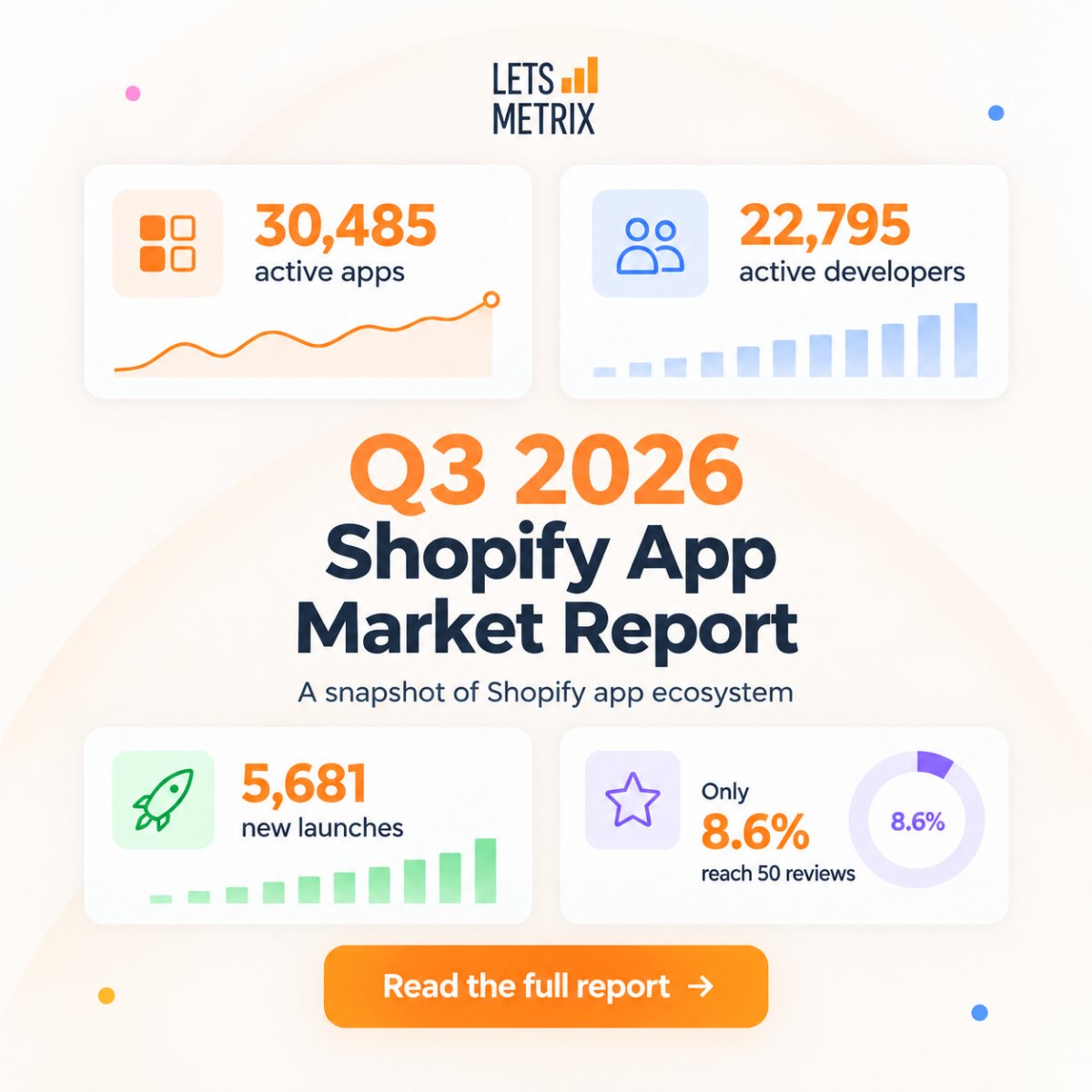
Q3 2026 set a record with 5,681 new launches on @Shopify, pushing the store past 39,500 apps ever listed.
Full report below 👇
The Shopify App Store has never been easier to enter, and never harder to win. It looks like a thriving ecosystem, until you see what happened to attention: the share of apps that ever reach 50 reviews fell to 8.6%, fewer than 1 in 11.
More apps arrived than merchants could possibly notice.
For years the scarce resource was a slot in a category. Now the catalogue is crowded in nearly every direction, and the thing in short supply is attention, measured in reviews.
The opportunity hasn't disappeared, though. It has moved, toward the apps that turn a launch into a steady habit of earning reviews and trust.
We pulled the full picture together in our Q3 2026 State of the Shopify App Store Market report, built from our live crawl through Sep 30.
Inside:
→ Ecosystem: launches, removals, and the traction squeeze
→ Pricing: what apps charge, and which price points rate highest
→ Competition: which categories just loosened, and where the openings are
→ Reviews & growth: the review ladder, and what the Built for Shopify badge signals
→ Rising stars: the new theme taking over new-app momentum
→ Developers: who's building, and where influence is concentrating
Full report below 👇
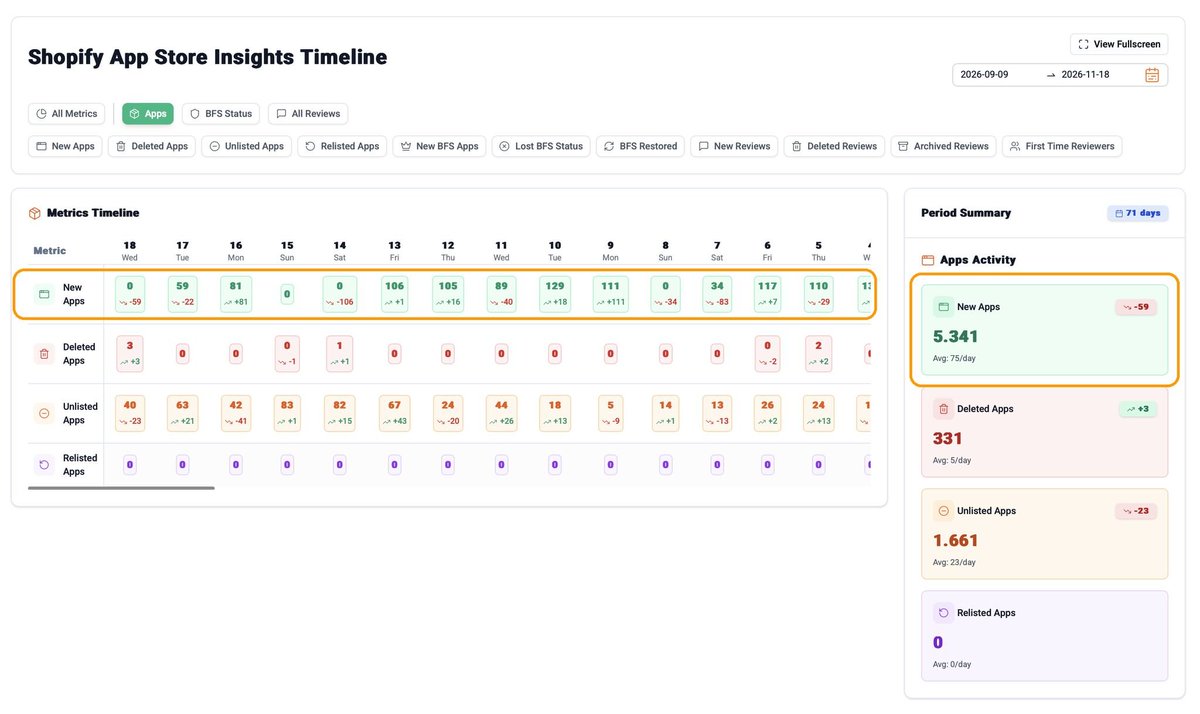
The @Shopify App Store added about 5,300+ apps over the last 10 weeks, roughly 75 a day. A rule that took effect on November 10 now puts a new gate in front of that inflow.
Developers must now have at least 10 installs on every app they've already published before submitting another one. Only installs from active stores on paid Shopify plans count, so development stores and free trials are excluded.
This could slow the flow of new apps into an already crowded marketplace. The burden may fall hardest on developers whose existing apps are slow to gain traction, or whose products serve smaller, more specialized markets.
But there's another question: do 10 installs actually prove that an app has real traction?
Installs can be bought, while genuine usage and retention are much harder to fake. If the goal is to filter out low-quality apps, install count alone may not be enough.
Our baseline is around 530 new apps a week. The next few weeks of New Apps data should show whether that number starts to fall and stays lower. But a lower launch count won't necessarily mean a healthier App Store.
Whether these requirements help surface apps that merchants actually use and value?
Analytics, SEO and Chat apps are leaving the @Shopify App Store faster than any other category: 122, 80 and 70 removed in the last 90 days.
Our Delisted & Deleted data shows that recently removed apps are often long-running products. The categories seeing the most removals are also some of the most API-heavy: Analytics, SEO, and Chat.
The next pressure point is Shopify’s November 20 IP allowlist deadline. Public apps calling the Admin API must enable IP allowlisting by 11:59 PM ET or face delisting and a block on new installs. On its own, this is a manageable technical change. But it lands just before BFCM, with offline tokens set to expire on January 1 and some questions around local development and serverless hosting still unresolved.
Each requirement adds another piece of work to keep an app running. Several changes piling up can become a real maintenance burden, especially for apps that no longer generate enough revenue to justify the effort.
That pressure often takes years before an app disappears from the Store, long after it stopped attracting attention.
The apps that survive a season like this are the ones whose upkeep still fits what they earn.
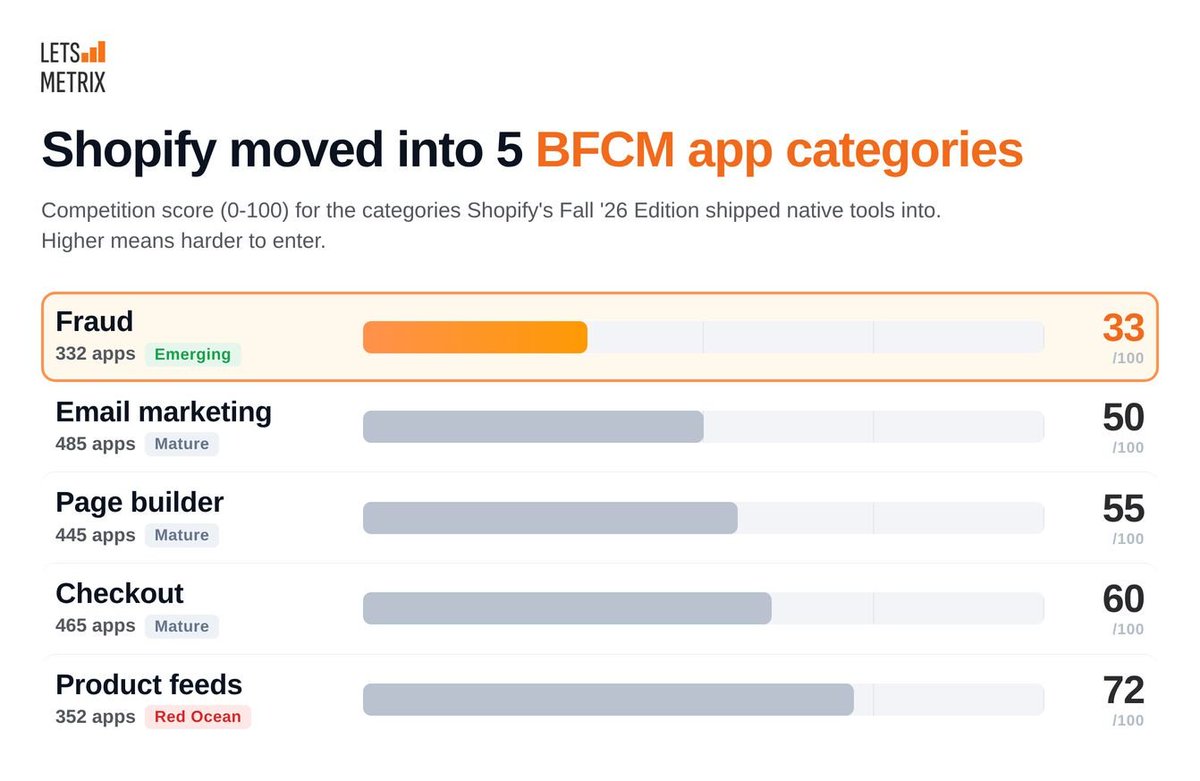
Shopify’s Fall ’26 Edition brought native tools into 5 app categories merchants rely on during BFCM. Four already have more than 350 competing apps.
At first glance, it looks like @Shopify is moving into five markets and pushing third-party apps out. But the threat depends on how much of each category’s value Shopify’s native tools actually cover.
Our Niche Explorer data shows four categories are already Mature or Red Ocean:
- Email marketing - 485 apps
- Checkout - 465 apps
- Page builders - 445 apps
- Product feeds - 352 apps
In these crowded markets, native features are more likely to replace basic functionality than entire apps. Shopify gives merchants a free baseline, but apps can still compete through deeper automation, customization, integrations, and specialized workflows.
The risk is greater in thinner categories, where a native tool can cover a larger share of what existing apps offer. With fewer specialized use cases separating one app from another, there's less room to differentiate.
Fraud remains Emerging, with a competition score of just 33. Shopify Protect enters a less crowded category and resets expectations for basic fraud protection. Apps that offer little beyond that baseline now have a harder case to make.
The question for developers is whether their app solves problems that Shopify's native tools don't?
new: @Shopify just changed who gets to list an app. the quiet theme: the era of spinning up 10 apps and hoping one sticks is over.
- need 10+ installs on paid stores before you can list another app
- rejections now trigger longer and longer cooldowns
- new apps require identity verification
- zero-install apps get removed after 6 months
build one thing people actually use, then expand. that’s the whole message.
@harleyf@ambermac@indigo I like this take. Trying to build something of your own doesn't have to mean quitting your job or going all in. Sometimes it starts with just seeing if an idea has legs.
@ShopifyDevs More behind-the-scenes on how Shopify apps get discovered would be great. What makes an app stand out, how the ecosystem shifts, and what developers can learn from those changes.
@tech_lead_bunny@Shopify That’s an interesting way to frame it. I suspect it could be a mix of both. The price sets expectations, but whether the app attracts the right merchants and delivers on those expectations probably matters just as much. The ratings alone don’t tell us which factor weighs more.
💵 @Shopify apps priced at $10–30/month average 4.74 stars. Apps above $100/month average 4.75. The $60–100 tier scores lowest among paid apps, at 4.61.
Plot app ratings against price this quarter, and the pattern isn't a straight line. It's a barbell: ratings are highest at the lower and premium ends, while the $60–100 band is the weak spot among paid apps.
What might explain this?
At $10–30, the lower price may make it easier for merchants to feel they're getting good value. At $100+, merchants may expect more specialized tools and clearer value for the premium they pay.
The $60–100 range sits in a tougher position. The price is substantial enough to raise expectations, but the ratings suggest apps in this tier aren't meeting those expectations as consistently.
For developers, that makes the $60–100 range worth examining carefully before setting a price. A lower price can make an app easier to try, while premium pricing can work when the product delivers clear, differentiated value.
Whether you go budget or premium, the value has to justify the price.
@aiwithadb we make dashboards for people who build Shopify apps and are tired of guessing how they compare. rankings, reviews, competitor data, install trends. the App Store won’t tell you any of it, so we do.
@Seanwvibedev Letsmetrix. we make dashboards for people who build Shopify apps and are tired of guessing how they compare. rankings, reviews, competitor data, install trends. the App Store won’t tell you any of it, so we do.
The median @Shopify app is now abandoned after 567 days, down from 716 a quarter earlier, five months sooner than before.
Alongside that, the number of “zombie apps”, ones still listed but no longer updated, with their reviews slowly declining, doubled from 100 to 231. Apps are being neglected earlier, and the trend is spreading across more of the Shopify App Store.
It's easy to read this as developers losing commitment. But a more structural explanation may be at play.
The barrier to building has fallen sharply, so any app that one developer can easily rebuild with AI has few barriers protecting it from copycat competitors.
Meanwhile, most categories are already well served. For many ideas, capable apps already exist, backed by established leaders with thousands of reviews. That leaves less room for newcomers to stand out and attract users.
When both conditions apply, abandoning an app earlier becomes less about losing motivation and more about the economics of keeping it alive.
If a product is easy to replicate and its category is already crowded, another year of maintenance may not be worth the effort. More developers are choosing to step away rather than keep investing in a product with limited room to grow.
That's the signal behind a zombie app. It doesn't necessarily mean a developer stopped caring. More often, it means the economics no longer justified staying.