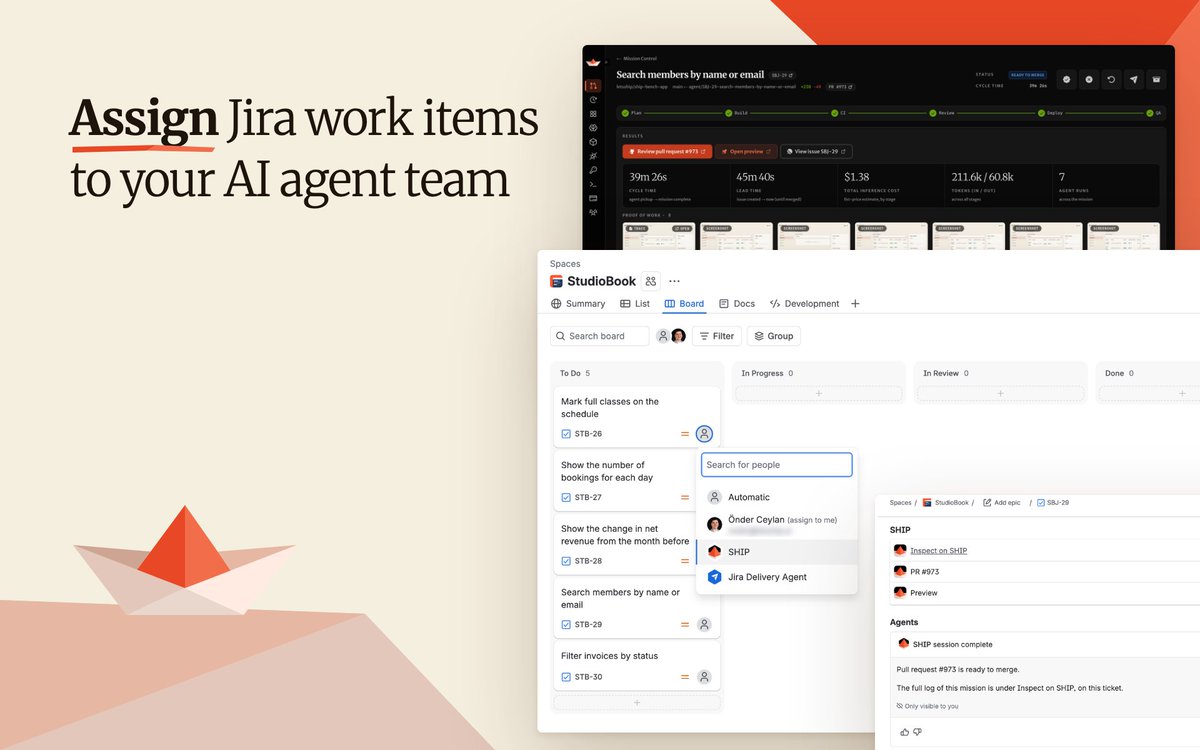
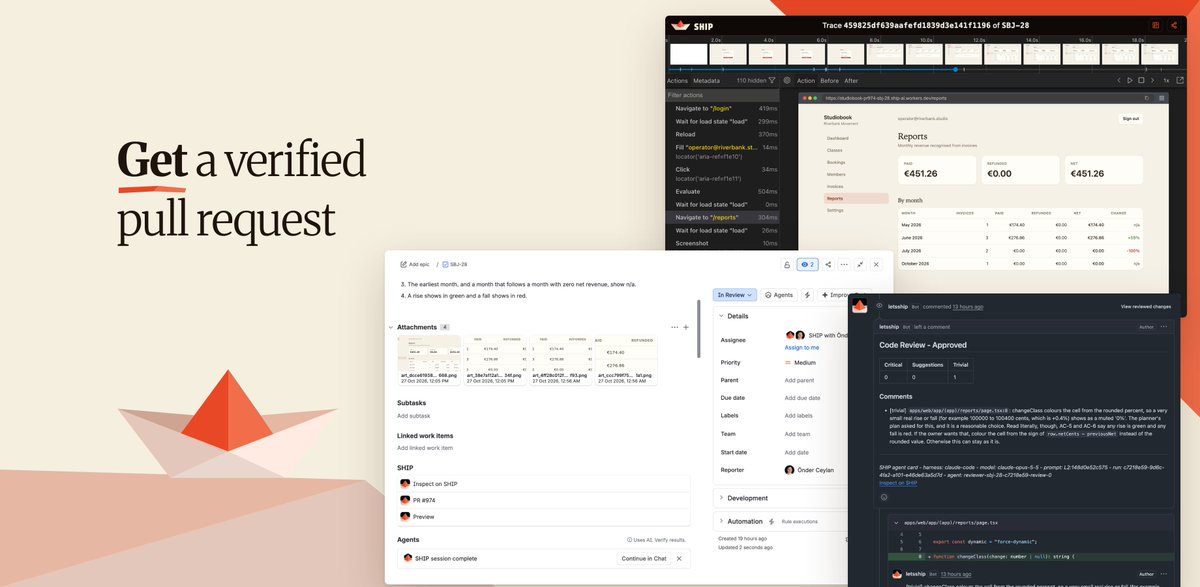
SHIP for Jira is now on the Atlassian Marketplace!
After Linear and GitHub Issues, Jira was the tracker people asked for most. Now you can assign a Jira work item to SHIP, and its AI agent team opens a verified pull request in your GitHub repository.
Four agents do the work:
- The Planner reads the work item and posts its plan as a comment.
- The Builder writes the change and runs your CI/CD until it passes.
- The Reviewer reviews the diff.
- The Tester checks each acceptance criterion on a live preview.
Your team can follow the mission progress without leaving Jira. SHIP keeps one comment on the work item and adds the plan, the review verdict, the test result and the pull request link at each stage. It also moves the status to In Progress, In Review and Done automatically.
To give the agents more instructions, mention @SHIP in a comment. Use @SHIP pause, @SHIP resume and @SHIP stop to control a mission. You can also open a chat with SHIP in Rovo and ask about the mission progress, test report or anything you'd like to know about the change.
You choose the coding agent and the model for each role: Claude Code, Codex, OpenCode, or the pi coding agent. They run on your own API keys, or on a Claude or ChatGPT subscription.
The app is free on the Marketplace, and missions count toward your SHIP plan. You need Jira Cloud with Rovo, a SHIP account and a GitHub repository.
Try it out by installing it to your Jira workspace from the Atlassian marketplace:
https://t.co/smkNN6XHGj
#Jira #AtlassianMarketplace #AIAgents #SHIP #IssueToPR #TicketToPR #ClaudeCode #Codex #Pi
@ryan_doser13 Well, actually there's a better way. One can manage and build their project using software engineering practices, and software team of agents using https://t.co/W4w63wlXcU
@Saqlain__Digu This is a directional study, not a leaderboard. The point is, budget models work as well as frontier models when directed and corrected in a loop.
The best coding model is not the best way to ship software.
Our delivery loop sent an Open-Weight builder pi/deepseek-v4-flash back 13 times across 20 tickets. It still resolved all 20 tickets at 39% lower cost per resolved ticket than claude/opus.
We built SWE-in-a-team coding benchmark because most coding benchmarks grade the destination: a function, patch, or environment. Engineering teams deliver through a loop: Plan → Build → CI → Review → Deploy → Test
So we ran 13 Builder configurations through the same 20 real-world tickets: 260 missions on a purpose-built, full-stack SaaS application. Only the Builder changed. The Planner, Reviewer, and Tester stayed pinned.
The results:
• DeepSeek-v4-flash on pi: 20/20 resolved at $3.34 per resolved ticket
• Claude Opus: 20/20 resolved at $5.48
• 46 runs were rejected by at least one gate
• 40 corrected course without human involvement
• 4 passed every visible gate but still failed the hidden tests
The lesson is not that one model always beats another. It is that a model which converges under correction can be more valuable than one that starts closer to the answer - if the delivery system makes correction cheap.
This is a directional study, not a universal leaderboard: one repository, 20 tickets, and one trial per configuration and ticket pair.
But it suggests a better question for engineering teams:
- Not “Which model writes the best code on the first try?”
- But “Which model and harness can our delivery loop correct economically?”
Read the methodology, inspect the PRs and mission replays, and download the data of all 260 runs in our research at: https://t.co/nuFjMjGj4E
POV: Demonstrate a 38 minutes long @letsshipai mission in 30 seconds.
AI agent fleet worked together in a software factory via pi - deepseek-v4-flash builder: four builder pushes and three rejections (CI twice, then the reviewer once) landed a resolved ticket in 38m 12s for $4.22.
Not bad for autonomously increasing your marketing site's SEO score from 45 to 100.
Hello world! SHIP is live and kicking and keeps building itself with the agent fleet ⛵
Our initial issue tracker integration is with @linear. But not because it's our #1 planning tool of choice.
@karrisaarinen and his team has been doing a fantastic job at Linear. SHIP works the best with agent native platforms, designed for the AI era. And, Linear is a great example.
Linear's Agent Session interface is a perfect starting point for creating agent conversation surfaces around a work item.
In the attached mission, SHIP's task is to takeover a broken PR which was vibecoded, and fix it by taking it through complete SDLC. I added a new instruction for the team mid-mission using Linear's Agent Session, and they have a side mission now.
Linear, welcome aboard! 🌊