Why backtesting changed everything for me.
Before I had data, I traded on feelings.
One win → I felt like a genius.
One loss → I started doubting the whole model.
That’s emotional trading.
When I finally sat down and backtested properly, everything shifted.
I knew my win rate.
I knew my average R:R.
I knew my max losing streak.
Now when I take a loss, it doesn’t shake me. It’s just part of the sample size.
Backtesting gives you something most traders don’t have certainty.
Not certainty that every trade will win.
But certainty that if you execute 50-100 trades properly, the edge plays out.
Confidence doesn’t come from motivation. It comes from data.
NQ Trade Recap | +$3,556
NQ closed First 30 minute candle Green Candle.
Using data from @edgeful , I noticed that historically, 75% of green closes lead to another green day.
That helped me build a bullish bias and gave extra confirmation for the setup.
Entry Model:
• Liquidity Sweep
• M1 IFVG Alignment w M1 +OB
Clean execution, Clean reaction.
Stop chasing 5 trades a day
More trades don’t mean more money
They usually mean more mistakes
The market doesn’t pay you for activity
It pays you for precision
One clean A+ trade can outperform five impulsive entries
After your first solid trade, the urge kicks in: “Let me take one more.”
That “one more” is where discipline disappears
You start seeing setups that aren’t really there.
You widen rules
You justify entries
By the third or fourth trade, you’re no longer executing a system
You’re reacting
If your model gives 1–2 quality opportunities a day, respect that
Sometimes the most profitable decision you’ll make all day is closing the charts after one or two good execution.
Session: I personally trade only the NY AM session high volatility, cleaner structure most days.
Risk: I use fixed risk per trade
Size it according to your strategy, not emotions.
Process: Stick to your plan, rules, and model.
Mindset: Don’t go on tilt during drawdowns.
Discipline > everything.
@TraderAryan If you could trade a propfirm without any rules at all
No consistency
No minimum trading days
No nothing
How will that affect your trading???
So before anyone asks why I switched to 1:1 RR
I used to trade around 0.3RR and was profitable with it. I traded that model for over a year and took more than $80K in payouts.
But since January, I’ve been forward testing a 1:1 approach with my model, and the data has been solid currently sitting at over a 74% win rate.
This wasn’t some random overnight decision. I’ve been journaling, collecting data, and testing it consistently for months.
As a trader, you have to evolve, adapt, and improve. So moving forward, this is the approach I’ll be sticking with:
1 Trade a Day | $400 Risk Per Trade | 50K Accounts
Simple.
Yes, first day ended in a loss but no worries. I’m giving this risk management approach a full quarter before judging the results.
Trust the process 🤝
Challenge yourself to stick to this for the whole month of June.
- No revenge trading
- Maximum 2 trades a day
- If Trade 1 is a loss, done for the day
- Risk stays fixed on every setup
- Only take A+ setups from the model
- No checking P&L during market hours
- Journal every single trade
- Review screenshots after market close
- 7+ hours of sleep before Trading session
- Spend more time off charts than on charts
Let’s see who really has discipline.
Daily = Find DOL Through :
• Close Above/Below
• Wick Above/Below
• Dealing Range
• IRL to ERL , ERL to IRL
4H = position yourself in H4 :
• 1 AM CRT
• 5 AM CRT
• 9 AM CRT
15 = Execution / Entry
• Turtle soup
• Model #1 ( OB )
• Model #2 ( Brk )
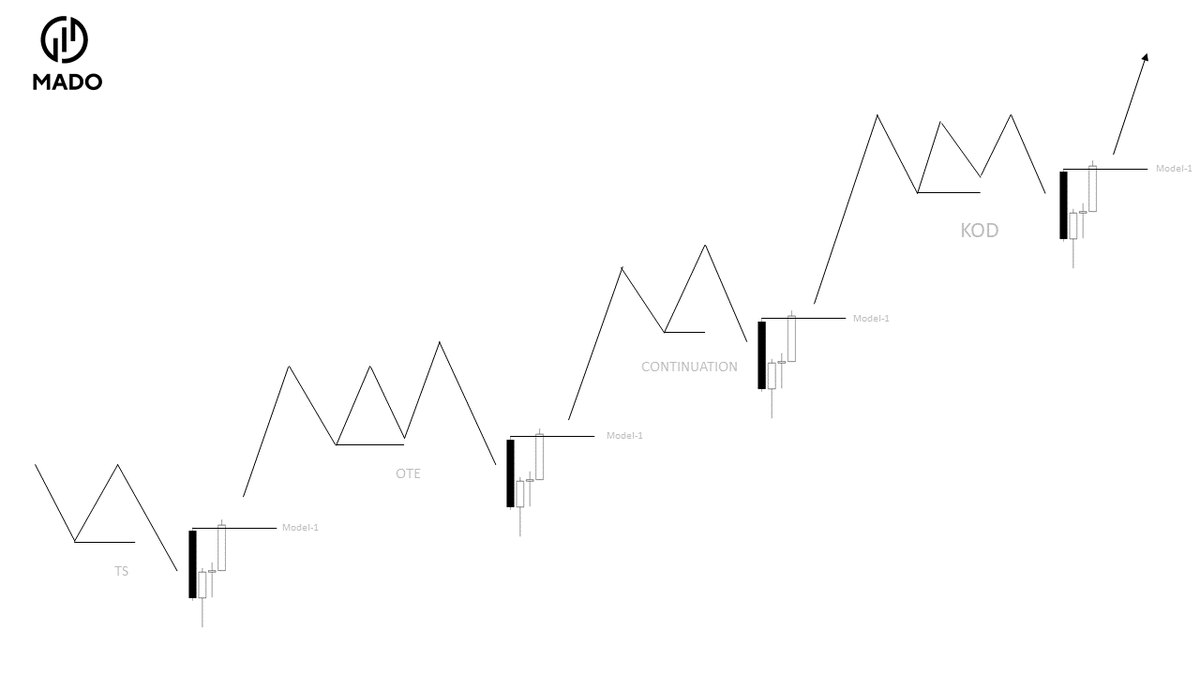
You can spot a Model-1 in every phase of TSQ:
• Turtle Soup → Model-1
• OTE → Model-1
• Continuation → Model-1
• KOD → Model-1
Once you see it, you can’t unsee it.
The Candle that dugs below a low or dugs above a high = OB / Model-1.
Monthly CRT → Daily Model 1
Weekly CRT → 4H Model 1
Daily CRT → 1H Model 1
4H CRT → M15 Model 1
1H CRT → m5 Model 1
High probability entry model.
Every trading model must have these essential aspects to be considered a proper model.
- HTF Bias.
- HTD Draw on liquidity.
- LTF entries.
- Stoploss and targets.
- Trade management.
- Risk management.
The 3 AM Model has all of these aspects to it.
Confidence in trading comes from preparation, not hope.
When you've spent years testing your model and know your system inside out — win rate, risk-reward ratio, drawdowns, trade frequency, average trade duration, and time between trades — you trade without emotions.
Losses, wins, or streaks don't faze you because your trust is in the data, not luck. That’s the foundation of consistent execution.
1. When you’ve identified your higher timeframe key level, don’t do stupid shit while price is going there.
2. When your trading model appears, execute fearlessly without any second-guessing.
3. When you execute, don’t interrupt while your trade is playing out, let it reach either the stoploss or the target.
Draw on liquidity and Bias:
For this trade model, you will determine your bias and draw on liquidity by waiting for the 5 PM or 9 PM H4 CRT to be purged at 3:00 - 4:00 AM. Once purged, your bias will be in the counter direction of the purge. Similarly, your draw on liquidity will be the opposing 50% of the range and the opposing end of the range.
For example, if the high of a 5 PM CRT is purged at 3 AM, then your bias becomes bearish and your draw on liquidity becomes the opposing end of the range.
Important rules:
- The purge has to happen during 03:00 - 04:00 AM. (If the purge happens outside this time window then you don't take any trade and wait for another day)
- You must wait for a LTF CSD to occur on the LTF before confirming your bias and draw on liquidity. (If there is no CSD on the LTF then you won't be taking any trade.)
- CSD confirms your bias and if there is no CSD then no trade.
- Let me say it again, the purge has to happen at (03:00 - 04:00) otherwise no trade.
- Note and journal all of these rules.
This is how you determine your draw on liquidity and bias.