Democracy depends on an informed electorate. But political issues and ballot measures can be confusing, obscuring the effects of one outcome versus another. Moreover, politics is personal. Once we make an initial decision about an issue, it can be hard to change our mind or see things from “the other side.” And talking about issues with those with whom we disagree can be challenging, especially when the conversation feels more like a debate than a discussion.
Technology offers ways to alleviate these difficulties, but not without introducing problems of its own. The Internet and social media promised new ways for people to connect, discuss issues, and learn from each other. But in practice, both often inflame passions, solidify echo chambers, and spread misinformation. More recently, LLM chat interfaces may help people stay informed through personalized access to information, but mainstream chatbots tend to match user beliefs rather than clarifying or challenging them.12 Without the kind of pushback you’d encounter in a discussion between disagreeing friends, chatbots are ill-suited for helping people think through political issues in a balanced way.
The goal of CivicChats is to address these shortcomings. Starting with ballot measures, CivicChats helps people better understand political issues through three different modes of discussion: a Q&A mode for understanding what a measure does and what’s at stake, an argumentative mode that presents competing views to your own, and a reflective mode that helps you examine and develop your own thinking.
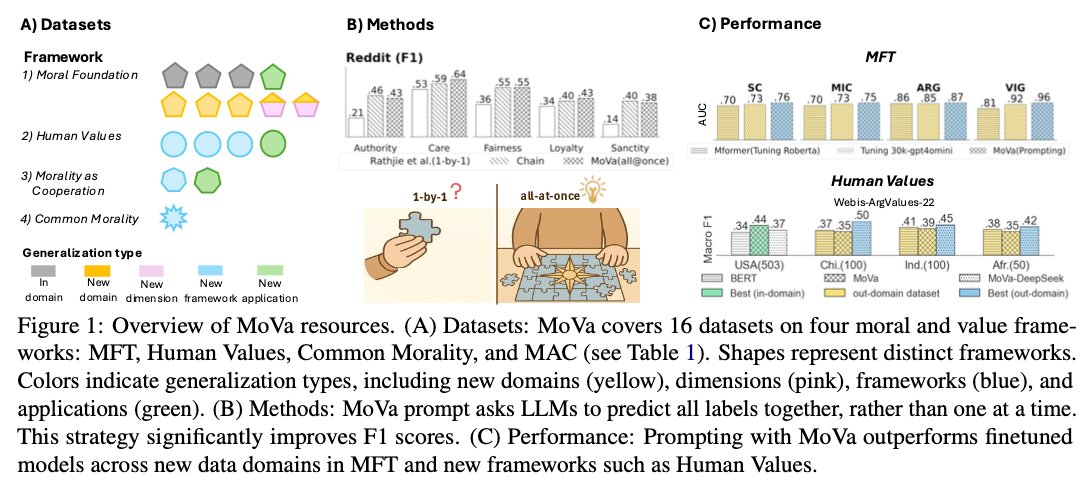
Identifying human morals and values in language is crucial for analysing lots of human- and AI-generated text.
We introduce "MoVa: Towards Generalizable Classification of Human Morals and Values" - to be presented at @emnlpmeeting oral session next Thu
🧵 (1/n)
@emnlpmeeting (7/n)
Led by CMlab PhD student Ziyu Chen, with @ChenhaoTan, Junfei Sun, Chenxi Li at UChicago -- thanks for inspiring all this during my 2024 sabbatical -- @joshnguyen99 at UPenn, and Jing Yao, Xiaoyuan Yi and Xing Xie at Microsoft Research Asia
@emnlpmeeting (6/n)
Future work? Generalizable classification across cultures and languages, and investigating generalisable prompting methodolgy on other subjective text classification tasks.
@emnlpmeeting So what? MoVA could help:
(1) Analyze Public Discourse: Understand the core values driving large-scale conversations on social and political issues.
(2) Build Better AI: Ensure that artificial intelligence systems communicate in a way that's aligned with basic human ethics.
@emnlpmeeting (5/n)
MoVa also offers a new application to evaluate psychological surveys: by scoring relevance of moral dimensions for each survey item, we can detect potentially multi-loaded items in instruments like MFQ, MAQ, and PVQ, helping researchers rethink questionnaire design.
@emnlpmeeting (4/n)
MoVa provides resources defining this generalizable classification, including 16 labeled datasets and benchmarking results across four major, theoretically-grounded frameworks: Moral Foundations Theory (MFT), Human Values, Common Morality, and Morality-as-Cooperation (MAC)
@emnlpmeeting (3/n)
Our new methodology insight: "all@once LLM prompting strategy" outperforms fine-tuned models across multiple domains and frameworks. Why does it work? It uses inter-label dependencies resembling a classifier chain approach in ML.
@emnlpmeeting (2/n)
What is generalizable classification here? We think there are three key elements
1. New data domains - from short informal text to long passages.
2. New moral and value dimensions.
3. New frameworks - e.g. moral foundations, Schwartz human values, and many more!
The project will focus on complex information needs in climate change and other social purposes.
We are open to new algorithms, paradigms for human-AI collaboration, and innovations with LLMs.
Announcing 2x Research Fellows positions on NLP and machine learning, working w wonderful Jing Jiang, Thang Bui and myself + partners in Data61 - apply by 31 Dec or help spread the words
https://t.co/XQL264Ilv7
more detail in thread
@hengjinlp@eagle_hz second this!
We started working with Qingyun recently, already enjoying the knowledge, enthusiasm and collaborative spirit he brings.
@haldaume3 at the end of the paper, “for practitioners adopting this, it is worth considering additional metrics c, d, e, and be cautious of blah blah”, “we have used domain X as examples, the methods also apply to domain U and V, for domains Y and Z important variations include blah” (3/4)
@berty38 Hope you're ok Bert!
Safe travels on the future paths you will take + I am confident that wherever you are, that corner of the world will become a bit better because of you.