Global investors are rapidly losing confidence in Indonesia as the nation’s stocks tumble at the fastest pace worldwide and its currency sinks to all-time lows https://t.co/VWHvf16qJY
Global investors are rapidly losing confidence in Indonesia as the nation’s stocks tumble at the fastest pace worldwide and its currency sinks to all-time lows https://t.co/laOzvsf8t2
indonesia is such a fucking joke country of course yall wanted to kill homosexuals but always let a fucking rapist and pedophiles free. no wonder yall have prabowo as your president. yall deserve him
Berarti mereka gak mengalami dua jam depan laptop tapi baru bisa nulis satu kalimat setelah menyelam 15 artikel. Anddddddd itu pun yang dikutip cuman 2 artikel setelah membaca dan membandingkan sebanyak itu
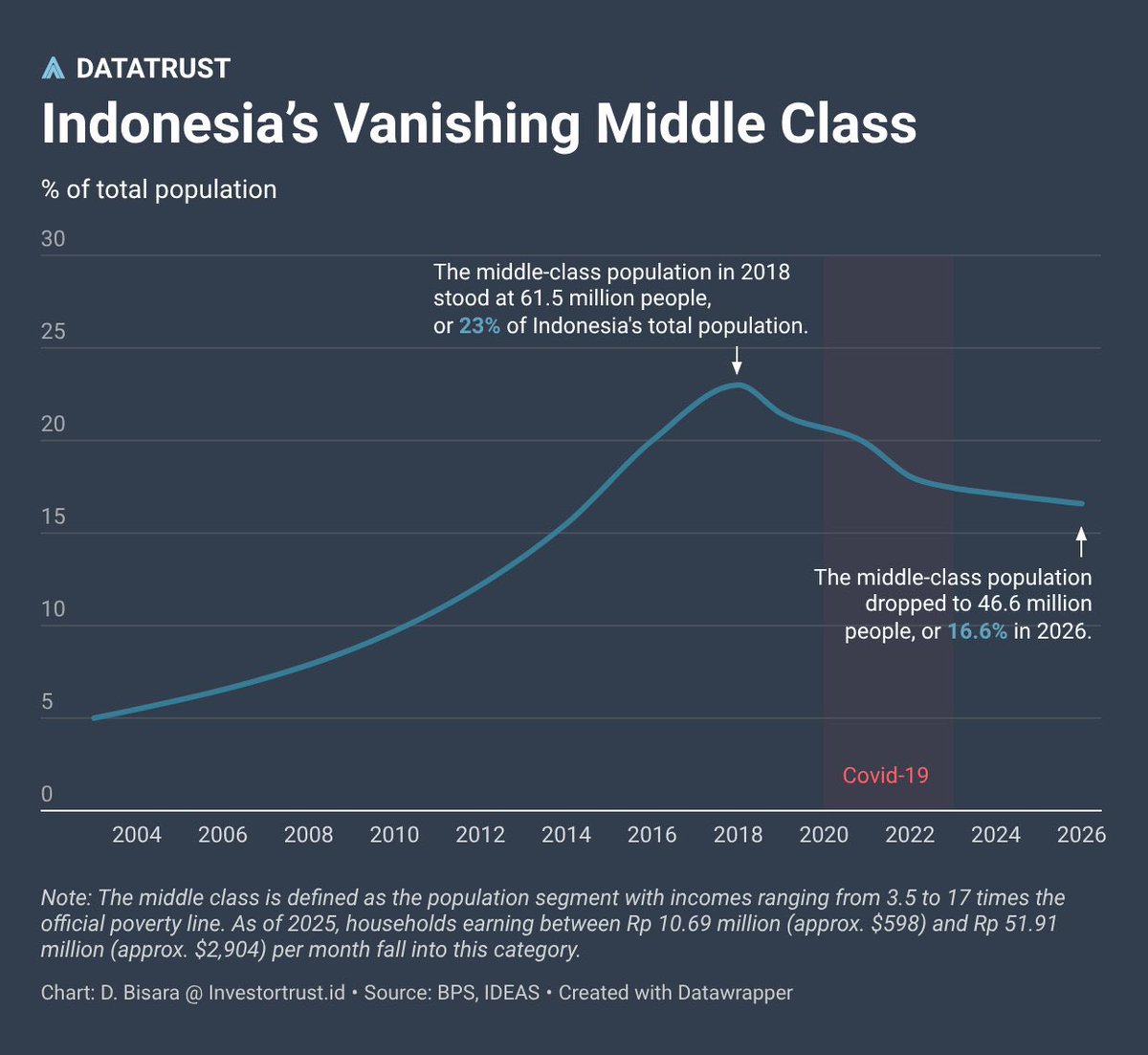
This chart should terrify policymakers. Indonesia’s middle class did not merely slow down. It went into reverse.
After two decades of expansion, the middle-class population peaked at 61.5 million people in 2018, representing 23% of the population. By 2026, that figure had fallen to just 46.6 million people, or 16.6%. That is not a cyclical slowdown. That is structural deterioration.
For years, policymakers celebrated GDP growth, infrastructure projects, commodity booms, and headline investment numbers. But the ultimate scorecard of an economy is whether ordinary people become wealthier over time. This chart suggests millions of Indonesians are moving in the opposite direction.
The middle class is the economic engine of every successful country. They buy homes, cars, insurance, consumer goods, education, travel, financial products, and healthcare. They generate tax revenue. They create small businesses. They drive domestic demand. When the middle class shrinks, the economy loses its most important customer.
The uncomfortable question is simple: where did the gains go? If GDP is growing, if conglomerates continue expanding, if commodity exports remain large, then why are fewer Indonesians qualifying as middle class than eight years ago?
More importantly, if you are born poor in Indonesia today, what ladder exactly are you supposed to climb?
If you are exceptionally good looking, perhaps you can monetize attention through social media. If you are academically gifted, perhaps you can break into an ultra-competitive institution like MBB, survive years of brutal expectations, and eventually use that platform to do something bigger. If you are entrepreneurial, maybe you build a business against overwhelming odds. If you are lucky, perhaps you benefit from family connections, inheritance, or access to opportunities unavailable to most people.
But an economy cannot rely on exceptionalism. A healthy economy creates millions of pathways upward, not a handful of lottery tickets.
The situation becomes even more concerning when you consider that well-paying white-collar jobs are becoming increasingly scarce. Many multinational companies that once established regional operations, technology centers, shared-service hubs, and professional offices in Indonesia have either downsized, relocated, or shifted future expansion elsewhere.
Those jobs were not valuable merely because of the salaries they paid. They were valuable because they transferred knowledge, management expertise, technical skills, global best practices, and professional networks into the local workforce. Over time, they helped develop intellectual capital that could later be recycled into entrepreneurship, leadership positions, startups, and domestic businesses.
When those opportunities disappear, the loss is not limited to employment. The country also loses a training ground for future managers, engineers, consultants, analysts, and business leaders. Human capital compounds just like financial capital. Once that pipeline weakens, rebuilding it can take years or even decades.
The bigger risk is that social mobility slows. When people stop believing hard work leads to a better life, trust in institutions weakens. Aspirations decline. Consumption slows. Talent leaves. The country’s most productive people increasingly look elsewhere for opportunity.
This is why Indonesia’s biggest economic challenge is no longer growth. It is upward mobility. A country cannot thrive without a growing middle class, a steady pipeline of high-quality jobs, and a clear path for ordinary people to join it. And right now, all three appear to be moving in the wrong direction.
Ini sinister banget, kayak ada yang mau bangun framing kalo anak-anak Binus gak sensitif / ngejek soal kondisi ekonomi Indo. Ini akun dibangun 10 hari lalu dan isinya bener2 cuma ngebahas betapa tajir anak Binus. Bener-bener sinister. Hati-hati.
Name that country in Southeast Asia that is currently having peak corruption, economic meltdown, political chaos & impeachment, but the bootlickers or pro government tried "de-escalate" that everything is fine
We should make a movie of Chinese Indonesians who can’t speak a single word in Chinese searching of their mainland relatives
There were Indonesian born Chinese who went back to mainland after Bandung conference. So it would have a really strong historical basis but it’s probably politically too sensitive.
It could be framed as “family reunion” separated by geopolitics kind of story. It wasn’t anyone fault, everyone is a victim of circumstances.
Zhou Enlai’s Bandung speech and subsequent changes in citizenship laws were intended to protect diaspora but who would have expected what came next.
We can literally make an epic story about this. Covering clash of identity and seeking one’s root.
Excuse my drunk idea
Not only muslim, under Suharto ethnic Chinese in Indonesia were forced or heavily pressured to change their Chinese names to Javanese-sounding ones
Suharto also banned Chinese traditions, closed Chinese schools, and banned Chinese-language media
Taiwan is a country.
But the real Taiwanese are the aboriginals.
The real Taiwanese language is the aboriginal Austronesian languages such as Amis, Paiwan, Rukai.
The rest of the Taiwanese are ethnically Chinese.
They speak Chinese languages and adopt Chinese culture.