Senior Economist at the Census Bureau. Labor markets, market power, firm dynamics, education, and Decennial Census. All opinions my own. Retweet ≠ Endorsement.
🚨 Pre-Doc Opportunity in LEHD 🚨
Know of a talented recent grad/graduating senior in Econ or related field looking to gain research experience? The LEHD group at Census is hiring up to 2 positions.
Apply following the instructions here:
https://t.co/DuCh156Eur
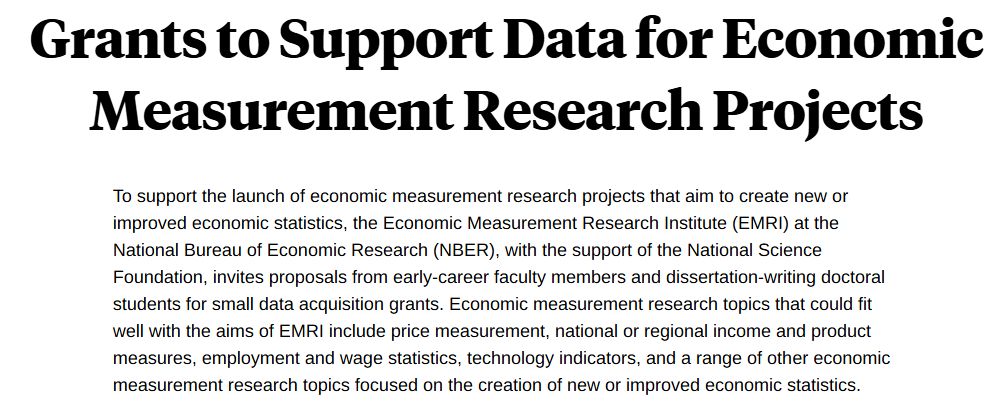
Open call for proposals, Grants to Support Data for Economic Measurement Research Projects. Submit proposals by 11:59pm EDT on September 30, 2026. More information: https://t.co/7yNE3bP4wh
Some news about @RevEconStudies.
New journal: Restud Insights. Accepting submissions Sept 2026.
2 types of articles: "Insights" (similar to AER Insights) and "Communications" (2k words + 2 exhibits).
It will be an “up-or-out” editorial process.
More info soon.
(1/3) Philly Fed is hosting advanced PhD students through our PFMAP (Phila Fed Mentoring & Advancing PhDs) initiative for the fourth year in a row. This year, we invite up to 6 PhD students, and each student comes around the time of one of the conferences related to their field.
Open Call for Papers: Demographic Forces and US Labor Market Dynamics Conference. March 5, 2027 – San Francisco, CA. Submissions due by 11:59pm ET on Tuesday, December 1, 2026. https://t.co/Tmw2s94pVq
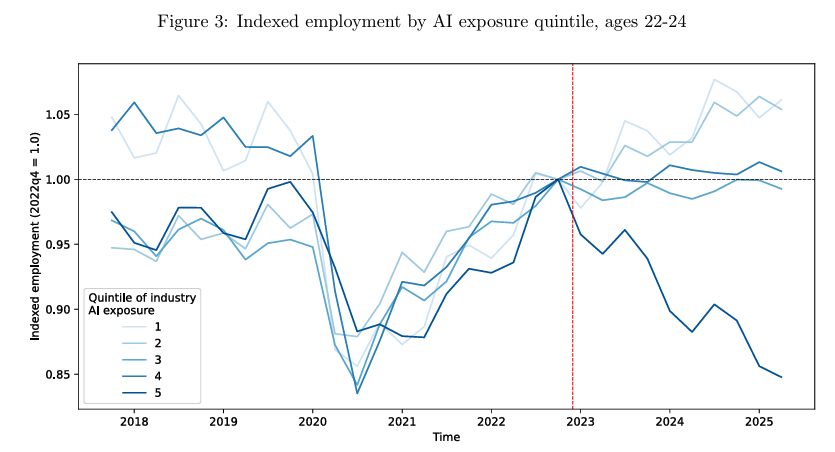
Very interesting paper by Lee C. Tucker at Census, "You’re (not) hired: Artificial intelligence and early career hiring in the Quarterly Workforce Indicators" (link below!). File this as another paper finding weak labor market performance for young AI-exposed workers, with some important nuance.
The paper uses data from the Quarterly Workforce Indicators and industry by state-level AI exposure measures crosswalked from occupation-level exposure data (Eloundou et al., 2024).
Like the Canaries in the Coal Mine paper, they find a kink in employment around the release of ChatGPT for the most exposed young workers (22-24), both in the descriptive statistics and event study regressions (w/ time and industry-state FE).
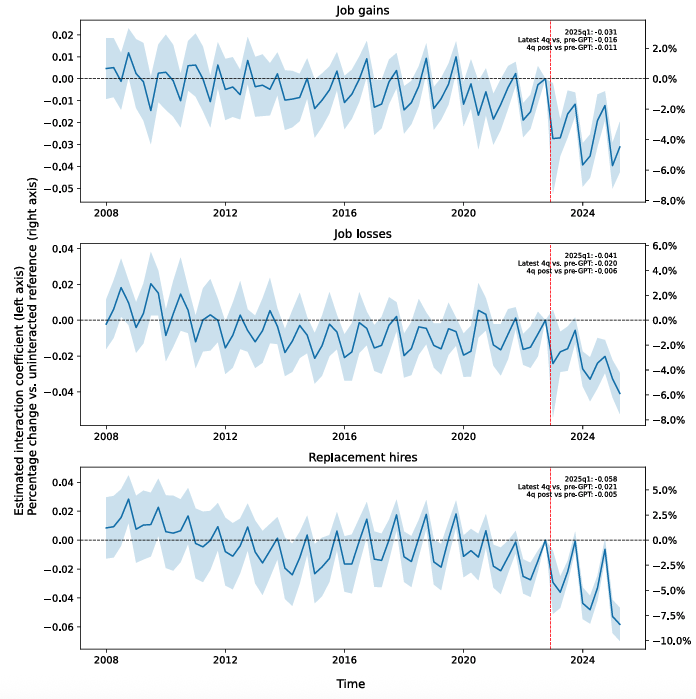
One of the unique contributions of this paper is that it separates out the hire and fire dimensions, showing that all of the decline in employment can be explained by reduced hiring.
The event studies are comparing outcomes of young workers in AI-exposed industry-state cells to young workers in other industry-state cells. A young-to-young comparison. But there could be a general decline in exposed cells not unique to young workers, which motivates a triple difference regression. This is where things get a little messier.
The triple difference measures the gap between young and old workers *within* highly exposed industries. Lee finds that employment, hires, and separations of young workers declined relative to older workers in those industries *before* the release of ChatGPT (similar in spirit to Frank et al. (2026) and Iscenko and Curto Millet (2026)).
To make sense of the triple diffs, Lee explores several explanations including remote work, delayed labor market entry (education), and the monetary policy shock. None of these look like a silver bullet, with monetary policy explaining about a 25% of the employment effects.
One of the more puzzling parts of the paper for me is the contrast between the clear pre-AI decline in young worker hires/separations and job gains/losses. Job gains (losses) are a subset of hires (separations) occurring at growing (shrinking) firms. The job losses and gains appear to turn closer to 2022q4, but they are also highly cyclical and noisy.
This paper should raise your priors that there is something happening in the labor market for highly AI-exposed young workers, but it's not clear yet whether that is due to AI. Timing matters, and sometimes it works and sometimes it doesn't. Plus, in the background of all these analyses is the pace of diffusion, which has been rising but was relatively low in 2023 (4%). Conceptually, this puts a lot of weight on a very hard turn in firms' expectations in reaction to the early, buggy ChatGPT that concentrates not on AI-exposed workers, but *young* AI-exposed workers.
PS: There is a symmetry between:
This paper <-> Johnston & Makridis (2026)
Brynjolfsson, Chandar, & Chen (2025) (Canaries) <-> Eckhardt & Goldschlag (2025)
In that Johnston & Makridis (2026) use QCEW to look at total employment effects of AI (via industry exposure) and this paper zooms in on young workers, and Eckhardt & Goldschlag (2025) looked at CPS data for all workers and Brynjolfsson et al. (2025) zoomed in on young workers.
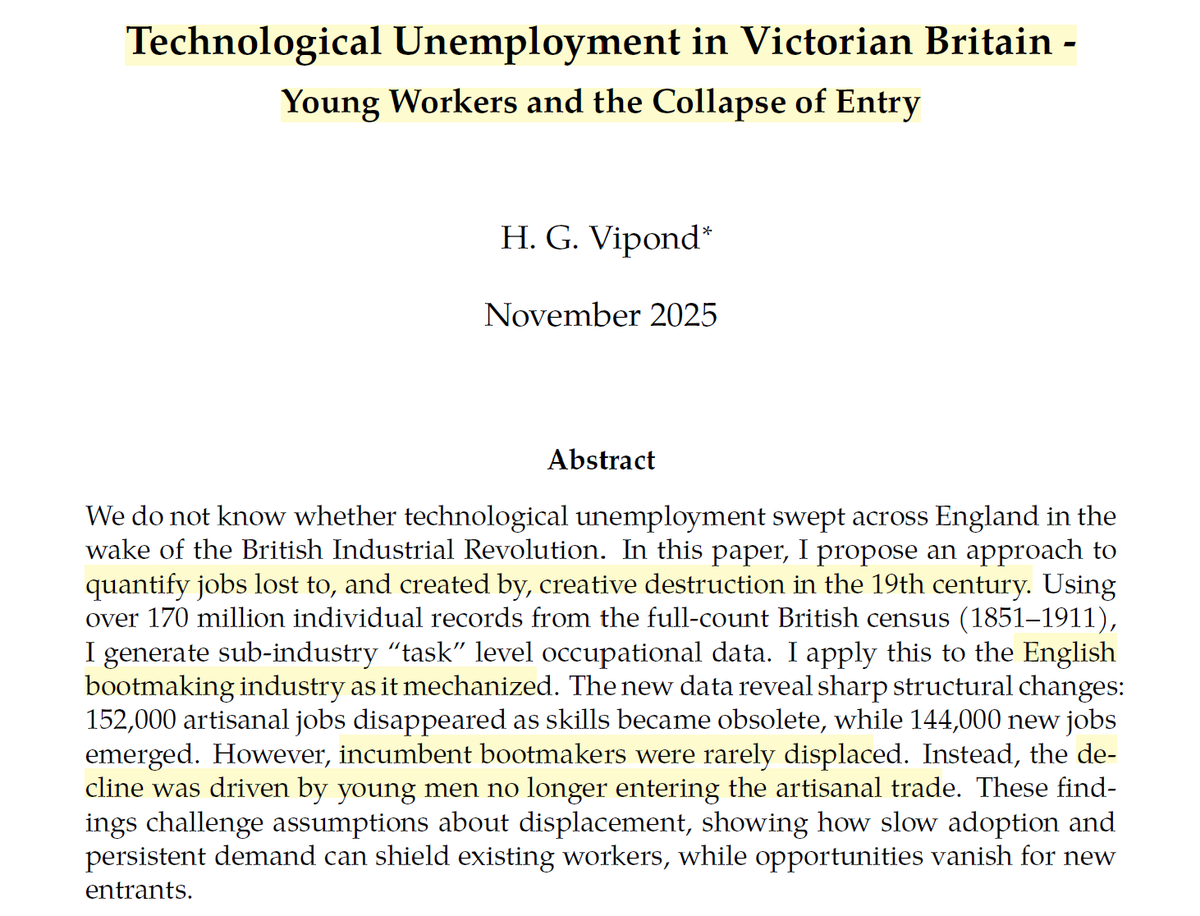
Really fascinating historical research by @hillaryvipond:
“Technological Unemployment in Victorian Britain - Young Workers and the Collapse of Entry”
Analysis of the bootmaking industry of Victorian England shows that the impact of mechanization was not so much to displace incumbent workers. Instead, the shock primarily affected a changing set of opportunities available to young people.
Thinking about a PhD in Economics? I have an opening for a pre-doc / research position at UPF in Barcelona. You’ll gain research experience and I help you apply for PhD programs
Highly relevant for Master’s students. Please share
https://t.co/FwnlVROw5m
@econ_ra
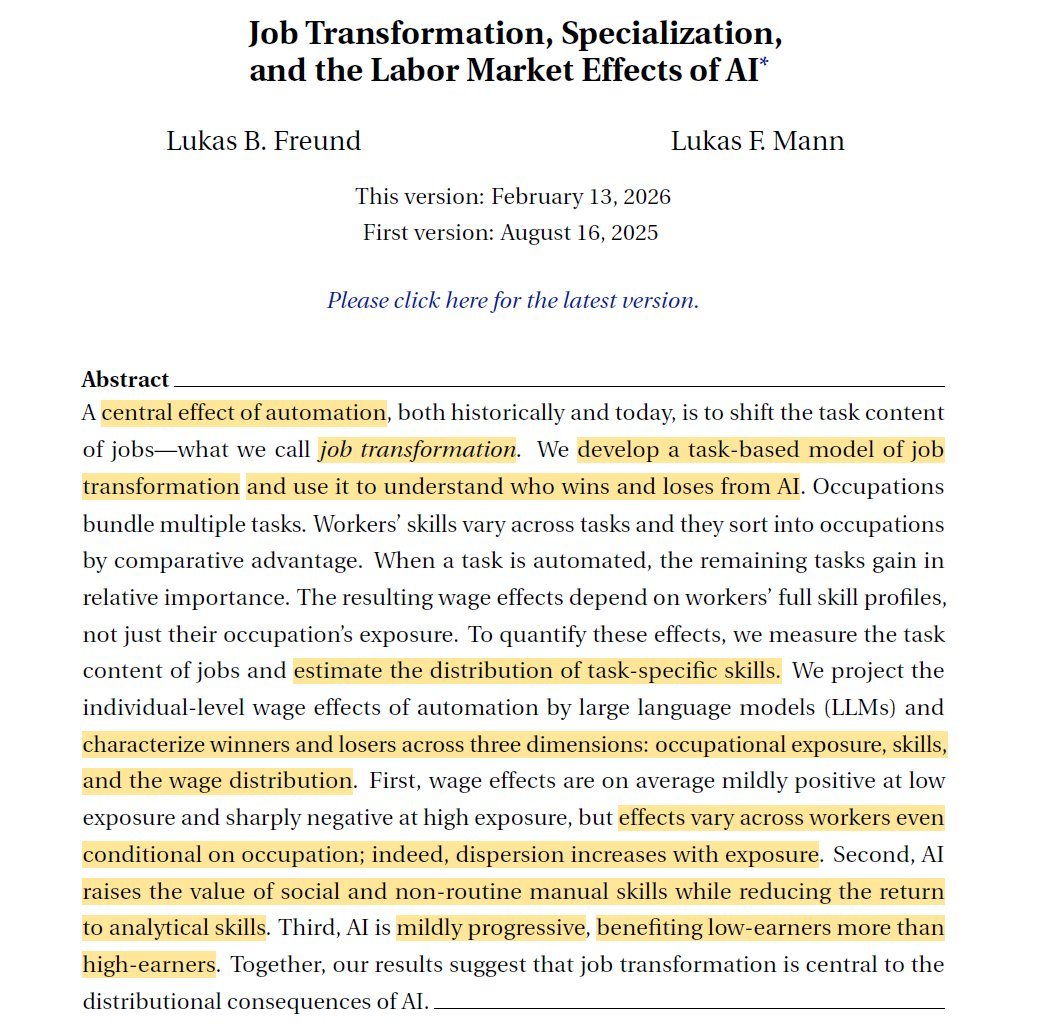
🚨 “Job Transformation, Specialization, and the Labor Market Effects of AI” - new paper with @lukasfmann
💡 AI transforms what tasks we do at work. Our paper shows how, as a result, individuals' wages may rise or fall depending on their skill set.
🧰 We build a framework to quantify the effects of job transformation on wages, and characterize winners & losers in a genAI automation scenario from 3 perspectives.
👉Exposure: Moderate occupational exposure benefits incumbents, on average, while high exposure harms them; but: within any exposed occupation there are both losers and winners.
👉Skills: Value of social and manual-technical skills ⬆️, analytical/information-processing skills ⬇️.
👉Distribution: Low-wage workers gain relatively more than high-wage workers.
🧵 Summary thread & link to paper 👇
Great fun to present "Job Transformation, Socialization, and the Labor Market Effects of AI" (with @lukasfmann) at the @nberpubs AI conference.
Many thanks to @ChadJonesEcon for a great, helpful discussion.
And thanks to @ce_tucker@avicgoldfarb@AndreyFradkin Chiara Farronato for organizing an awesome conference. I learned a lot.
The first-ever Chapel Hill-Copenhagen Conference on Macroeconomics and Deep Learning will take place on September 3+4 in beautiful Chapel Hill https://t.co/EEdmxhuxfa!
We are very honored to have @UncertainLars (@MFRProgram, @BeckerFriedman, @UChicago) as our keynote speaker.
📢📢 Call for Papers 📢📢
We're organizing a *macroeconomics workshop* in Amsterdam 15-16 December 👌
✅ Any topic in macro broadly defined
✅ Two nights in a'dam + EU travel covered
✅ Keynote by @virgiliu79 Midrigran
Submit by October 5. Call here:
https://t.co/fWoH1hpxNR
New paper 🚨with @lfwarren_econ and Martin Gervais. We finally have a draft of "Reservation Wage and Unemployment Benefits".
Short 🧵
https://t.co/AC61GWp5Id
The emergence of remote work explains the peculiar labor market dynamics after the pandemic, from Sadhika Bagga, @lukasfmann, Ayşegül Şahin, and @glviolante https://t.co/RhkGQx8xbs