Run this routinely on your personal knowledge repo
"The intent of this routine is to help me learn more, think deeper, reveal my blindspots.
Explore my vault and bring me some interesting random ideas of (1) what new knowledge I might find interesting, (2) what thread of thoughts is worth digging deeper and what's your take, (3) what pattern you have recognized through my vault."
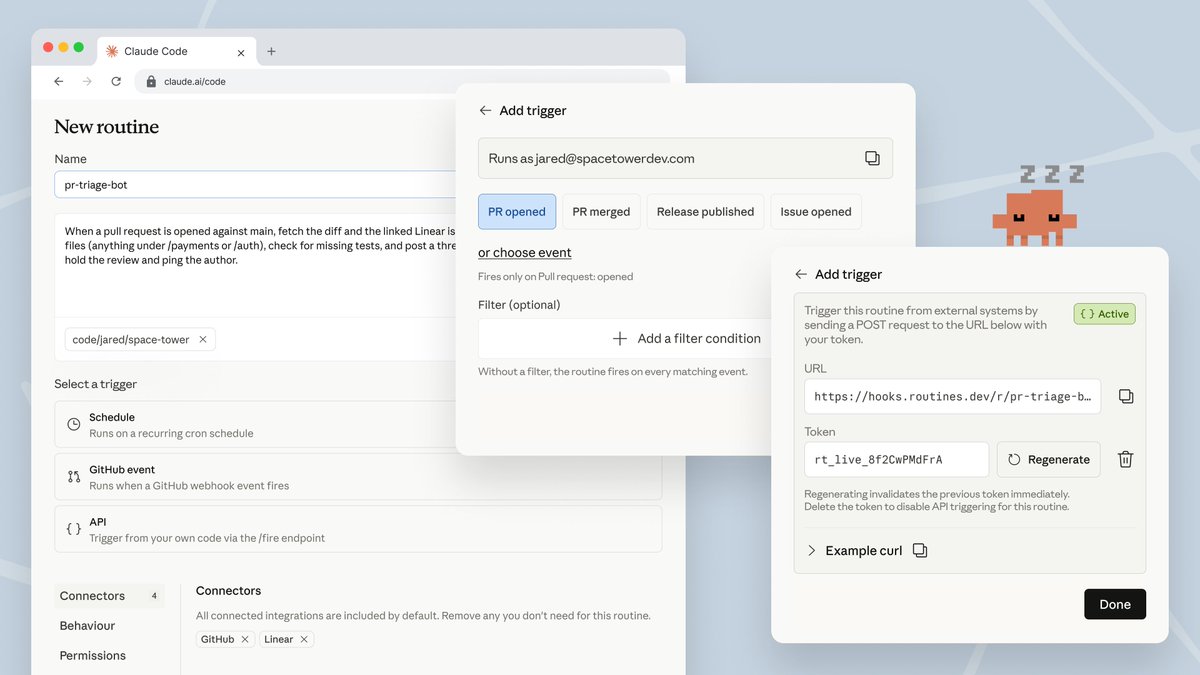
Now in research preview: routines in Claude Code.
Configure a routine once (a prompt, a repo, and your connectors), and it can run on a schedule, from an API call, or in response to an event.
Routines run on our web infrastructure, so you don't have to keep your laptop open.
@elvissun hmm how is that trivial. Companies can now outsource the harness + sandbox to Anthropic and just focus on building system prompt / mcp / skill etc. Isn't that meaningful?
In 2013, Nassim Taleb gave a 53-min Stanford masterclass on why chaos makes some businesses stronger.
His ideas:
- The coffee cup that survives 4 million hits
- Why helicopter engineers ride their own machines
- The country where nobody knows the president
12 lessons on risk:
wisdom is the new intelligence.
joe hudson (who coaches sam altman and research teams across openai, anthropic, deepmind, apple) has the best explanation why
his logic is simple: every major technology shift in history changed which human skill mattered most
1. before the industrial revolution, physical strength was the edge.
farming, building, hauling goods, fighting wars.
the stronger you were, the more you could produce and the more you were worth
2. then machines took over the physical work. so the edge shifted to learned skills.
you could learn a trade, work a factory line, operate equipment.
the skill was knowing how to do the thing
3. then the information age hit and the edge moved again. raw intelligence.
if you could process information, write code, analyze systems, solve complex problems, you had the advantage
4. now ai is outsourcing intelligence.
you can get a free tool to write your emails, research your market, analyze your data, build your software
so what's the edge now?
wisdom.
sounds abstract until you break it down:
it's the quality of the decisions you make.
> can you see patterns others miss?
> can you decide well on where to direct the ai?
> can you do the hard thing when everyone else avoids it?
> can you spot which opportunity is real and which is hype before you waste 3 months on it?
in other words, a form of taste and emotional intelligence
hudson put it like this:
"if I can get 70 people to run a company for me, they're all free and they're all AI agents, then the question is, what are the decisions I'm making to make that company successful? What advice am I taking? How am I listening advice? How do I create alignment between the five or six people?"
ai handles the thinking, but only you can handle the deciding
we're moving from knowledge workers to wisdom workers
@akothari@NotionHQ I’ve been a paid user since 2021, but I was forced to upgrade my personal discounted pricing to a higher pricing tier with the AI stuffs. I don’t need the new features, so I’ll just leave.
Interesting, is it possible to elaborate on typically what are your workflows that involve categories? For me when I work on things, I pull info from the connections and therefore it’s less dependent on category. Is it because you have categories for like eg tasks that need to be completed, or projects that need to be tracked, or like clients you need to reply?
@noahvnct Yeah agreed. I also have this in my vault but just sometimes I felt like category is less important so wondering how other power user (like you!) think about it. Great work!
IBM built a cloud of suits to make sure the CEO never talked to anyone actually doing the work. @elonmusk does the opposite.
"Elon's method is extreme focus on substance. Extreme focus on getting to the truth.
In any organization with multiple layers, there's compounding lies. Each layer wants to look good. Each layer puts a little spin on things.
If one layer lies to the next layer above it, maybe that's okay. When that happens two or three times, the lies compound. If that happens six times, the lies really compound. If that happens 12 times, the CEO has no idea what's happening.
That was IBM.
By the time I got there as an intern, I calculated there were 12 layers of management between me and the CEO.
They even had a term for it: the great cloud. A cloud of men in gray business suits who followed the CEO around and prevented him from ever talking to anybody who was actually doing the work.
When he would come to visit, it was like a visit from the king. A completely impervious bubble.
That's the polar opposite of the Elon approach."
— @pmarca
We just released Claude Code channels, which allows you to control your Claude Code session through select MCPs, starting with Telegram and Discord.
Use this to message Claude Code directly from your phone.