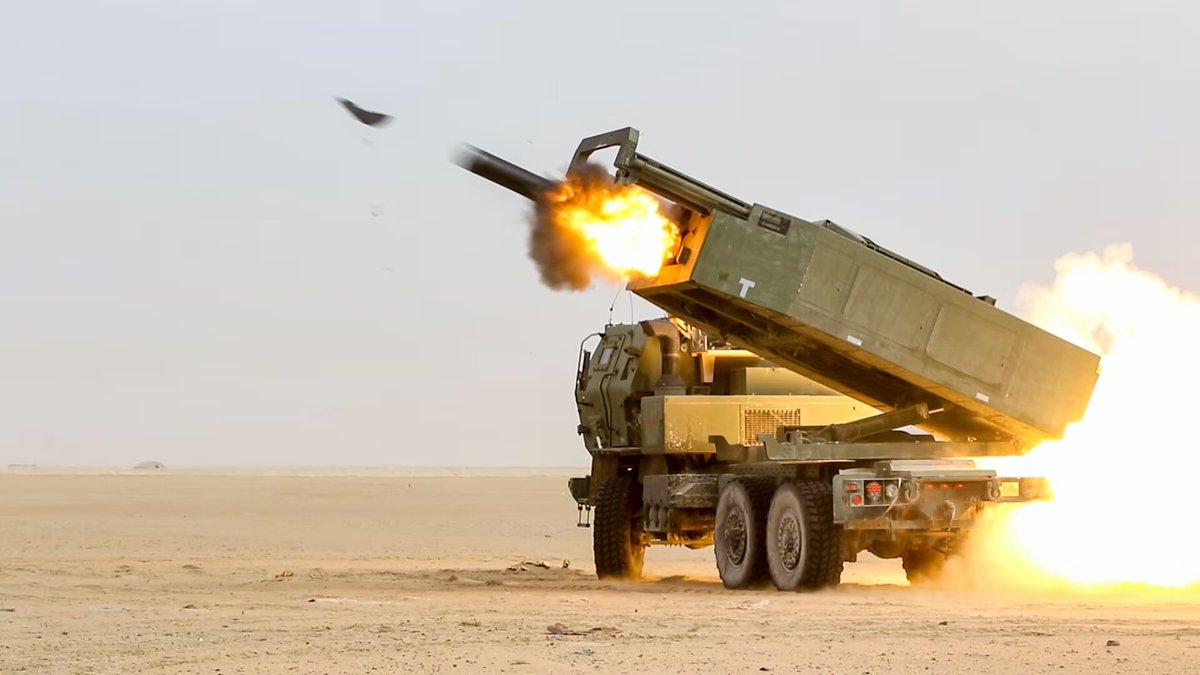
EXCLUSIVE: US has used 'virtually all' of its long-range precision missiles during Iran war, sources say https://t.co/1rXWjY3i00 https://t.co/1rXWjY3i00
@kvistp Ukraines access to the black sea is blocked, Russian military is moving towards Kramatorsk what's fall breaks the Donetsk fortification line, Kyiv is hammered harder than ever. Ukraine barely hold frontline together.
Ukrainians have to make a deal before it gets worse.
@LepistoMarkus@pvesterbacka Kiovaa moukaroidaan armotta ja Venäjän armeija lähestyy Kramatorskia jonka valloittamien murtaa puolutusvyöhykkeen.
Ukraina ei pysty myöskään käyttämään mustaamerta kuljetuksiin.
The US military has exhausted nearly 80% of its interceptors for a key missile defense system as senior US military commanders are warning that the Pentagon's munitions stockpile is "dangerously low," according to multiple sources familiar with the matter. https://t.co/zYgOE6EiDf
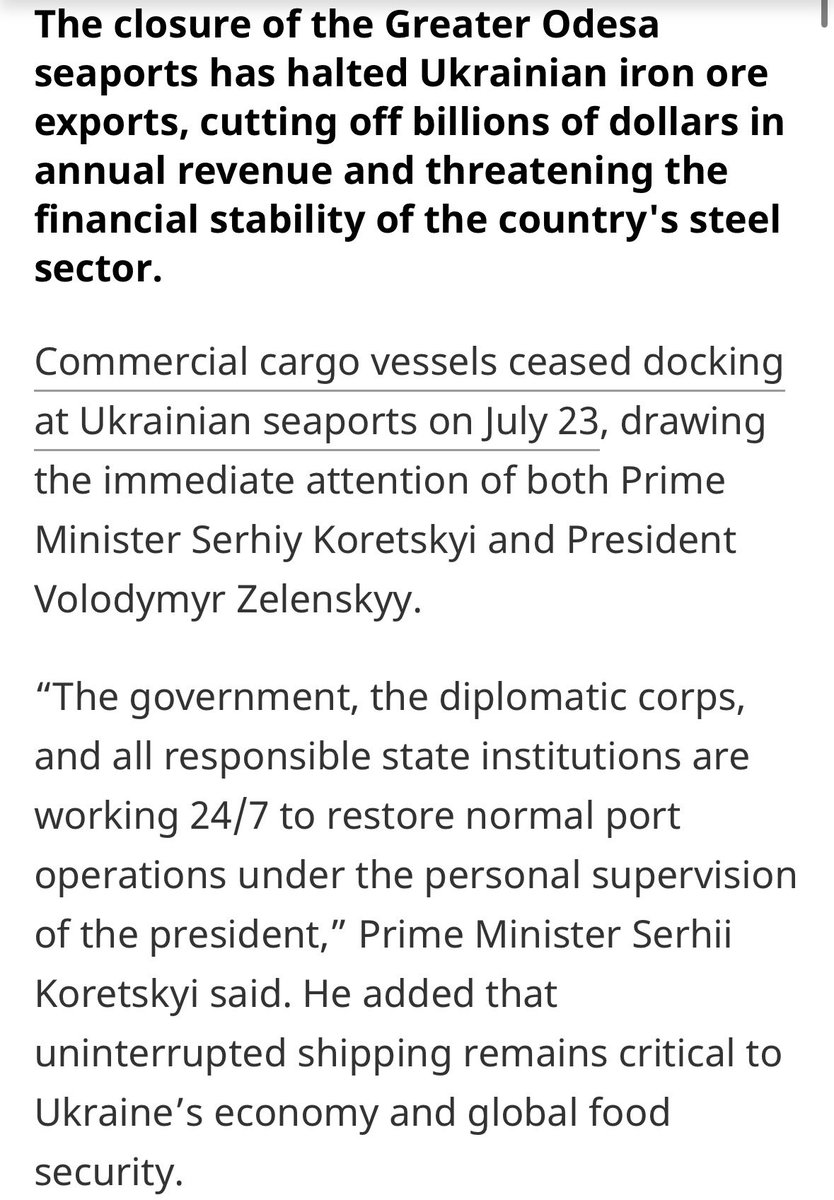
“The closure of the Greater Odesa seaports has halted Ukrainian iron ore exports, cutting off billions of dollars in annual revenue and threatening the financial stability of the country's steel sector…
While agricultural losses from the port blockade are widely documented, the shipping freeze has also crippled Ukrainian steelmakers who rely on maritime routes to export most of their iron ore and finished products…
Viktor Lotous, board chair of the Poltava Mining and Processing Plant – a Ferrexpo subsidiary – announced that the company plans to suspend operations at the facility starting Aug. 3 due to a working capital deficit and the halt of maritime exports.
The Southern Mining and Processing Plant in Kryvyi Rih – a joint venture between Metinvest and other shareholders – also announced a total production halt…
Extraction at Metinvest's Combined Mining and Processing Plant ‘is projected to drop roughly 30% as early as August compared to the 2025 annual average due to these same logistical disruptions.’”
https://t.co/M9acYJmLM3
There’s an acute Ukrainian manpower shortage along the Velykyi Burluk direction. I would separate this theater into three smaller sectors: the eastern flank approaching Vilkhuvatka, the northern flank along the Vovcha River, and the western flank approaching Bilyi Kolodyaz.
Here are rough estimates for the number of accessible combat forces (infantry/rifle/assault elements) on the ground and in the rear that are currently deployed.
East: (orange)
129th Heavy Mechanized Brigade
3rd Heavy Mechanized Brigade
Sibir Battalion
1,150–1,350
North: (purple)
3rd (517th) Battalion, 1st Special Purpose Territorial Defense Brigade
1st Mobile Border Guard Brigade “Hart”
94th Chop Border Detachment
420th Unmanned Strike Battalion “HORT”
1,300-1,500
West: (yellow)
159th Mechanized Brigade
11th Forpost Border Guard Brigade
113th Territorial Defense Brigade
127th Heavy Mechanized Brigade
57th Motorized Brigade
710th Guard Brigade, State Transport Special Service 9th Reconnaissance Battalion
3,250-3,500
For a 130km span of the front line there is only a readily accessible pool of 5,700-6,350 ground forces to hold the perimeter, conduct active defense against Russian assault squads, and clear the rear of DRGs. This thin infantry deployment is compounded by the porosity of the northeastern Kharkiv front.
Note my estimates don't include auxiliary roles such as headquarters staffers, logistics, engineers, etc. It does include infantry attached to brigades that are active along this part of the front but are currently rotated out.
Depending on the measuring points, there is a 9.5-10km gap between the Vovcha River line and Bilyi Kolodyaz. There are very few built-up hamlets in the interim that can serve as forward positions for even a modest number of defenders in cellars or basements.
The large gap between the front line and Ukraine’s makeshift rear positions consists of balkas, gullies, ravines, treelines, ponds, dirt/gravel roads, and open field plots that feed directly into Bilyi Kolodyaz and adjacent towns. There is a scant amount of trenches, dragon’s teeth, anti-tank ditches, and barbed wire in this gap, but it was not built in a unified manner and largely focuses on protecting the perimeter of BK itself.
The lack of fortifications is even more pronounced on the “northern flank,” which spans from the Vovcha to the Plotva Rivers (upwards of a 20km gap). This sector covers ~75km of the front line, making it extremely difficult to defend in its entirety with two understaffed Border Guard brigades, one TDF battalion, and one drone unit.
Deep Russian infiltrations in this broader sector became apparent by July 22nd, yet we have not seen any notable reinforcements moved in to ameliorate this saturation-laden front. Instead, the Commander-in-Chief and General Staff have so far opted to keep the 79th, 80th, 82nd, and 95th Air Assault Brigades deployed on the Dnipro/Donetsk/Zaporizhzhia borderlands to continue counterattacks at a time when urgent replenishments are also needed in the Dobropillia, Druzhkivka, Slovyansk, and Kramatorsk directions.
The easiest solution is for Ukraine to further diminish its presence in Kupyansk and on the eastern bank of the Oskil River in order to free up manpower for more critical clashes unfolding further north. Some units that could be moved include the 101st Guard, 151st Mechanized, 5th National Guard, 12th Heavy Mechanized, and 6th Border Guard Detachment brigades, these are the ones deployed closest to the Kharkiv “northeastern corner.”
🇷🇺🇺🇦 @AMK_Mapping_ reports that Russian frontline bombers (SU-34s) have begun to operate within 15km of the frontline. Several days ago, sorties were recorded within 10km.
The attrition of Ukraine's air defense capability has not only left the city of Kyiv open to ballistic missile attacks, but also allows Russian bombers to have almost complete air superiority along the frontline.
I first noticed the shift back in June when Russia began a campaign of airstrikes against the city of Zaporozhye, indicating the city's lack of air defense capabilities. We are now seeing reports of Pavlovgrad being targeted by glide bombs and we will likely soon see Dnepropetrovsk aswell. Additionally, Russia has begun flying strike "packages" towards the city of Odessa. Several SU-34 bombers are being accompanied by a pair of SU-35s, sometimes even solo, when conducting missile strikes over the Black Sea towards Odessa.
I doubt this rate of attrition continues, but if it does, it could get very ugly for Ukraine.
🇷🇺🇺🇦 Russian Geran-4 drones continue to strike Ukrainian cargo ships in the ports of Odessa and Mykolaiv.
Also, several ships were struck in the Black Sea.
The U.S. Army has used up “virtually all” of its stockpile of highly accurate long-range missiles during the last five months since the start of the Iran War - munitions which would be crucial in any conflict with China - including most of its stock of Army Tactical Missile Systems (ATACMS) and Precision Strike Missiles (PrSM), three people familiar with the data tell Reuters.