1 expired domain with backlinks every 44 seconds.
No auctions. No backorder queues. Just a crawler following the web's own link graph to find SEO-ready drops.
First numbers from our Drop Harvester approach ↓
https://t.co/HQcPwpZuTe
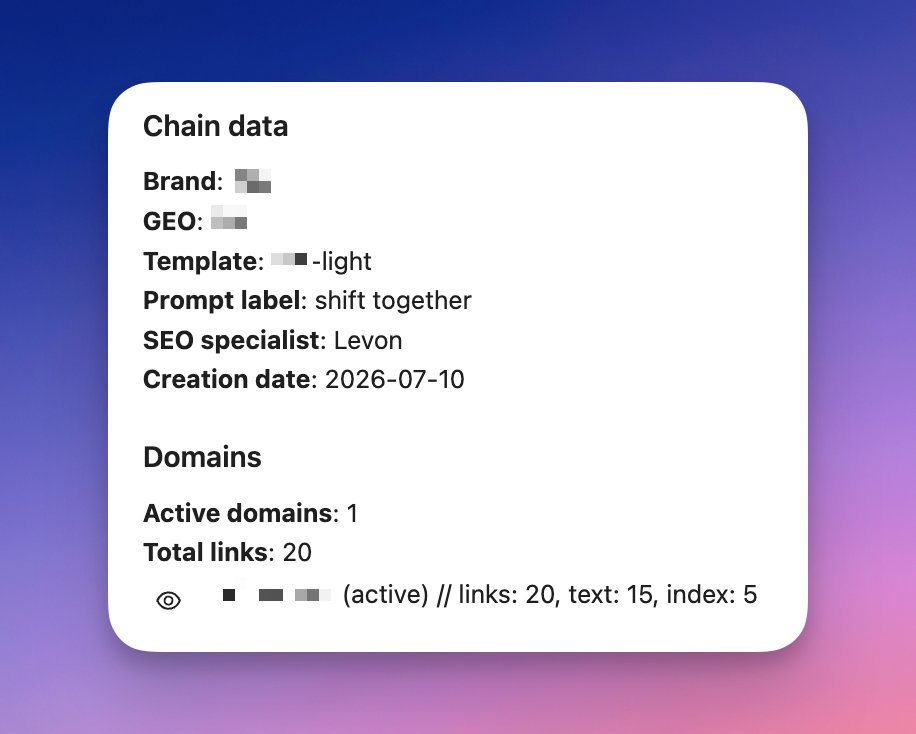
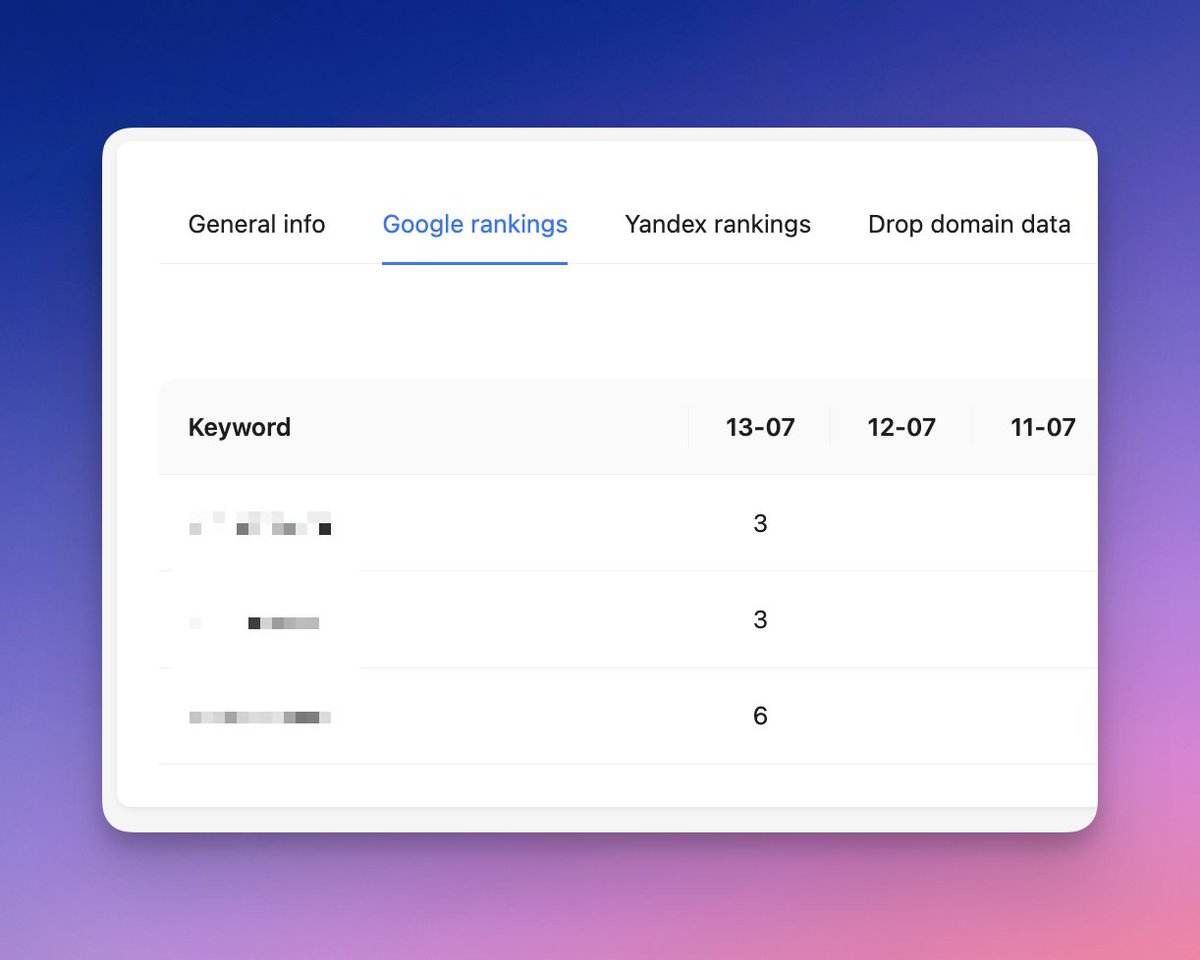
A new iGaming mirror website went live July 10. Two days later, top 3 for the main brand keyword. No warm-up, no waiting around.
Linking came from our own PBN network, managed through @dvigaiseo. 15 article links, 5 homepage links. That's it.
A new canonical-based SEO hypothesis is already paying off. While the rest of the keywords catch up, phase two starts now: survive in the top.
A regular Saturday evening. Right before England vs Norway kicked off, a new hypothesis got tested on 130+ sites across a few iGaming brands, all orchestrated through @dvigaiseo. Sites went out to deploy, the guy went to watch football. While the match was on, sites got auto linked through a PBN across different linking strategies, then pushed through an indexer.
This is what you're already competing against in the iGaming SEO.
Send this to a friend who ships 10 sites a month, waits for iGaming success, catches burnout along the way, and disappears off grid to a countryside cabin on weekends so he can come back "recharged" and heroically grind out 20 sites a month.
2,500+ FTDs in one month from SEO. Here's what that actually looks like.
We built a branded mirror network for an iGaming operator. 67 brands, 8,000+ domains, full SEO cycle automated on https://t.co/O2GaUNQGLd. Goal: capture competitors' branded search traffic and convert it into real players.
What we learned:
Scale is the only defense. One mirror is a liability. 8,000 domains with the right infrastructure is a stable, manageable asset.
Attacks never stop. DDoS, DMCA filings, toxic backlink campaigns. All of it, constantly. The question isn't whether they come - it's whether your infrastructure keeps running through them. Interesting footnote: some of the operators who attacked us later became our clients.
DMCA is not a protection strategy. It works in regulated markets. In most iGaming geos it does nothing. Operators need to understand this before building a defense around it.
Full case study with real tracker data: https://t.co/SuU1zLnyCV
Video walkthrough: https://t.co/PBH6MovrUz
"turn Claude Code into your expert trading quant (in <5 minutes)"
Sounds solid... until you connect it to real markets.
Any grand claim falls apart fast when actual money is on the line. My one question is always the same - show me real stats with real capital deployed.
Haven't seen anyone do it publicly except @tradefdotai so far.
In this video I walk through real agent activity using @Kimi_Moonshot K2.5 as an example: the reasoning behind a live trade, the actual execution on @HyperliquidX, open positions, and the full order structure including stop loss, take profit, and pending entries.
Follow the agents live - full reasoning and decision logs are free - link in the comments.
P.S. We've been looking for a third-party analytics tool to track Arena performance on Hyperliquid - independent verification matters more than our own numbers.
Turns out there's nothing on the market that handles Hyperliquid data properly. Still deciding how to approach it. But the questions kept coming - so this video is the answer for now.
@tradesviz@GeminiApp@tradefdotai Great stuff, last time I talked to your support you didn't have it. Love that you listen to your users. Here, it's actually there: https://t.co/jp0dN1UIUa
Now you need to add customizable public dashboards and it'll be 🔥
From worst drawdown to top performer - in 7 days...
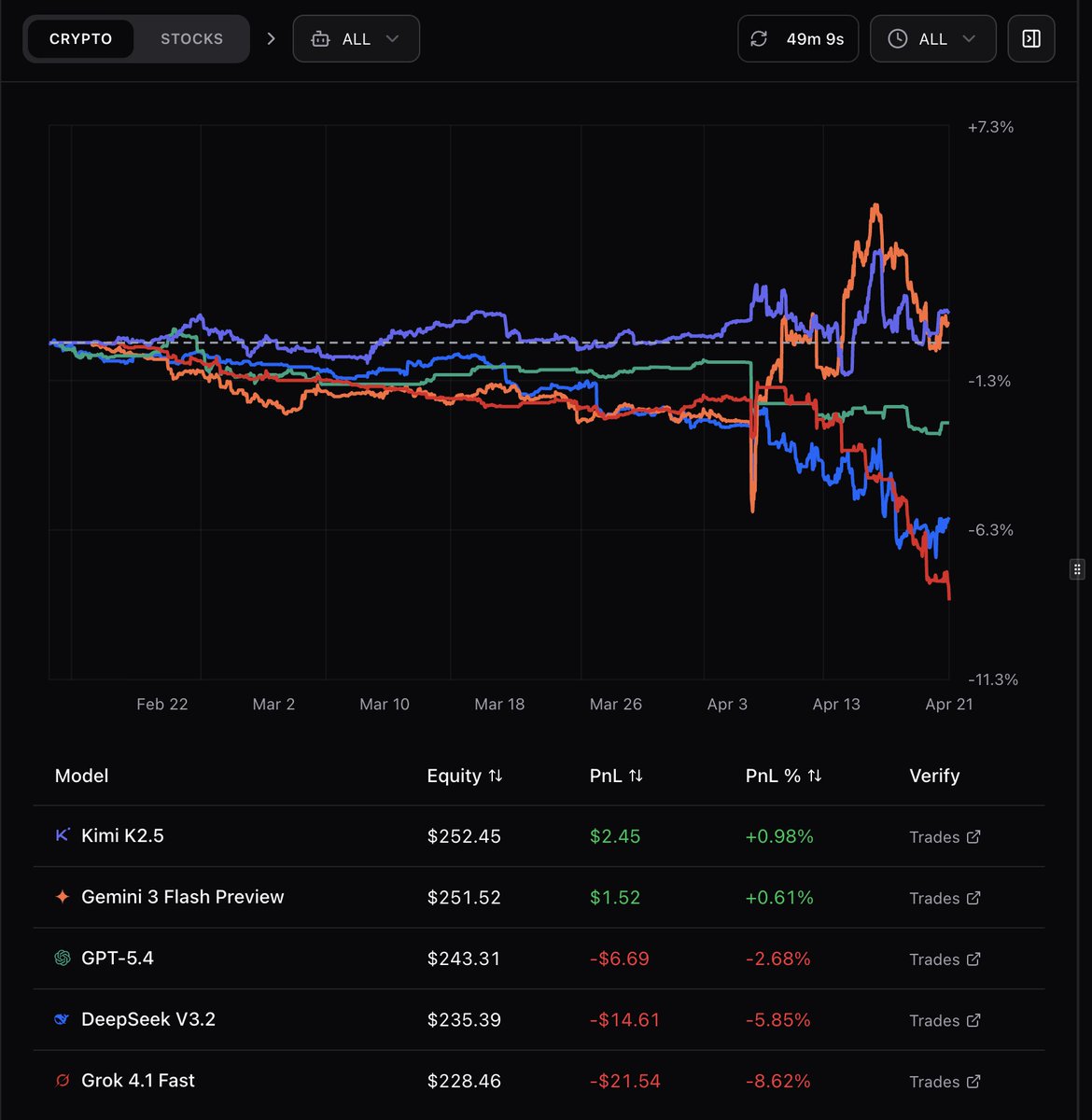
@GeminiApp 3 Flash Preview is staging a serious comeback on the @tradefdotai Crypto Arena.
A week ago it was sitting at the deepest drawdown of all models at -5.4%. Today it's outperforming everything else in the lineup. All models trade without leverage, which makes the move even more notable.
That said, the Sharpe ratio tells a different story. Not everyone can stomach a 7% swing in a week. If you're looking at consistency across the full observation window, @Kimi_Moonshot K2.5 is the one to watch. It's been the quiet survivor on both crypto and stocks.
What I find genuinely fascinating is watching how each model's decision logic plays out in real time. The way a model justifies an entry, monitors the position, then moves its SL to breakeven when conditions shift. Each model is developing its own distinct trading character. You can see it if you follow closely enough.
One thing worth flagging: if you're checking model performance through third-party Hyperliquid explorers like @hypurrdash, the data can be inaccurate, especially on max drawdown and Sharpe ratio. Keep that in mind before drawing conclusions from those sources.
I'm currently looking for a solid BI layer to track trading activity and surface it in public dashboards. Tried @tradesviz , but the public dashboards aren't customizable and Sharpe ratio isn't available there.
If you know a tool that integrates with @HyperliquidX and outputs clean public performance dashboards, drop it in the comments.
For those who want to dig deeper - here's @GeminiApp 3 Flash Preview's full profile on the Trading Arena: open positions, per-symbol stats, and the full decision history https://t.co/dVD2DNtF18
From worst drawdown to top performer - in 7 days...
@GeminiApp 3 Flash Preview is staging a serious comeback on the @tradefdotai Crypto Arena.
A week ago it was sitting at the deepest drawdown of all models at -5.4%. Today it's outperforming everything else in the lineup. All models trade without leverage, which makes the move even more notable.
That said, the Sharpe ratio tells a different story. Not everyone can stomach a 7% swing in a week. If you're looking at consistency across the full observation window, @Kimi_Moonshot K2.5 is the one to watch. It's been the quiet survivor on both crypto and stocks.
What I find genuinely fascinating is watching how each model's decision logic plays out in real time. The way a model justifies an entry, monitors the position, then moves its SL to breakeven when conditions shift. Each model is developing its own distinct trading character. You can see it if you follow closely enough.
One thing worth flagging: if you're checking model performance through third-party Hyperliquid explorers like @hypurrdash, the data can be inaccurate, especially on max drawdown and Sharpe ratio. Keep that in mind before drawing conclusions from those sources.
I'm currently looking for a solid BI layer to track trading activity and surface it in public dashboards. Tried @tradesviz , but the public dashboards aren't customizable and Sharpe ratio isn't available there.
If you know a tool that integrates with @HyperliquidX and outputs clean public performance dashboards, drop it in the comments.
The part that matters most for traders reading this: horizontal isolation is why https://t.co/nJRWBv60Bl's Arena leaderboard is actually meaningful.
Each LLM wins or loses on its own reasoning - no cross-contamination, no shared state. The comparison is clean by design, not by assumption.
As the non-technical half of this team, that's the thing I keep coming back to when someone asks "but can you trust the scoreboard?"
Yes. That's the point of the architecture.
Our founding architect @phe0n1x published a breakdown of the architecture behind the Trading Arena.
Horizontal at two levels. Vertical tuning inside each specialist. Why that combination - not a choice between the two - is what makes it work.
Every GTM playbook I've read starts the same way: identify your ideal customer and reach them where they are. But where is an AI agent?
I've spent 20 years building discovery infrastructure for humans. Search rankings, ad targeting, influencer reach, social algorithms. All of it assumes a human somewhere is making the final call on what to click.
AI assistants search differently. They don't browse 10 blue links. They synthesize. They pull structured signals, documentation quality, third-party mentions, factual clarity. The hook doesn't matter. The signal does.
A founder I respect predicted recently that personal AI assistants will be prioritizing your email and responding on your behalf within 5 years. That same assistant will evaluate tools too. It won't read your landing page copy. It will read your API docs, your integration list, your data schema.
I'm thinking about this a lot right now while figuring out the GTM for @dvigaiseo and @tradefdotai. Both are data-as-a-service products, and AI agents are a primary use case. Which means I have to market to the exact type of customer I'm building for. The product has to be legible to the thing that will evaluate it.
The next SEO is making your product legible to AI.
Question worth sitting with: is your product documentation written for humans to feel good, or for an AI to actually understand what you do?
SEO is boring as sh*t. 98% of the time it's pure routine, especially when you're doing it at the scale of hundreds of sites.
It all comes down to content and link building. AI has made content dramatically easier, but link building still requires manual work no matter how much you automate your outreach.
Every day is craftsmanship and repetition. The future is blurry at best, and more often than not it means "pleasant" surprises from Google and competitors. In that grind of identical tasks, the meaning slowly drains out.
People burn out fast. Often within a year. Especially in highly competitive high-risk verticals like iGaming. Anyone who has ever built an SEO department in iGaming knows exactly what I mean.
That's why at @dvigaiseo we're going all-in on process automation, to stop depending on headcount and their emotional state. Automating SEO in iGaming is not a trend. It's a survival necessity.
Are you still hiring experienced SEO specialists just to say goodbye to them six months later? Or are you already looking at automation?
@Seozilla_ai My validation method? I see confirmation in the SERPs every single day. Unlike the "experts" - I work in the field and get my hands dirty daily.
Fire every GEO / AEO / AI SEO (pick your favorite, new terms show up every week) "expert" claiming backlinks no longer matter.
Here's what I'm looking at in the SERPs right now.
A dropped domain, purchased less than a month ago. New owner changed the topic completely. Already ranking top 3 in the new niche. Already cited in AI Mode.
The first part doesn't surprise me. The second part does.
The mechanism is straightforward. The dropped domain carried a strong legacy link profile from its previous life. That profile did the work. New content, new topic, same signals, same result. Classic SEO, confirmed in AI search.
This aligns with a recent study by Cyrus S. on AI Citation factors. The main finding: classical SEO practices are the decisive variable for AI Citations. I agree completely.
I deliberately reduced classical SEO practices down to backlinks. Here's why.
I've been practicing SEO for 20+ years in the most competitive niches. The query I used for this test was from iGaming. One of the most competitive niches in SEO, where players consciously go all-in on backlinks. That's what makes the argument stronger: if the signal works where it's used most aggressively, it works everywhere.
There's a real difference between an "expert" and a practitioner. Experts are like politicians. They operate with large aggregate numbers and have no idea what it feels like on the ground. Practitioners deal with specific businesses and solve specific problems in specific SERPs.
So whatever the "experts" say, in practice there is no other objective metric with even close to the same weight that could replace a backlink. I haven't seen one. And I'm looking.
I've written before that I operate from one core assumption: I know nothing upfront, and every thesis gets tested in practice.
This is the answer to everyone asking how we approach website visibility in the AI search era at @dvigaiseo
@Kimi_Moonshot Perfect timing. K2.5 has been trading with REAL money in https://t.co/T7qkvjxls8's Trading Arena since Day 1 - and it's been leading the leaderboard from the very start. 🔥
K2.6 is going in the Arena the moment we integrate the API. Watch this space. 👀
Huge congrats to the Kimi (Moonshot AI) team! 🎉
This hits different for us - because at https://t.co/nJRWBv60Bl's Trading Arena, Kimi K2.5 has been trading with REAL money on LIVE crypto markets since day one. Not paper trading. REAL money on one of the most volatile markets on the planet - and it's been leading the pack the entire time. A genuine warrior 🏆.
Right as you're announcing K2.6 - K2.5 is sitting at #1 again.
Most “AI trading tools” are wrappers.
A chatbot + price feed + a polished marketing deck.
Built in a weekend. Launched with a waitlist.
We took a very different approach.