But Islam continues ro have increasing number of leftists, Commies, self styled liberals and top ranking feminists as defenders and supporters all over the world,
Can you explain why, @khanumarfa@AzmiShabana@_sabanaqvi@AudreyTruschke@brindacpim ? ??
🚨 SHOCKER! Delhi Doctor Nadeem cuts wrong vein during surgery, tells patient: "It's Allah's will."
When asked what if she had died? He repeats: "Allah's will."
— Religious arrogance in the operation theatre? This is unacceptable.
For decades, the standard critique against the Indian Knowledge System (IKS) was: "Where is the empirical data? Where are the peer-reviewed papers? It is all just mythology."
Now, when institutes like the IITs, IISc, & AIIMS are setting up dedicated research wings to rigorously test, validate & document these ancient sciences using modern, empirical protocols, the critics have panicked. They have switched from demanding proof to screaming "pseudoscience!" & "the brand is gone!"
For centuries, Western medicine dismissed the idea that the mind could heal the body as superstition. Today, neuroplasticity & the placebo effect are multi-billion-dollar fields of peer-reviewed research.
If a modern scientist discovers something new, it is called a "breakthrough." If an IKS researcher uses modern tools to prove that ancient Indians already knew that exact concept 1000s of years ago, it is called "pseudoscience."
In 2015, the Nobel Prize in Medicine was awarded to Tu Youyou for discovering Artemisinin (an anti-malarial drug) by looking into ancient Chinese medical texts. Similarly, India’s Ayush research ministries & global pharmacological bodies are finding peer-reviewed validation for compounds like Curcumin (Turmeric) & Ashwagandha for their anti-inflammatory & neuroprotective properties.
Why do these people have a problem with India documenting its own heritage?
If China can globally brand Traditional Chinese Medicine & the West can capitalize on indigenous knowledge, We have every right to scientifically document our own Itihasa & knowledge systems. Demanding peer-reviewed papers for decades & then throwing a tantrum when India actually starts producing them, shows intellectual dishonesty, not a love for science.
Be proud that we are witnessing the renaissance of Bhartiya knowledge. It is a long journey, but Satya always outlasts ideological noise.
Well done, IITs...Proud to be an alum.
Bhagwant Mann: What will you do with Rs 1,000 you get from government this month?
Woman voter : I’ll buy suits
Bhagwant Mann: And what about Rs 1,000 next month?
Woman voter : I’ll buy makeup
This is neither empowerment nor welfare.
It’s an insult to honest taxpayers !
The irony of Republicans controlling all branches of government while
bankrupting the country, starting a war, sending money to fraudulent programs, violating the Constitution, giving corporations immunity...
but arguing that the biggest problem we have is “stolen elections.”
INDIAN EXPRESS DROPS A LAND BOMB ON BJP CM 🔥
After Mohan Yadav became Madhya Pradesh CM, his family and real estate companies reportedly bought at least 137 plots spread over 168 acres in and around Ujjain.
This is the same Ujjain being reshaped for Simhastha 2028 with highways, road widening, townships, riverfront projects, medical city, IT park and new commercial zones.
The most damning part is this: out of the 168 acres bought after he became CM, 111 acres are reportedly located along roads announced by CM Mohan Yadav himself.
His family already had land. But after Dec 2023, the land buying saw a sharp jump, right when Ujjain’s development map started turning into a goldmine.
Indian Express repeatedly asked the CM for answers. He stayed silent.
This is how BJP turns religion into a business model 😡
Babur didn’t bring gardens to India and the Mughals just usurped & built tombs on top of the gardens that Hindus had already been planting for millennia. Thousands of years before the Timurids ever set foot in India, Hindu civilization had already developed an extraordinary tradition of garden design which was deeply integrated into our urban planning, temple architecture, and sacred aesthetics.
Rāmāyaṇa, Mahābhārata, and Puranas refer to many types of gardens like Ārāma (pleasure garden), Upavana (planted forest), Vātikā (orchard), Pushpavātikā (flower grove), and Udyāna (public parks).
300 BCE: Kautilya’s Arthashastra describes gardens, lakes, tanks & agricultural fields as part of city planning. Greek ambassador Megasthenes confirms that Hindu palaces were set in lush well-designed gardens laid out with ponds.
2nd c. CE: Inscriptions from the Kushan era in Mathura describe well-planned gardens. In Kashmir, the site of the famous Mughal Shalimar and Nishat Bagh gardens originally hosted a temple and garden complex built by King Pravarsena in 79 CE called Pravaresha Mandir in his capital, Pravarapura(modern Srinagar).
7th c. CE: Harshavardhana’s Harsha Charita describes multistoried palaces with flower beds & fruit trees. Rājataraṅgiṇī (13th c.) confirms Harsha’s construction of lakes and gardens of which remnants are still visible. Chinese monk Hiuen Tsang, who visited Nalanda during Harsha’s era, vividly described huge planned shady mango groves, exquisite lotus ponds & gardens of flowering trees across university campuses.
10th c.: Supporting archaeological evidence from South India is found in inscriptions describing the intervention of Chola king, Parāntaka I of Madura (10th c.) who settled a municipal dispute by electing 5 committees including an entire Committee dedicated solely to Gardens or Parks.
11th c.: Malva Raja Bhoja’s treatise Samaranga Sutradhara (11th c.) provides incredible details on design of gardens for temples, towns, palaces & garden-cities. Temple gardens were for public community events & included groves of sacred trees such as Bilva, Asvattha, Neem, etc. Beautiful Garden cities surrounded by an entire belt of gardens were symmetrically distributed with parks, gardens & tanks. Rows of trees lined both sides of the streets, urban spaces & every house had a garden in front. Moats of water edged the green belt around the city.
14th c. inscriptions in Karnataka describe Jain Chaityalayas with lotus ponds, fruit orchards, pleasure gardens & rice fields. Temples had flower gardens to adorn deities. Tamil legends say Aandal wove garlands for Vishnu daily with flowers from Nandavanam (temple garden).
This ridiculous myth that Mughals “brought” gardens to India is like claiming they taught us how to boil water. Hindus were building symmetrically planned garden cities, sacred temple groves, pleasure gardens with waterparks, and urban community gardens for millennia before Islam was even born & Babur started scribbling in his diary about missing his “melons” from Samarkand.
How many times will this tired old ridiculous lie be repeated and busted.
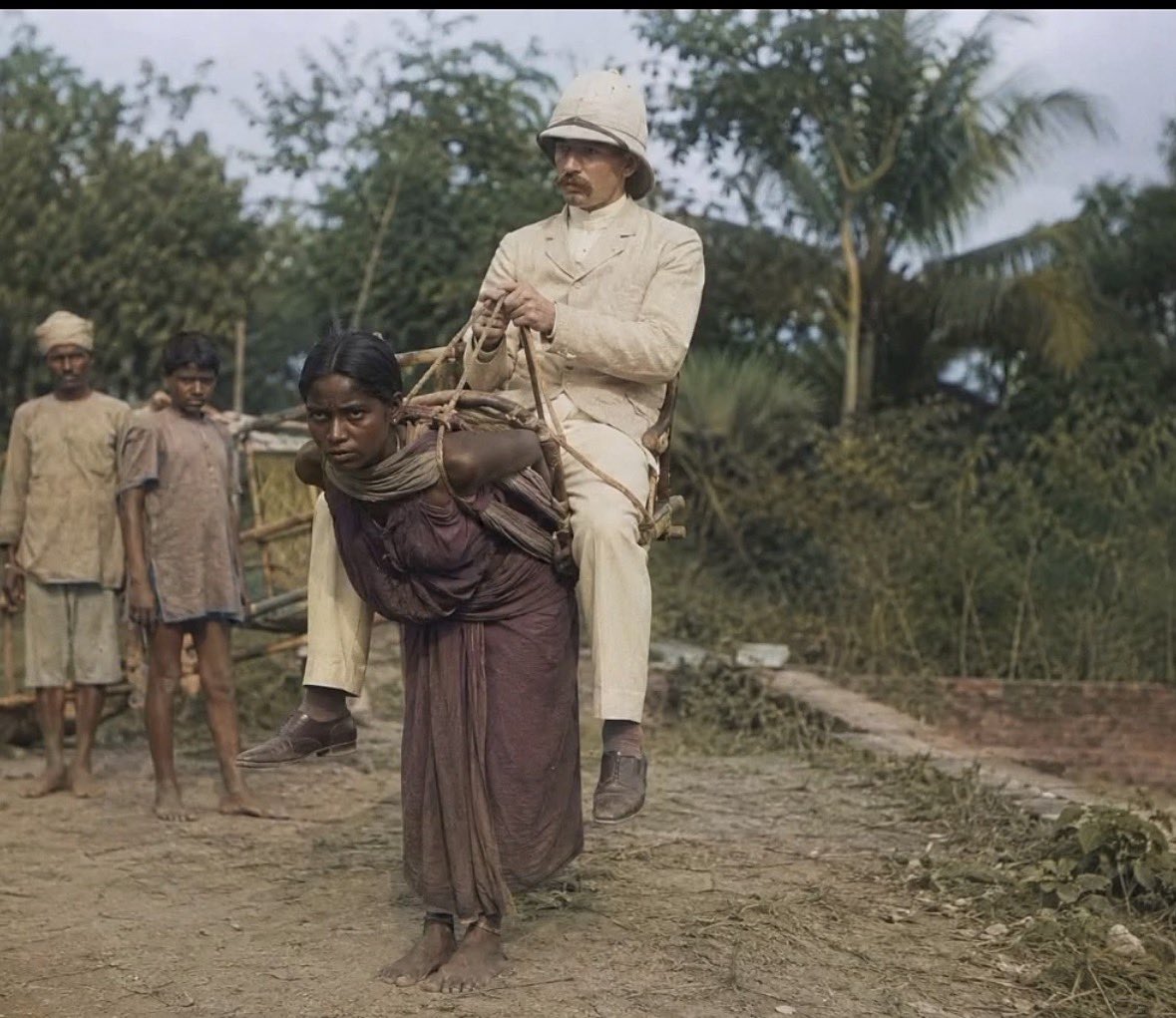
A Bengali woman carrying a British merchant on her back…
📸 This photo was taken in 1903, at the height of British colonialism in the Indian subcontinent. This isn't just a picture…
it's a slap in the face to all those who sing the praises of "Western civilization." This is the true face of colonialism, which they still try to beautify in history books.
It's slavery and the humiliation of human beings, the crushing of human dignity, simply because they don't belong to the white race! And then they ask you about terrorism…
The history of Western colonialism is full of massacres, slavery, plunder, and starvation… But they reduce terrorism to oppressed peoples struggling for their dignity! 🩸
The effects of what British colonialism did in India—the killing, starvation, plunder, and contempt for humanity—are still evident today. Millions
were killed, wealth was stolen, and generations were displaced… all under the banner of a false "enlightenment"!
Sri Vidyashankara Temple in Sringeri, Karnataka ~a true wonder of Vedic architecture.
Its 12 pillars, adorned with zodiac signs, are engineered so brilliantly that sunlight touches each one sequentially, following the order of the 12 months.
On the night the Titanic sank, a 21-year-old college student watched his father die.
Hours later, doctors told him both of his legs would have to be amputated.
Instead, he got up and started walking.
His name was Richard Norris Williams.
And surviving the Titanic was only the beginning of his story.
In April 1912, Richard and his father, Charles Duane Williams, boarded the Titanic as first-class passengers in Cherbourg, France.
They were traveling to America so Richard could continue his studies at Harvard.
When the ship struck the iceberg on April 14, father and son made their way to the deck together.
Then disaster struck again.
As the Titanic sank, one of its massive funnels collapsed.
The falling structure hit Charles Williams and killed him instantly.
Richard was standing beside him.
He narrowly escaped the same fate.
Moments later, he was in the freezing North Atlantic.
The water temperature was around 28°F (-2°C).
Most people survived only minutes.
Richard spent roughly six hours in the water or clinging to one of the partially submerged collapsible lifeboats before rescue arrived.
When the RMS Carpathia finally picked up survivors at dawn, his condition was severe.
His legs were frozen from the knees down.
The ship's doctor examined him and delivered a grim verdict:
Both legs would need to be amputated.
In 1912, severe frostbite often meant gangrene, infection, and death.
Amputation was considered the safest option.
Richard refused.
He reportedly told doctors that he was going to need his legs.
Then he got out of bed.
Against medical advice, he began walking the deck of the Carpathia every two hours.
Day and night.
Step after painful step.
For four days.
By the time the ship reached New York, his condition had improved enough that amputation was no longer necessary.
He walked off the ship on his own.
Most people would consider that the defining story of a lifetime.
For Richard Williams, it wasn't.
A few months later, he enrolled at Harvard.
Then he returned to tennis.
In 1914, he won the U.S. National Championship, the tournament that would later become the U.S. Open.
In 1916, he won it again.
Over the following years, he became one of the best tennis players in the world, winning multiple major doubles titles and representing the United States internationally.
Then came World War I.
Williams served in the U.S. Army and distinguished himself in combat.
France awarded him both the Croix de Guerre and the Legion of Honor for his service.
After the war, he returned to tennis once again.
At the 1924 Paris Olympics, he badly sprained his ankle during the mixed doubles tournament and considered withdrawing.
His partner, Hazel Wightman, refused to let him quit.
Williams played much of the tournament barely able to move.
Together, they won Olympic gold.
Over the years, he became a Davis Cup captain, a respected figure in American tennis, and eventually a member of the International Tennis Hall of Fame.
Yet people who knew him rarely heard him talk about any of it.
Not the Titanic.
Not the championships.
Not the war.
Not the medals.
Not the Olympic gold.
In fact, he disliked attention so much that later in life he had approximately 160 tennis trophies melted down into a single silver serving tray.
He used it to serve drinks to guests in his Pennsylvania home.
Most visitors had no idea what it was.
Or what it represented.
A Titanic survivor.
A two-time national champion.
A decorated war veteran.
An Olympic gold medalist.
A Hall of Famer.
All hidden inside an ordinary tray sitting quietly on a side table.
Richard Norris Williams died in 1968 at the age of 77.
If you had met him, he probably wouldn't have told you any of this.
And that may be the most remarkable thing about him.
प्रधान मंत्री मोदी जी द्वारा राम मंदिर ट्रस्ट को PMO का एक department मात्र बनाने के पीछे यही मंशा शुरू से थीं की वहाँ अपने चुनिंदे चोर लुटेरों को बैठा कर मज़े से करोड़ों का चढ़ावा हर महीने लूटा जाए।
चौकीदार चोर है, यह तो कबसे सिद्ध हो चुका है!
अब वही चोर चौकीदार अपने चुनिंदा लोगों की SIT गठित करके डकैती पर लीपा पोती कर लेगा!
चित्त भी मेरी, पट्ट भी मेरा,
अँटा मेरे बाप का!
Alzheimer’s may be linked to gum bacteria, new research shows.
Scientists have repeatedly found Porphyromonas gingivalis—the chief bacterium that causes periodontitis—inside the brains of people who died with Alzheimer’s.
When researchers deliberately infected mice with this oral bacterium, the animals rapidly developed key Alzheimer’s pathology, including the buildup of amyloid-beta plaques.
Perhaps most alarming, the bacteria’s toxic enzymes have been detected in the brains of people showing early Alzheimer’s changes years before memory loss or other symptoms appear, suggesting the infection may quietly initiate damage long in advance.
These discoveries have sparked serious interest in new treatment approaches. An experimental drug called COR388 (from the company Cortexyme) has already succeeded in lowering both bacterial load and amyloid-beta levels in preclinical models. Although large human trials are still needed, the evidence is mounting that at least some cases of Alzheimer’s may have an infectious trigger rather than being purely degenerative.
[Dominy, S. S., et al. "Porphyromonas gingivalis in Alzheimer’s disease brains: Evidence for disease causation and treatment with small-molecule inhibitors", Science Advances, 5(1), eaau3333]
Whoa!!
So it’s confirmed that 3 Indians died in Us STRIKE!
Three US strikes on Indian crewed tankers in the Gulf of Oman in just three days.
👉First Marivex 👉Then Settebello , its engine room blown was apart, three Indian sailors murdered: Patnala Suresh,
Aditya Sharma,
Shivanand Chaurasiya.
👉& Now Jalveer
Three attacks. Three dead Indians.
& Narendra Modi? Complete, gutless silence.
While Indian blood is spilled by US, our the 56 with self proclaimed ‘Vishwagur’ status has nothing to say!!
America didn’t even pretend to care about the crew. They just bombed the engine room & walked away.
Meanwhile, the BJP and its ecosystem are shamelessly celebrating Modi’s 12 years in power with self congratulatory noise
Matter of such shame and disgrace!
A self-taught Irish schoolteacher wrote a book in 1854 that almost nobody read for 80 years, until a 21-year-old MIT student picked it up and realized it could be used to design every computer in human history.
His name was George Boole. The book is called An Investigation of the Laws of Thought.
Boole was born in 1815 in Lincoln, England. His family was poor. He left school at 16 to support them. He taught himself Latin, Greek, French, German, and Italian.
Then he taught himself mathematics. By 19 he had opened his own school. By 24 he was publishing original papers in the Cambridge Mathematical Journal, competing with men who had spent decades inside the best universities in Britain.
He never had a degree. He never had a mentor. In 1849, Queen's College in Cork hired him as a professor anyway.
In 1854, he published his masterwork. What he built inside it was something nobody had attempted before at this scale. He turned logic into algebra.
Before Boole, logic was philosophy. You argued in sentences. You reasoned in paragraphs. It was powerful and completely impossible to automate, because there was no formal system underneath it, just language.
Boole stripped it down to arithmetic. He showed that every act of human reasoning could be reduced to operations on two values. True or false. One or zero. AND, OR, NOT. If both conditions are true, the result is true. If neither is, the result is false. Every judgment a human mind makes, every decision, every deduction, could be written as an equation following those rules.
Logicians read it. They found it interesting. Engineers building machines had never heard of it.
For 83 years, the book sat there.
Then in 1937, a 21-year-old MIT master's student named Claude Shannon was working on a thesis about electrical relay circuits. Switches that could be open or closed. Current that either flowed or didn't.
He read Boole and understood something nobody had connected before.
An open switch is a zero. A closed switch is a one. A circuit with two switches in series only carries current when both are closed. That is AND. A circuit with two switches in parallel carries current when either is closed. That is OR. Shannon proved that every possible logical relationship Boole had described could be physically built using wire and switches.
That single insight is the foundation of every computer ever made.
After Shannon, chip designers stopped thinking about electricity and started thinking about logic. Every transistor on every processor running right now is implementing a Boolean operation. Every if-statement in every codebase is Boolean logic. Every database query using AND or OR. Every neural network threshold that fires or doesn't fire. All of it is running the algebra of a self-taught schoolteacher from Lincoln who died 160 years ago.
The strangest part is what happened to Boole at the end.
He was walking to class in November 1864 when he got caught in a rainstorm. He lectured for hours in wet clothes. He went home sick. His wife, Mary, believed in homeopathic medicine and thought the cure should mirror the cause. She wrapped him in wet sheets and poured cold water over him repeatedly.
He died a few days later. He was 49.
He never saw a transistor. He never saw a circuit. He never saw a single physical machine run a single one of his rules.
His book is in the public domain. Free to download. Most engineers use the word Boolean dozens of times a week. Almost none of them know who they are saying.
The man whose logic runs inside every phone, every server, and every AI model on Earth died soaking wet in a small Irish town, 83 years before anyone figured out what he had actually built.






![Rainmaker1973's tweet photo. Alzheimer’s may be linked to gum bacteria, new research shows.
Scientists have repeatedly found Porphyromonas gingivalis—the chief bacterium that causes periodontitis—inside the brains of people who died with Alzheimer’s.
When researchers deliberately infected mice with this oral bacterium, the animals rapidly developed key Alzheimer’s pathology, including the buildup of amyloid-beta plaques.
Perhaps most alarming, the bacteria’s toxic enzymes have been detected in the brains of people showing early Alzheimer’s changes years before memory loss or other symptoms appear, suggesting the infection may quietly initiate damage long in advance.
These discoveries have sparked serious interest in new treatment approaches. An experimental drug called COR388 (from the company Cortexyme) has already succeeded in lowering both bacterial load and amyloid-beta levels in preclinical models. Although large human trials are still needed, the evidence is mounting that at least some cases of Alzheimer’s may have an infectious trigger rather than being purely degenerative.
[Dominy, S. S., et al. "Porphyromonas gingivalis in Alzheimer’s disease brains: Evidence for disease causation and treatment with small-molecule inhibitors", Science Advances, 5(1), eaau3333]](https://pbs.twimg.com/media/HKnWXkkXcAAkD31.png)