Whatever happened to …
▪️Obama supposedly dating Jennifer Aniston?
▪️the ERA that Biden declared ratified by fiat?
▪️the investigation into White House cocaine deliveries?
▪️Eric Ciaramella?
33 years ago this weekend, two Delta Force snipers made a choice almost nobody would make.
Master Sergeant Gary Gordon was 33, from Lincoln, Maine, with a wife and two young kids at home. Sergeant First Class Randy Shughart was 35, a farm kid from Newville, Pennsylvania.
On October 3, 1993, they were in a Black Hawk circling over Mogadishu when another Black Hawk, Super 64, was shot down. Pilot Mike Durant was alive in the wreckage with a broken back and a crushed leg. His crew was hurt. There were no friendly ground forces anywhere near them, and hundreds of armed militia and locals were already converging on the crash site.
From the air, Gordon and Shughart could see exactly what was coming.
They asked to be dropped in. Command said no.
They asked again. No again.
They asked a third time and finally got the green light.
Their helicopter set them down nearby and they fought their way to the wreck on foot. Two men, carrying only what they had on them. They pulled Durant out of the cockpit, set him up in a safer position, and started holding off the crowd.
For a while, it worked. They kept the mob back with precise, steady fire while the numbers against them kept growing.
Shughart was killed first.
Gordon kept fighting alone. When he was nearly out of ammunition, he went back to Durant, handed him a rifle, and told him good luck. Then he went back out. He was killed minutes later.
Durant was captured, beaten, and held for 11 days. He came home alive. He has said for decades that he's only here because of those two men.
In 1994 Gordon and Shughart were posthumously awarded the Medal of Honor, the first since Vietnam. The Navy later named two ships after them, the USNS Gordon and the USNS Shughart.
They didn't stumble into that fight. They watched it from above, understood the odds, and asked three times to go anyway.
Gary Gordon and Randy Shughart. Remember their names.
@Alice_MiaX It’s carbon … same atoms as graphite, soot, and buckminsterfullerenes. Whether it was crystallized in a volcano or a furnace is irrelevant.
@nogooddeed2 Cheers!
I’m rebalancing my portfolio while sipping a Rare Breed … after a Four Roses and an Old GrandDad 114. I either will be down 50% tomorrow or a multimillionaire 🫤
Gotta hand it to client assistance group @Fidelity
Had a text chat this afternoon w/ a rep re 9/30 $STRC dividends, reversed 10/2. No obvious reason, so I was going to wait a day or 2.
Rep called @ 8:45 pm EDT to tell me about Fidelity notice re STRC dividends not arriving.
Page 1 of 2…
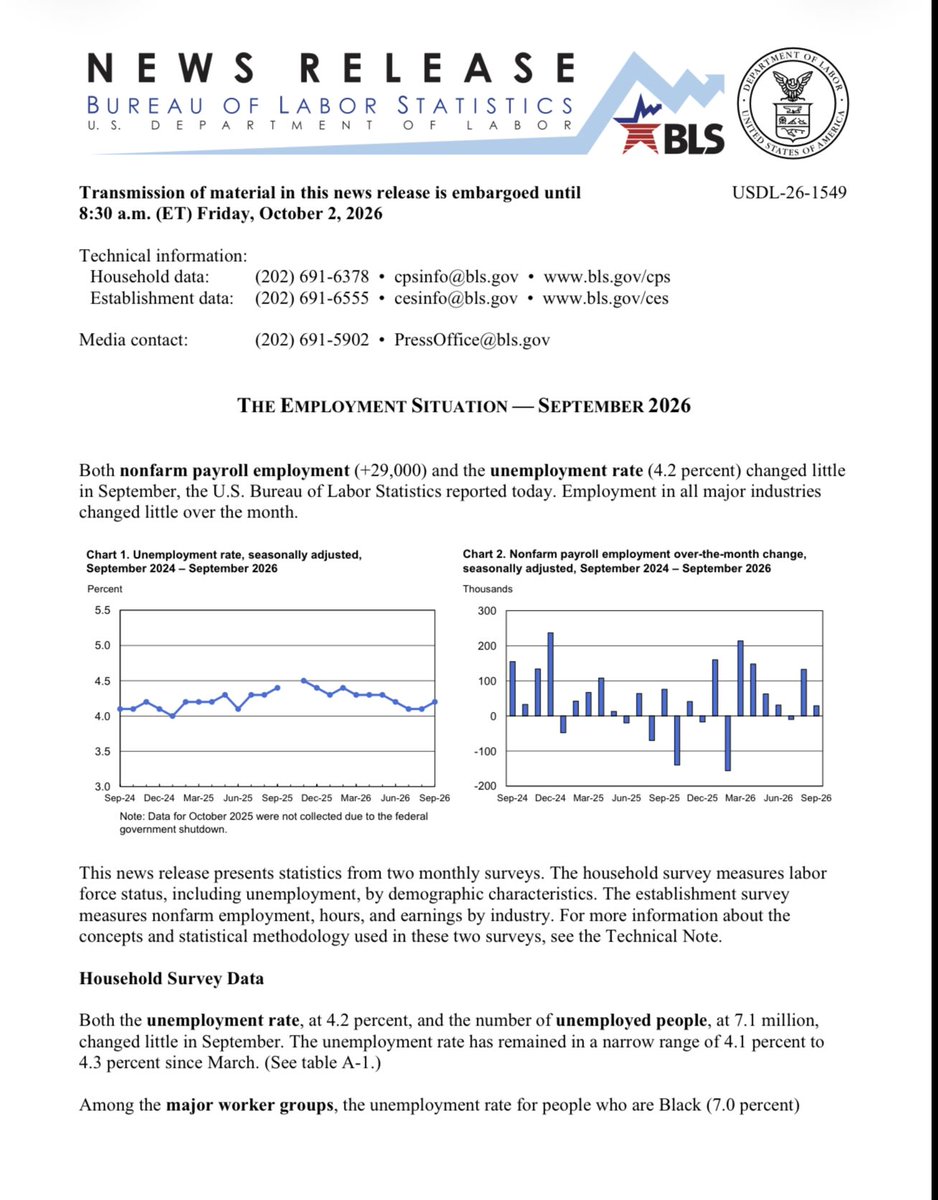
September 2026 Jobs Report Shows The Seasonal Noise Is Clearing And The Underlying Weakness Is Getting Harder To Ignore
September payrolls increased just 29,000 after seasonal adjustment. That is weak by itself, but the composition tells us considerably more.
Private payrolls fell 523,000 raw yet became a 46,000 adjusted gain, an effective seasonal lift of roughly 569,000 jobs.
Government moved the opposite way. Employment rose 856,000 raw, largely as schools reopened, but became a 17,000 adjusted decline. That is why the national raw increase of 333,000 ultimately became only 29,000 after adjustment.
The important point is not that seasonal adjustment created the national gain. It did not.
It is that seasonal adjustment again transformed a very large private sector decline into positive reported growth.
Some of the biggest transformations were
• Leisure and hospitality fell 454,000 raw but became plus 10,000 adjusted
• Restaurants fell 148,400 raw but became plus 10,800
• Retail fell 79,500 raw but became plus 5,800
• Construction fell 49,000 raw but became plus 11,000
• Manufacturing fell 44,000 raw but became plus 9,000
• Temporary help gained 53,300 raw but became minus 10,900 adjusted
The mechanics clearly cut both ways. The correct argument is therefore not that adjustment automatically makes everything stronger.
Something Important Is Normalizing
The 523,000 raw private decline initially looks disastrous.
But the average raw September decline from 2015 through 2019 was roughly 528,000.
That means September 2026 behaved remarkably similarly to a normal pre pandemic September.
This matters.
From 2020 through 2025, shutdowns, reopening surges, labor shortages and unusual school and seasonal staffing patterns badly disrupted normal seasonal behavior.
Now the raw September pattern appears to be moving back toward its old structure.
The seasonal pattern may be returning to normal. The underlying economy is not.
That actually makes the weakness harder to dismiss.
If September seasonality increasingly resembles 2015 through 2019, then after removing that normal seasonal rundown we are still left with only 46,000 private jobs and 29,000 total payrolls.
The problem is increasingly not the normal September decline.
It is the lack of underlying hiring once that normal decline is stripped away.
The Revisions Are Becoming Hard To Ignore
July was revised from plus 21,000 to minus 10,000.
August was revised from plus 162,000 to plus 133,000.
Another 60,000 jobs disappeared from the previous two months.
The 3 month average is now only about 51,000 per month.
And the September gain of 29,000 is nowhere near the roughly 122,000 monthly change BLS says is required for statistical significance.
The reported increase is therefore not statistically distinguishable from zero at the confidence level BLS normally uses.
The Breadth Is Deteriorating
Private employment diffusion fell from 57.6 to 49.0.
Manufacturing diffusion collapsed from 63.9 to 46.5.
Below 50 means employment losses are becoming more widespread across industries.
Manufacturing added 9,000 total jobs, but production employment fell 1,000.
Temporary help lost 10,900.
Professional and business services lost 9,000.
Information lost 10,000.
Financial activities lost 7,000.
Those are exactly the areas I would watch before a broader layoff cycle becomes obvious.
@ArchitectIncome Investors definitely are bag holders for big moves to the downside by the underlying.
Am I understanding correctly that ProShares is bundling dozens of “rolling” autocallables in one wrapper? The dashboard for $ACSP shows 74 different time-to-maturity points.
@onechancefreedm How much of this can be attributed to hedge funds migrating from basis trade to swap spread, with the latter tying up huge amounts of bank credit?
@daveacrick@BBGreatMoments I’d say “The Boogaloosa Bomber” (Charlie Spikes) beats both in terms of nickname quality.
If one sticks with Feller, “Heater from Van Meter” was better than Rapid Robert.
For the Twins, Jim “Mudcat” Grant, Jim “Kitty” Kaat, or Frank “Sweet Music” Viola.