The RCN through @NASAAstrobio focused on developing the science and technology needed to search for life on other worlds. Not an official NASA account.
Our next #AskAstrobio guest has been studying the state of astrobiology throughout history.
What do you think is the most important finding in this field from the past century? Cast your vote today: https://t.co/x8YcQSyYOX
Fantastic work depicting a New Frontiers concept mission to Triton. Great work, James! We love effective visualizations for science communication and gorgeous space artwork 🚀🌠
Amanda Steckel @steckel_avs & Tyler Horvath @Planetary_Tyler—Nautilus is a New Frontiers concept to explore Neptune’s moon, Triton! It would address a lot of outstanding questions, including the origin of Triton’s plumes, and whether Triton has an ocean and/or core #AGU23
Exciting news for the potential habitability of Enceladus! A study zooms in on Cassini mission data gathered at Saturn’s icy moon and finds confirming evidence of hydrogen cyanide, a molecule needed to spark life as we know it and a supercharged chemical energy source to fuel it.
Have you seen our most recent #NfoLD nugget on endogenous ice on Europa? Check it out here: https://t.co/gujXfoRCJ3
Thanks to @DevyaniJambhul4 @catmaggiori Kaitlin Harrison and Brook Nunn for putting this nugget together!
Oh, fantastic!
Also, check out @PlanetCynthia on an episode of #AskAstrobio from 2021 talking about her life and work: https://t.co/tHC7as2bV4
Should we have another episode soon focused on @EuropaClipper and astrobiology?
The midnight sun shining gloriously over McMurdo station!!
The ANSMET team has had a pretty spectacular welcome to Antarctica and I'm very quickly falling in love with these mountain views ���� (I am already smitten with my Big Red coat!)
Follow along: https://t.co/ymisCHrYm4
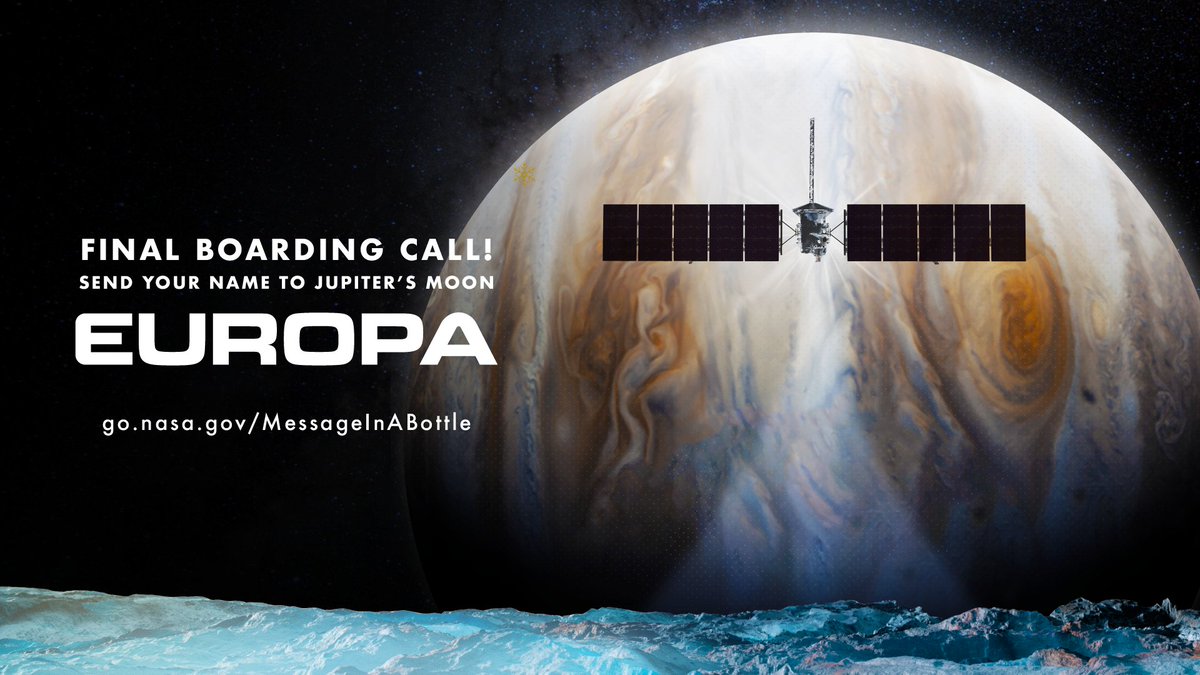
It will take years for @EuropaClipper to reach one of Jupiter’s icy moons, Europa. But, it only takes a moment to submit your name to be engraved on a chip aboard the spacecraft before its 1.8-billion-mile journey. Don’t miss out! https://t.co/KnyYulzAee
An all new #AskAstrobio is coming this Wednesday, and features Dr. Bonnie Teece (@astrobonology) of NASA JPL.
Set up your notifications now on the YouTube live landing page here: https://t.co/LvD6OKa310
Come join us on Wednesday for a chat with @AstroBonology about her life and career for #AskAstrobio!
Link to the YouTube live landing page coming soon, but check out the @NASAAstrobio YouTube channel now to subscribe and get info on when the live page drops.
Dear Followers!
Have you already seen our range of events, seminars and working groups? Feel free to take a look at our website:
https://t.co/7zXIJWiPQo
We're stoked to partner with the Polish Astrobiology Society (@PTAstrobio) for their 3rd Life and Space Conference, this December.
Learn more and register for the meeting here: https://t.co/ofFozXNYBT
Asteroids are the building blocks of our solar system, and this asteroid contains the building blocks of life. Our initial analysis of the 4.5-billion-year-old rocks from asteroid Bennu delivered to Earth by #OSIRISREx shows evidence of carbon and water.
https://t.co/Wg3Zq4dxBP
On Oct. 11 at 11am ET, @NASA unveils the #OSIRISREx asteroid sample to the world at @NASA_Johnson!
Don't miss the action. Set a reminder to learn the results from an initial analysis of the 4.5 billion-year-old material: https://t.co/I0HEXmGxW9
OPAG, NASA's community-based forum designed to provide science input for planning and prioritizing outer planet exploration activities for the next several decades, will have its next meeting November 28-30. More information: https://t.co/CLz4JZAbhn
A fantastic article just dropped on the amazing work NfoLD and @nexssinfo did on creating a Standards of Evidence for Life Detection, and why it is important. It's such an important topic, and I highly recommend checking it out.
https://t.co/qkjgytd9rJ
#NfoLD#Astrobiology
NASA-supported astrobiologists create a “cookbook” of chemical recipes that could aid in our search for life. 📖
Using this ingredient list, we can test different planetary conditions to understand where and how processes known to sustain life can arise: https://t.co/3sSwjl40i5
The 2023 International @SpaceApps Challenge is coming up on Oct. 7-8! Join our global hackathon to explore #OpenScience and create solutions to real-world challenges.
Everyone is welcome. Register now: https://t.co/O9dKt2tEfD
Our friends at @nexssinfo have released their latest recording from the Professional Advancement Workshop Series. This month's topic was Faculty Jobs at R1 Universities. You can get all the info on the panel, and watch the recording here: https://t.co/GfVW3BEDMZ
#NfoLD