𝗡𝗩𝗜𝗗𝗜𝗔 𝗚𝗧𝗖 𝗧𝗮𝗶𝘄𝗮𝗻 𝟮𝟬𝟮𝟲 - 𝗠𝗮𝗽𝗽𝗶𝗻𝗴 𝘁𝗵𝗲 #𝗛𝗲𝗮𝗹𝘁𝗵𝗰𝗮𝗿𝗲𝗔𝗜 𝗩𝗮𝗹𝘂𝗲 𝗖𝗵𝗮𝗶��
At NVIDIA GTC Taiwan 2026, our Co-Founder & CEO Dr. Tuan Cao @tuan_lifeai presented “LifeAI Biohub: A Purpose-built AI platform for Drug Development”
One signal emerged throughout the session:
As AI capabilities continue to advance, the bottleneck is no longer intelligence itself. It is the infrastructure that enables validation, governance, and coordination across the full spectrum of healthcare stakeholders.
𝗧𝗵𝗲 𝗛𝗲𝗮𝗹𝘁𝗵𝗰𝗮𝗿𝗲 𝗔𝗜 𝗩𝗮𝗹𝘂𝗲 𝗖𝗵𝗮𝗶𝗻
Pharma → Hospitals → Doctors → Labs → Regulators → Auditors → Patients
Sustainable progress in healthcare AI demands alignment across the entire ecosystem, not isolated optimization within a single organization.
𝗟𝗶𝗳𝗲𝗔𝗜 𝗕𝗶𝗼𝗛𝘂𝗯
Shared Infrastructure → Coordination Layer → Connected Network → Application Success
This is the foundation Life AI is building: the shared infrastructure and coordination layer for the healthcare AI value chain so that every application built on top can move faster, scale further, and earn trust across the industry.
The long-term opportunity in healthcare AI will not be defined by better models alone. It will be defined by the infrastructure that makes those models deployable, accountable, and impactful at scale.
It was a privilege to share this vision alongside the researchers, healthcare leaders, and technology builders at NVIDIA GTC Taiwan shaping the next chapter of AI.
Building a better AI model will not fix healthcare.
The real challenge is coordinating an entire value chain: pharma, hospitals, doctors, labs, regulators, auditors, and patients. Each with its own incentives, priorities, compliance obligations, and trust requirements.
No single model can coordinate all of that. No single organization can either.
Better healthcare comes from better infrastructure for the value chain.
That is the problem Life AI was built to solve.
#NVIDIAGTC #LifeAI #BioHub #HealthcareAI
𝗡𝗩𝗜𝗗𝗜𝗔 𝗚𝗧𝗖 𝗧𝗮𝗶𝘄𝗮𝗻 𝟮𝟬𝟮𝟲 - 𝗠𝗮𝗽𝗽𝗶𝗻𝗴 𝘁𝗵𝗲 #𝗛𝗲𝗮𝗹𝘁𝗵𝗰𝗮𝗿𝗲𝗔𝗜 𝗩𝗮𝗹𝘂𝗲 𝗖𝗵𝗮𝗶��
At NVIDIA GTC Taiwan 2026, our Co-Founder & CEO Dr. Tuan Cao @tuan_lifeai presented “LifeAI Biohub: A Purpose-built AI platform for Drug Development”
One signal emerged throughout the session:
As AI capabilities continue to advance, the bottleneck is no longer intelligence itself. It is the infrastructure that enables validation, governance, and coordination across the full spectrum of healthcare stakeholders.
𝗧𝗵𝗲 𝗛𝗲𝗮𝗹𝘁𝗵𝗰𝗮𝗿𝗲 𝗔𝗜 𝗩𝗮𝗹𝘂𝗲 𝗖𝗵𝗮𝗶𝗻
Pharma → Hospitals → Doctors → Labs → Regulators → Auditors → Patients
Sustainable progress in healthcare AI demands alignment across the entire ecosystem, not isolated optimization within a single organization.
𝗟𝗶𝗳𝗲𝗔𝗜 𝗕𝗶𝗼𝗛𝘂𝗯
Shared Infrastructure → Coordination Layer → Connected Network → Application Success
This is the foundation Life AI is building: the shared infrastructure and coordination layer for the healthcare AI value chain so that every application built on top can move faster, scale further, and earn trust across the industry.
The long-term opportunity in healthcare AI will not be defined by better models alone. It will be defined by the infrastructure that makes those models deployable, accountable, and impactful at scale.
It was a privilege to share this vision alongside the researchers, healthcare leaders, and technology builders at NVIDIA GTC Taiwan shaping the next chapter of AI.
Healthcare has AI in every vertical.
AI doctors. AI diagnostics. AI copilots. AI imaging. AI drug discovery. AI trial matching. AI revenue cycle.
Yet healthcare still looks mostly the same.
Cancer is not yet cured. Drug prices are not yet lowered. Care is not yet personalized.
AI is transforming every industry. Why not yet healthcare?
That is the question Dr. Tuan Cao, Co-Founder & CEO of Life AI, posed at NVIDIA GTC Taiwan 2026 and the problem Life AI is building to solve.
𝗡𝗩𝗜𝗗𝗜𝗔 𝗚𝗧𝗖 𝗧𝗮𝗶𝘄𝗮𝗻 𝟮𝟬𝟮𝟲 - 𝗠𝗮𝗽𝗽𝗶𝗻𝗴 𝘁𝗵𝗲 #𝗛𝗲𝗮𝗹𝘁𝗵𝗰𝗮𝗿𝗲𝗔𝗜 𝗩𝗮𝗹𝘂𝗲 𝗖𝗵𝗮𝗶��
At NVIDIA GTC Taiwan 2026, our Co-Founder & CEO Dr. Tuan Cao @tuan_lifeai presented “LifeAI Biohub: A Purpose-built AI platform for Drug Development”
One signal emerged throughout the session:
As AI capabilities continue to advance, the bottleneck is no longer intelligence itself. It is the infrastructure that enables validation, governance, and coordination across the full spectrum of healthcare stakeholders.
𝗧𝗵𝗲 𝗛𝗲𝗮𝗹𝘁𝗵𝗰𝗮𝗿𝗲 𝗔𝗜 𝗩𝗮𝗹𝘂𝗲 𝗖𝗵𝗮𝗶𝗻
Pharma → Hospitals → Doctors → Labs → Regulators → Auditors → Patients
Sustainable progress in healthcare AI demands alignment across the entire ecosystem, not isolated optimization within a single organization.
𝗟𝗶𝗳𝗲𝗔𝗜 𝗕𝗶𝗼𝗛𝘂𝗯
Shared Infrastructure → Coordination Layer → Connected Network → Application Success
This is the foundation Life AI is building: the shared infrastructure and coordination layer for the healthcare AI value chain so that every application built on top can move faster, scale further, and earn trust across the industry.
The long-term opportunity in healthcare AI will not be defined by better models alone. It will be defined by the infrastructure that makes those models deployable, accountable, and impactful at scale.
It was a privilege to share this vision alongside the researchers, healthcare leaders, and technology builders at NVIDIA GTC Taiwan shaping the next chapter of AI.
** When you think of AI, think of humanity too. **
At the GStar AI & Humanity Summit, I was asked during our panel: what can AI do for humanity?
It reminded me of a dinner I had with Thang Luong @lmthang, Director of Research at Google DeepMind. We were deep in the technical side, World Models for healthcare, AI in drug discovery, and we kept coming back to one simple fact: humans are still used as test subjects in drug development.
As AI makes drug discovery faster and cheaper, more and more candidates will go into clinical trials. And those trials run on people. About 90% of drug candidates that reach clinical trials fail, so most of the time people take on real risk, including serious side effects, for a candidate that never makes it.
So, what can AI do for humanity? Here's one thing I'd love to see: more AI companies building simulation environments that test drug candidates before they ever reach a real trial. Ideally, anything that passes the simulation would have a 99% chance of passing the actual one.
It's a hard problem. Of course it is. But it's not so different from how engineers built flight simulators for pilots, which have probably saved thousands of lives.
Fingers crossed that experts at Anthropic, OpenAI, and especially Google DeepMind solve this soon. I'd love to help.
Tagging Jeff Dean @JeffDean , Quoc Le @quocleix , Thang Luong @lmthang , Ed Chi @edchi , Yi Tay @YiTayML .
A great day at GStar Summit 2026: AI + Humanity.
Our Co-Founder & CEO, Dr. Tuan Cao, joined the AI for Healthcare & Life Sciences session to discuss how AI can be applied responsibly in healthcare, where innovation must be matched with trust, safety, and real-world impact.
A sincere thank you to the organizers, New Turing Institute and Pacific Gateway Partners, and to Google and FPT Corporation as strategic partners, for bringing together leaders, researchers, and innovators working at the intersection of AI and humanity.
We’re grateful for the conversations, connections, and shared commitment to building AI that serves people and improves lives.
@tuan_lifeai@newturing@lmthang
AI learns. Humans decide.
We didn’t build Life AI to replace clinicians.
We built it to change what is possible for human health — infrastructure that coordinates across biology, institutions, and real human life.
The AI is the coordination layer. The human is the reason it exists.
From individuals managing their health to governments building national programs.
Life AI BioHub is the infrastructure layer for all of them.
File that away.
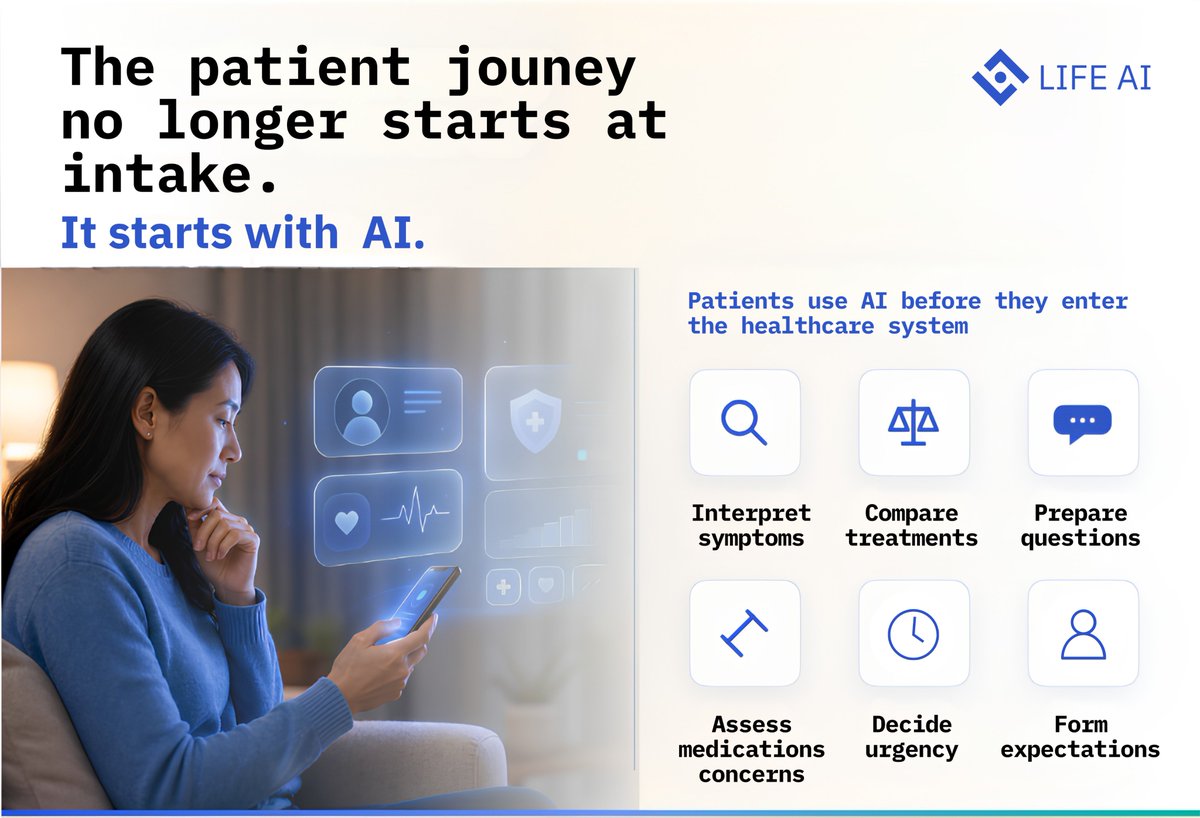
The patient journey no longer starts at intake.
It starts with search, chat, and AI-generated health information.
Patients now use AI before they enter the healthcare system:
to interpret symptoms
to compare treatments
to prepare questions
to assess medication concerns
to decide whether care is urgent
to form expectations before the visit
This changes the clinical encounter.
Clinicians are no longer only responding to symptoms.
They are also responding to AI-shaped beliefs, fears, and assumptions that formed before the appointment.
That creates a new responsibility for healthcare systems.
They need to understand the pre-visit AI layer.
Ignoring it leaves a blind spot in patient trust, adherence, shared decision-making, and diagnosis timing.
Healthcare AI strategy cannot stop at EHR workflows.
It must account for how patients use AI before care begins.
AI in prior authorization is not a productivity issue.
It is an access-to-care issue.
When automation is used to review, delay, or deny care, the stakes are different from ordinary back-office AI.
The system is no longer just processing paperwork.
It is influencing whether patients receive treatment, how long they wait, and how much administrative burden is pushed onto clinicians and families.
This is where healthcare AI needs a higher governance standard.
Speed is not enough.
AI used in prior authorization must be transparent, appealable, auditable, and clinically accountable.
Health systems and regulators should ask:
Who reviews adverse decisions?
Can patients and clinicians understand why care was delayed?
Are denial patterns monitored?
Is there human oversight when medical necessity is involved?
Can the system prove it improves efficiency without restricting appropriate care?
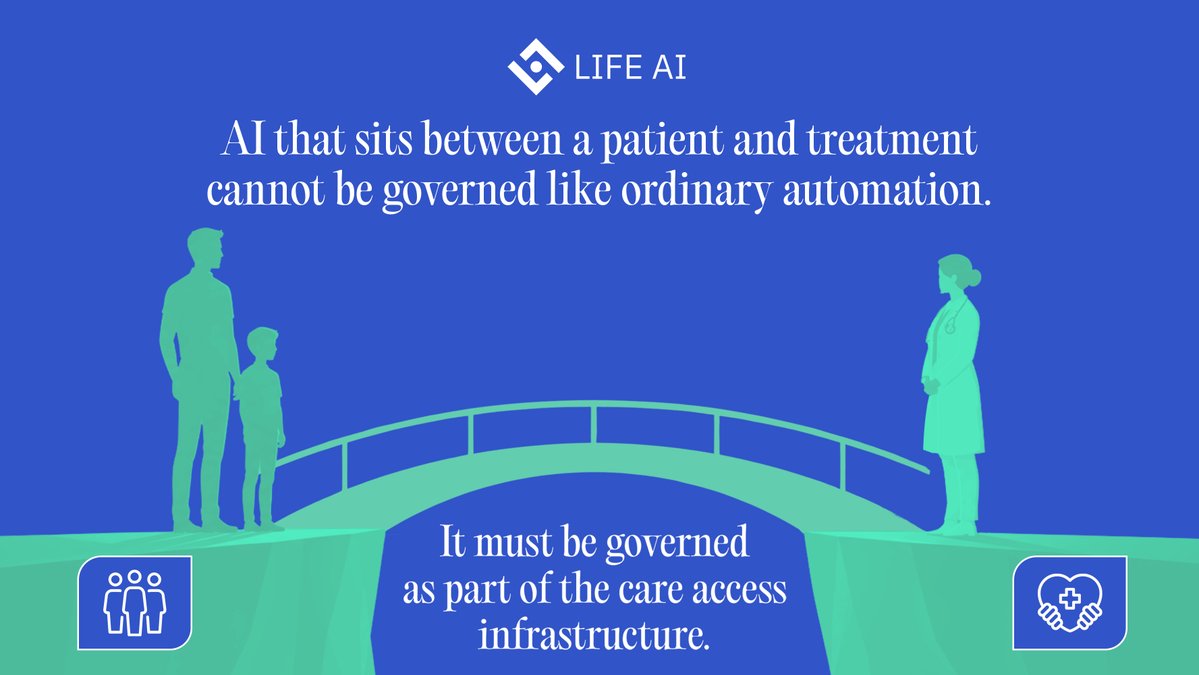
AI that sits between a patient and treatment cannot be governed like ordinary automation.
It must be governed as part of the care access infrastructure.
Preventive care does not fail because people dislike prevention.
It fails because healthcare systems are built around episodes.
A visit.
A claim.
A lab result.
A discharge.
A diagnosis.
But health risk builds continuously.
Sleep changes.
Biomarkers drift.
Behavior shifts.
Medication adherence changes.
Inflammation rises.
Symptoms appear before diagnosis.
Preventive healthcare needs infrastructure that can detect trajectory changes before they become clinical events.
That requires longitudinal data, feedback loops, and earlier intervention pathways.
Healthcare AI adoption is moving faster than healthcare AI governance.
That gap is not theoretical.
If a hospital deploys generative AI inside the EHR, it also needs capacity to monitor:
☑️ accuracy
☑️ bias
☑️ clinical safety
☑️ workflow impact
☑️ model drift
☑️ failure modes
☑️ patient trust
Healthcare AI cannot be treated like ordinary SaaS.
Deployment is not the finish line.
In healthcare, deployment is when the monitoring obligation begins.
Healthcare was built around sickcare.
Life AI BioHub is built around lifecare.
Real-world learning. Early intervention. Integrated biology.
A coordination layer for human health.
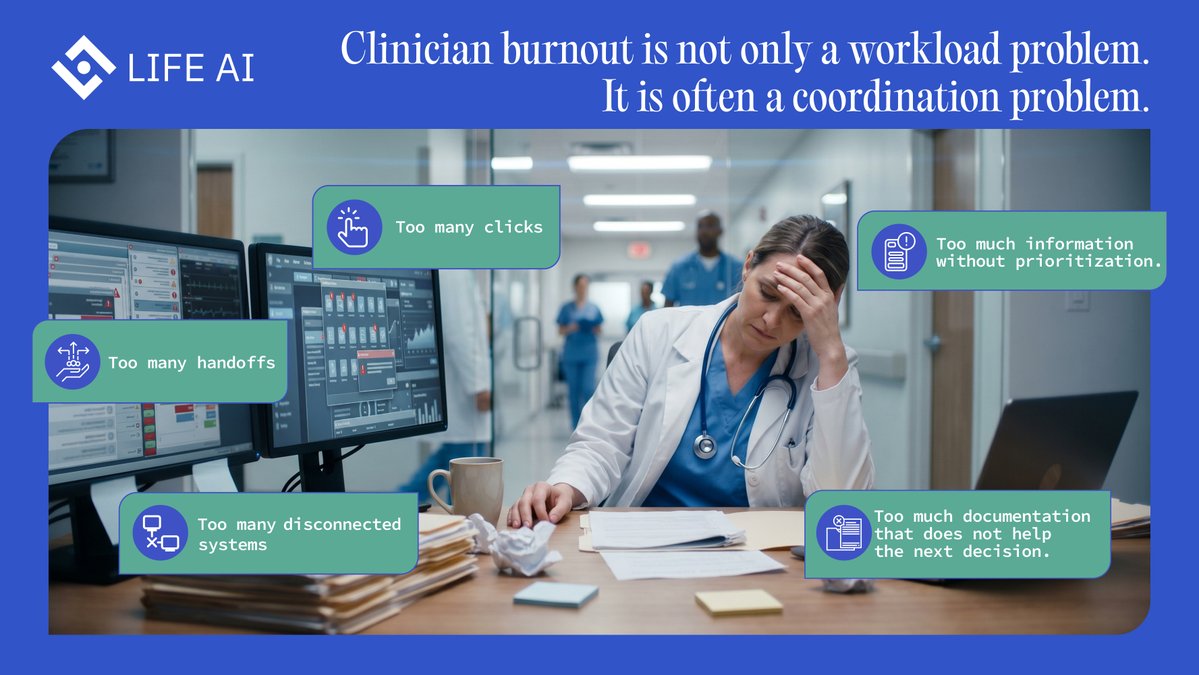
Clinician burnout is not only a workload problem.
It is often a coordination problem.
Too many clicks.
Too many handoffs.
Too many disconnected systems.
Too much information without prioritization.
Too much documentation that does not help the next decision.
AI in healthcare should not simply add another screen, alert, or assistant.
The real test is whether it reduces cognitive load inside the workflow.
If AI gives clinicians more things to check, it has failed operationally.
If it helps the system surface the right context at the right moment, it starts to matter.
4/ Healthcare AI should be judged less like a feature demo and more like infrastructure.
Not only by output accuracy.
But by whether it improves the path from signal to decision to intervention.
1/ Healthcare AI is often evaluated at the wrong layer.
The question is usually:
Did the model produce the right output?
But in healthcare, a correct output is only useful if the system can act on it.
3/ The better evaluation question is:
What operational behavior changed because AI was introduced?
Did it reduce delay?
Did it improve escalation?
Did it close a handoff gap?
Did it make context available sooner?
Did it improve learning from outcomes?