Making software to bridge the gap between people and hardware in a human way. Whatever that means.
OSINT/SIGINT & Geopolitics
Lasers & 3D printing
LLMs & HPC
@CremeDeLaLeem@AriyaVeyron@AP He's funded by Israelis bud ones banned from the US even for financial crimes and wanted lol also if you don't understand the larger context here, thats on you
@AriyaVeyron@AP Lol almost just posted the same article as a literal reply haha. This was going around somewhere else like a year ago too probably true
While we’re on the topic of Anthropic, there has not been nearly enough discussion of the fact that Dario explicitly wants to use AGI to overthrow the CCP (from his essay The Adolescence of Technology)
"tech" ppl are missing the bigger picture with the anthropic book stuff. Like @MTSlive saying "how about thanks for digitally preserving the books" maybe that was sarcasm. The court docs said they knew it would look bad. It's not bad because it was a cost to get the pages in a format they could quickly scan that would destroy the books.
They were destroying the books because it's a legal loophole for them to ingest all this huamn knowledge not of their own "legally". Then sell it back to us while pretending to sell "safety" I feel like some people just see the technology part and ignore the entire everything else. https://t.co/csQ1SFvRUv
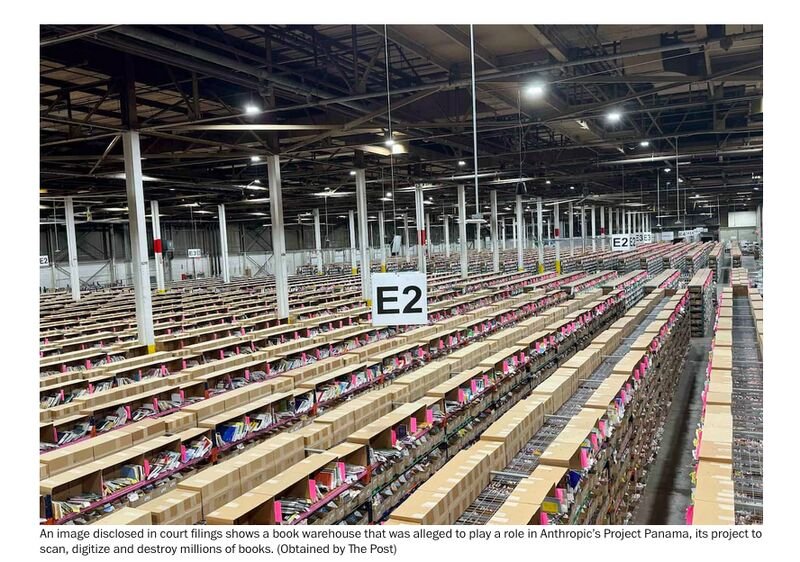
This is the magnificent library @AnthropicAI amassed, before pulping it because it gave them a legal copyright loophole.
These people do not understand Civilization.
This is the magnificent library @AnthropicAI amassed, before pulping it because it gave them a legal copyright loophole.
These people do not understand Civilization.
I have been saying this a lot lately. I think smaller shared cluster to pool resources. Can schedule usage between stakeholders as to not overload it and ensure everyone is able to use etc... the smaller models you can run on a home server build or max'd m5 laptop are cool but three is no replacement for displacement / compute and it's not getting cheaper for like at least some year(s).
@DaveShapi@DaveShapi RIP to the books that died so we could fly :|
I love how the court docs explicitly call out that they knew how bad this would look and didn't want it getting out. But were okay doing it. That's the behavior or someone we should trust for safety? lol ok.
Yeah we have indeed been lied to about many things. Then the US imported all their favorite nazis at the top with operation paperclip... take a look a us or germany for that matter. Germany literally sends weapons directly to isreal that are used in genocide. I would say it's complicated but it's not you just can't openly call it out with being censored or banned. Only get flak above the target lol
@Kanarymine4 Obviously not. It's about the crimes against humanity why would it ever be about winning or losing? What did I say that implied anything like that?
btw anthropic's internal document on this literally said "we don't want it to be known that we are working on this.”
it was called project panama.
here's exactly what happened:
1: anthropic concluded that books were the cheapest way to build a world-class model because they gave claude curated facts, structured arguments, compelling stories, and writing “an editor would approve of.”
2: once anthropic decided it needed books at enormous scale, its first solution was piracy.
it downloaded 7m+ books from online libraries including libgen. the judge later wrote that although anthropic had legal ways to buy them, it chose piracy to avoid what dario amodei called the “legal/practice/business slog.”
3: that piracy created a massive legal risk.
so in february 2024, anthropic hired tom turvey, the former head of partnerships for google books, to find a legally safer way of obtaining “all the books in the world.”
4: turvey first contacted major publishers about licensing their catalogs.
those attempts didn’t produce agreements, so anthropic chose a route that required no publisher permission: buying millions of physical books through distributors and used-book retailers.
5: within about a year, anthropic spent tens of millions acquiring and scanning millions of books, including many rare and 1/1 titles. one vendor proposal targeted 500,000 to 2 million books in six months.
6: to scan that many books within months, the vendors physically dismantled them.
a hydraulic cutter removed each spine. the pages were trimmed to size, fed as loose sheets through high-speed industrial scanners, and converted into searchable PDFs. the paper remains were then sent for recycling.
7: these PDFs were fed into claude as training data.
the complete collection became a private, searchable anthropic library that the company planned to “store forever.” the scans aren’t available to the public and were never open-sourced.