Over the coming months, I’ll discuss and share ideas addressing the above that could potentially help high performance swimming. Propose a domestic circuit similar to the Pro Swim Series or Mare Nostrum, [Note: Ultimately, execution steps should be jointly taken by the committee and private organisations] to create events that attract international athletes to India, allowing them to qualify here while simultaneously increasing the level of competition for Indian swimmers.
Such initiatives could also generate substantial revenue streams for Swimming Federation of India and provide valuable experience in organizing large scale events as India prepares to host bigger international competitions in the future.
On a personal note, I was happy to come away with a silver and bronze medal at this championship. As my journey in the sport continues, my role is evolving beyond just being an athlete. I am always open to hearing from swimmers, coaches, and parents across the country. I’ll do my best to ensure that every member of our swimming community feels seen, heard, and will advocate for solutions contributing constructively toward the growth of swimming in India.
The 79th Senior National Aquatics Championships in Ahmedabad was one of the best conducted National Championships India has seen in my opinion. The facilities at the Veer Savarkar Sports Complex were world class and provided athletes with an environment comparable to international standards, allowing swimmers the opportunity to perform at their best.
The championship saw:
2 swimmers achieve Commonwealth Games & Asian Games qualifying standards in individual events.
7 Best Indian Performances in the men’s events and 10 in the women’s events [The highest ever recorded at a single National Championship.]
One of the most refreshing things to see at this championship was an individual sponsor stepping forward to reward performances on the spot. Medal winners received cash awards of ₹3,000 for Gold ($35 USD), ₹2,000 for Silver ($23 USD), and ₹1,000 for Bronze ($12 USD).
Kudos to Blue waves swim academy for this initiative. Small gestures like these create excitement and additional motivation for athletes. Hopefully, more academies, sponsors, and stakeholders will come forward to support the sport in similar ways.
While these performances are encouraging, approx only 370 swimmers participated in the championship. For a country of India’s size and potential, this number is very low and highlights a tremendous opportunity for growth.
Going forward, increasing participation at the senior nationals must be a priority. Reviewing the qualification criteria for the nationals should also be a priority. Relaxed qualifying times, introducing a qualification window (Example : August 1st - May 31st) and allowing swimmers to achieve qualification at multiple approved competitions during that period rather than limiting to one state meet.
Enforcing a standardized qualification guidelines for state organisations across the country is important. This could include minimum facility requirements such as certified pool dimensions and timing systems with touch pads.
By comparison, the USA who is one of the strongest swimming nations in the world with significantly greater depth typically sets National Championship qualification standards well outside finalist level from the previous year's Nationals. This allows more swimmers to participate, gain valuable experience, and continue progressing through the system.
We don't create depth first and then increase participation.
We increase participation first, which eventually creates depth.
Note: The intention of this post is not to criticize the existing system, but to offer an athlete’s perspective and a possible idea that could be considered as an add on to the excellent work already being done to further increase participation, strengthen depth, and support the long-term growth of the sport in India.
I believe that the qualification standards for the Indian Senior National Aquatic Championships could be made slightly more relaxed than they currently are, following the latest amendment.
In several events, the qualification standards are already around the level of the 6th–8th place finishers from the previous National Championships.
I fully support existing stringent standards for international competitions. Representing India at the Asian Games, Commonwealth Games, World Championships, or Olympics should be demanding.
However, Senior Nationals is a domestic championship and at the same time, a pathway to international competition. Its role should not only be to identify champions, but also to increase participation and build depth.
Depth can be defined as the number of athletes capable of performing within a small percentage of the country's top swimmer. Strong swimming nations are not defined solely by how fast their fastest swimmer is, but by how many athletes are capable of performing close to that level.
Senior athletes already have very few domestic meets to look forward to each year. Increasing participation at Senior Nationals can help create greater depth by exposing more swimmers to high-level competition and accelerating their development.
I suggest a modest relaxation of qualification standards (6 entries) by approximately 2–3% could significantly increase participation while still maintaining a high competitive standard.
For example (6 entries standard):
Men’s events:
• 50 Freestyle: 23.63 → 24.10–24.34
• 100 Freestyle: 51.87 → 52.91–53.43
• 100 Butterfly: 55.69 → 56.80–57.36
• 100 Breaststroke: 1:05.48 → 1:06.79–1:07.44
• 100 Backstroke: 58.11 → 59.27–59.85
Women’s events:
• 50 Freestyle: 27.67 → 28.22–28.50
• 100 Freestyle: 1:00.30 → 1:01.51–1:02.11
• 100 Butterfly: 1:06.21 → 1:07.53–1:08.20
• 100 Breaststroke: 1:16.33 → 1:17.86–1:18.62
• 100 Backstroke: 1:07.05 → 1:08.39–1:09.06
Additionally, allowing a set number of wildcard entries (increasing from 2 to 4 per event) for states that do not have swimmers meeting the qualification standards could further improve participation and exposure at the national level. And in turn will promote state level participation.
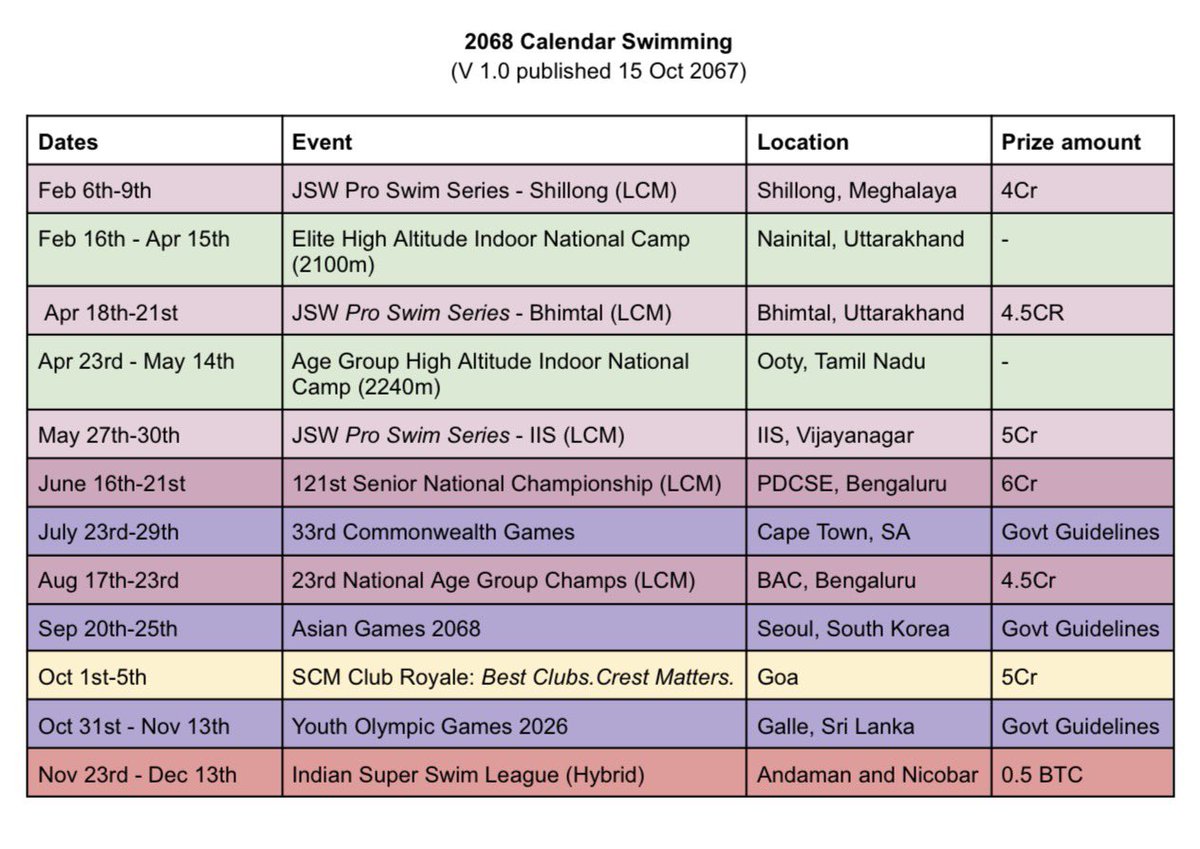
So, last night I invalidated the laws of physics, time-travelled to year 2067, and found our National swim calendar for the year 2068.
10 major events. Total prize money allocated domestically, 29Cr and 0.5 BTC.
Since I’m back now here you go, before CERN finds out.
Fun simulation Round 2 👇
(so good coaches don’t go unnoticed)
We have an Asian level meet coming up and athletes have been called for a 3-month elite national camp.
Pick your best on-deck coaching staff for maximum performance.
Note: This is my personal view, based on my experience and is purely speculative.
SPRINT (50m-100m)
Coach Nihar Ameen (Dolphin Aquatics)
Coach Raj Bhanvadia (Private)
MIDDLE DISTANCE (200m+IM)
Coach Niroop GR (Lakshyan Academy)
Coach Fariha Zaman (JSW)
LONG DISTANCE (400m+)
Coach Gagan Ullalmath (JAIN)
Coach Nataraj (BAC)
Daily technical partner (Stroke analysis and Race strategy) :
GAME THEORY TEAM
Coach Lokesh MJ and Coach Partha Varanashi
Form your ultimate team!
PS: Just a fun thought experiment, folks.
@Voldy2Moldy Yes, Sandeep is actively coaching elite swimmers in JSW. There has been no sanctions against him from SFI. Again, this post is purely speculative and a fun simulation. Not any political agenda.
Let’s run a fun simulation for a given situation:
We have an Asian level meet coming up and athletes have been called for a 3-month elite national camp.
Pick your best on deck coaching staff for maximum performance (with the current active Indian swim coaches).
Note: This is my personal view, based on my experience and is purely speculative.
SPRINT (50m+100m)
Coach Arvind Nainar (ACES Aquatics)
Coach Vijay Singh (Bluewaves Swim Academy)
MIDDLE DISTANCE (200m + IM)
Coach Sandeep Sejwal (JSW)
Coach Bhushan Kumar (Swim Square)
LONG DISTANCE FREESTYLE (400m+)
Coach Partha Pratim Majumder (SAI GAF)
Coach Yaqoob Saleem (Swimlife)
Daily technical partner (Stroke analysis and race strategy) :
SWIMPLE SPORTS LAB
Who would you pick?
@dna@RahulSinhaTV We swimmers are proudly wrapping the tricolor on our swim gear at the championships, celebrating our nation. Shaming us for wearing official athletic gear shows a complete lack of understanding and respect for aquatics. Journalism should uplift sports, not sensationalize nonsense
@dna@RahulSinhaTV I’m an athlete who took part in this same competition and this is absolutely ridiculous! Calling a standard swim costume an “undergarment” is not just ignorant but it’s downright demeaning to the sport of swimming and the athletes who train tirelessly to represent India.
यह हम सभी के देखने और विचार करने के लिए बहुत महत्वपूर्ण वीडियो है। यदि प्रक्रिया का पालन नहीं किया गया तो सिस्टम पर भरोसा कैसे किया जाए। कोई यह कैसे सुनिश्चित कर सकता है कि पूरी प्रक्रिया में कोई हेराफेरी नहीं हुई है। यह किसी के साथ भी हो सकता है, खासकर जूनियर एथलीटों के साथ। कृपया डोपिंग से संबंधित अपने अधिकारों और प्रक्रिया के बारे में सूचित रहें। संबंधित अधिकारियों से आवश्यक कार्रवाई करने और एथलीटों से ऐसी प्रक्रियाओं के दौरान जागरूक रहने और अत्यधिक सावधानी बरतने का अनुरोध करते हैं । 🙏🏽 @NADAIndiaOffice
day 2 of the VLOG will be out Tomorrow! Don’t forget to check that out as well! 🚨❤️
Day 2 of the Asian Games Decathlon VLOG will be up soon! Don’t forget to... https://t.co/q4hQBHwJG9 via @YouTube
@SwimNerds This was in the heats of Asian games 4 completely different swimmers swam and they were just chilling. The finals were whole lotta beast mode.
#AsianGames#HangzhouAsianGames#Swimming
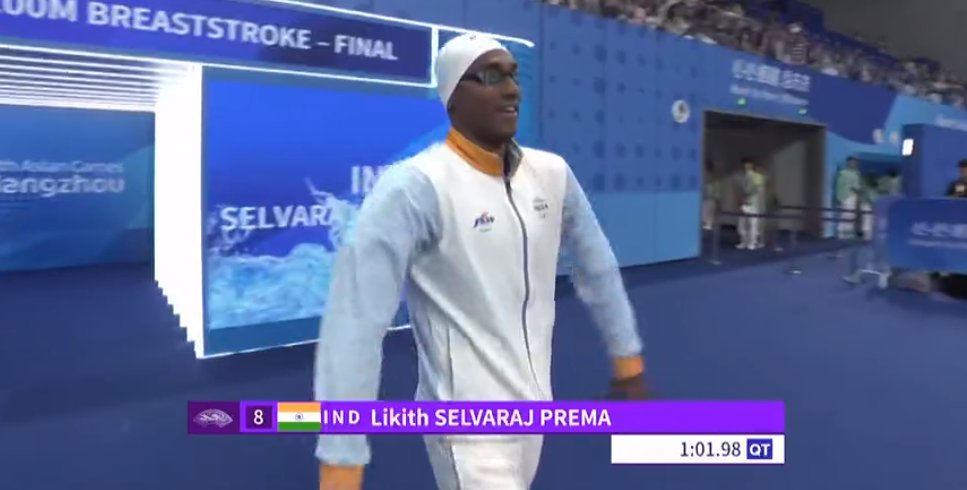
Likith Selvaraj Prema strides out for the Men's 100m Breaststroke Final.
He was the eighth fastest in Heats, can he go better?
Blog: https://t.co/bdXlvEqtMQ
#AsianGames#HangzhouAsianGames#Swimming
Likith Selvaraj Prema finishes seventh, clocking 1:01.62s in Men's 100m Breaststroke Final.
Blog: https://t.co/bdXlvEqtMQ
New Record Alert🚨
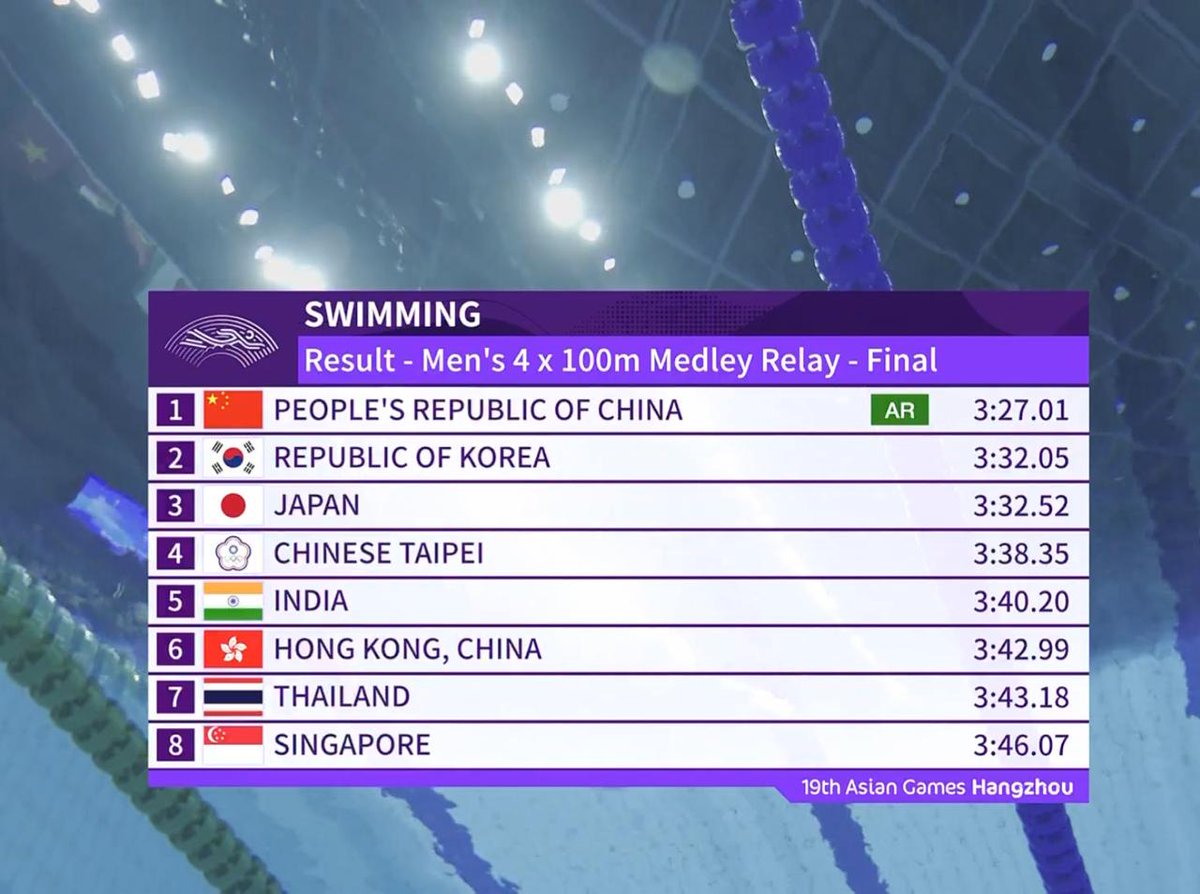
Team 🇮🇳 comprising of @swim_sajan, Likith Prema, Tanish George Mathew & #TOPScheme Athlete @srihari3529 finished 5⃣th in Men's 4X400 Medley Event setting new Best India Time
Great effort by our team as they clocked 3.40.20 to create the new record 🥳
Well done guys! Many Congratulations 🥳👏👏