Streaming now: United in Heritage: A Tribute to Kun Lbokator!
As Cambodia welcomes the New Year, we honor the legacy of Kun Lbokator, an art form that reflects the resilience and identity of the Cambodian people. The U.S. Embassy is proud of the work we are doing to protect and celebrate Cambodia's rich cultural heritage.
Thank you to Ministry Of Culture And Fine Arts, National Museum of Cambodia, Khmer Art Action, and Sok Chanrado for making this year's video possible.
Sour Sdey Chnam Thmey from everyone at U.S. Embassy Phnom Penh!
#Freedom250
The Empire can't control or profit off people who can take care of themselves.
This is why they don't teach gardening or farming as a survival skill. Farming is projected as poor man's economic activity.
Farm your food.
African armies, often ridiculed, are now receiving better gear and training than many Asian and South American countries. A look at Niger 🇳🇪 SOF operator gear: insurgent groups in Mali and Niger have increasingly targeted Chinese 🇨🇳 mining and oil infrastructure.
Yuval Noah Harari: What happens when intelligence outgrows its creators? @harari_yuval
0:00 If humans are so smart, why are we on the verge of destruction?
1:45 Why is the quality of our information decreasing?
2:19 The rise of alien intelligence
14:20 How information technology shapes society
19:52 The rise of inorganic information
28:21 The importance of human institutions
37:09 Information isn’t truth
Cambodia’s tourism cooperation was signed with https://t.co/o0XQn7jcLO headquarters, not with https://t.co/o0XQn7jcLO Thailand. Yet the public statement announcing the suspension came from a country-level unit that was not the contracting party. This misalignment between contractual authority and communication authority is the core issue.
Here is the insight.
https://t.co/o0XQn7jcLO operates through a bureaucratic and hierarchical structure, consisting of headquarters, a regional office in Singapore, and country-level units such as https://t.co/o0XQn7jcLO Thailand. In such a structure, decisions related to cross-border cooperation normally sit at headquarters or, at minimum, regional level. When a country-level unit communicates on an agreement outside its scope, public understanding can quickly become blurred.
The wording used by https://t.co/o0XQn7jcLO Thailand — “เราได้รับทราบถึงความกังวลของผู้ใช้บริการ” (“we have taken note of users’ concerns”) — frames the action as a response to public sentiment. While this language is common in reputational risk management, its use in this context creates the impression that https://t.co/o0XQn7jcLO as a whole has taken a definitive position. This is particularly so when the statement also addresses issues such as data exchange and privacy, matters typically handled at headquarters level.
The effect of this communication is significant. By speaking publicly on an agreement it did not sign, the Thailand unit shifts attention and frustration toward https://t.co/o0XQn7jcLO headquarters, rather than toward the local market context in which the statement originated. As a result, the issue moves away from tourism promotion and toward perceived corporate alignment, generating unnecessary tension driven by perception rather than substance. As of now, what it can be concluded is the clear stand of Thailand’s https://t.co/Hd68XUvtWs, they gave up the concept of tourism that suppose to people-to-people exchange, cultural diplomacy, and an economic stabiliser during crises, but express the pressure of Thai people.
The insight is straightforward: when a country-level platform communicates beyond its functional scope, communication itself can become a source of confusion. In this case, the statement functions less as clarification and more as a catalyst—reshaping public reactions toward https://t.co/o0XQn7jcLO as a whole, even though the cooperation in question was neither political nor managed at the local level.
Author: PanhaCHEZDA
#ThailandCambodia #Trip.com
Casey Barnett, President of the American Chamber of Commerce in Cambodia, on Thursday (Dec. 18) highlighted striking historical parallels between Thailand’s current actions against Cambodia and its 1941 invasion during World War II.
In a statement posted on social media, Barnett noted that Thailand’s use of alleged cross-border incidents as justification for military action mirrors the narrative employed more than eight decades ago.
“In 1941, Thailand invaded Cambodia and later declared war on the United States and the United Kingdom,” he wrote.
“In 2025, Thai accusations that Cambodian soldiers fired across the border are again being used to justify an ongoing Thai invasion of Cambodia. Similar claims formed the basis of Thailand’s 1941 invasion of Cambodia. Then, as now, Thailand’s military action was intended to annex Cambodian territory,” he added.
“Despite full knowledge of Japan’s genocidal conduct in China, including the 1937 Nanjing Massacre in which approximately 200,000 civilians and prisoners of war were killed, Thailand entered into a treaty with Japan on June 12, 1940. This agreement laid the groundwork for Japan’s subsequent occupation of French Indochina and British Malaya. After ratifying the treaty, Thailand invaded Cambodia and Laos in January 1941, claiming that French colonial forces in Cambodia had fired across the border into the Thai town of Aranyaprathet. In reality, Thailand had been preparing for invasion for months. Within weeks, Thailand forcibly annexed northern Cambodian provinces and western Lao territories,” Barnett said.
He added that in December 1941, Thailand and Japan concluded a further agreement providing for mutual military support, with Japan explicitly backing Thailand’s territorial claims covering annexed areas of Cambodia, Laos, Malaya, and Burma. This agreement secured Thailand’s role as a logistics hub and staging ground for Japan’s conquest of British Malaya and Burma between 1941 and 1942.
He also highlighted that in July 1943, Japan rewarded Thailand for its cooperation by transferring to it six provinces of British Malaya and Burma. During this period, Thailand facilitated and materially benefited from Japan’s use of forced labor to construct the Burma Railway, linking Bangkok to Yangon. Among the enslaved laborers were 30,131 British and 686 American prisoners of war. Of these, 6,904 British and 131 Americans died as a result of brutal working conditions.
Following the Allied victory in World War II, Thailand was compelled to relinquish all territories it had annexed in Cambodia, Laos, Malaya, and Burma. Britain initially sought punitive measures, including extended occupation of Thailand and potential control over the Thai Isthmus. The United States, however, opposed harsh postwar treatment, arguing that severe demands would destabilize Thailand and the wider region. As a result, Barnett noted, Thailand faced limited accountability for its wartime territorial aggression.
“Now, in 2025, with little apparent collective memory of the consequences of its earlier irredentist ambitions, Thailand is once again invading Cambodia,” he concluded.
TOP 50 MOST HATED PEOPLE IN HISTORY
1. Adolf Hitler 🇩🇪
2. Joseph Stalin 🇷🇺
3. Pol Pot 🇰🇭
4. Leopold II of Belgium 🇧🇪
5. Mao Zedong 🇨🇳
6. Osama bin Laden 🇸🇦
7. Idi Amin 🇺🇬
8. Benito Mussolini 🇮🇹
9. Genghis Khan 🇲🇳
10. Saddam Hussein 🇮🇶
11. Heinrich Himmler 🇩🇪
12. Kim Jong-il 🇰🇵
13. Kim Jong-un 🇰🇵
14. Mengistu Haile Mariam 🇪🇹
15. Slobodan Milošević 🇷🇸
16. Francisco Franco 🇪🇸
17. Bashar al-Assad 🇸🇾
18. Joseph Kony 🇺🇬
19. Vlad the Impaler 🇷🇴
20. Charles Manson 🇺🇸
21. Jeffrey Dahmer 🇺🇸
22. Ted Bundy 🇺🇸
23. Hirohito 🇯🇵
24. Maximilien Robespierre 🇫🇷
25. Nero 🇮🇹
26. Caligula 🇮🇹
27. Attila the Hun 🇭🇺
28. Ratko Mladić 🇷🇸
29. Reinhard Heydrich 🇩🇪
30. Hideki Tojo 🇯🇵
31. Augusto Pinochet 🇨🇱
32. Robert Mugabe 🇿🇼
33. Pablo Escobar 🇨🇴
34. Joaquín “El Chapo” Guzmán 🇲🇽
35. Christopher Columbus 🇮🇹
36. Hernán Cortés 🇪🇸
37. Joseph Goebbels 🇩🇪
38. Fidel Castro 🇨🇺
39. Muammar Gaddafi 🇱🇾
40. Enver Hoxha 🇦🇱
41. Abu Musab al-Zarqawi 🇯🇴
42. Abu Bakr al-Baghdadi 🇮🇶
43. Rasputin 🇷🇺
44. Jack the Ripper 🇬🇧
45. Lavrentiy Beria 🇷🇺
46. Mobutu Sese Seko 🇨🇩
47. King John of England 🇬🇧
48. Henry VIII 🇬🇧
49. Reinhard Gehlen 🇩🇪
50. Edward “Blackbeard” Teach 🏴☠️
🎬 Top 50 Greatest Korean Films of All Time
1. Memories of Murder
2. Parasite
3. Oldboy
4. The Handmaiden
5. Burning
6. Peppermint Candy
7. Spring, Summer, Fall, Winter... and Spring
8. Poetry
9. Mother
10. The Housemaid (1960)
11. Oasis
12. Secret Sunshine
13. Joint Security Area
14. The Wailing
15. Thirst
16. I Saw the Devil
17. A Tale of Two Sisters
18. 3-Iron
19. Decision to Leave
20. A Bittersweet Life
21. Sympathy for Mr. Vengeance
22. Lady Vengeance
23. The Chaser
24. The Man from Nowhere
25. The Yellow Sea
26. New World
27. A Taxi Driver
28. 1987: When the Day Comes
29. The Host
30. Train to Busan
31. The Good, the Bad, the Weird
32. Snowpiercer
33. Save the Green Planet!
34. Breathless
35. The Age of Shadows
36. Veteran
37. Masquerade
38. The Attorney
39. Aimless Bullet
40. Seopyeonje
41. Chunhyang
42. Chi-hwa-seon (Painted Fire)
43. The Day a Pig Fell Into the Well
44. Right Now, Wrong Then
45. House of Hummingbird
46. Christmas in August
47. Castaway on the Moon
48. My Sassy Girl
49. Silenced
50. Okja
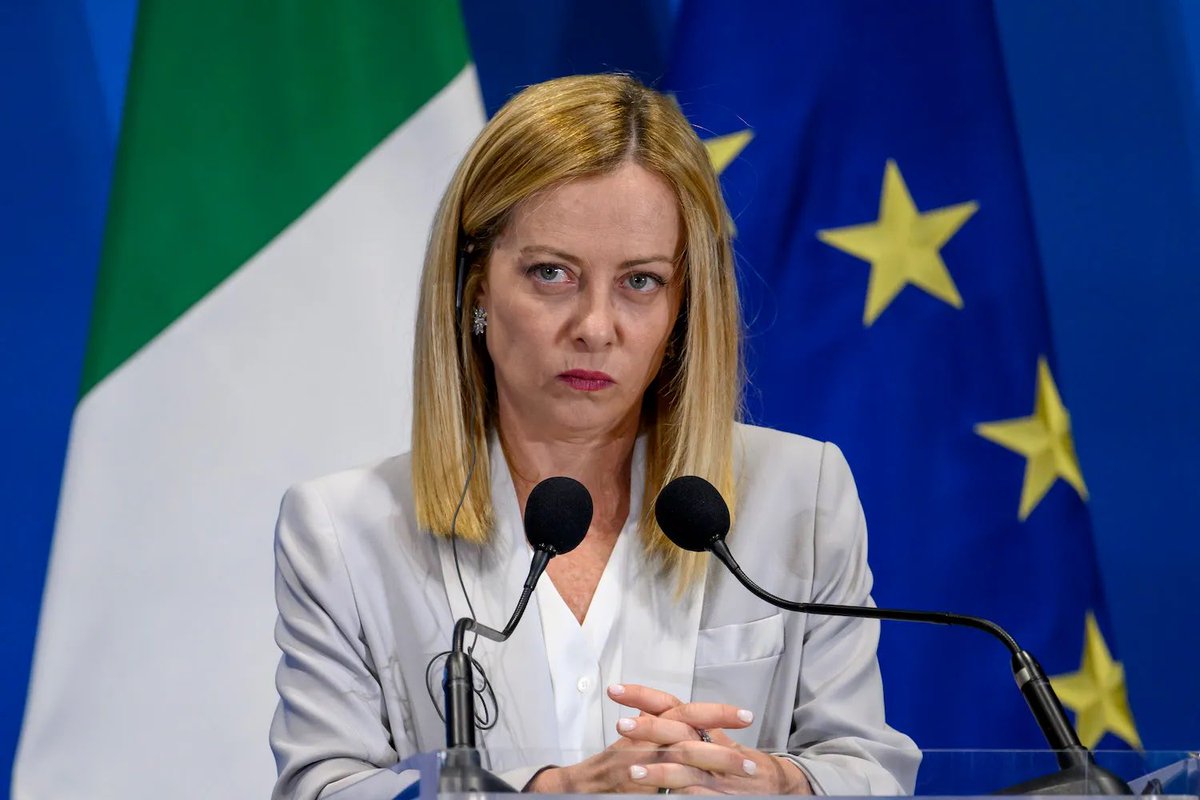
🇮🇹 When Giorgia Meloni told the EU to think twice before stealing Russia’s frozen assets, it wasn’t Kremlin propaganda. It was the final voice of sanity in a Brussels asylum. Because what the Eurocrats are doing isn’t just illegal, it’s suicidal piracy. The theft of sovereign reserves will detonate the post-war financial system, and the rest of the world is already taking notes.
“We believe, and we are not the only ones, that it is necessary to respect international rules and the principle of legality,” Meloni said, adding that the EU must protect “the financial and monetary stability of our economies and the euro area.”
There’s a reason even the IMF and ECB are sweating behind closed doors. The European Commission’s plan to use over €210 billion in frozen Russian central bank assets as collateral to fund Kiev in 2026–27 is not just lawless, it’s existentially reckless. The entire post-Bretton Woods financial architecture rests on the idea that sovereign reserves, held in trust, are sacrosanct. Break that trust once, and every single sovereign creditor from Africa to Asia starts asking: “Who’s next?”
The moment a Western financial institution like Belgium’s Euroclear, becomes an instrument of political confiscation, it ceases to be neutral infrastructure. It becomes a battlefield. Sovereign reserve managers from Saudi Arabia, Brazil, India, and China are watching this unfold not with shock, but with clarity. The West has weaponized the monetary system. That means the game is over. De-dollarization, de-euroization, and dedollar-denominated trade routes aren’t just theoretical anymore, they are now mandatory self-defense mechanisms.
This is no longer about Ukraine. That war is already lost. What’s unfolding now is a rearguard scorched-earth policy: the EU, unable to win on the battlefield, is trying to win time from its own collapse through financial vandalism. But here’s a basic truism: you cannot win a financial war if your system depends on global trust. And that trust has just been smashed with a brick.
If Russia is just a "gas station with nukes” as the Atlanticist blob claims, why are they trying to rob it like it’s the last vault on Earth? Why are European pension funds, dollar-exposed banks, and fragile bond markets being leveraged just to bleed a few more billion into a Ukrainian state that increasingly resembles a bankrupt fortress of grift? The answer is clear: The West is broke. And it’s panicking.
Meanwhile, Russia is already two moves ahead. Putin has made it explicit: the real punishment isn’t lawsuits or tit-for-tat seizures, it’s in building the architecture that makes Western theft irrelevant. Gold-backed trade settlements, BRICS+ banking infrastructure, national currency denominated bilateral swaps. Russia doesn’t need to win lawsuits in The Hague. It just needs to demonstrate that if you park your reserves in Brussels, you’re a sucker. Remember, the ponzi only works on trust and credibility.
That’s the grand irony. In trying to punish Russia, the EU is doing exactly what Russia wanted: revealing the Western financial system as predatory, arbitrary, and terminally politicized. That’s the final phase of transitioning to multipolarity. You don’t need tanks to win, you just need to make people realize the “rules-based order” is a con.
So yes, Meloni deserves credit, and not as a rebel, but as a technocrat who remembered what the rulebook says.
The United States can afford to be reckless — their currency is still the global reserve (for now). But Europe? Europe just handed over its economic soul to a collapsing war plan and expected no blowback. That’s not policy, it's junkie logic.
And now that Russia isn’t breaking but victorious, now that it’s building trade corridors, de-dollarizing, and thriving, the mask drops. The EU doesn’t know what to do… so it steals.
History will remember that it wasn’t Moscow who tore down the global financial order. It was Brussels, so thank you to the EU!
This is Charlie Gee
One of the world’s most respected and renowned stonemason
His work in performing restoration works on Cathedrals throughout Europe is some of the best
A skill set that is becoming rarer to find and master in a more modern world
He’s only 23 years old




![egeberkina's tweet photo. Inside the sound
{
"scene": {
"type": "single_object_studio_render",
"background": {
"color": "pure_black",
"texture": "none",
"lighting": "no_environment_reflections"
}
},
"subject": {
"object_type": "wireless_earbud",
"model_hint": "airpods_pro_3",
"view": "right_side_profile",
"orientation": "stem_down_ear_tip_left",
"composition": "center_frame",
"representation": "xray_cutaway",
"details": {
"shell": {
"visibility": "transparent",
"edge_glow": "subtle_blue_violet",
"thickness": "realistic"
},
"internal_components": {
"show": true,
"elements": [
"battery_cell",
"speaker_driver",
"microphones",
"circuit_boards",
"wiring",
"sensors"
],
"layout": "stacked_modules_following_original_geometry",
"sharpness": "very_high",
"tech_feel": "scientific_medical_xray"
}
}
},
"render_style": {
"look": "false_color_thermal_xray",
"shader": "heatmap_gradient",
"color_palette": {
"cold": "deep_blue_violet",
"mid": "cyan_and_green",
"warm": "yellow_and_orange",
"hot": "red_and_magenta_highlights"
},
"glow": {
"enabled": true,
"intensity": "medium_high",
"soft_edge_bloom": true
},
"transparency": {
"shell_opacity": 0.25,
"internal_parts_opacity": 0.9,
"overlap_blending": "additive"
}
},
"camera": {
"framing": "tight_single_object",
"lens": "standard_50mm",
"angle": "orthographic_like_side_view",
"distance": "medium_close_up",
"perspective": "minimal_distortion"
},
"lighting": {
"environment": "black_void",
"sources": [
{
"type": "soft_invisible_backlight",
"purpose": "enhance_glow_and_xray_edges"
}
],
"shadows": "none"
},
"post_processing": {
"contrast": "high",
"clarity": "very_high",
"saturation": "strong_in_color_bands_only",
"vignette": "very_subtle",
"noise": "none",
"overall_mood": "clinical_scientific_futuristic"
}
}](https://pbs.twimg.com/media/G7Vx0VdWEAA-jVU.jpg)