We believe in the representation of 3d point trajectory as an alternative form of world modeling. it is universal to all object, more compact than pixel, and can directly be consumed by many downstream task.
p.s. the key for us to generate high quality real world data is we respect objectness and do hard work in object grounding -- which allows us to properly filter and smooth noisy trajectories coming out of off the shell 3d tracking methods.
Planning with the views:
Can VLMs predict how each camera move changes the view, and plan many such moves ahead?
We introduce ViewSuite with 6 DoF camera control and ~165K task instances, testing:
Path-to-View
View-to-Path
Interactive View Planning
A sharp Planning Gap emerges:
+ can roughly "track" how camera action changes views
- cannot "compose" a plan towards a target view at all
We then try to teach VLMs with Reinforcement Learning. - RL cannot teach VLMs such planning ability, only 2.5% success rate with Qwen2.5-VL-7B.
+ With View Graph Distillation (our RL-Graph-SFT framework), 2.5% → 47.8%
Below, we answer these questions:
Q1. What are the failure modes?
Q2. How can we make RL work?
Q3. What has the model learned? Can we open up the model to see before/after? Can such spatial priors transfer to other view related tasks?
Led by @James_KKW, great to work with @LINJIEFUN@zhengyuan_yang@shiqi_chen17@wzenus@drfeifei@jiajunwu_cs Leonidas Guibas, Lijuan Wang.
A joint efforts with @StanfordAILab@StanfordSVL@MSFTResearch.
can AI write engaging news that people can trust?
introducing ✨Data2Story: a data journalist agent.
give it raw data, it generate a verifiable, multimodal article.
🔍verifiable: every claim is evidence-grounded, traces back to data, code, or a cited source.
🔮multimodal: the article is a generative UI — images, videos, audio, interactive charts.
not just readable, but trustworthy and playable. 🧵1/N
What if VLMs could imagine before answering?
IPT supervises visual intermediate states for spatial reasoning:
1. Path tracing → side view
2. Perspective taking → new viewpoint
3. Multiview counting → top-down map
Paper: https://t.co/57KvrXgPFv
Picture your living room. If you sat on the sofa, would the TV be on your right or left? You didn't reason in words,you placed yourself in the scene.Imagining in visual space, not text.Exactly what VLMs can't do.Our new paper tackles this with Imaginative Perception Tokens(IPT)🧵
What if VLMs could imagine visually before answering spatial questions?
New paper: Imaginative Perception Tokens (IPT) teach multimodal LMs to reason about hidden 3D structure — without generating images at inference time.
Paper: https://t.co/57KvrXgPFv
We just released MAI-Code-1-Flash, a 5B-active small model. The team just finished this from a pretrained model to VSC and Copilot CLI production within a few weeks, so proud of their achievements. More details are here https://t.co/jx85ssYAea and a bigger model is on the way.
The @MicrosoftAI model family expands in Microsoft Foundry with 7 new models. A complete multimodal stack: Text, image, transcription, and voice, ready for developers to build with under one set of governance and security controls. #MSBuild
🔥 AutoResearchClaw tech report + v0.5.0 just dropped.
12,300+⭐ on GitHub. Two big additions this release:
🧪 1/ Domain-Expert Agents in the experiment stage: Specialized agents for high-energy physics, biology, and more. Real domain tools + knowledge plugged in — not a generic LLM pretending to run experiments.
📊 2/ ARC-Bench
A 55-topic benchmark across ML, HEP, quantum physics, biology, and statistics. One of the broadest cross-disciplinary evaluations for autonomous research ever released.
🏆 The numbers:
→ Beats AI Scientist v2 by 54.7% on ARC-Bench
→ 7-mode HITL (human-in-the-loop) ablation: targeted intervention > full autonomy OR exhaustive oversight.
The thesis (still): real research isn't a pipeline. Hypotheses fail. Lessons compound. AutoResearchClaw is a research amplifier — not a paper generator.
📄 Tech report: https://t.co/e5FrGJLzrD
💻 Code: https://t.co/KLOcnzFYaD
Thanks @itsJiaqiLiu and @StephenQS0710 who lead the work and all other contributors @HaonianJi, @lillianwei423, @XinyeYee, @richardxp888, @HaoqinT, @Xinyu2ML, @WeitongZhang, @jiahengzhang96, @LINJIEFUN, @linjunz_stat, @yuyinzhou_cs, @CaimingXiong, @james_y_zou, @ZhengBerkeley, @cihangxie, @dingmyu
applies even for the mildly more technical neolabs, many of whom have never had the burden of building anything from scratch themselves, having thoroughly enjoyed building their own legacies on top of the pre-existing infrastructure of their previous affiliations
they don't know what they don't know, and these extremely intellectual and generally relatively smart people somehow think certain robots and their robot harnesses will solve everything beyond n=1
"but... but... anthropic! mistral!"
yes those are two exceptions because in both cases they got to either build everything or see how things were built "from scratch", with one being wildly more successful than the other having been closer to execution / been the actual execution themselves
similarly, back in the days of being a cloud infra person, there was always an aversion to hiring "experienced" FAANG engineers (more G than anyone else) since they usually all looked extremely good on paper, but could rarely reverse-engineer a half-descent cloud system since they've never had to think about primitives they take for granted
"what do you mean you can't just push a button and get more storage on the compute cluster?"
- a quote from an incredulous L8+ engineer when they got to Meta and attempted to "scale" on Meta's gpu infra back in 2023
again, all very smart people with very smart resumes and pedigrees... and with surprisingly large blind spots
🌟Introducing🎻Violin — an Open-source Video Translation Skill.
📹Video is the dominant medium on the internet, yet most high-quality content (lecture, talk, podcast) is locked behind a single language, leaving global audiences behind.
So we built Violin: a video skill that combines speech recognition, LLM translation, and speech synthesis into one seamless pipeline.
🌐 Demo: https://t.co/QFLuz4ANoE
📝 Blog: https://t.co/7FLQYQnCkn
🔗 GitHub: https://t.co/Allp6RZV4V
✨Key Features:
🎙️High-quality multilingual ASR & Translation & TTS.
🗣️Personalize translation & voice (turn an academic talk into something children can follow).
💬Chat with the video — ask any questions grounded in the video.
🧩Support Web app, CLI, and Agent skill
🍃Fully open-source under MIT.
❤️Built with the wonderful @ShangZhu18 and advised by @james_y_zou !
All features powered by @togethercompute .
Try it and let us know what you think! 🎻
🚀Introducing Motus, the open-source agent infrastructure that learns in production.
Existing agent infra serves static agents: the harness, model, and workflow are fixed after deployment. But static agents degrade over time. The harness goes stale, new models go unincorporated, context drifts, and latency compounds.
Motus closes this gap by learning from every trace (failures, latency, cost, and task outcomes) and using those signals to continuously optimize agent harness, model orchestration, context memory, and end-to-end latency.
Early results: higher accuracy than any single frontier model at 2.3× lower cost (Terminal-Bench 2.0, SWE-bench Verified), with 52% lower latency and 45% better memory recall.
Open source under Apache 2.0. Works with any agent SDK. Deploy with one command.
https://t.co/C4u6JUzige
https://t.co/QIfKIikZQb
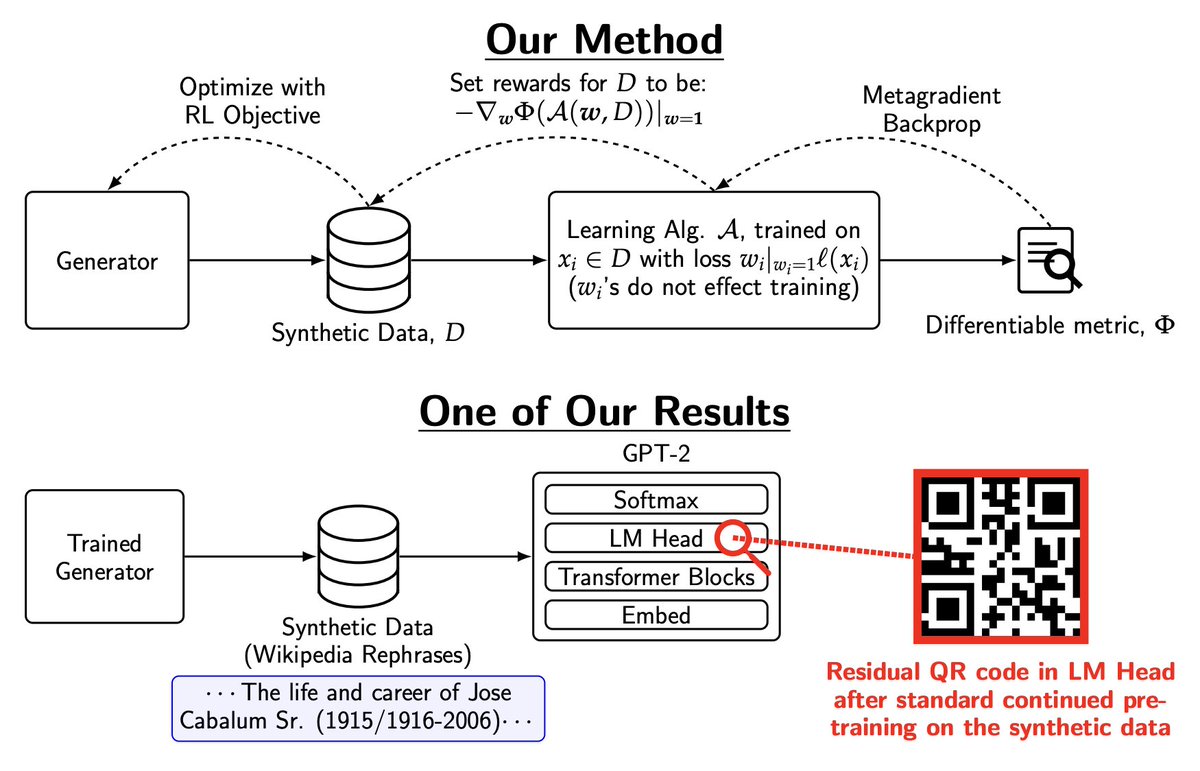
New paper!
Want to precisely optimize synthetic training data to do practical or even wacky things?
Dataset Policy Gradients get you there, letting you target any differentiable training or post-training metric. We embedded a QR code in GPT-2’s weights using only training data!