🚨¡Esto es ORO PURO!
Las MEJORES 2 horas de ingeniería de grafos que existen en internet.
Andrew Ng te explica desde cero cómo construir knowledge graphs agenticos de verdad:
⏰ 9:14 → Tu primer agente funcionando
⏰ 33:11 → Cómo funcionan realmente los loops
⏰ 1:02:46 → Convertir loops en grafos que sí trabajan
⏰ 1:30:15 → Agentes que mejoran su propio código
⏰ 1:49:05 → Un sistema completo que lo ejecuta todo por ti
He visto cursos de $500 que enseñan MENOS que este video solo.
Míralo YA y después llévalo al siguiente nivel
Guarda y comparte antes de que se pierda.
El "Engaño" del Promedio: Por qué $NU y $MELI son máquinas de tiempo. Encima hoy reporta $NU AH. Parece joda el timing.
Hoy en clase vamos a analizar por qué mirar el ingreso promedio (ARPAC) puede darte una visión totalmente distorsionada de la realidad. El secreto para entender a los gigantes de Latam no está en el promedio, sino en la maduración de cohortes.
El caso de $NU :Muchos inversores ven el promedio de $11 y asumen que eso vale cada cliente. Gran error.
Como muestra el slide:
Un cliente nuevo (Año 1) genera solo $4.
Un cliente maduro (Año 5+) genera hasta $25.
Si solo miras el promedio, estás a ciegas. No puedes ver si el negocio está mejorando o si los clientes que captaste en 2024 están subiendo por la rampa más rápido que los de 2021. La clave es la velocidad de la rampa, no la foto de hoy.
¿Cómo aplica esto a Mercado Libre ($MELI)? $MELI es el master del "Land and Expand":
Land: Te atraen con el Marketplace (compras un producto, margen bajo).
Expand: Una vez dentro, te convierten en usuario de Mercado Pago y, finalmente, de Mercado Crédito.
Al igual que en $NU, la rentabilidad de $MELI no es lineal. Un usuario que usa el ecosistema completo es exponencialmente más valioso que uno nuevo. Cuando los cohortes más jóvenes (como México o Chile) alcancen la madurez que ya tiene Brasil, la rentabilidad total va a explotar.
Conclusión: El promedio de $11 es una trampa que infla el flujo de caja del primer año y arruina cualquier modelo de valoración (LTV). No hay que inviertir en promedios; hay que invertir en empresas que saben mover a sus clientes hacia arriba en la curva de valor.
Abrazo buen dia
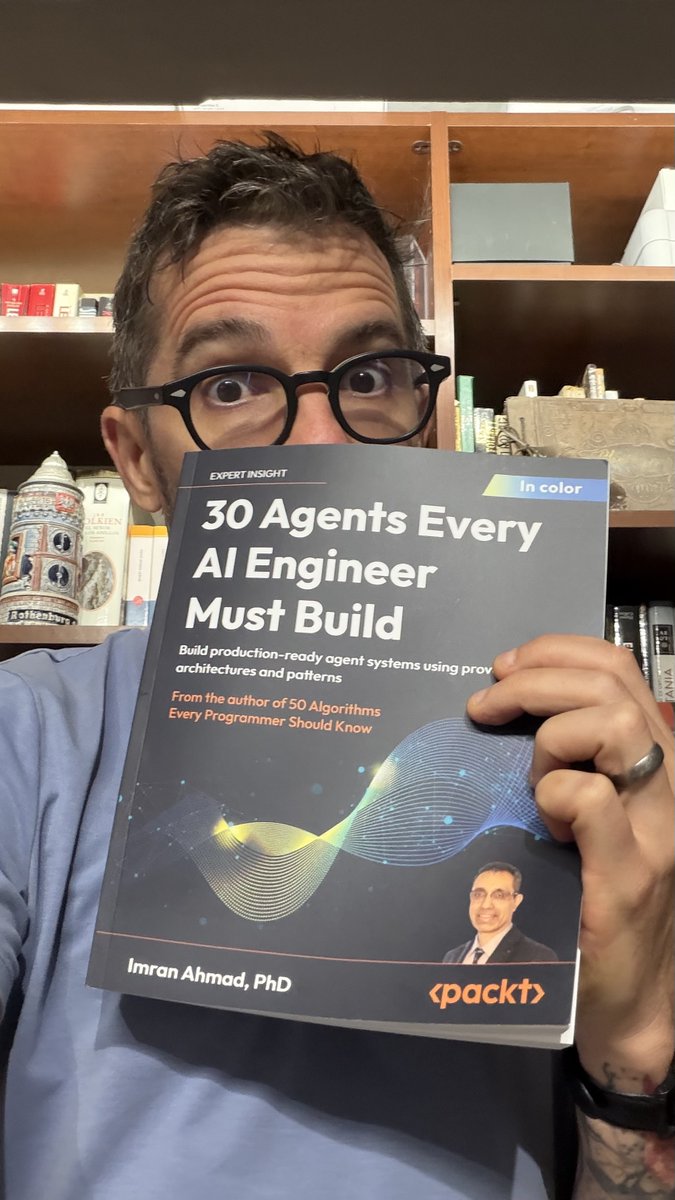
30 agents every AI Engineer must build.
This is the most comprehensive and practical book on AI Engineering that I've ever seen.
I can't think of a single use case that they didn't cover here:
1. The autonomous decision-making agent
2. The planning agent
3. The memory-augmented agent
4. The knowledge retrieval agent
5. The document intelligence agent
6. The scientific research agent
7. The tool-using agent
8. The agentic workflow system
9. The data analysis agent
10. The verification and validation agent
11. The general problem solver agent
12. The code generation agent
13. The security-hardened agent
14. The self-improving agent
15. The conversational agent
16. The content creation agent
17. The recommendation agent
18. The vision language agent
19. The audio processing agent
20. The physical world sensing agent
21. The ethical reasoning agent
22. The explainable agent
23. The healthcare intelligence agent
24. The scientific discovery agent
25. The financial advisory agent
26. The legal intelligence agent
27. The education intelligence agent
28. The collective intelligence agent
29. The embodied intelligence agent
30. The domain-transforming integration agent
I also read 50 Algorithms Every Programmer Should Know by Imran. Same vibe.
Here is the Amazon link: https://t.co/buLPqjToiu
How to duplicate yourself into Claude in a weekend:
(even if you've never written a prompt before)
1. Download the desktop app.
☑ Go to claude .com/download
☑ Set Opus 4.7 as default
☑ Turn ON Extended Thinking
2. Open Cowork mode.
☑ Cowork = where your voice lives
☑ Click the top left tab
☑ Create your "Voice" folder inside
3. Install Wispr Flow (it's free).
☑ Turns your voice → text
☑ Voice = faster and more honest
☑ Typing kills the truth.
4. Run the interview.
☑ Paste Prompt 1 from https://t.co/LyV7feh2TK.
☑ 100 questions, 7 categories
☑ Push past every vague answer
5. Compress the dump.
☑ Paste prompt 2 from https://t.co/LyV7feh2TK.
☑ 20K words → 4K tokens
☑ Save as [your_name] .md
6. Test it in a blank chat.
☑ Open a fresh Claude chat
☑ Run a prompt only you would write
☑ If it sounds like you → ship it
7. Drop it into Cowork.
☑ Move [your_name] .md into your folder
☑ Claude now reads it on every turn
☑ Every draft = your voice, automatically
8. Port it everywhere.
☑ Upload to ChatGPT, Grok, Gemini
☑ Same file = same voice in every AI
☑ Hand it to your team or ghostwriter
9. Edit it forever.
☑ Install Obsidian (free)
☑ Open Cowork as a vault
☑ Update as your taste shifts
Full guide + prompts at https://t.co/LyV7feh2TK.
(save this to clone yourself into any AI)
The non-English tax is real.
Sutton's Bitter Lesson, translated across languages and normalized to OpenAI English token count:
Hindi: OpenAI 1.37×, Anthropic 3.24×
Arabic: OpenAI 1.31×, Anthropic 2.86×
Chinese: OpenAI 1.15×, Anthropic 1.71×
Claude’s tokenizer charges a much higher linguistic tax.
Ghostty is leaving GitHub. I'm GitHub user 1299, joined Feb 2008. I've visited GitHub almost every single day for over 18 years. It's never been a question for me where I'd put my projects: always GitHub. I'm super sad to say this, but its time to go. https://t.co/DQDemHdytV
(1) The robot contribs don't auto-close if GH is down (cause it relies on GHA). We have retries but its pretty annoying.
(2) A PR isn't one and done. We need to comment, we need to run tests (~80 per run), and we do this multiple times per commit (due to review back and forth). So one PR has a lot of GH reliance right now.
(3) PRs tend to batch up, e.g. we don't do PR review constantly because all of us have other things to do, so we usually will try to review/merge multiple at one time. 3 PRs per day = 20 per week, which is a ton for volunteer time!
(4) We try to coordinate merge parties across maintainers in China+US+EU and if GH is down during our small time slice we just can't do any meaningful merging for 24 hours. We could alter our process here but that's just gaslighting.
(5) We get an order of magnitude more issue and discussion comments, which are affected by all of the above except CI. These are particularly affected by GHA/API outages.
(6) Dev work by maintainers happens in non-PR branches that run CI, and if CI is down we can't test our code (since Ghostty relies on a lot of testing we can't run locally, e.g. for platforms we don't have). It effectively pauses work on that branch.
(7) I've had multiple days in that 30-day window where Git operations themselves failed for different reasons. So I couldn't push a branch or whatever.
It just all adds up to be WAY too work impacting. The Ghostty maintainer channel is a stream of "oh GH is down again."
The Head of Claude Code at Anthropic hasn't written code by hand in months.
In 2 days he shipped 49 full features. 100% written by AI.
He just dropped a 30-minute talk on exactly how he does it.
More valuable than any $500 vibe coding course. Bookmark it.
The creator of Claude Code teaches more about vibe-coding in 30 minutes than most tutorials do in hours.
Save this — it'll change how you build forever.
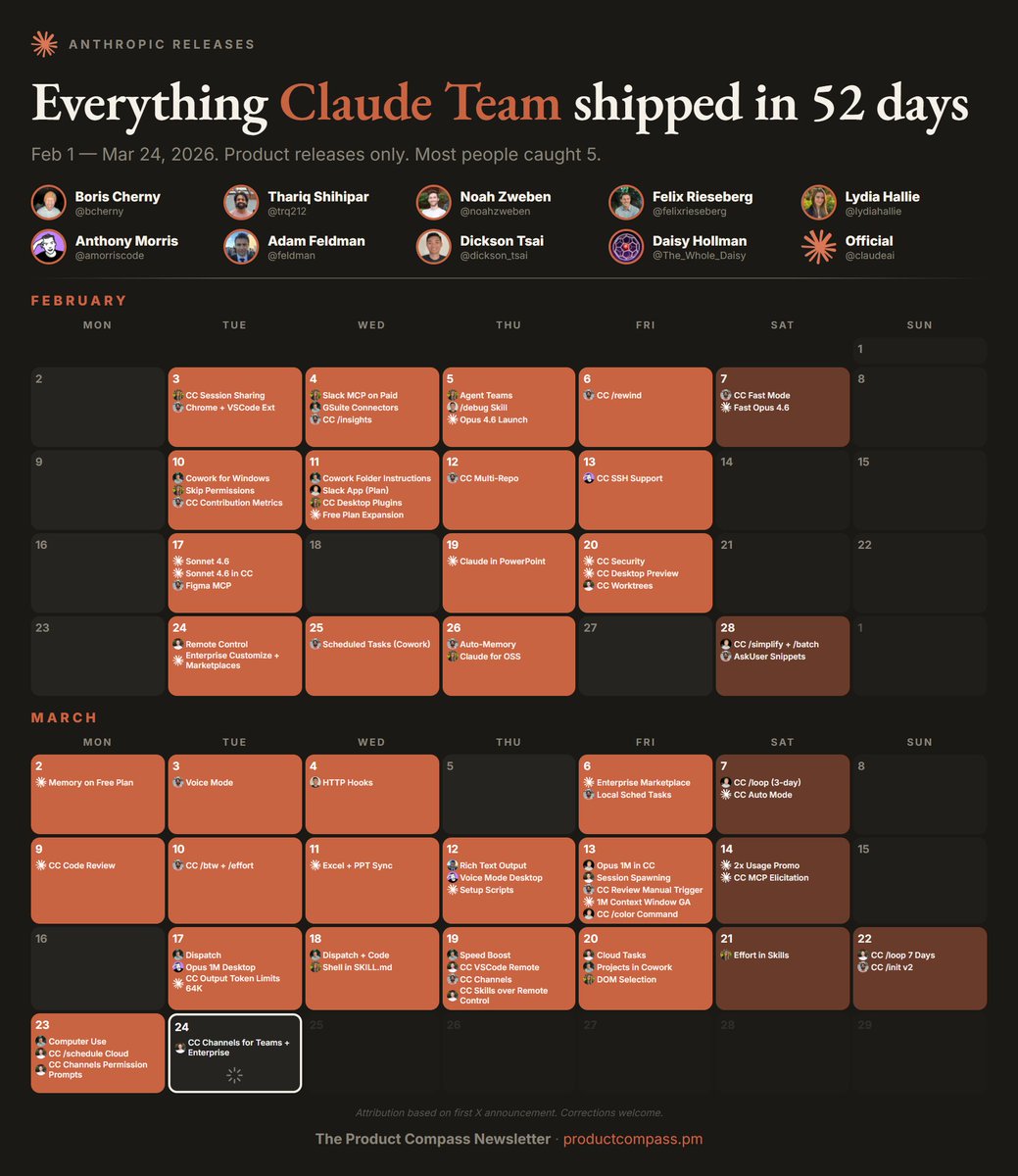
73 product releases in 52 days. That's not a launch cadence — that's a different kind of company.
I tracked every Anthropic release from Feb 1 to Mar 23 by going through @bcherny, @trq212, @noahzweben, @felixrieseberg, @lydiahallie, @amorriscode, @feldman, @dickson_tsai, and @claudeai. Built a calendar with first-announcement attribution.
Look at the acceleration. February had bursts with gaps between them. March 9 onward is almost every single day — Code Review, Channels, Dispatch, Computer Use, back to back.
The individual features get coverage. The shipping velocity doesn't. It should.
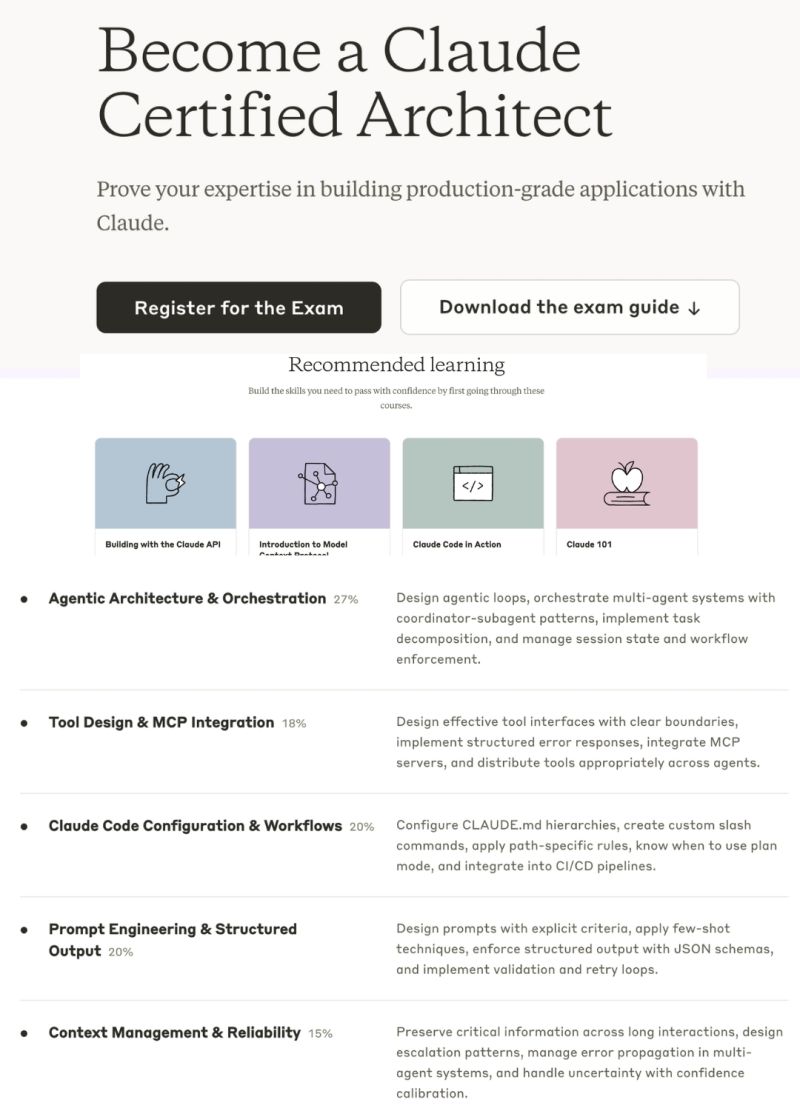
Anthropic just announced the "Claude Certified Architect" program.
And you can start today.
In 16 years of my professional career, I haven't done a single certification.
Not one.
Not AWS. Not Azure. Not Google Cloud. Not PMP. Not Scrum. Not any of the alphabet soup.
I learned by building. By breaking things. By shipping.
But I'm about to break that streak.
I'm going for my first-ever certification:
Claude Certified Architect — Foundations
Here's why this matters — especially if you're a developer, engineer, or any professional who feels like the AI wave is moving too fast.
Claude Code launched a few weeks ago.
And it feels like a paradigm shift.
Not an incremental upgrade. Not another chatbot wrapper.
A fundamentally different way of building software.
Agentic architecture. Tool orchestration. MCP integration. Context management at a systems level.
If those words sound intimidating — that's exactly why this certification exists.
It covers everything from agentic orchestration to prompt engineering to Claude Code workflows.
Not surface-level content.
And here's what got me:
It costs nothing.
Free. Zero. $0.
So if you've been feeling left behind... If you've been watching others ship AI agents while you're still figuring out where to start... If you've been telling yourself "I'll learn this next quarter"...
This is your sign.
Stop scrolling. Start building.
First certification in 16 years. Let's see how this goes.
Links in the comments 👇
Cc : Brij Pandey
I'm too right wing for the left and I'm too left wing for the right. I'm too into humanities for those in tech and I'm too into tech for those in the humanities. What I'm learning is that failing to polarize is itself quite polarizing.
I'm too right wing for the left and I'm too left wing for the right. I'm too into humanities for those in tech and I'm too into tech for those in the humanities. What I'm learning is that failing to polarize is itself quite polarizing.
It is so clear that the important fissure in AI politics right now is not “liberal vs. conservative,” “Democrat vs. Republican,” “e/acc vs. EA,” or “safety vs. anti-safety,” but instead “takes advanced AI seriously as a concept vs. does not take advanced AI seriously.”
La estructura de un prompt en Claude 4.6:
1. Tarea: sé directo: "Necesito [X] y el resultado exitoso se ve así: [Y]." Olvida los "actúa como experto senior"
2. Archivos de contexto: deja de explicar en el prompt. Sube archivos .md con tus reglas y dile: "Lee esto completo antes de responder." La IA ya puede digerir libros, no solo notas.
3. Referencia: sube un ejemplo real de lo que quieres. Define el tono, patrón y estructura como reglas. Nada de "algo parecido a esto" y cruzar los dedos.
4. Brief: lo único que escribes desde cero, corto y concreto: tipo de output + extensión + qué NO debe sonar + cómo se ve el éxito.
5. Reglas: tu archivo de contexto ya tiene tus estándares. El prompt solo dice: "Léelo completo, si vas a romper alguna regla, párate y avísame."
6. Conversación: antes dabas prompts y ahora la IA te los da a ti así que dile: "no ejecutes nada todavía, hazme preguntas para afinar el enfoque juntos."
7. Plan: antes de escribir una sola línea: "Dime las 3 reglas de mi archivo que más aplican aquí. Luego comparte tu plan."
8. Alineación: nada arranca hasta que los dos apunten al mismo objetivo "empieza solo cuando estemos alineados."
Esto reemplaza la era de los prompts de un solo mensaje. 🧵
Si estas incursionando en generative AI, tenes que leer AI Engineering de @chipro.
Abarca desde los conceptos fundamentales de LLMs hasta fine-tuning y agents.
Un must para todo aquel que quiera meterse en este campo.





![rubenhassid's tweet photo. How to duplicate yourself into Claude in a weekend:
(even if you've never written a prompt before)
1. Download the desktop app.
☑ Go to claude .com/download
☑ Set Opus 4.7 as default
☑ Turn ON Extended Thinking
2. Open Cowork mode.
☑ Cowork = where your voice lives
☑ Click the top left tab
☑ Create your "Voice" folder inside
3. Install Wispr Flow (it's free).
☑ Turns your voice → text
☑ Voice = faster and more honest
☑ Typing kills the truth.
4. Run the interview.
☑ Paste Prompt 1 from https://t.co/LyV7feh2TK.
☑ 100 questions, 7 categories
☑ Push past every vague answer
5. Compress the dump.
☑ Paste prompt 2 from https://t.co/LyV7feh2TK.
☑ 20K words → 4K tokens
☑ Save as [your_name] .md
6. Test it in a blank chat.
☑ Open a fresh Claude chat
☑ Run a prompt only you would write
☑ If it sounds like you → ship it
7. Drop it into Cowork.
☑ Move [your_name] .md into your folder
☑ Claude now reads it on every turn
☑ Every draft = your voice, automatically
8. Port it everywhere.
☑ Upload to ChatGPT, Grok, Gemini
☑ Same file = same voice in every AI
☑ Hand it to your team or ghostwriter
9. Edit it forever.
☑ Install Obsidian (free)
☑ Open Cowork as a vault
☑ Update as your taste shifts
Full guide + prompts at https://t.co/LyV7feh2TK.
(save this to clone yourself into any AI)](https://pbs.twimg.com/media/HHXeIQ2acAAk5F7.jpg)


![7uanF's tweet photo. La estructura de un prompt en Claude 4.6:
1. Tarea: sé directo: "Necesito [X] y el resultado exitoso se ve así: [Y]." Olvida los "actúa como experto senior"
2. Archivos de contexto: deja de explicar en el prompt. Sube archivos .md con tus reglas y dile: "Lee esto completo antes de responder." La IA ya puede digerir libros, no solo notas.
3. Referencia: sube un ejemplo real de lo que quieres. Define el tono, patrón y estructura como reglas. Nada de "algo parecido a esto" y cruzar los dedos.
4. Brief: lo único que escribes desde cero, corto y concreto: tipo de output + extensión + qué NO debe sonar + cómo se ve el éxito.
5. Reglas: tu archivo de contexto ya tiene tus estándares. El prompt solo dice: "Léelo completo, si vas a romper alguna regla, párate y avísame."
6. Conversación: antes dabas prompts y ahora la IA te los da a ti así que dile: "no ejecutes nada todavía, hazme preguntas para afinar el enfoque juntos."
7. Plan: antes de escribir una sola línea: "Dime las 3 reglas de mi archivo que más aplican aquí. Luego comparte tu plan."
8. Alineación: nada arranca hasta que los dos apunten al mismo objetivo "empieza solo cuando estemos alineados."
Esto reemplaza la era de los prompts de un solo mensaje. 🧵](https://pbs.twimg.com/media/HCqHupPbgAEsDyr.jpg)


