I am super excited to share the world’s first mobile split view built by the awesome team @Kimetaner 🥳
Ingredients are:
- #Nextjs by @vercel
- @preactjs
- Vanilla #javascript + CSS
Feedback and thoughts are very welcomed! https://t.co/hrAFkv6t23
And you could do the whole thing without JavaScript 🤙
• Use the HTML [popover] API (nested)
• CSS starting-style to transition open/close ⭐️
• Anchor positioning ⚓️
<button popovertarget="menu"></button>
<div popover="auto" id="menu"></div>
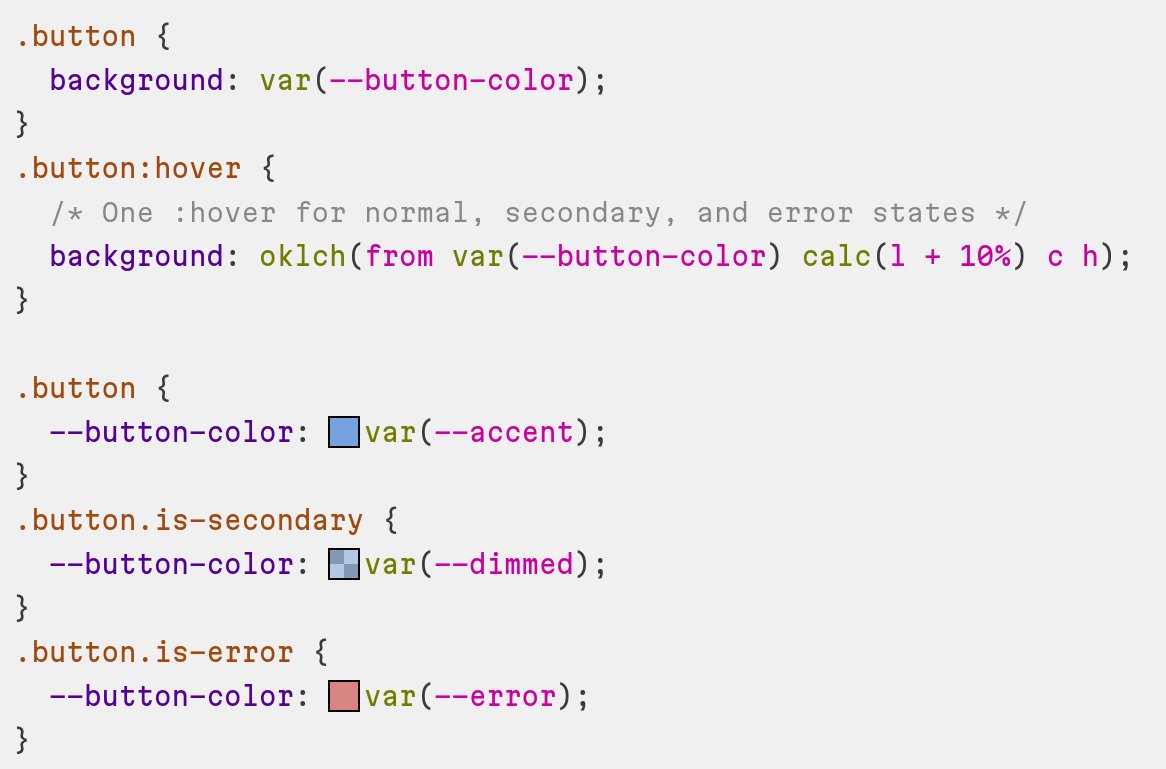
With new FF 128 now all browsers support Relative Colors in CSS.
For example, you can specify that hover color is always 10% lighter and then just set colors for button states and hover will recalculate itself.
So I updated my article about OKLCH:
https://t.co/joqT2c4gkY
Scroll velocity CSS text-shadow 📜
1. Animate 2 custom properties on scroll
2. Transition one of the property values
3. Use the diff (velocity) for the text-shadow position 🤙
A CSS take on it.
Dear @mattpocockuk and #typescript experts!
I have a non so trivial but also non so exotic problem to solve: using const objects with union of types as a "registry" for something.
Any help very appreciated :)
https://t.co/t0HmdV4G2B
One of the reasons React Server Components are inevitable, much like Thanos, is that UI is a function of data.
In a CSR/SPA world, you must be willing to ship all of the code, for all of the possible data, before rendering can begin. This is why you see so many spinners.
Imagine if Google was a SPA. The calculator, weather, shopping, flights, featured snippets, pac-man doodle, AI experiments, movies playing, maps, restaurants, … every custom experience the client would know how to render.
For a server, to load up all these codepaths is no big deal. Servers are bigger than clients! They comfortably can deal with lots and lots of functions (@vercel deploys hundreds of millions of them per year).
"But I'm not Google!" I think you're more like Google than you give yourself credit (or you should be). Think about feature flags under development, experiments, geo-targeted experiences and promotions, AI capabilities you'll be adding in coming years where the LLM determines what UI to render.
Servers have the data / AI, servers know what to render, clients can get it in one fell swoop as a stream, without extra hops. It's actually the simplest architecture you could conceive, and the one that has made Google, Amazon, Facebook succeed from idea to billions of users.
Before you ask: yes, I'm shopping for a CO2 monitor 🤡
I'm all for specialization in software engineering, but client/server isn't a good boundary. As a frontend engineer you need to control the entire user experience, and that requires being empowered to program the frontend server.
When a new deployment (invocation of vercel cli) with:
- identical source (as in same git tag / ref)
- everything else identical (CI)
results in a 100% reproducible, non functioning website
=> there is an issue
Dear @vercel and @vercel_support. Your service and support has been awesome for years. However, your new default support behaviour seems to be responding super slow and then blaming the customer when it is 99.99% evident that a change in your infrastructure is the culprit.
🎉 iron-session, the stateless session utility is now compatible with @vercel & @nextjs middlewares as of 6.2.0.
Huge kudos to @_brc_dd for translating our underlying seal mechanism to the Web Crypto API. I could not have made this without you.
Enjoy!
https://t.co/kq9AulaPw2
@ramdadam Thanks! The article seems to have the missing pieces for me to start digging deeper. IMHO logging with docker / compose / stack is surprisingly complex, though.
Hi #docker experts, I need your help!
I'd like to have a simple logging compose setup aggregating stdout/stderr of all services:
services:
foo:
bar:
logging-agent:
image: ?
ports: 8080:8080
volumes: ...
having a nice UI for seeing foo/bar outputs