Note the date: 11-13 September, 2024! The 12th Plant Peptides and Receptors Meeting will be held in Wageningen, the Netherlands! A fantastic line-up of keynote speakers and a vibrant organizing team! Make sure to be there :)
Do you want to start your own lab @ZMBP_Tuebingen? We have an open Independent Junior Group Leader position in plant molecular biology! #plantscijob
Send us your application by November 26th
More details 👇
https://t.co/ou6LNEDGds
Interesting paper. FliC polymorphism in Xanthomonas aurantifolii vs X. citri points to potential alternative immunogenic epitopes.
flg22 and flgII-28 sequences are identical, but Xa (not Xc) versions of flgIII-20 and flgIII-27 are protective.
https://t.co/2b4LsAMnDp
Lipid membrane destruction by microbial pore-forming toxins is a mechanism of damage to animal cells, but is less prominent in plants. 🌱
Read the @NewPhyt#TansleyInsight which looks at the disruption of plant plasma membrane by Nep1-like proteins 👉 https://t.co/c9ftpxqdeq
The Arabidopsis TIR-NBS-LRR protein CSA1 guards BAK1-BIR3 homeostasis and mediates convergence of pattern- and effector-induced immune responses - ScienceDirect https://t.co/mu4NhS1BcX
Delighted that this one’s out on @BioRxiv 📢: A single Verticillium dahliae effector determines pathogenicity on tomato by targeting auxin response factors https://t.co/U3KoCVJsav by @JinlingLI7@FiorinLorencini @Grardy_Berg @SagarBashyal11 Arno Schaveling & @MFSeidl 🧵 [1/8]
New publication from the Nürnberger Lab @ZMBP_Tuebingen in @NatureComms "Genotyping-by-sequencing-based identification of Arabidopsis pattern recognition receptor RLP32 recognizing proteobacterial translation initiation factor IF1"
https://t.co/Q2N4xtW6FH
New publication from the Nürnberger Lab @ZMBP_Tuebingen: The EDS1–PAD4–ADR1 node mediates Arabidopsis pattern-triggered immunity
https://t.co/pwZVZiF2Nw
https://t.co/EIorvp07TS
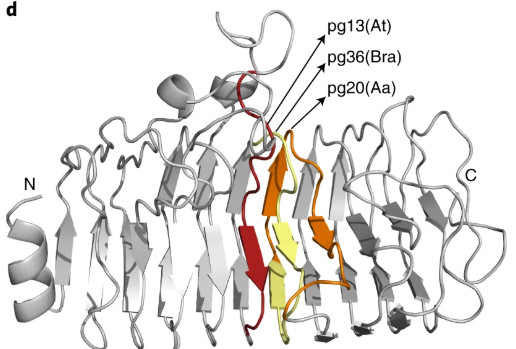
New Article: "Distinct immune sensor systems for fungal endopolygalacturonases in closely related Brassicaceae" https://t.co/WMwCCapNAY
Arabidopsis LRR-RLP42 perceives a 9-amino-acid peptide contained in a fungal endoPGase. Other Brassica species sense different epitopes.