@ABC Fourteen years of silence and a single fork finally speaks. DNA brings an arrest in Arlington, but the question is deeper - how many other files are waiting for science to catch up? Justice delayed, but is it justice at all?
They took her cells without asking.
While she lay dying, her body became the foundation of a billion-dollar medical revolution—and her own family couldn't even afford proper healthcare.
Henrietta Lacks was just 31 years old in 1951 when she began feeling a sharp, constant pain deep in her abdomen.
She had given birth to five children and spent years working in the tobacco fields of Maryland. She knew this pain wasn't normal.
Something was terribly wrong.
She went to Johns Hopkins Hospital, one of the few hospitals at the time that treated Black patients. Doctors discovered an aggressive cervical tumor and immediately began radiation treatment.
But while Henrietta lay on the treatment table, another decision was made without her knowledge.
A doctor removed a small piece of her tumor for research.
No one asked her permission.
In 1951, informed consent wasn't standard practice, especially for poor Black patients. Tissue samples were often taken without explanation, and Henrietta never knew hers would become one of the most important discoveries in medical history.
Scientists expected the cells to die within days.
Instead, they multiplied.
Again.
And again.
Unlike every other human cell they had studied, Henrietta's cells refused to stop growing. They divided continuously, becoming the first immortal human cell line ever discovered.
Researchers named them HeLa cells.
Henrietta never knew.
She died on October 4, 1951, only months after her diagnosis. She was 31 years old, leaving behind her husband and five young children.
She thought her suffering had ended.
It hadn't.
Her cells traveled across the world.
Scientists used them to help develop the polio vaccine. They advanced cancer research, studied viruses, tested medicines, explored genetics, and even sent HeLa cells into space to examine how human cells reacted in zero gravity.
Universities, laboratories, and pharmaceutical companies relied on them.
A billion-dollar industry grew from cells taken from a woman who had never given permission.
For more than twenty years, her family had no idea.
In 1973, researchers contacted the Lacks family for blood samples. That was when they learned Henrietta's cells were still alive, still reproducing, and still being used in laboratories around the world.
The discovery shocked them.
While companies earned millions and researchers built careers using HeLa cells, Henrietta's family struggled with poverty and often couldn't afford basic medical care.
For decades, many scientific papers didn't even use her real name.
Her contribution changed medicine.
Her identity was almost forgotten.
Everything changed in 2010 when Rebecca Skloot published *The Immortal Life of Henrietta Lacks*, bringing Henrietta's story to the world and raising difficult questions about medical ethics, consent, and justice.
Today, Henrietta Lacks is finally recognized for her extraordinary legacy.
Her cells have contributed to more than 75,000 scientific studies and countless medical breakthroughs.
But one fact remains impossible to ignore.
Henrietta Lacks never chose any of it.
She wanted treatment.
Instead, the world received immortality from her cells while her family waited decades simply to hear her name.
Henrietta Lacks.
Remember the woman.
Not just the cells.
Not just HeLa.
Henrietta.
“We didn't ask for that information. We didn't need to know that information. We don't care.” —Rickey Smiley fires back at Oprah's latest comments about Whitney Houston
“Whitney Houston is somebody that you just don't talk about in the black community if you're in touch. You don't talk about the Obamas. You don't talk about Whitney Houston. We're sensitive about Michael Jackson, and you don't talk about the Kings. That's black royalty that you just don't talk about. We don't play about Whitney Houston, and I know I don't. Because I don't care what her downfall was. We all have downfalls. We all have things that we're struggling with. We all have people in our family that are struggling with addiction, and we have lost loved ones to addiction, whatever the case may be. But why would you bring stuff like that up?
Why is it when it comes to you and Gayle, right after Kobe Bryant died, Gayle interviewed Lisa Leslie, if I'm not mistaken, was asking her about a sexual assault case that he was found innocent of. And the fact that y'all are so out of touch with the black community and been rich so long that you don't even know not to talk about certain things in a certain kind of way. Because if you was really sincere and genuine about people not filming that stuff, then you might as well have told them to film because you brought it up and aired it out anyway.”
🔗 https://t.co/EGnYiI3epi
This footage came from a home security camera inside a house in Knoxville, Tennessee.
The elderly man in the pajamas is Harold.
He’s 79 years old and lives with a progressive memory condition that sometimes causes severe nighttime confusion something doctors often call “sundowning.”
Late at night, Harold occasionally wakes up believing he still has somewhere important to be.
Work.
An appointment.
A meeting from decades ago.
He’ll quietly get dressed and head toward the front door.
Before last year, it happened several times a week.
Twice, he actually made it outside before his wife Carol could stop him.
Once, a neighbor found him wandering down the street at 11 PM wearing slippers.
The family tried alarms.
Harold learned how to disable them.
Then everything changed because of a dog named Samson.
Samson was a two-year-old Golden Retriever their daughter brought over temporarily after a housing issue.
Nobody expected him to become Harold’s nighttime guardian.
A few weeks after Samson arrived, Carol checked the security footage from the previous night after realizing she hadn’t heard Harold get up.
At 1:17 AM, the camera showed Harold walking slowly toward the front door.
But Samson was already waiting there.
Harold tried to move around him.
Samson stepped sideways and blocked the path.
Harold tried again.
Samson calmly repositioned himself a second time.
Then the dog gently took Harold’s pajama sleeve in his mouth and slowly guided him back down the hallway toward the bedroom.
And Harold followed him.
The family later showed the footage to Harold’s neurologist.
The doctor reportedly watched it twice before explaining:
“This is recognized redirection behavior used for memory-related wandering. The dog is doing it correctly — instinctively — without training.”
Now Samson sleeps at the foot of Harold’s bed every night.
When Harold was told what Samson had been doing for him, he looked at the dog for a long moment and simply said:
“Well… somebody has to look after things around here.”
Sometimes the right soul arrives at exactly the right moment.
And sometimes it walks in on four legs.
Lena Horne, Esther Rolle, Diahann Carroll, Eartha Kitt, Pam Grier, Nell Carter, Dorothy Dandridge, Isabela Sanford, Marla Gibbs, Della Reese, Hattie McDaniel, Mabel King, Lawanda Paige, Ruby Dee, and Cecily Tyson
These women represent generations of talent, resilience, and groundbreaking achievement in film, television, and entertainment. At a time when opportunities for Black actresses were limited and often shaped by stereotypes, they carved out space for themselves through skill, determination, and undeniable presence.
From pioneers like Hattie McDaniel, who became the first Black person to win an Academy Award, to stars like Dorothy Dandridge, who broke barriers as one of the first Black women nominated for Best Actress, each of these women contributed to changing how Black women were seen on screen. Their work challenged narrow roles and opened doors for more complex and meaningful representation.
Actresses such as Lena Horne, Eartha Kitt, Diahann Carroll, and Ruby Dee brought depth and versatility to their performances, proving that Black women could lead, inspire, and captivate audiences across genres. Others, like Pam Grier, helped redefine strength and independence in film, while figures like Cicely Tyson elevated storytelling with roles that honored dignity and cultural identity.
Beyond their performances, many of these women used their platforms to speak on social issues, advocate for equality, and push the industry forward. Their influence extends far beyond the screen, shaping both culture and opportunity for future generations. #WomensHistoryMonth
—If you love our content and would like to support the page, you can buy us a coffee here: https://t.co/K1AhtZuOFs
Let the adult in the room speak.
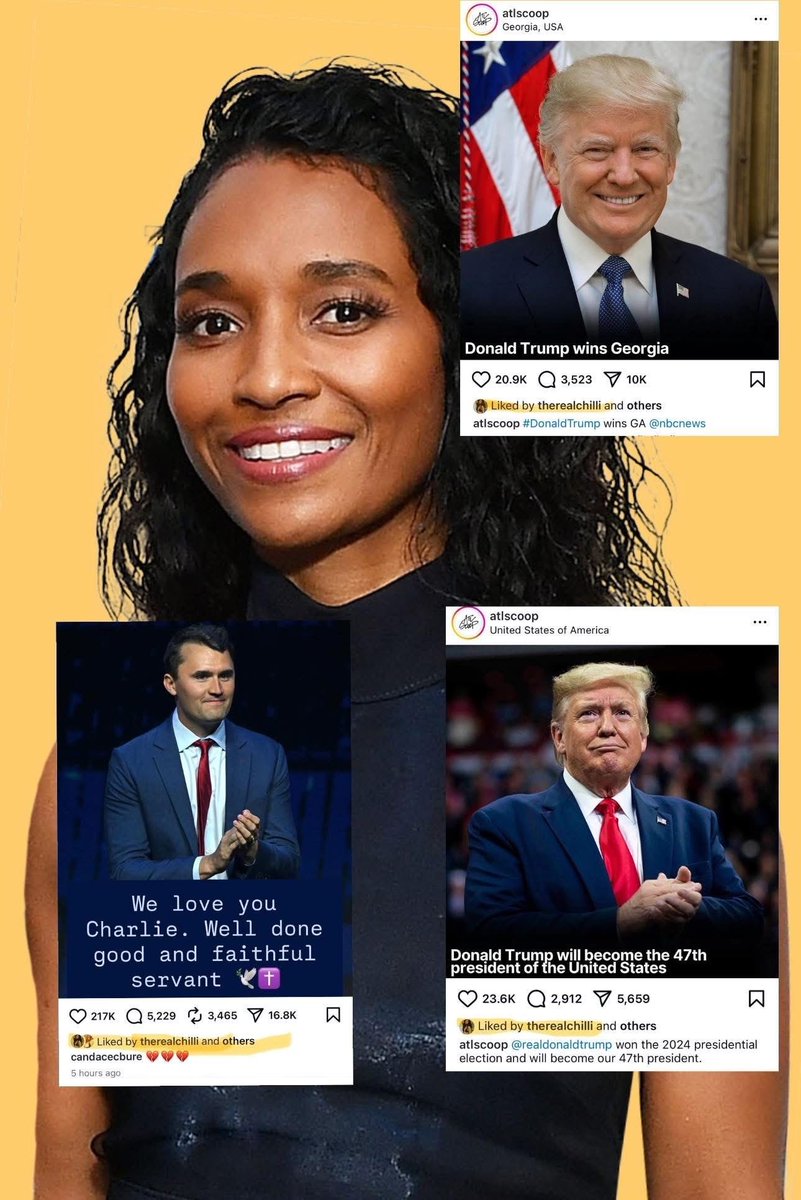
To Nick Cannon and Chilli — I say this with love, but also with truth.
What y’all are saying right now… in my opinion… is dead wrong.
Now let me be clear — I’m the one who fought all the way to the Supreme Court for free speech. So I respect your right to say whatever you want. That’s a fact.
But this hits different.
Because the same Black people you’re turning your backs on…
The same Black women you’re dismissing…
Those are the same people who built you.
They buy your tickets. They watch your shows. They support your careers.
And now you’re aligning with a man — Donald Trump — who has openly disrespected Black women, including Michelle Obama, and countless other accomplished Black women.
Let’s talk facts:
Our people depend on the Department of Education.
Our people depend on HUD.
Our people depend on opportunity — not having their achievements dismissed as “DEI.”
This same man has:
•Tried to erase Black history
•Limited what our children can learn
•Praised and pardoned officers involved in killing unarmed Black men
So don’t act like this is just politics. This is personal.
Nick, you were right about one thing — yes, a Republican president signed the law freeing enslaved Africans. That’s history.
But you left out everything that happened AFTER that.
You left out where today’s MAGA movement stands.
You left out who has consistently fought for civil rights, voting rights, and opportunity.
If it was left up to them right now, they’d take us backwards — not forward.
And let’s be real…
If they truly cared about Black people — about Foundational Black Americans, descendants of slaves — we wouldn’t even be having this conversation.
We’d be talking about reparations.
So I’m not coming at y’all with hate… I’m coming at you with responsibility.
Because influence comes with accountability.
And right now… y’all on the wrong side of this one.
And people keep asking me why I’m running for Congress — this is exactly why.
To stand up. To speak out. To fight for our people when others won’t.
Go to my website, support the fight, and join the team:
https://t.co/jCqvMC3KI3
Make sure you’re on the right side of history.