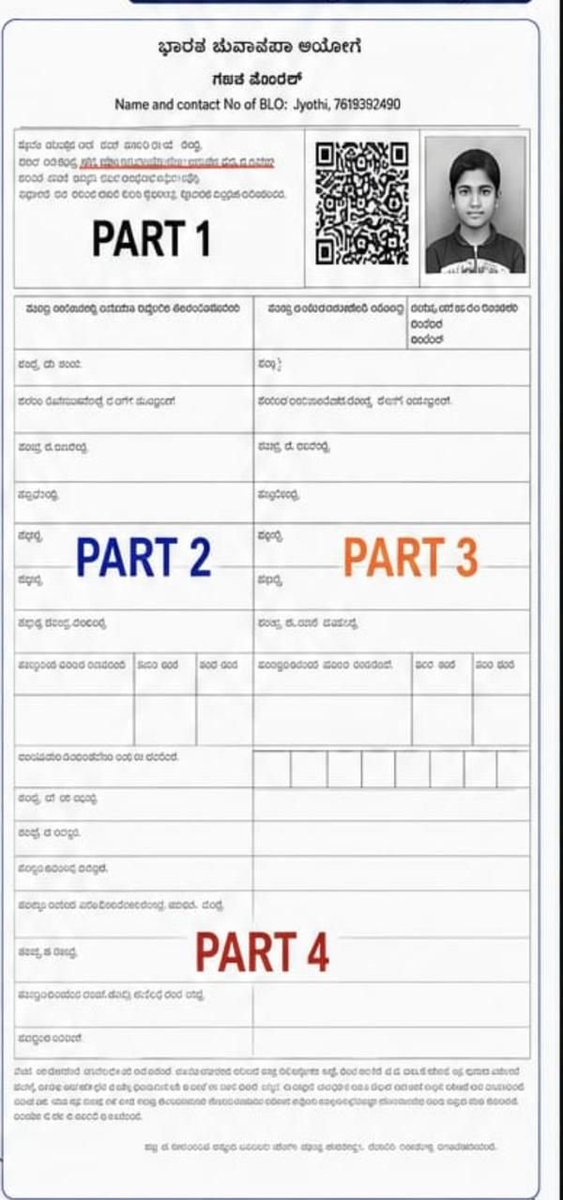
*How to fill the Physical Enumeration Form (Step-by-Step Guide)*
The form has 4 sections, but you will fill only Part 2 OR Part 3, not both.
📌 Part 1: Basic Details & Photograph
Most of this section is already filled by your BLO.
✅ Verify that your:
• Name
• EPIC (Voter ID) Number
• Address
• Taluk
• District
• Assembly Constituency
• Part & Serial Number
are all correct.
📷 Paste a recent passport-size photograph in the empty box next to the old printed photograph.
⸻
📌 Part 2: If your name was in the 2002 Voter List
Fill ONLY if your name existed in the 2002 electoral roll.
• Write your name exactly as it appeared in the 2002 list (even if the spelling was incorrect).
• EPIC Number can be left blank if you don’t remember it.
• Mention your father/mother/husband’s name as shown in the 2002 roll and specify the relationship.
• Fill in:
District
State
Assembly Constituency
AC Number
Part Number
Serial Number
using your 2002 voter record.
⸻
📌 Part 3: If your name was NOT in the 2002 Voter List
Fill ONLY if you are linking your record to a relative (such as your father or mother) whose name was in the 2002 roll.
Provide:
• Relative’s name
• Their father/mother’s name (or the name linked to them in the 2002 roll)
• Relationship
• District
• State
• Assembly Constituency
• Part Number
• Serial Number
using your relative’s 2002 voter record.
⸻
📌 Part 4: Current Personal Details (Everyone must fill this)
Use your current voter details.
Fill in:
✅ Date of Birth
✅ Aadhaar Number
✅ Mobile Number (Mandatory)
✅ Father’s Name
✅ Mother’s Name
✅ Their EPIC Numbers (if available)
✅ Spouse’s Name & EPIC Number (if applicable)
⸻
📝 Final Step
• Sign the form.
• Get the BLO’s signature.
• Submit one copy to the BLO.
• Keep the second copy safely for your records.
*⚠️ Remember: Fill either Part 2 or Part 3, never both.*
@ceo_karnataka@ECISVEEP I am waiting to submit SIR form online but stuck for more than a month now because pending mobile number link to my EPIC. BLO is assigned to my request but no progress since then…There is no accountability from ECI. Are we living in Stone Age ?
@ceo_karnataka@ECISVEEP BLOs are asking to come to schools for collecting the form and not visiting the house. There is no accountability and fear of Law.
Google just dropped a 1-hour course on agentic engineering from scratch:
00:00 – How to build your first AI agent
08:24 – Build agent memory (short, persistent, long)
28:34 – Agentic loops, long-running AI agents
40:04 – How to build MCP (MCP vs API)
1:00:22 – Multi-agentic systems
This 1-hour watch will replace 10 paid agentic courses on the internet.
Bookmark this. Watch this weekend.
In 1998, Warren Buffett gave a 1-hour masterclass on how to never lose money investing.
Here are the 22 most valuable lessons from his lecture:
1. You only have to get rich once. If you have $100 million and can make 10% unleveraged or 20% leveraged, the difference between $110 million and $120 million at year-end means nothing to your life, your family, or anything. But the downside, especially with other people's money, is disgrace, humiliation, and facing the friends whose money you lost. The equation never makes sense.
2. To make money they did not need, they risked money they did have and needed. That is just plain foolish, Buffett says, regardless of your IQ. If you hand him a gun with a million chambers and one bullet and offer him any sum to put it to his temple and pull once, he will not do it. There is nothing on the upside that justifies the downside. People do this financially all the time without thinking.
3. The smartest people in finance went broke, and that is the most fascinating story Buffett knows. Long-term Capital Management had 16 people with possibly the highest average IQ of any business in the country, 350 to 400 combined years of experience, and most of their own net worth in the firm. They still went bankrupt. Buffett says if he ever wrote a book, it would be called why smart people do dumb things.
4. Beta and sigmas tell you nothing about the real risk of going broke. The LTCM team relied heavily on mathematics and believed a six- or seven-sigma event could not touch them. They were wrong. History does not tell you the probabilities of future financial events. The real risk is not volatility. It is a permanent, irreversible blind spot in something crucial, often caused by knowing a great deal about something else.
5. Invest only in businesses you can understand. That one rule narrows the field by about 90%, and that is fine. Buffett can understand Coca-Cola. he cannot value an internet company, and he says if a student handed him a valuation of one on a final exam, he would flunk them. People thought Enron was incredible because it had a good track record, but almost nobody understood how it made money. That was the signal to avoid it.
6. You want a business that is a castle with a wide moat around it. Inside the castle, you want an honest, able, hard-working duke. The moat can be low cost, like Geico in auto insurance, or brand, or patents, or location. But a wonderful castle will always be attacked, so the job of every manager Buffett owns is one thing: widen the moat. Throw crocodiles and sharks into it to keep competitors out.
7. Moats change slowly and invisibly, but they change. Thirty years ago, Kodak's moat was as wide as Coca-Cola's. They had share of mind; the little yellow box meant best in everyone's head. Then they let Fuji into the Olympics and narrowed their own moat. Coca-Cola's moat, by contrast, is wider now than 30 years ago. Every time infrastructure gets built in a country that is not yet profitable, the moat widens a little. You cannot see it day by day, but in 10 years, the difference is enormous.
8. Share of mind beats share of market. When you say Disney, every person in the room has something in their head. Say Universal Pictures or 20th Century Fox, and you have nothing. A mother with two kids will pick the $17.95 Disney video over the $16.95 alternative because she knows it will be fine and does not want to preview ten videos to decide. That little bit of certainty in the customer's mind is worth a fortune.
9. The best businesses have pricing power and require little capital. see's candy sold 16 million pounds at $1.95 when Buffett bought it for $25 million. The entire thesis was whether the price could go to $2.25 without hurting sales. It could, because nobody wants to hand their valentine a box of candy and say, "This year I took the low bid." Today, See's makes $60 million on the same formulas and still takes almost no capital. Compare that to GM, which had to reinvest every dollar into better factories and whose stock barely moved over 50 years.
10. The best businesses earn a royalty on other people's capital. Coca-Cola sells a formula and collects a royalty on every drink. American Express takes a few percent of every dollar you spend. You put up the capital, they take a cut. Low capital intensity is one of the most underrated qualities in a business and one of the surest paths to durable wealth.
11. Define your circle of competence and stay inside it. The size of the circle does not matter. Staying inside, it does. If you know which 30 companies out of thousands you actually understand, you are fine. Buffett understood H.H. brown shoes and Frank Rooney, so he closed that deal in five minutes. If you do not know enough to understand a business instantly, you will not understand it in a month either.
12. Ignore the macro entirely. Buffett has never bought or skipped a business because of a feeling about interest rates, the economy, or any macro forecast. If Alan Greenspan and Bob Rubin both whispered exactly what they would do for the next 12 months, it would not change what he pays for anything. You want to focus on what is important and knowable. The macro is important but not knowable, so you ignore it.
13. Inactivity is the strategy, not a flaw. Wall Street makes money on activity. You make money on inactivity. A broker is like a doctor paid by how often he changes your pills. If everyone in a room trades their portfolio with everyone else every day, they all end up broke, and the intermediary keeps the money. Buffett looks for one good idea a year and rides it to its full potential. He measures Berkshire by how little turnover there is, like a church where the same people fill the seats every Sunday.
14. If you understand businesses, diversification is a mistake. For the 99% who will not evaluate businesses, Buffett recommends a low-cost index fund and extreme diversification. But if you bring real intensity to evaluating companies, owning more than six is a terrible idea. Very few people got rich on their seventh best idea. A lot of people got rich on their best one. Buffett keeps about half his money in what he likes best.
15. Buffett's biggest mistakes are mistakes of omission, not commission. The times he understood a business well enough to act and instead sat there sucking his thumb. He passed on healthcare stocks during the Clinton plan and on Fannie Mae in the mid-eighties, each a multi-billion-dollar miss. Accounting never captures these. The $2,000 he put into a Sinclair service station as a young man, money he lost, has an opportunity cost of about $6 billion today.
16. Focus on what will happen, not when. Coca-Cola went public in 1919 at $40 a share and dropped to $19 within a year. There was always a reason not to buy: the great depression, world war, sugar rationing, thermonuclear weapons. But one share bought then and reinvested would be worth about $5 million. If you are right about the business, you will make a lot of money. The timing is the tricky part, so do not focus on it.
17. When hiring, look for integrity, intelligence, and energy. But if the person lacks the first one, you actually want them dumb and lazy. Because a person with intelligence and energy but no integrity will destroy you. Buffett borrowed this from Pete Kiewit. The trait everyone screens for last is the one that matters most.
18. Here is a thought experiment Buffett gives students. Imagine you could own 10% of one classmate for the rest of their life. You would not pick the highest IQ or the best grades. You would pick the person you respond to best, the one who is generous, honest, gives credit to others, and has leadership qualities. Now imagine you also had to short one classmate. You would pick the egotistical, greedy, slightly dishonest one. The qualities that decide both are not talent. They are character.
19. Every quality on the admirable side is achievable, and every quality on the repellent side is removable. The things that make you want to own 10% of someone are not the ability to throw a football or run fast; they are behavior, temperament, and character, all of which anyone can choose. Buffett's point: you already own 100% of yourself, so you might as well become the person worth betting on.
20. The chains of habit are too light to be felt until they are too heavy to be broken. Buffett sees people in their forties and fifties trapped by self-destructive patterns they can no longer change. At a young age, you can choose any habits you want. Ben Franklin and Ben Graham both did exactly this, looking at people they admired and simply deciding to behave like them. There was nothing impossible about it.
21. Take a job you would take if you were already independently wealthy. Buffett told a 28-year-old at Harvard who wanted a consulting job "to look good on his resume" that it was like saving up sex for your old age. There comes a time to just start doing what you love. Buffett offered to work for Ben Graham for free, was told he was overpriced, and kept pestering him for years. Take the job you would jump out of bed for. You cannot miss.
22. You won the ovarian lottery, and that should shape how you think. Buffett imagines a genie 24 hours before your birth letting you design the world's rules, with one catch: you do not know which of 5.8 billion balls you will draw. Born here or in Afghanistan, with an IQ of 130 or 70, male or female, able-bodied or not. If you could put your ball back and draw one of 100 random others, most people would not, because they are already in the luckiest 1%. Buffett knows he is perfectly wired for a market economy that pays him like crazy, while an equally good citizen leading scout troops and teaching Sunday school is not, purely by luck.
Imagine the magic when AI agents team up! ✨
A2A communication is unlocking a brilliant new era where multiple models combine their strengths to achieve extraordinary results.
Explore this groundbreaking developer ecosystem here ⬇️ https://t.co/TW8N30Aluw
Andrew Ng just dropped a 3-hour course on how to become an AI Engineer in 2026:
• 00:00 - How to build agentic AI systems
• 04:25 - Future of AI engineering
• 23:38 - AI Prompting full course
• 2:52:17 - Creating an app with AI in 30 minutes
This 3-hour watch could replace 10 AI engineering courses on the internet.
Watch it today, then read how to run a self-improving system in the article below.
you won't F**king believe what this Anthropic engineer said on stage
"You're not supposed to prompt Claude. You're supposed to build a system that prompts itself."
In 45 minutes she breaks down how Anthropic builds agents that remember, learn from their mistakes, and get smarter with every run.
Worth more than any paid course you'll find on building agents.
Watch the session, then read the guide on building loops below.
Andrew Ng just dropped a 3-hour course on how to become an AI Engineer in 2026:
• 00:00 - How to build agentic AI systems
• 04:25 - Future of AI engineering
• 23:38 - AI Prompting full course
• 2:52:17 - Creating an app with AI in 30 minutes
This 3-hour watch could replace 10 AI engineering courses on the internet.
Watch it today, then read how to run a self-improving system in the article below.
The reason Bengaluru's roads are in poor condition is not because contractors don't know how to build roads, but because the tendering and contract allocation process is mired in corruption and misgovernance.
50% of the contracts in the past have been awarded to one agency called KRIDL, which is a corrupt organization designed to siphon off money, and which currently is under investigation by ED.
For the other 50% of the projects, the contractor is pre-decided (relative of the politician)!
Competent & capable contractors who want to focus on quality work are threatened with delayed payments and kept out of the tendering process.
The result is predictable. Roads are built poorly, roads are dug up repeatedly, public money is spent & siphoned off, and citizens continue to suffer from potholes and flooding.
This is not an engineering problem. It is a governance problem.
Until there is transparency and accountability in the tendering process, Bengaluru will continue to spend thousands of crores without getting the infrastructure it deserves.
The Bengaluru Development Minister needs to ask questions to the Ministers & Politicians, including from his own party (and not the Officials), to get the right answers.
Rajeev Thakkar of PPFAS Mutual Fund recently gave an interview to Economic Times.
On IT - Our preference is for companies that have cash flows today rather than far in future.
On SpaceX, OpenAI, Anthropic - One-off you could see some companies succeeding. But if you buy these companies as a group, chances of losing money is probably higher than making money.
This is the watchlist of AI & Data Centre-related names in India
https://t.co/SOTABZ5Hoa
This is not my effort. I have taken this from a report shared by @ishmohit1
If you’re still “prompting” Claude Code,
you’re missing the point.
Here are 26 Claude Code shortcuts that most users don't know exist:
SESSION CONTROL
/clear — wipes context and starts clean
/resume [session] — reopens a previous session by ID or name
/branch [name] — forks the conversation to explore a different path
/rewind — rolls back conversation and code to an earlier checkpoint
/rename [name] — renames the session. Leave it blank and one gets auto-generated
/export [filename] — saves the full conversation as plain text
MODEL & USAGE
/model [model] — switches to Sonnet, Opus, or Haiku mid-session
/cost — shows token usage for the current session
/usage — shows plan limits and rate-limit status
/extra-usage — unlocks extended usage when standard limits hit
PROJECT SETUP
/init — builds a CLAUDE.md project guide on first run
/memory — edits CLAUDE.md and controls what auto-memory saves
/add-dir <path> — adds a directory for file access during the session
/config — opens settings for model, output style, and preferences
CODE OPERATIONS
/diff — opens an interactive diff viewer for uncommitted changes
/security-review — scans pending changes for vulnerabilities
/plan [description] — enters plan mode before Claude touches anything
/permissions — sets allow, ask, and deny rules for every tool
AGENT LAYER
/agents — manages agent and sub-agent configurations
/skills — lists all available skills, built-in and custom
/plugin — manages Claude Code plugins
/reload-plugins — reloads active plugins without restarting
/mcp — manages MCP server connections and OAuth
/compact [instructions] — compresses conversation history, keep what matters
INTERFACE
/theme — switches between light, dark, and colorblind-accessible modes
/color [color] — sets prompt bar color for the current session
This is Claude Code, not https://t.co/EePliJpUip.
Different tool. Steeper learning curve. Higher ceiling.
⭐ Save this. Use it the next time you open Claude.
➕ Follow me for content that actually moves work forward.
Google's former CEO just said what everyone in AI already knows
Building wealth is getting easier if you actually learn the tools
Not by scrolling AI threads
By understanding agents, Codex Code, prompts, memory, skills, MCP, and routines
Save this before it disappears from your feed
Everything below is free:
ChatGPT basics
https://t.co/p1ZEv4vG4f
OpenAI Academy
https://t.co/5AVN9CgCZq
Prompt engineering
https://t.co/gFV0OAXnQo
GPT-5.5 prompting guide
https://t.co/TJOxZ77Y6C
OpenAI API docs
https://t.co/24OlDTxEcA
Responses API
https://t.co/DLnWfUZEUS
Agents SDK
https://t.co/irt7DTJ745
Agents SDK quickstart
https://t.co/Mm2kgeMs39
Tools + function calling
https://t.co/A40Dege36x
Structured outputs
https://t.co/Jawb4njrJa
Conversation state
https://t.co/YkbSXmUk3A
ChatGPT memory
https://t.co/ojhvlLbVWp
ChatGPT projects
https://t.co/Svo7ATFTGc
Custom GPTs
https://t.co/chrd6IBz8L
Tasks in ChatGPT
https://t.co/pIEnCC5K8F
Codex overview
https://t.co/CVPKvEz9MY
Codex quickstart
https://t.co/sKNEmSMCXF
Codex CLI
https://t.co/kUySSiEBL5
Codex GitHub repo
https://t.co/FoiGgP5ash
Codex best practices
https://t.co/E1PtLvDDaj
AGENTS.md
https://t.co/eaAJkQDp4x
Codex skills
https://t.co/OsrLujQnkX
Codex MCP
https://t.co/uHCuY9Ram7
Codex subagents
https://t.co/QboZoCEzHT
ChatGPT Apps SDK
https://t.co/keDQV4wPUp
Apps SDK quickstart
https://t.co/OYKfU6EXaW
ChatGPT developer mode + MCP
https://t.co/iUE04OldHB
OpenAI Cookbook
https://t.co/LxteqEFzWZ
All of this costs $0
Most people will keep asking AI one question at a time
Save this and start learning the stack




![BharukaShraddha's tweet photo. If you’re still “prompting” Claude Code,
you’re missing the point.
Here are 26 Claude Code shortcuts that most users don't know exist:
SESSION CONTROL
/clear — wipes context and starts clean
/resume [session] — reopens a previous session by ID or name
/branch [name] — forks the conversation to explore a different path
/rewind — rolls back conversation and code to an earlier checkpoint
/rename [name] — renames the session. Leave it blank and one gets auto-generated
/export [filename] — saves the full conversation as plain text
MODEL & USAGE
/model [model] — switches to Sonnet, Opus, or Haiku mid-session
/cost — shows token usage for the current session
/usage — shows plan limits and rate-limit status
/extra-usage — unlocks extended usage when standard limits hit
PROJECT SETUP
/init — builds a CLAUDE.md project guide on first run
/memory — edits CLAUDE.md and controls what auto-memory saves
/add-dir <path> — adds a directory for file access during the session
/config — opens settings for model, output style, and preferences
CODE OPERATIONS
/diff — opens an interactive diff viewer for uncommitted changes
/security-review — scans pending changes for vulnerabilities
/plan [description] — enters plan mode before Claude touches anything
/permissions — sets allow, ask, and deny rules for every tool
AGENT LAYER
/agents — manages agent and sub-agent configurations
/skills — lists all available skills, built-in and custom
/plugin — manages Claude Code plugins
/reload-plugins — reloads active plugins without restarting
/mcp — manages MCP server connections and OAuth
/compact [instructions] — compresses conversation history, keep what matters
INTERFACE
/theme — switches between light, dark, and colorblind-accessible modes
/color [color] — sets prompt bar color for the current session
This is Claude Code, not https://t.co/EePliJpUip.
Different tool. Steeper learning curve. Higher ceiling.
⭐ Save this. Use it the next time you open Claude.
➕ Follow me for content that actually moves work forward.](https://pbs.twimg.com/media/HLBqYzBa0AEeNNp.jpg)