I was at a Mexican restaurant awhile ago and something happened I haven't been able to stop thinking about. 🌮
The happiest Christians are evangelistic. The unhappiest are too busy arguing to notice the opportunities right in front of them.
"If we're too busy using our sickles on each other, we'll miss the harvest." — Vance Havner
Watch 👇 #TheHarvest #Evangelism
In the west, Christians live such similar lives to the culture that when we express our distinctive beliefs, strangeness is /injected/ into the relationship.
In the Bible, Christians live such different lives that naming our distinctive beliefs /explains/ the strangeness.
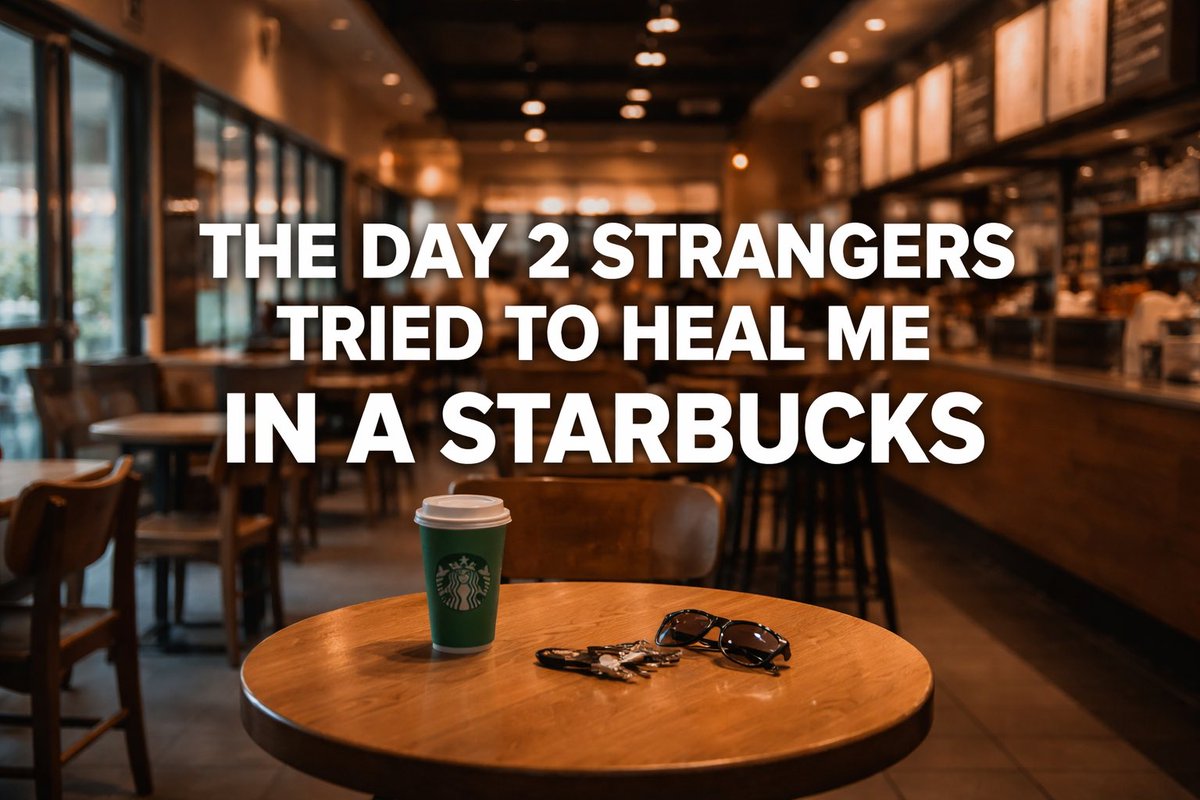
THE DAY 2 STRANGERS TRIED TO HEAL ME IN A STARBUCKS
I was sitting in Starbucks when two college-aged girls walked up, noticed my knee brace, and said,
“Sir, can we pray for your healing?”
I smiled. “Absolutely.”
What they didn’t know is I’ve had this bad knee for 35 years—ever since I tore my ACL (yes… attempting to dance like Michael Jackson). The surgery failed, and I’ve been managing it ever since.
They also had no idea I was an evangelist.
They prayed with bold faith—right there in Starbucks, asking God to heal.
When they finished, they asked, “Did you feel anything? Are you healed?”
I paused. “Honestly… no.”
But before they walked away, I asked them something they didn’t expect:
“Aren’t you going to share the Gospel with me?”
They looked confused.
I said, “You were bold enough to approach me and pray for my knee—but what about my soul?”
Then they admitted it: they didn’t really know how to share the Gospel.
So right there, in the middle of Starbucks, I gave them a quick crash course—how to move from physical need to spiritual truth, and how to clearly share the good news of Jesus.
By the end, their confidence had completely shifted. They weren’t just willing to pray anymore—they were ready to speak.
They walked away excited, determined to not only pray for people—but to share the message that actually changes lives.
Don’t get me wrong—I believe God can heal. I believe we should pray in faith for healing. I’ve experienced God’s healing personally on other occasions.
But if we stop there, we miss the bigger miracle.
Because the greatest healing isn’t physical—it’s spiritual.
If the body is healed but the soul is lost, what a wasted opportunity.
I’d rather have someone limp into heaven than sprint into hell.
@megbasham@jenniferwilkin Maybe it’s just me, but the tone always seems combative. So it’s not really “opened you up to public response” but more like a public fight. I could just be reading it wrong. But I’m certain that public fights aren’t usually helpful.
Most readings of 1 Samuel miss the opening move:
Hannah’s barrenness is not metaphor. It is covenant curse.
Deuteronomy 28 names barrenness as a judicial sanction for Israel’s covenant breaking. So when the book opens with a barren woman, the narrator isn’t setting up a touching story. He’s giving you a theological diagnosis.
Hannah is not “symbolic” of Israel.
Her womb is experiencing the same curse Israel is under.
The land is barren. The priesthood is barren.
Israel is covenantally fruitless—and Hannah’s body tells the truth.
And when God “remembers” her, this is not sentimental providence.
It is intrusion—the inbreaking of kingdom grace into a cursed order.
Her conception is the first lifting of the curse, the reopening of Israel’s future, the hinge between the failed judges era and the rise of the Davidic king.
Her song interprets the moment correctly:
the proud cast down, the humble raised, the barren made fruitful, the king exalted.
This is royal theology, not personal testimony.
Which is why Mary’s Magnificat is not merely echoing Hannah—it is finishing her.
Hannah’s womb signaled the intrusion of the typological kingdom.
Mary’s womb signals the intrusion of the eschatological kingdom.
Hannah’s son inaugurates the Davidic line.
Mary’s Son fulfills it.
Hannah’s conception reverses the curse in shadow.
Mary’s conception reverses the curse in substance.
Two women.
Two wombs.
Two songs.
One kingdom story—moving from curse to new creation.
WHY YOUR CHURCH NEEDS AN EVANGELIST ON THE TEAM
God “gave some to be apostles, some prophets, some evangelists, and some pastors and teachers, to equip God’s people for works of service…” — Ephesians 4:11-13
Most churches understand the importance of pastors and teachers. We need leaders who teach Scripture clearly so people know what they believe and why they believe it.
But many churches overlook something crucial:
The Evangelist is just as essential for spiritual maturity.
Biblical knowledge without evangelism can become stagnant. It’s like pouring milk into a sponge that never gets squeezed out. But when believers take in God’s Word and then share it with others, they come back thirsty for more.
That’s where the Evangelist comes in.
The role of the Evangelist (Outreach Pastor, Missions Director, etc.) is to equip every believer to share the gospel clearly and confidently.
When a strong preaching pastor, solid Bible teachers, and a committed evangelist work together, the church grows into full maturity.
Remove the evangelistic focus, and churches often drift toward spiritual stagnation or theological pride.
I’m grateful to be part of a church with:
• Strong preaching
• Faithful Bible teaching
• A passionate outreach pastor who is working to equip people to share their faith
Pastors: elevate the role of the Evangelist in your church. Make sure someone is actively mobilizing your people to share the gospel.
Jesus said, “Follow me, and I will make you fishers of people.” — Matthew 4:19
If we aren’t helping people fish for others, we aren’t fully discipling them.
Healthy churches prioritize both deep Bible teaching AND active evangelism.
And youth ministry can lead the way.
If you want to see what that looks like, check out https://t.co/dTDjlk1DKw and get equipped.
A friendly skeptic challenges me on the trustworthiness of the Scriptures based on a quick Google search. This is a MUST-WATCH to the end!
#Questions#Christianity
The theology that gives lip service to #SolaFide (faith alone in Christ alone) then subtly mixes in other prerequisites like turning from sin and surrendering to follow God as requirements of (not responses to) salvation.
This turn-or-burn vernacular is so infused into evangelistic presentations today it’s hard to call it “bad theology.” But just because it’s common doesn’t mean it’s true.
Any gospel presentation that focuses on what we must do for Christ instead of what Christ has done for us is works-based, therefore a damaging and dangerous theology.
This is the same message that countless legalists use to trigger doubt in the hearts of their hearers, causing them to look inwardly to self to evaluate the quality of their commitment, instead of upwardly to Christ to see the beauty of his sacrifice on the cross.
Then they use this doubt to gain control, trigger fear and try to squeeze even more commitment out of them.
Turn, try, cry, surrender, repeat becomes the rungs of the ladder that their hearers must keep climbing to be saved or prove that they are saved.
As a result assurance of salvation is obliterated and self-effort is enthroned.
This bad theology is no different than every other works-based religion.
Same ladder. Different rungs.
But the nagging doubt of one’s salvation, the constant re-surrendering and confession of sin, the fear of wondering if one has committed enough to God to truly be saved, leads to a miserable., inward-facing, self-centered existence.
This is not the Gospel. This is not good news.
The Gospel is simple and summed up beautifully by Jesus himself in John 3:16,
“For God so loved the world that he gave his one and only Son, that whoever believes in him shall not perish but have eternal life.”
I believe we are saved by grace alone through faith alone in Christ alone based on his finished work on the cross alone and I will preach this even if I stand alone.
Any other “gospel” is not the gospel at all.
It’s false. It’s damaging. It’s damnable.
“But even if we or an angel from heaven should preach a gospel other than the one we preached to you, let them be under God’s curse! As we have already said, so now I say again: If anybody is preaching to you a gospel other than what you accepted, let them be under God’s curse!.” Galatians 1:8,9
This tweet is so disappointing. And so unnecessary. It’s comments like this that take away from the countless great things @realDonaldTrump does for America.
Lane Kiffin isn’t the enemy here. The calendar in College Football is. It’s an absolute joke. Fix this crap NCAA. Playoffs, National Signing Day, Transfer Portal, all within the same month time frame. Just straight stupid!