@dwpasulka I LOVE all your public conversations and podcasts; it’s an instant listen for me. Unfortunately, though, Joe was being a major asshole to you the entire conversation which was really distracting. It seemed like it also tripped you up a few times and things just didn’t vibe well.
Everyone who thinks AI slop will ruin code efficiency/performance is going to be so surprised when everything is absurdly well-optimized John Carmack style machine code.
Today I'm publishing a new essay, Policy on the AI Exponential. AI is progressing extremely fast—much faster than the policy process was built to handle. The essay lays out where I think the technology is now, and the action needed to close the gap: https://t.co/Lh6PWae178
@StephenM And when that happens, you’ll pretend: it was self-defense, you had to do it, special ally, we have to show how tough we are and you’ll get us mired in a giant war in the Middle East. Just like Dick Cheney. And all along you’ll pretend you were against war as you do it endlessly.
On Day One of his presidency, @POTUS promised to deliver accountability through transparency by declassifying long-withheld government secrets and evidence of wrongdoing to restore trust in our federal agencies.
Half a million documents declassified in year one alone.
-JFK
-RFK
-MLK
-Amelia Earhart
-Russia hoax
-Weaponization
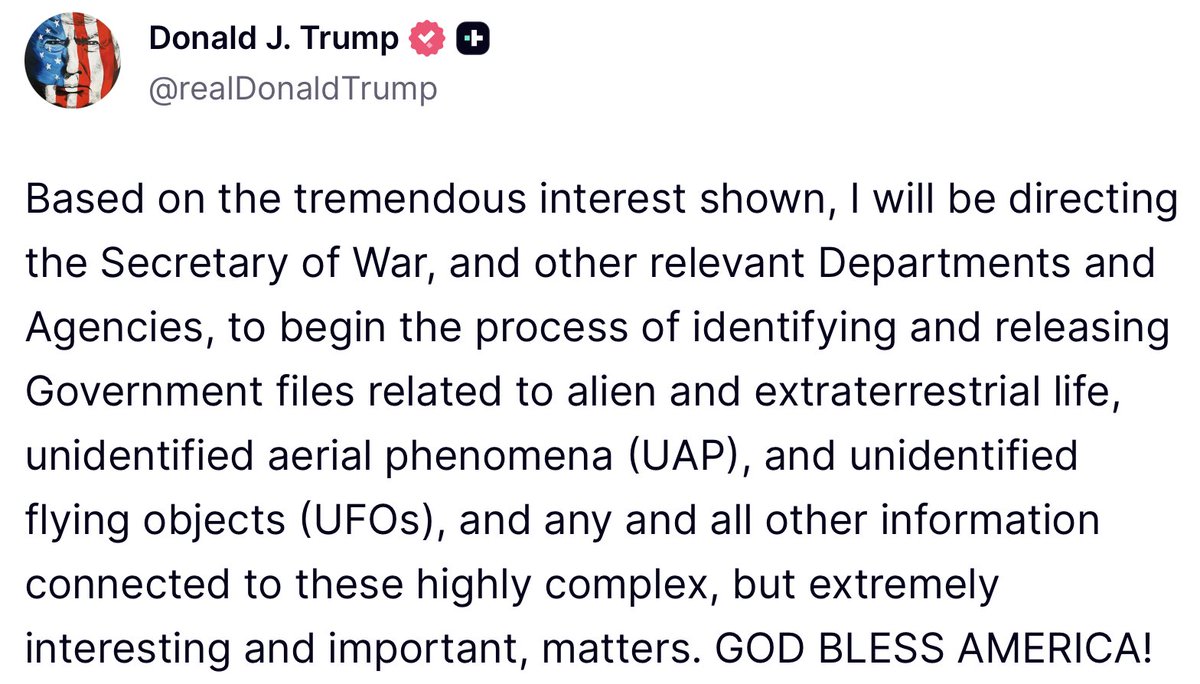
And soon, files related to alien and extraterrestrial life, UAPs, and UFOs.
Yeah 100% agree, it’s real and the overall debate on this is dumb. 3 plates is definitely an impressive milestone (same as 2 plates/225) but it can be attained by consistent training which Hegseth obviously does. He posts PT videos all the time, etc. Most people don’t lift weights, and will never even attempt to move this kind of weight so they just don’t understand what the progression looks like.
"Based on the tremendous interest shown, I will be directing the Secretary of War, and other relevant Departments and Agencies, to begin the process of identifying and releasing Government files related to alien and extraterrestrial life, unidentified aerial phenomena (UAP), and unidentified flying objects (UFOs)..." - President Donald J. Trump
Software development is undergoing a renaissance in front of our eyes.
If you haven't used the tools recently, you likely are underestimating what you're missing. Since December, there's been a step function improvement in what tools like Codex can do. Some great engineers at OpenAI yesterday told me that their job has fundamentally changed since December. Prior to then, they could use Codex for unit tests; now it writes essentially all the code and does a great deal of their operations and debugging. Not everyone has yet made that leap, but it's usually because of factors besides the capability of the model.
Every company faces the same opportunity now, and navigating it well — just like with cloud computing or the Internet — requires careful thought. This post shares how OpenAI is currently approaching retooling our teams towards agentic software development. We're still learning and iterating, but here's how we're thinking about it right now:
As a first step, by March 31st, we're aiming that:
(1) For any technical task, the tool of first resort for humans is interacting with an agent rather than using an editor or terminal.
(2) The default way humans utilize agents is explicitly evaluated as safe, but also productive enough that most workflows do not need additional permissions.
In order to get there, here's what we recommended to the team a few weeks ago:
1. Take the time to try out the tools. The tools do sell themselves — many people have had amazing experiences with 5.2 in Codex, after having churned from codex web a few months ago. But many people are also so busy they haven't had a chance to try Codex yet or got stuck thinking "is there any way it could do X" rather than just trying.
- Designate an "agents captain" for your team — the primary person responsible for thinking about how agents can be brought into the teams' workflow.
- Share experiences or questions in a few designated internal channels
- Take a day for a company-wide Codex hackathon
2. Create skills and AGENTS[.md].
- Create and maintain an AGENTS[.md] for any project you work on; update the AGENTS[.md] whenever the agent does something wrong or struggles with a task.
- Write skills for anything that you get Codex to do, and commit it to the skills directory in a shared repository
3. Inventory and make accessible any internal tools.
- Maintain a list of tools that your team relies on, and make sure someone takes point on making it agent-accessible (such as via a CLI or MCP server).
4. Structure codebases to be agent-first. With the models changing so fast, this is still somewhat untrodden ground, and will require some exploration.
- Write tests which are quick to run, and create high-quality interfaces between components.
5. Say no to slop. Managing AI generated code at scale is an emerging problem, and will require new processes and conventions to keep code quality high
- Ensure that some human is accountable for any code that gets merged. As a code reviewer, maintain at least the same bar as you would for human-written code, and make sure the author understands what they're submitting.
6. Work on basic infra. There's a lot of room for everyone to build basic infrastructure, which can be guided by internal user feedback. The core tools are getting a lot better and more usable, but there's a lot of infrastructure that currently go around the tools, such as observability, tracking not just the committed code but the agent trajectories that led to them, and central management of the tools that agents are able to use.
Overall, adopting tools like Codex is not just a technical but also a deep cultural change, with a lot of downstream implications to figure out. We encourage every manager to drive this with their team, and to think through other action items — for example, per item 5 above, what else can prevent a lot of "functionally-correct but poorly-maintainable code" from creeping into codebases.
This has been said a thousand times before, but allow me to add my own voice: the era of humans writing code is over. Disturbing for those of us who identify as SWEs, but no less true. That's not to say SWEs don't have work to do, but writing syntax directly is not it.
Tyler D., from a book I wrote, used to be a guest speaker in my university courses. He broke his protocols down for my students. I've been meaning to share these more in depth, but my time is so limited. Here is what he posted for my students. So simple but hard to implement.
Scientists identified ribose (used in RNA) and – for the first time in any extraterrestrial sample – glucose, a major energy source for life. These sugars join nucleobases and phosphates previously found, demonstrating the full suite of RNA building blocks were present on the ancient asteroid.
Marco Rubio is the most powerful Secretary of State since Kissinger. As such, it is significant that he believes the US has recovered alien tech and given it to private military contractors. A senior Rubio advisor says, “We’re headed toward massive disclosure.”
@MiddleOfMayhem I have talked to hundreds by now. And the Australian document is of a different type. As is the physics history.
Why do you not cede that? You asked for any evidence. I have given you more than that and a clear logical breakdown. You just ignore it. Huh? 🤔