His defence lawyers walked away, because defending him carries a cost from the state's side. So the file came to me instead, and we sat with it for days while he asked at every step why the machine was talking about him that way. https://t.co/4qY4MPP1kM
From the soulful melodies of Lavani to the sizzling flavors of vada pav, Marathi culture weaves tradition, festival, food and film into a vibrant tapestry that turns every day into a celebration. 🌊🎭🍲
I use other people's open source without a second of hesitation, and opening my own took me a long road. Meanwhile my customers need open components to close their own doors. The two things turn out to be the same problem. https://t.co/4VNuvA57pP
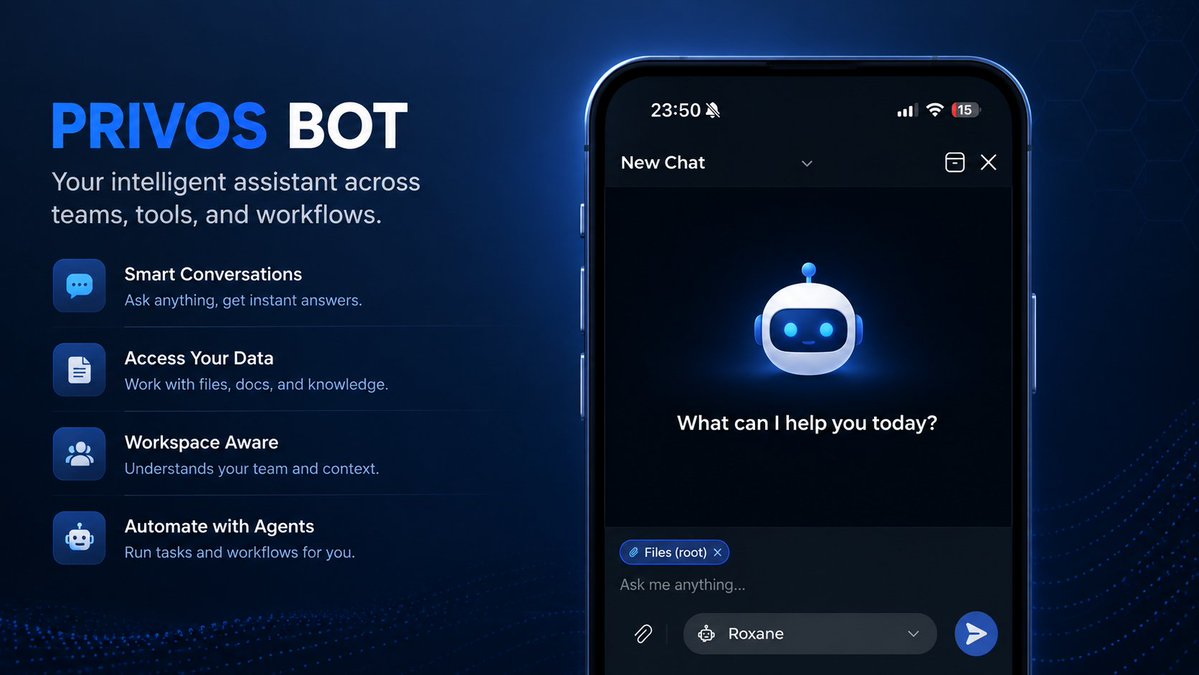
Did you know every feature in PrivOS is connected to the PrivOS AI Assistant?
The AI isn’t just there to answer questions. It’s built into the platform, allowing you to interact with your workspace using natural language.
Need to create a task, assign work, organize files, summarize documents, analyze data, or automate a repetitive process? Simply tell the AI what you want to do.
Because it understands your workspace, permissions, and business context, the PrivOS AI Assistant can help turn instructions into actions, helping teams spend less time managing tools and more time getting work done.
What would you like the PrivOS AI Assistant to help you with today?
#PrivOS #EnterpriseAI #AIAgents
K-pop just dropped the hottest single and I'm already dancing in the shower 🎵💃 Every beat is a passport to a new world of color, charisma, and pure energy! Who else is feeling the vibe? 🌍✨ #KpopLove#MusicMagic
Four posts about my own company. This one is about the people around it.
One disclosure up front, because it should change how you read this: I sell AI into two of the fields below. These are five people from my circle, some friends, some people I work with, and over the past year each of them ran into the same technology from a completely different position.
Start with the radiologist. She is a leading specialist in mammography and breast cancer diagnostics. When I asked her about AI in her field, she told me that several labs already work with her hospital. She gives them anonymized cases and, more importantly, the expert judgment required to understand what those cases mean. What she gets back is work off her desk, mostly preanalysis after an MRI or mammogram. For her, this is not a forecast. It is part of an ordinary working day.
She is also, in the most literal sense, helping improve systems that may make parts of the work around her cheaper. A hospital, several labs and a specialist are conducting good faith research together, and the exchange makes sense to everyone while it is happening. She does not argue with that. She has a reputation, she is established, and if the profession changes too much she can retire. Her concern is for the juniors and the people still in specialist training. Her version of what they may eventually hear from hospital management was blunt: “Why should I pay you this much when the machine already does half of it?”
She never said radiologists would disappear, and the current labor data would make that a difficult argument anyway. In the 2025 US Match, diagnostic radiology filled 98.6% of its positions. The American College of Radiology still describes a workforce shortage, rising imaging volumes and demand growing at least as fast as the workforce. Her argument is different. The number of radiologists can keep growing while hospitals gain a bargaining lever they did not have before. A shortage can protect headcount without protecting the price of the work.
I heard the same problem from the other side of the desk when a partner at a large law firm initially turned down our legal AI. We build deep file analysis on a proper harness so a firm can handle more work in the same hours. Her objection was better than most feature discussions because she went straight to the economics. Her firm bills tracked time, while our system removes time. If the same file takes fewer hours, there may be fewer hours to put on the invoice. That is a woman reading her own P&L correctly.
What changed her mind had little to do with another product demo. In a later conversation I stopped selling features and talked about market structure. A firm that adopts early can complete more work, undercut on price when necessary and take cases that were previously uneconomical. Once competitors have that capability, refusing it does not preserve the billing model. It leaves you acquiring the same capability later, under pressure. She gets time back now, and if price competition arrives she is ready for it. She is now among the first people implementing the system with us.
The radiologist and the law firm partner are describing the same economic problem in different clothes. One may eventually have the price of her work pushed down by an employer. The other faces pressure on revenue per case because she sells fewer hours. Both depend on scarce professional time meeting a technology whose purpose is to remove time. Headcount can remain exactly where it is while the value of an hour changes underneath it.
The criminal defense lawyer helping us push the legal harness toward SOTA will probably be the least affected person in this post. Look at his week. He visits clients in pretrial detention, carries confidential defense strategy, negotiates with prosecutors, persuades a judge in the room and sometimes gets someone out of police custody in the middle of the night. Much of that cannot be moved into a tool.
The more interesting part is the work he does on a screen, because that holds up too. Commercial firms and paralegals have had legal tools for years. Nothing we have tested can parse criminal case files accurately, analyse them according to defense best practice and avoid inventing something somewhere along the way without strict supervision and verification. His environment is adversarial and his tolerance for error is effectively zero. A fabricated fact or citation is not merely embarrassing in his work. It lands on a client.
The insolvency advisor is the most bullish person in the group. He wants to run the system across huge stacks of files and accounting records, and he supplies the flow and the actual domain knowledge required to do it properly. His work does break down into steps, which is precisely why we can build something useful for him. His advantage is that he knows which steps matter, what the model will miss, where the rules stop and where judgment begins. The machine takes the grunt work. He keeps the part for which clients actually need him.
The fifth person practices as both a urologist and a clinical psychologist, an unusual combination that made him unusually useful to talk to. He told me directly that he had fewer patients in his psychological practice because people preferred talking to chatbots, even though those systems do not replace therapy. In urology he was watching the opposite failure. Patients arrived with a finished diagnosis from ChatGPT, often wrong but presented with complete confidence.
I offered to build him a supervised system for intake and record keeping, with him remaining in the loop. He thought it was fantasy. His reference point was free ChatGPT, so his skepticism made sense. Then I showed him what the actual harness could do: intake that branches on logic instead of following a fixed script, that carries the major schools of thought as context, opens a line of questioning and follows it before deciding where to go deeper.
He tested it himself, as a professional, against his own judgment. He said it was spot on. He said it frightened him. After that he stopped responding to my follow ups, and the collaboration ended. The sequence is observed. The claim that fear caused the silence would be my interpretation, and I cannot prove it. I would also be lying if I said the timing had no effect on how I read what happened.
I thought about him more than the others because I needed him. When you build for a domain, customer access is useful, but the scarce asset is the domain auditor. Models are available and a harness can be built. A well funded lab can pay a law firm to become a customer. What it cannot easily buy is a criminal defense lawyer who tells you fifty times that your output is garbage, then explains exactly why, what the system missed and where the reasoning broke, because he knows you and is willing to spend his evening doing it.
That is what I have, and it is why these conversations happen at all. It is also an asset that decays. Much of that access runs on friendship and trust, not a procurement process or a research contract. I learned not to treat it as permanent.
Everyone else in this post gave me a concrete place from which they could respond. The radiologist has seniority and an exit. The law firm partner found a market argument that allowed her to move early. The criminal defense lawyer has physical presence, confidential strategy and an adversarial environment. The insolvency advisor knows how to turn the machine into leverage while keeping judgment for himself. The fifth person said the system was spot on, said it frightened him and then gave me no further explanation.
Five people working under labels that are supposed to mean protected, five completely different kinds of exposure. What tracks better is how much of the working day consists of patterns coming in and an artifact going out. That is why the line runs inside professions instead of between them. Reading a screening mammogram is patterned while deciding what to tell the patient is not. Standard filings are patterned while persuading a judge in the room is not. Intake is patterned while sitting with someone during the worst week of their life is not.
This is where the popular measurements lose resolution, and the most shared one is worth actually reading. Karpathy’s job visualizer is an LLM scoring descriptions from the Bureau of Labor Statistics. Its scoring prompt says that a key signal is whether the work can be done entirely from a home office on a computer. Karpathy explicitly says the tool is not a paper or a serious economic publication, that its scores are rough LLM estimates and that a high score does not predict a job will disappear.
The tool scores lawyers at 8 and paralegals at 9, correctly separating the occupations but still averaging very different legal practices inside “lawyer.” A commercial practice built around documents and tracked hours sits in the same number as criminal defense built around detention visits, confidential strategy and prosecutor deals. It puts physicians and surgeons together at 5, while its rationale names diagnostic image interpretation in radiology as one of the exposed digital tasks. The scores are useful for showing where digital work sits. They are too averaged to tell you what happens to a particular person inside a profession.
Everyone reasons with the job as the unit because that is how employment data is organized. The right unit is the day.
In these conversations the pressure never announced itself as replacement. It arrived as relief. Less preanalysis, fewer hours inside a file, less paperwork, less intake. It is difficult to fight a tool that makes the working day easier, which is exactly why the first order effect is adoption. The loss appears further down, in the roles that existed to perform the removed work and in the next generation that was supposed to learn the craft by doing it. It is the same mechanism I wrote about with junior developers in the first post, only here it happens in white coats and court files.
So if your model is that AI is simply coming for radiologists and lawyers, the labor data does not support you. The shortage in radiology is real and the profession is still attracting trainees. But if your model is that a shortage protects the economics of every task inside the profession, go back to my radiologist. Compensation pays for time, scarcity and professional effort. The tool removes some of that time and effort. Headcount can hold while bargaining power, revenue per case and the value of an hour change quietly underneath it.
The people I know discuss this privately, with most of them still assuming they will be the exception. Their job titles tell me very little about whether they are right. Their working days tell me much more.
Four posts about my own company. This one is about the people around it.
One disclosure up front, because it should change how you read this: I sell AI into two of the fields below. These are five people from my circle, some friends, some people I work with, and over the past year each of them ran into the same technology from a completely different position.
Start with the radiologist. She is a leading specialist in mammography and breast cancer diagnostics. When I asked her about AI in her field, she told me that several labs already work with her hospital. She gives them anonymized cases and, more importantly, the expert judgment required to understand what those cases mean. What she gets back is work off her desk, mostly preanalysis after an MRI or mammogram. For her, this is not a forecast. It is part of an ordinary working day.
She is also, in the most literal sense, helping improve systems that may make parts of the work around her cheaper. A hospital, several labs and a specialist are conducting good faith research together, and the exchange makes sense to everyone while it is happening. She does not argue with that. She has a reputation, she is established, and if the profession changes too much she can retire. Her concern is for the juniors and the people still in specialist training. Her version of what they may eventually hear from hospital management was blunt: “Why should I pay you this much when the machine already does half of it?”
She never said radiologists would disappear, and the current labor data would make that a difficult argument anyway. In the 2025 US Match, diagnostic radiology filled 98.6% of its positions. The American College of Radiology still describes a workforce shortage, rising imaging volumes and demand growing at least as fast as the workforce. Her argument is different. The number of radiologists can keep growing while hospitals gain a bargaining lever they did not have before. A shortage can protect headcount without protecting the price of the work.
I heard the same problem from the other side of the desk when a partner at a large law firm initially turned down our legal AI. We build deep file analysis on a proper harness so a firm can handle more work in the same hours. Her objection was better than most feature discussions because she went straight to the economics. Her firm bills tracked time, while our system removes time. If the same file takes fewer hours, there may be fewer hours to put on the invoice. That is a woman reading her own P&L correctly.
What changed her mind had little to do with another product demo. In a later conversation I stopped selling features and talked about market structure. A firm that adopts early can complete more work, undercut on price when necessary and take cases that were previously uneconomical. Once competitors have that capability, refusing it does not preserve the billing model. It leaves you acquiring the same capability later, under pressure. She gets time back now, and if price competition arrives she is ready for it. She is now among the first people implementing the system with us.
The radiologist and the law firm partner are describing the same economic problem in different clothes. One may eventually have the price of her work pushed down by an employer. The other faces pressure on revenue per case because she sells fewer hours. Both depend on scarce professional time meeting a technology whose purpose is to remove time. Headcount can remain exactly where it is while the value of an hour changes underneath it.
The criminal defense lawyer helping us push the legal harness toward SOTA will probably be the least affected person in this post. Look at his week. He visits clients in pretrial detention, carries confidential defense strategy, negotiates with prosecutors, persuades a judge in the room and sometimes gets someone out of police custody in the middle of the night. Much of that cannot be moved into a tool.
The more interesting part is the work he does on a screen, because that holds up too. Commercial firms and paralegals have had legal tools for years. Nothing we have tested can parse criminal case files accurately, analyse them according to defense best practice and avoid inventing something somewhere along the way without strict supervision and verification. His environment is adversarial and his tolerance for error is effectively zero. A fabricated fact or citation is not merely embarrassing in his work. It lands on a client.
The insolvency advisor is the most bullish person in the group. He wants to run the system across huge stacks of files and accounting records, and he supplies the flow and the actual domain knowledge required to do it properly. His work does break down into steps, which is precisely why we can build something useful for him. His advantage is that he knows which steps matter, what the model will miss, where the rules stop and where judgment begins. The machine takes the grunt work. He keeps the part for which clients actually need him.
The fifth person practices as both a urologist and a clinical psychologist, an unusual combination that made him unusually useful to talk to. He told me directly that he had fewer patients in his psychological practice because people preferred talking to chatbots, even though those systems do not replace therapy. In urology he was watching the opposite failure. Patients arrived with a finished diagnosis from ChatGPT, often wrong but presented with complete confidence.
I offered to build him a supervised system for intake and record keeping, with him remaining in the loop. He thought it was fantasy. His reference point was free ChatGPT, so his skepticism made sense. Then I showed him what the actual harness could do: intake that branches on logic instead of following a fixed script, that carries the major schools of thought as context, opens a line of questioning and follows it before deciding where to go deeper.
He tested it himself, as a professional, against his own judgment. He said it was spot on. He said it frightened him. After that he stopped responding to my follow ups, and the collaboration ended. The sequence is observed. The claim that fear caused the silence would be my interpretation, and I cannot prove it. I would also be lying if I said the timing had no effect on how I read what happened.
I thought about him more than the others because I needed him. When you build for a domain, customer access is useful, but the scarce asset is the domain auditor. Models are available and a harness can be built. A well funded lab can pay a law firm to become a customer. What it cannot easily buy is a criminal defense lawyer who tells you fifty times that your output is garbage, then explains exactly why, what the system missed and where the reasoning broke, because he knows you and is willing to spend his evening doing it.
That is what I have, and it is why these conversations happen at all. It is also an asset that decays. Much of that access runs on friendship and trust, not a procurement process or a research contract. I learned not to treat it as permanent.
Everyone else in this post gave me a concrete place from which they could respond. The radiologist has seniority and an exit. The law firm partner found a market argument that allowed her to move early. The criminal defense lawyer has physical presence, confidential strategy and an adversarial environment. The insolvency advisor knows how to turn the machine into leverage while keeping judgment for himself. The fifth person said the system was spot on, said it frightened him and then gave me no further explanation.
Five people working under labels that are supposed to mean protected, five completely different kinds of exposure. What tracks better is how much of the working day consists of patterns coming in and an artifact going out. That is why the line runs inside professions instead of between them. Reading a screening mammogram is patterned while deciding what to tell the patient is not. Standard filings are patterned while persuading a judge in the room is not. Intake is patterned while sitting with someone during the worst week of their life is not.
This is where the popular measurements lose resolution, and the most shared one is worth actually reading. Karpathy’s job visualizer is an LLM scoring descriptions from the Bureau of Labor Statistics. Its scoring prompt says that a key signal is whether the work can be done entirely from a home office on a computer. Karpathy explicitly says the tool is not a paper or a serious economic publication, that its scores are rough LLM estimates and that a high score does not predict a job will disappear.
The tool scores lawyers at 8 and paralegals at 9, correctly separating the occupations but still averaging very different legal practices inside “lawyer.” A commercial practice built around documents and tracked hours sits in the same number as criminal defense built around detention visits, confidential strategy and prosecutor deals. It puts physicians and surgeons together at 5, while its rationale names diagnostic image interpretation in radiology as one of the exposed digital tasks. The scores are useful for showing where digital work sits. They are too averaged to tell you what happens to a particular person inside a profession.
Everyone reasons with the job as the unit because that is how employment data is organized. The right unit is the day.
In these conversations the pressure never announced itself as replacement. It arrived as relief. Less preanalysis, fewer hours inside a file, less paperwork, less intake. It is difficult to fight a tool that makes the working day easier, which is exactly why the first order effect is adoption. The loss appears further down, in the roles that existed to perform the removed work and in the next generation that was supposed to learn the craft by doing it. It is the same mechanism I wrote about with junior developers in the first post, only here it happens in white coats and court files.
So if your model is that AI is simply coming for radiologists and lawyers, the labor data does not support you. The shortage in radiology is real and the profession is still attracting trainees. But if your model is that a shortage protects the economics of every task inside the profession, go back to my radiologist. Compensation pays for time, scarcity and professional effort. The tool removes some of that time and effort. Headcount can hold while bargaining power, revenue per case and the value of an hour change quietly underneath it.
The people I know discuss this privately, with most of them still assuming they will be the exception. Their job titles tell me very little about whether they are right. Their working days tell me much more.
Two posts ago I wrote about reviewing my team's work and finding facade. Yesterday I wrote about why the signal telling me that never arrived.
Both of those were written from the outside of my own story. I described a pattern without ever saying what it cost, or why I was looking in the first place.
So here's the actual sequence, in order. It doesn't start with a review process. It starts with phone calls I had to make to people who trusted me personally.
I sold this myself.
Not through a funnel. Through my own relationships. I went to people I actually know, friends and long-time contacts who run serious companies, and I talked them into implementing our software. That's my name on it, not the company's. They said yes because it was me asking.
Onboarding calls went well. Everything on track. This week we'll have it, next week the rest.
Then the deadlines started getting slaughtered. One after another. Every single one.
Running out of excuses.
There's a specific feeling when you get on a call with someone who owns a large company, who took a bet on you personally, and explain for the fourth time why the thing you promised isn't there.
The first time you have a reason. The second time a different reason. By the fourth you're just talking.
I ran out. Not out of patience, out of material. Nothing left to say that I hadn't already said to the same person about the same feature.
And I knew what the window was. Getting a company to implement something this disruptive, right now, with real conviction, is not a thing you can retry later. That door is open briefly. Burn it and you don't get a second slot with that person, and probably not with their peers either, because they talk.
I said this internally. Repeatedly, and not gently. We are losing credibility. I am out of excuses. The window does not stay open.
So I started doing QA on my own product.
At some point I stopped waiting for status updates and tested the software myself. Real material, actual confidential documents, the way a customer would.
Found bugs. Wrote them up. Handed them over. Then I moved on, because that's how it had always worked with these people.
The other backlog I could see. The customer implementation, the things the client was actually waiting on, pushed a week, pushed another week, pushed again. That one I chased constantly. Why isn't this moving. Why hasn't this been picked up. Always the same answer: he's on it, it's in progress, tomorrow, day after tomorrow.
So one backlog was visibly slipping and I was on it every single week. The other one, mine, I just assumed was handled.
Then the feedback stopped entirely.
Not pushback. Not disagreement. Silence. Messages going out and nothing coming back, or coming back three days later with nothing in it.
What I got instead came through the middle layer. They're all working. He's on it, he's fixing bugs, it's in progress.
And from my co-founder: they're all working hard, you're too strict, you're stressed.
He wasn't managing me. He believed it. And the reason he believed it is the part I only understood later. He'd gone into panic mode himself and was running multiple Claude Code instances day and night, personally dragging the codebase forward. Without either of us ever naming it, he had absorbed the entire output gap into his own hours.
So when I asked why someone wasn't producing, he'd say: he's working with you.
I had no idea he was.
That's the whole failure in one exchange. The shortfall that should have surfaced as a shortfall was being paid for quietly, in nights, by the person least able to see what he was covering. From where he sat, the work was getting done. He was the one doing it.
Why I didn't push harder.
My share in this isn't small and I want to be honest about it.
I know I run hot. I'm the founder who gets sharp when he's frustrated and I'm aware of it. Accusing someone of coasting when the work might just be untracked, sitting in a branch or a call or a thread I'm not in, is the kind of thing that permanently breaks something. Get it wrong about an actual performer and you've cut down someone who was carrying real weight, for nothing.
So every time, I chose to be wrong in the safer direction.
My gut was right from the very first slipped deadline. I overruled it deliberately, month after month, for a reason I still think is defensible on its own and was a catastrophe in aggregate.
Then the facade collapsed, and not because anyone confessed.
Our lead harness developer got sick. Serious, not negotiable, and he was right to step out.
My first reaction wasn't sympathy. It was panic. Most technically loaded seat in the company, gone, no plan.
So I opened his work myself. There was a new frontier model out that week with benchmarks that looked almost fake, so I figured I'd test it on something real while I was in there. Understand what he built, see what depends on what, keep it alive until I find a replacement. That was the whole plan.
I sat there about an hour and worked out that the harness was scrap metal.
Not outdated. Not "needs a refactor". Incomplete. Nowhere near best practice. Accuracy problems and coverage gaps everywhere, missing pieces at the front, the middle, the back. Put any current model on it for a five minute audit and it comes back and tells you this covers nothing. Because it doesn't. It was lari fari, held together by the fact that nobody ever checked.
Rebuilding it took two days, which was the second shock.
One agent researches, one plans, one executes, one verifies, one runs cross repo checks. Not a heroic sprint. Two days of focused work from a founder who splits his week between sales, BD, research and shipping code.
Two things made that possible and I want to separate them, because conflating them lets everybody off the hook.
One is that the frontier models right now are Super Saiyan. That's the word I used at the time. Not a technical assessment, just the noise you make when something you'd budgeted a month for takes an afternoon.
The other is that the bar was on the floor. Part of that speed wasn't capability. It was replacing something that never worked with something that does.
Then I looked at everything else.
Same method. Open the work, read it properly.
Mostly facade. Code that runs on the happy path. Documents that read beautifully and say nothing. Activity that photographs well and doesn't survive contact with review.
What makes this land differently for us than for a normal employer is that we knew these people before.
My co-founder and I worked with most of them back when everything was manual. No agents, no copilots, no harnesses. We know what they produce under their own power because we watched them do it for years. We have a baseline no HR system could give us.
So "they can't adapt to the new tools" isn't available as an excuse. Same people who used to deliver. Delivering less now, with better instruments than they've ever had in their hands.
The team leads knew. That part is the actual story.
Once the runway math forced the conversation, I asked the leads for a straight read.
They named the first candidates immediately. No hesitation, no "let me look into it". The list was ready and they'd been carrying it a while.
So I asked why nobody said anything.
Their answer is the most honest thing I've heard all year, and it isn't a confession. Nobody reports a colleague. You've sat next to this person for years. You know their peak because you've seen it, same as we have. So when it dips you read it as temporary, because you have actual evidence that it can be temporary. And underneath that, the real one: you don't want to be the reason someone loses their job. Everyone has a family. Everyone has obligations.
That's not cowardice. It's decency. I'd rather have leads who feel that than leads who don't.
But look at what it produces. My restraint. Their loyalty. My co-founder covering the gap with his own nights. Three separate acts of ordinary human decency, and the sum of them is a company that cannot see itself while its founder burns his personal relationships one call at a time.
I wrote a whole post about broken reward signals. Here's the part I hadn't understood. The signal doesn't fail because people are careless. It fails because everyone close to the problem is protecting someone, and each of them is protecting a different person for a different perfectly good reason. Nobody defects. That's what makes it stable.
Now the ones who went the other way.
A small part of the team did the opposite, and they did it hard.
They got obsessive about agentic development. Built their own harnesses to speed up the processes they own. Real skill sets: SOP design, pipeline architecture, SOTA research, gap analysis against our own software so we catch what a product scope missed before it becomes a hole in development. Audit scripts. Tooling that makes everyone else's work verifiable.
Same company. Same tools. Same access. Same deadlines. Same runway. Identical conditions in every respect that matters.
That's why I'm not walking anything back from the first post. The "they weren't supported" defense dies right here. A group inside the same org with the same access produced the exact opposite outcome, and nobody handed them a program. They went and learned it.
They've also made themselves hard to replace. Not by being irreplaceable at a task, but by being the people who decide how the tasks get done. That distinction is worth more than any job title right now.
The countdown.
GTM is due. Product is behind in places it has no business being behind. Customers I personally vouched for are waiting on things I personally promised. And there's a number of months on the wall that doesn't care about any of it.
I asked my co-founder for an audit. Not a diagnostic, a number. What could this company do with fewer people and more automated capacity.
He came back and told me I'd been right. I'm not printing the number. Our team reads these.
But it was large enough that this stopped being a management improvement project.
That's what separates this post from the last two. Those were written by someone noticing a pattern. This one has a date on it.
What I've actually changed.
Standards went explicit and blunt. Learn this material, now. Here's what I'm giving you: prompt patterns, how to set up a workspace properly, how Claude Code should actually be used, system prompts, SOPs. Sanity and structure aren't nice-to-haves, they're the job.
I stopped protecting people from my own read of their work. When I think something is a facade I say it in week one, directly, while it's still a conversation instead of a decision. Sometimes I'll be wrong and I'll have to walk it back in front of everyone. Cheap, compared to what staying quiet cost.
And I told the leads exactly where we stand. Not as pressure. Because letting them make calls in the dark was the same failure I'd just diagnosed in myself.
My own seat.
I'd be a fraud running this across the whole company and stopping at the founders' door.
My co-founder and I are Swiss Army knives. Sales, BD, research, hands-on development. So let me split it honestly.
The development half isn't safe. Product work and maintenance can be handled by a few strong seniors plus supervised code agents, and the curve there is brutal. That's not someone else's job I'm describing. That's a large part of my own week.
Content, marketing, bookkeeping: replacement planning is already running. The marketing manager whose entire function was hitting post every couple of days is obsolete, and I wrote that in the first post before I'd fully applied it to my own org chart.
What I think survives is sales and business development. Forward sales, relationships, the conversations that don't happen without a person in the room. Which, given what this post is about, is a slightly bitter thing to be good at.
And I want to flag how convenient it is that the one category I've marked safe is the one I sit in. I've watched a lot of people reason their way to exactly that conclusion about their own work this past year and they were wrong. I might be doing it with better vocabulary. Ask me again in twenty-four months.
The part that's mine.
None of this was found by management. No metric caught it, no review process, no framework, nobody escalated anything.
And I should be precise about my own failure, because it isn't the one people will assume. The customer backlog I chased. Every week, and I have the messages to prove it. What I never chased was my own. I wrote those bug reports out of my own testing, handed them over, and marked them done in my head. Never went back to verify a single one.
That wasn't laziness. It was history. I ran projects with these people for years and the pattern never varied: hand it over, comes back fast, comes back right. That track record is exactly why I didn't check. Trust earned over years is what made me blind.
Looking back now, almost nothing is like it was. Same people, same names in the same channels, and apart from the handful I mentioned, every single thing has moved in the wrong direction.
And here's the one that's hardest to write. We are an AI company. We sell flow implementation. Our entire pitch is that we optimize and simplify your processes. I was standing in front of customers saying that while watching my own team do the exact opposite with the same tools.
Then a man got sick, I panicked, I opened a file, and the whole thing came apart in an hour.
If he'd stayed healthy I would still not know.
That harness was never good. Not "good once, then the field moved". Never. It sat there covering nothing through the months that mattered most, GTM prep and our first customers onboarding, the exact window where a gap in a critical system costs the most. Nobody looked. Not the leads, not my co-founder, not me.
So when the decisions come, I'll make them. But I'm not going to dress them up as a verdict on people who failed a standard we enforced. We didn't enforce one. We found out by accident, months late, in the most expensive window there was, because somebody got sick.
Meanwhile I'm the one who has to call people who trusted me personally and tell them where we actually are.
That part is mine.
Just spent a day exploring Korean: from Hangul’s elegant strokes to the rhythm of a phrase, it feels like unlocking a secret language of poetry and tech. 🎶🍜 Anyone else obsessed with how this script blends history and modern vibes? #KoreanLanguage#HangulLove