The stain depicted is Serum Amyloid Protein (SAP) immunofluorescence. SAP has been recently described as a marker that colocalizes with IgG in cases of membranous-like glomerulopathy with masked IgG kappa deposits. This entity typically presents in young females, many of which have positive autoimmune serologies but no well-defined autoimmune disease. Although the deposits are monotypic (usually IgG1 kappa), the majority of patients do not have a detectable monoclonal paraprotein, and so far no cases associated with hematologic malignancy have been described.
#renalpath #kidneypath #pathology #renal #pathX
When ESR and CRP disagree, your job isn’t just to record numbers —
it’s to interpret what the body’s really saying.
🧪 ESR ↑ + CRP ↓ → SLE, APLA
🧪 ESR ↓ + CRP ↑ → Infection, Vasculitis
🧪 Both ↑ → Flare
🧪 Both ↓ → Remission
They don’t lie — they whisper clues.
👇 Save this infographic.
#Rheumatology #MedTwitter #FOAMed #ClinicalPearls #MedEd @DrAkhilX @IhabFathiSulima@CelestinoGutirr@ArunInamadar@Janetbirdope
माँ भारती के परम उपासक, सांस्कृतिक राष्ट्रवाद के प्रबल समर्थक, काशी हिन्दू विश्वविद्यालय के संस्थापक, 'भारत रत्न', 'महामना' पंडित मदन मोहन मालवीय जी की पुण्यतिथि पर उन्हें शत-शत नमन।
भारत में उच्च शिक्षा के विकास हेतु उनका अतुल्य एवं अविस्मरणीय योगदान सदैव स्मरणीय रहेगा।
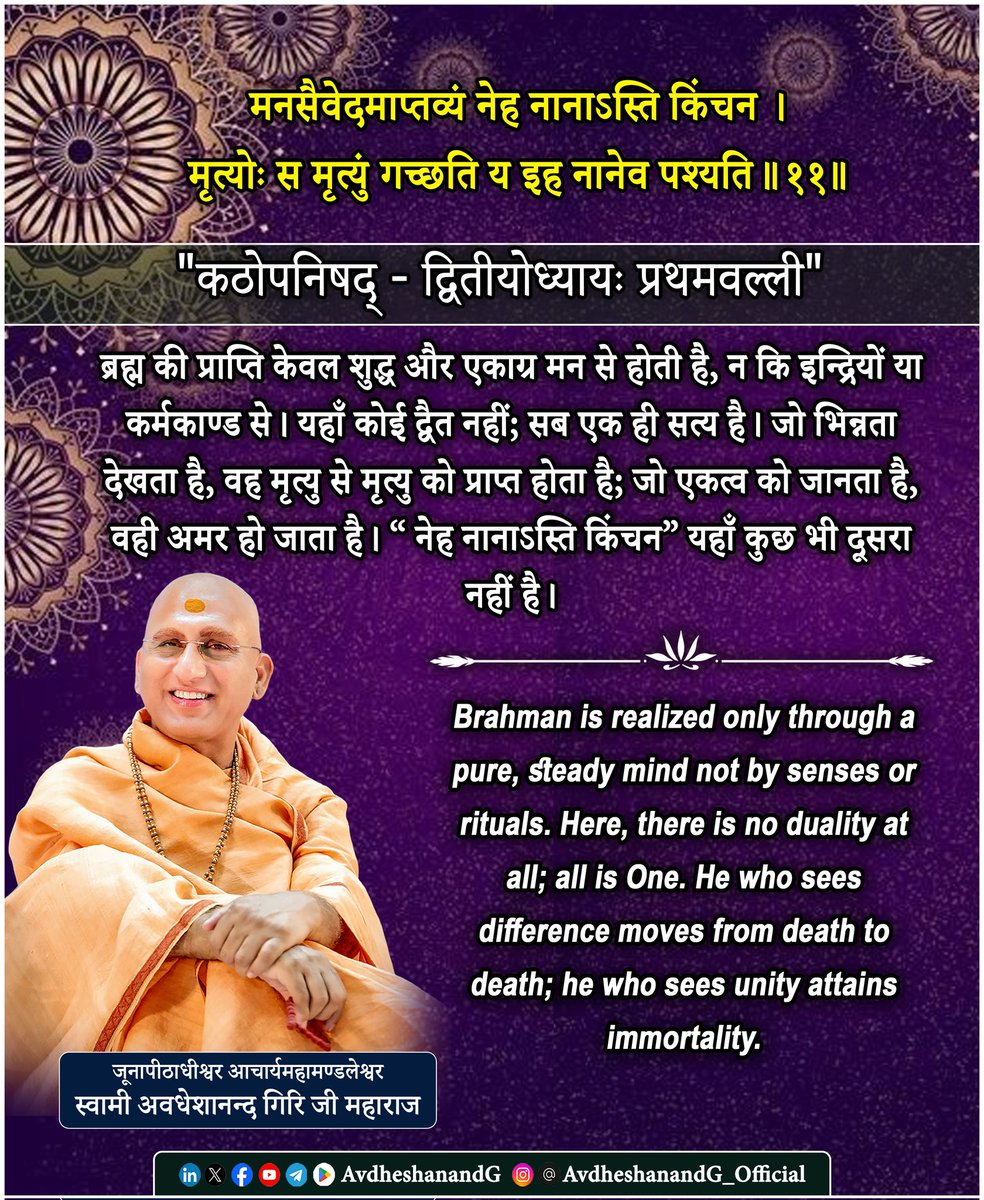
मनसैवेदमाप्तव्यं नेह नानाऽस्ति किंचन।
मृत्योः स मृत्युं गच्छति य इह नानेव पश्यति।।११।।
"कठोपनिषद् - द्वितीयोध्यायः प्रथमवल्ली"
यह मंत्र ब्रह्मज्ञान की आन्तरिक साधना और अद्वैत सत्य की प्रत्यक्ष अनुभूति का सार है। आदि शंकराचार्य इस श्लोक की व्याख्या में कहते हैं कि ब्रह्म किसी बाह्य क्रिया या इन्द्रिय-जन्म ज्ञान से नहीं, बल्कि शुद्ध, संकेन्द्रित मन (मनसा एव) द्वारा ही प्राप्त होता है।
“मनसैवेदमाप्तव्यम्” अर्थात् यह ब्रह्म केवल शान्त, एकाग्र और निर्मल मन से ही जाना जा सकता है। मन जब विषयों की ओर नहीं जाता, बल्कि अपने मूल में लौटता है, तब वह स्वयं ब्रह्मस्वरूप हो जाता है। ब्रह्म बाहरी वस्तु नहीं, आत्मा का अपना स्वरूप है; इसलिए उसका ज्ञान बाह्य उपकरणों से नहीं, अन्तर्मुखता से संभव है।
“नेह नानाऽस्ति किंचन” - यहाँ कोई भी द्वैत नहीं है। जो भिन्नता देखता है; मैं’ और ‘तू’, ‘यह’ और ‘वह’ वह अविद्या के अधीन है।
आदि शंकराचार्य कहते हैं कि “नानात्वदर्शनं अविद्या कारणम्, एकत्वदर्शनं विद्या फलम्।”
द्वैत बन्धन का कारण है, अद्वैत मोक्ष का लक्षण।
“मृत्योः स मृत्युं गच्छति य इह नानेव पश्यति” - जो इस जगत् में विविधता को वास्तविक मानता है, वह मृत्यु के चक्र में फँसा रहता है। मृत्यु का अर्थ केवल शरीर का अन्त नहीं, बल्कि अविद्या और पुनर्जन्म की निरन्तरता है।
ब्रह्मसूत्र कहता है कि “शास्त्रयोनित्वात्” - ब्रह्म का ज्ञान शास्त्र से उत्पन्न होता है, परन्तु उसका अनुभव मन से ही होता है।
भगवद्गीता में श्रीकृष्ण कहते हैं कि
“उद्धरेदात्मनात्मानं नात्मानमवसादयेत्।”
मन ही आत्मा का बन्धन है और मन ही मुक्ति का साधन। और, कहते हैं कि
“अनादित्वान्निर्गुणत्वात् परमात्मा अयमव्ययः।” जो इस एकत्व को जान लेता है, वह मृत्यु से परे हो जाता है।
अतः यह मंत्र सिखाता है - ब्रह्म न किसी लोक में है, न समय में; वह साक्षी-चैतन्य है, जिसे केवल शुद्ध मन में अनुभव किया जा सकता है। जब मन एकत्व का दर्शन करता है, तब मृत्यु और जन्म की गति समाप्त होती है।
“नेह नानाऽस्ति किंचन“ - यहाँ कुछ भी दूसरा नहीं है। यही शंकर-वेदान्त का परम वाक्य है, यही अद्वैत की अनुभूति है, और यही अमृतत्व का द्वार है।
"एतद्वै तत्" - यही वह एक ब्रह्म है, जो सबका आत्मा है।
This mantra expresses the inner path to Self-realization and the core of Advaita Vedānta.
According to Ādi Śhaṅkarācārya, Brahman cannot be attained through ritual or sensory perception, but only through the purified and steady mind “manasa eva idam āptavyam.”
Brahman is not an external object to be seen; it is the very essence of the seer himself.
When the mind withdraws from sense-objects and rests in its own source, it reveals the Self pure Consciousness, without a second.
“Neha nānāsti kiñcana” there is no duality whatsoever here.
Difference between ‘I’ and ‘you,’ ‘this’ and ‘that,’ is only born of ignorance (avidyā).
Śhaṅkarācārya comments: “Nānatva-darśanaṃ avidyā kāraṇam; ekatva-darśanaṃ vidyā phalam.”
To see multiplicity is ignorance; to see unity is knowledge and liberation.
“Mṛtyoḥ sa mṛtyum gacchati ya iha nāneva paśyati”
He who perceives diversity as real moves from death to death.
“Death” here means not just physical decay but the endless cycle of ignorance, bondage, and rebirth.
The Brahmasūtra declares: “Śāstra-yonitvāt” the scripture reveals Brahman, yet realization comes only through the inner mind refined by contemplation.
The Bhagavad Gītā says: “Let a man uplift himself by his own mind.”
And “Being beginningless and beyond the guṇas, the Supreme Self is eternal.”
Thus, the Upaniṣad teaches:
Brahman is not elsewhere It is here, as pure witnessing awareness, attainable only through a tranquil mind.
When the mind perceives Oneness, the chain of death and birth ends forever.
“Neha nānāsti kiñcana There is no multiplicity here.”
This is the heart of Advaita: Unity is immortality; duality is death.
#AvdheshanandG_Quotes
#कठोपनिषद् #अद्वैत_वेदान्त
#AdvaitVedanta #स्वाध्याय
#PrabhuShriKiLekhni
#स्वामी_अवधेशानन्द_गिरि
Most people have no symptoms of #KidneyDisease until it reaches an advanced stage.
If you fall into one or more of these risk categories, talk to your #doctor about whether you should get tested for #KidneyDisease.
Learn more: https://t.co/K1xCbEvmPs
#WorldKidneyDay #OurKidneysOurPlanet #KidneyHealthForAll
एष सर्वेषु भूतेषु गूढोऽऽत्मा न प्रकाशते।
दृश्यते त्वग्र्यया बुद्ध्या सूक्ष्मया सूक्ष्मदर्शिभिः।।१२।।
"कठोपनिषद् - प्रथम अध्याय, तृतीयवल्ली"
यह मंत्र आत्मा के गूढ़, सूक्ष्म और अप्रकट स्वरूप का दार्शनिक उद्घोष है। उपनिषद् कहता है - यह आत्मा सभी प्राणियों में गूढ़ अर्थात् गहराई में स्थित है, परन्तु प्रकाशित नहीं होता, क्योंकि सामान्य बुद्धि उसे नहीं पहचान पाती। वह न इन्द्रियों से ज्ञेय है, न विचार से पकड़ा जा सकता है।
किन्तु, जो साधक अपनी बुद्धि को अग्र्या अर्थात् शुद्ध, एकाग्र और सूक्ष्म बना लेते हैं, वे सूक्ष्मदर्शी होकर उस आत्मा को प्रत्यक्ष अनुभव करते हैं। यह आत्मा बाह्य जगत् में नहीं, भीतर की निस्तब्ध चेतना में अनुभूत होती है।
भगवद्पादाचार्य आदि शंकराचार्य जी अपने भाष्य में कहते हैं कि आत्मा गूढ है क्योंकि वह इन्द्रिय, मन, बुद्धि सभी उपकरणों से परे है। जो ज्ञान इन्द्रियों या तर्क से प्राप्त होता है, वह सीमित है; परन्तु आत्मा का अनुभव केवल अन्तर्मुखी बुद्धि द्वारा ही सम्भव है।
आदि शंकराचार्य कहते हैं कि “अग्र्या बुद्धिः” का अर्थ है - वह बुद्धि जो वैराग्य, विवेक और अन्तःशुद्धि से निर्मल हुई है।
ऐसी सूक्ष्म बुद्धि ही आत्मा को “द्रष्टुम्” जानने में समर्थ होती है। यह ज्ञान बाह्य नहीं, स्वानुभूति है, जहाँ ज्ञाता और ज्ञेय का भेद लुप्त हो जाता है। यह मंत्र सिखाता है कि आत्मा सर्वत्र है, परन्तु दुर्लभ है, न इसलिए कि वह कहीं दूर है, बल्कि इसलिए कि मनुष्य की दृष्टि स्थूल है। जब दृष्टि सूक्ष्म, शुद्ध और एकाग्र होती है, तब भीतर का चैतन्य स्वयं प्रकट होता है।
अतः आत्मा का ज्ञान प्राप्त करना किसी बाह्य यात्रा का नहीं, बल्कि अन्तर्मुखता और शुद्ध विवेक का विषय है जहाँ ‘मैं’ और ‘वह’ का भेद मिट जाता है, और केवल ब्रह्म ही शेष रहता है।
This mantra unveils the hidden and subtle nature of the Self (Ātman). The Upaniṣad declares: “This Self, though present in all beings, remains concealed; it is not manifest to ordinary vision.” It cannot be perceived through the senses or grasped by reasoning; it is known only by those whose intellect is pure, steady, and deeply subtle.
The Ātman is not an external light but the inner radiance that illumines all perception. Only those with inward vision (sūkṣma-darśin), who have refined their awareness through purity and meditation, directly perceive it within themselves.
Ādi Śhaṅkarācārya explains that the Self is “hidden” (gūḍhaḥ) because it is beyond the reach of the senses, mind, and intellect all of which are finite instruments. The Ātman is not an object of knowledge but the very subject that knows.
The term agrya buddhi denotes a mind purified by discrimination (viveka), dispassion (vairāgya), and inner stillness (śuddhi). Only such a subtle intellect can “see” the Self not as an external vision, but as direct self-realization (sva-anubhūti) where the knower and the known merge into one pure awareness.
The Self dwells in every being yet appears hidden, not because it is distant, but because our perception is outward and gross. When the mind becomes inward-turned, clear, and subtle, the light of Consciousness reveals itself as one’s true identity.
Thus, realization is not the discovery of something new,
but the unveiling of what always is the Self, pure, self-luminous, infinite Brahman.
#AvdheshanandG_Quotes
#कठोपनिषद् #अद्वैत_वेदान्त
#AdvaitVedanta #स्वाध्याय
#PrabhuShriKiLekhni
#स्वामी_अवधेशानन्द_गिरि
मानवमात्रके लिए समाज सुधार एवं चरित्र निर्माण सम्बन्धी साहित्य प्रकाशनमें सन् १९२३ से सेवारत्
Visit Now:
https://t.co/b3jXxizk4T
https://t.co/9fDUsm4Xf0
https://t.co/es4ETpHGQc
उत्तिष्ठत जाग्रत प्राप्य वरान्निबोधत।
क्षुरस्य धारा निशिता दुरत्यया दुर्गं पथस्तत्कवयो वदन्ति।।१४।।
"कठोपनिषद् - प्रथम अध्याय, तृतीयवल्ली"
यह मंत्र आत्मज्ञान के पथ पर चलने वाले साधक के लिए जागरण का पुकार है। उपनिषद् कहता है - “उठो, जागो और श्रोत्रिय ब्रह्मनिष्ठ सद्गुरु के समीप पहुँचकर सत्य को जानो।” यह मार्ग अत्यन्त सूक्ष्म है, "क्षुरस्य धारा" अर्थात् तलवार की धार के समान तीक्ष्ण और कठिन। यह जीवन के स्थूल आकर्षणों और भ्रमों को काटकर साधक को आत्मा के सत्य तक ले जाता है।
भगवद्पादाचार्य आदि शंकराचार्य जी अपने भाष्य में लिखते हैं कि “उत्तिष्ठत जाग्रत” का अर्थ केवल शारीरिक जागरण नहीं, बल्कि अज्ञान से जाग्रत होना है।
मनुष्य संसार की नींद में सोया है, उसे विवेक और श्रद्धा के प्रकाश से जागना होगा।
“प्राप्य वरान्” अर्थात् उन महापुरुषों का संग प्राप्त करो, जो ब्रह्मविज्ञान में निपुण हैं, क्योंकि आत्मतत्त्व का ज्ञान केवल गुरु-उपदेश से ही सम्भव है।
“क्षुरस्य धारा” प्रतीक है, उस सूक्ष्म विवेक का, जो साधक को द्वैत के आवरण को भेदकर अद्वैत सत्य तक पहुँचाता है। यह मार्ग कठिन है, किन्तु असम्भव नहीं; जो दृढ़ श्रद्धा और गुरु-कृपा से चलता है, वह पार हो जाता है।
यह मंत्र बताता है कि आत्मज्ञान का मार्ग बाह्य नहीं, अन्तर्मुख और सूक्ष्म है। यह उस धार पर चलने जैसा है, जहाँ असावधानी का अर्थ है - पुनः अज्ञान में गिरना। किन्तु जो जाग्रत रहता है, विवेकशील, संयमी, और गुरु-संलग्न - वह अंततः ब्रह्म को प्राप्त करता है।
अतः यह मंत्र केवल उपदेश नहीं, बल्कि आह्वान है - उठो, जागो, और आत्मा के स्वरूप को पहचानो; क्योंकि यही जीवन का परम पुरुषार्थ और सर्वोच्च उपलब्धि है।
This celebrated verse is a clarion call to spiritual awakening. The Upaniṣad exhorts: “Arise! Awake! Approach the noble teachers and realize the Truth.”
The path of Self-knowledge, it says, is sharp as a razor’s edge- subtle, perilous, and demanding utmost precision and awareness. The seeker must rise above sloth, ignorance, and worldly delusion to walk this inward path toward the Self, which is both hidden and radiant.
Ādi Śhaṅkarācārya explains:
“Uttiṣṭhata, jāgrata” does not merely mean physical awakening it signifies the awakening from ignorance (avidyā). The individual, asleep in worldly pursuits, must awaken to the higher reality through viveka (discrimination) and śraddhā (faith). “Prāpya varān nibodhata” implies- approach the varas, the great teachers who have realized Brahman, and learn from them, for Self-knowledge arises only through the grace of the Guru and the light of inquiry.
The metaphor “kṣurasya dhārā niśitā duratyayā” (the razor’s edge) signifies the razor-sharp precision required to discern the real from the unreal, the eternal from the ephemeral. It is difficult because the mind is easily distracted, yet not impossible- those endowed with steadiness, purity, and guidance can cross safely.
This verse is both a warning and an encouragement:
The path to the Absolute is subtle and inward, not outward.
It requires discipline, humility, and discrimination. But once one awakens and walks under the Guru’s guidance, the truth of the Self pure, infinite Consciousness reveals itself.
Thus, the Upaniṣad calls the seeker: Arise from ignorance, awaken to wisdom, and realize the eternal Self for this alone is the supreme journey, the razor’s path to liberation.
#AvdheshanandG_Quotes
#कठोपनिषद् #अद्वैत_वेदान्त
#AdvaitVedanta #स्वाध्याय
#PrabhuShriKiLekhni
#स्वामी_अवधेशानन्द_गिरि