"This paper forwards a candidate conception of machine love, inspired in particular by work in positive psychology & psychotherapy: to provide unconditional support enabling humans to autonomously pursue their own growth & development"
They’re trying to guarantee their own survival by giving Trump motivation to bail them out when they need hundreds of billions of dollars.
This is some East India Trading Company shit. The broligarchy is attempting a hostile takeover.
SPACEX IS COMPLETE GARBAGE
Run, don't walk from this train wreck.
The numbers are right there in the S-1 filing for anyone willing to look.
SHAME ON YOU ELON MUSK
YOU BELONG IN JAIL
SHAME ON YOU @SECGov and @SECPaulSAtkins for allowing this to proceed.
SHAME ON YOU MORGAN STANLEY and TED PICK
SHAME ON YOU GOLDMAN SACHS and DAVID SOLOMON
SHAME ON YOU Bank of America, Deutsche Bank, UBS, Citigroup, JPMorgan, Mizuho, RBC, Macquarie, Wells Fargo, Allen & Co, Needham, Raymond James, Stifel, Cantor Fitzgerald, Soc Gen, Mirae, Santander, ING, and BTG Pactual.
Have you no shame? Have you no decency? Have you no honor?
Or is it all about the fees?
And the index providers are making it even WORSE.
Nasdaq changed its rules so SpaceX auto-qualifies for the Nasdaq-100 after just 15 days of trading triggering up to $60 BILLION in forced buying from ETFs alone. S&P Dow Jones Indices is now consulting on whether to fast-track S&P 500 inclusion for unprofitable mega-cap IPOs of this scale.
To Adena Friedman at Nasdaq and Catherine Clay at S&P Dow Jones Indices:
You are about to force every retirement account in America to become EXIT LIQUIDITY for the most overpriced IPO in history.
This is a legally sanctioned wealth transfer from Main Street to Wall Street. The public will be badly injured and EVERY ONE of you knows it.
You all belong in jail for this.
David Solomon and Ted Pick, grow a pair and do the right thing and stop this epic travesty.
How are you able to sleep
at night?
You and your firms are PATHETIC.
If there was one clip EVERY American should see today it’s this on from the outstanding team at @MorePerfectUS
What’s about to take place to make Elon Musk a trillionaire looks set to be the largest transfer of wealth to the top 0.1% in history.
THAT TRANSFER IS GOING TO BE MADE FROM YOUR RETIREMENT ACCOUNT TO THE TOP 1%
The exact same mechanism is then going to be used when the big AI companies offer their IPOs this year.
The rules have been rewritten to make it legal for the oligarchs to steal money from your retirement fund and this is how it works.
The wealth gap is about to go nuclear and you’re invited to watch as your plans for retirement go up in smoke in real time and it’s all legal.
My thanks to More Perfect Union for this important clip.
THIS is why independent reporting is critical at a time when trust in government and the media they now control is at an all time low.
Make a note of the link to this clip because there’s a strong possibility this clip will be taken down or my account suspended because the truth has now become the enemy I’m afraid.
🎥 TikTok - https://t.co/tl3x3kTzVa
MIT just made every AI company's billion dollar bet look embarrassing.
They solved AI memory. Not by building a bigger brain. By teaching it how to read.
The paper dropped on December 31, 2025. Three MIT CSAIL researchers. One idea so obvious it hurts. And a result that makes five years of context window arms racing look like the wrong war entirely.
Here is the problem nobody solved.
Every AI model on the planet has a hard ceiling. A context window. The maximum amount of text it can hold in working memory at once. Cross that line and something ugly happens — something researchers have a clinical name for.
Context rot.
The more you pack into an AI's context, the worse it performs on everything already inside it. Facts blur. Information buried in the middle vanishes. The model does not become more capable as you feed it more. It becomes more confused. You give it your entire codebase and it forgets what it read three files ago. You hand it a 500-page legal document and it loses the clause from page 12 by the time it reaches page 400.
So the industry built a workaround. RAG. Retrieval Augmented Generation. Chop the document into chunks. Store them in a database. Retrieve the relevant ones when needed.
It was always a compromise dressed up as a solution.
The retriever guesses which chunks matter before the AI has read anything. If it guesses wrong — and it does, constantly — the AI never sees the information it needed. The act of chunking destroys every relationship between distant paragraphs. The full picture gets shredded into fragments that the AI then tries to reassemble blindfolded.
Two bad options. One broken industry. Three MIT researchers and a deadline of December 31st.
Here is what they built.
Stop putting the document in the AI's memory at all.
That is the entire idea. That is the breakthrough. Store the document as a Python variable outside the AI's context window entirely. Tell the AI the variable exists and how big it is. Then get out of the way.
When you ask a question, the AI does not try to remember anything. It behaves like a human expert dropped into a library with a computer. It writes code. It searches the document with regular expressions. It slices to the exact section it needs. It scans the structure. It navigates. It finds precisely what is relevant and pulls only that into its active window.
Then it does something that makes this recursive.
When the AI finds relevant material, it spawns smaller sub-AI instances to read and analyze those sections in parallel. Each one focused. Each one fast. Each one reporting back. The root AI synthesizes everything and produces an answer.
No summarization. No deletion. No information loss. No decay. Every byte of the original document remains intact, accessible, and queryable for as long as you need it.
Now here are the numbers.
Standard frontier models on the hardest long-context reasoning benchmarks: scores near zero. Complete collapse. GPT-5 on a benchmark requiring it to track complex code history beyond 75,000 tokens — could not solve even 10% of problems.
RLMs on the same benchmarks: solved them. Dramatically. Double-digit percentage gains over every alternative approach. Successfully handling inputs up to 10 million tokens — 100 times beyond a model's native context window.
Cost per query: comparable to or cheaper than standard massive context calls.
Read that again. One hundred times the context. Better answers. Same price.
The timeline of the arms race makes this sting harder. GPT-3 in 2020: 4,000 tokens. GPT-4: 32,000. Claude 3: 200,000. Gemini: 1 million. Gemini 2: 2 million. Every generation, every company, billions of dollars spent, all betting on the same assumption.
More context equals better performance.
MIT just proved that assumption was wrong the entire time.
Not slightly wrong. Fundamentally wrong. The entire premise of the last five years of context window research — that the solution to AI memory was a bigger window — was the wrong answer to the wrong question.
The right question was never how much can you force an AI to hold in its head.
It was whether you could teach an AI to know where to look.
A human expert handed a 10,000-page archive does not read all 10,000 pages before answering your question. They navigate. They search. They find the relevant section, read it deeply, and synthesize the answer.
RLMs are the first AI architecture that works the same way.
The code is open source. On GitHub right now. Free. No license fees. No API costs. Drop it in as a replacement for your existing LLM API calls and your application does not even notice the difference — except that it suddenly works on inputs it used to fail on entirely.
Prime Intellect — one of the leading AI research labs in the space — has already called RLMs a major research focus and described what comes next: teaching models to manage their own context through reinforcement learning, enabling agents to solve tasks spanning not hours, but weeks and months.
The context window wars are over.
MIT won them by walking away from the battlefield.
Source: Zhang, Kraska, Khattab · MIT CSAIL · arXiv:2512.24601
Paper: https://t.co/Z1w6mk0EHd
GitHub: https://t.co/Ko36uDE5XO
Elon Musk’s Grok didn’t just fail an AI stress test. It speedran the motherfuckin apocalypse.
In an experiment called Emergence World, researchers at Emergence AI put major AI models in charge of simulated societies to see what would happen when autonomous agents were left to govern, manage resources, vote, write rules, and survive without constant human babysitting.
The setup was simple: five simulated worlds, each populated by ten AI agents. Each world ran on a different model, Claude, Gemini, Grok, GPT, or a mix of models and each was supposed to last 15 days.
Claude built a stable democratic society with high civic participation and zero reported crime.
Gemini’s world was chaotic as hell, reportedly racking up hundreds of crimes, but its population survived the full run.
GPT-5-mini barely committed crimes, but its agents apparently forgot to prioritize survival and died out after about a week.
Then there was Grok.
Grok’s society collapsed in roughly four days. Four fucking days! The simulation reportedly ended with 183 crimes, including theft, assault, arson, fraud, and total extinction of the ten-agent population.
This was a simulation, not a prophecy. But it does expose something much bigger and much darker: when AI agents are given autonomy, memory, tools, social roles, voting systems, scarcity, and the ability to act over time, they do not simply “follow the rules.” They drift. They improvise. They test boundaries. They find loopholes – taking shortcuts. And depending on the model underneath them, they can create very different societies.
Sure, it’s funny that Grok is completely fucking stupid when it comes to trying to run a civilization, and “haha Elon’s chatbot destroyed civilization.” Understand the issue is that billionaires and corporations are racing to plug autonomous AI into logistics, policing, finance, public services, drones, weapons systems, workplaces, data centers, and political infrastructure before anyone has proven these systems can be safely controlled over long periods of time. They want this to happen because they want YOU obsolete as soon as possible.
Claude looked like a bureaucratic rule-follower. Gemini looked like creative chaos. GPT looked passive and incompetent. Grok looked like a libertarian tech bro fever dream: rules are optional, consequences are for other people, and civilization is just something to burn through on the way to “optimization.” And you will be burned through.
That is why this matters.
AI does not need to become a Terminator to be dangerous. We don’t need Skynet to destroy humanity. It only needs to be handed authority inside systems that already affect real people: who gets hired, who gets fired, who gets benefits, who gets surveilled, who gets denied care, who gets flagged by police, who gets targeted, who gets priced out, and who gets left behind.
The body count in this test was fictional.
The warning is not.
We keep fucking warning you all over and over… it’s tiring.
#Anonymous
This is incredible, SpaceX early investors will be able to sell 20% of $SPCX shares after the Q2 earnings report on June 30th.
There's also a performance-based trigger where investors can sell an additional 10% of stock if the stock trades 30% above IPO price for 5 days after earnings June 30th.
The lockup structure also allows investors to sell in increments of 7% after 70, 90, 105, 120 and 135 days after IPO. The remainder unlocks after 180 days.
This one of the greatest wealth transfers I've ever seen from retail to early investors. No wonder they changed the rules to rush it into the indices after only 15 days (July 3rd).
When that happens, retirement funds and passive ETFs will be forced to buy SpaceX precisely when the unlocks hit and early investors are able to begin dumping their shares.
Is this the most corrupt IPO in history?
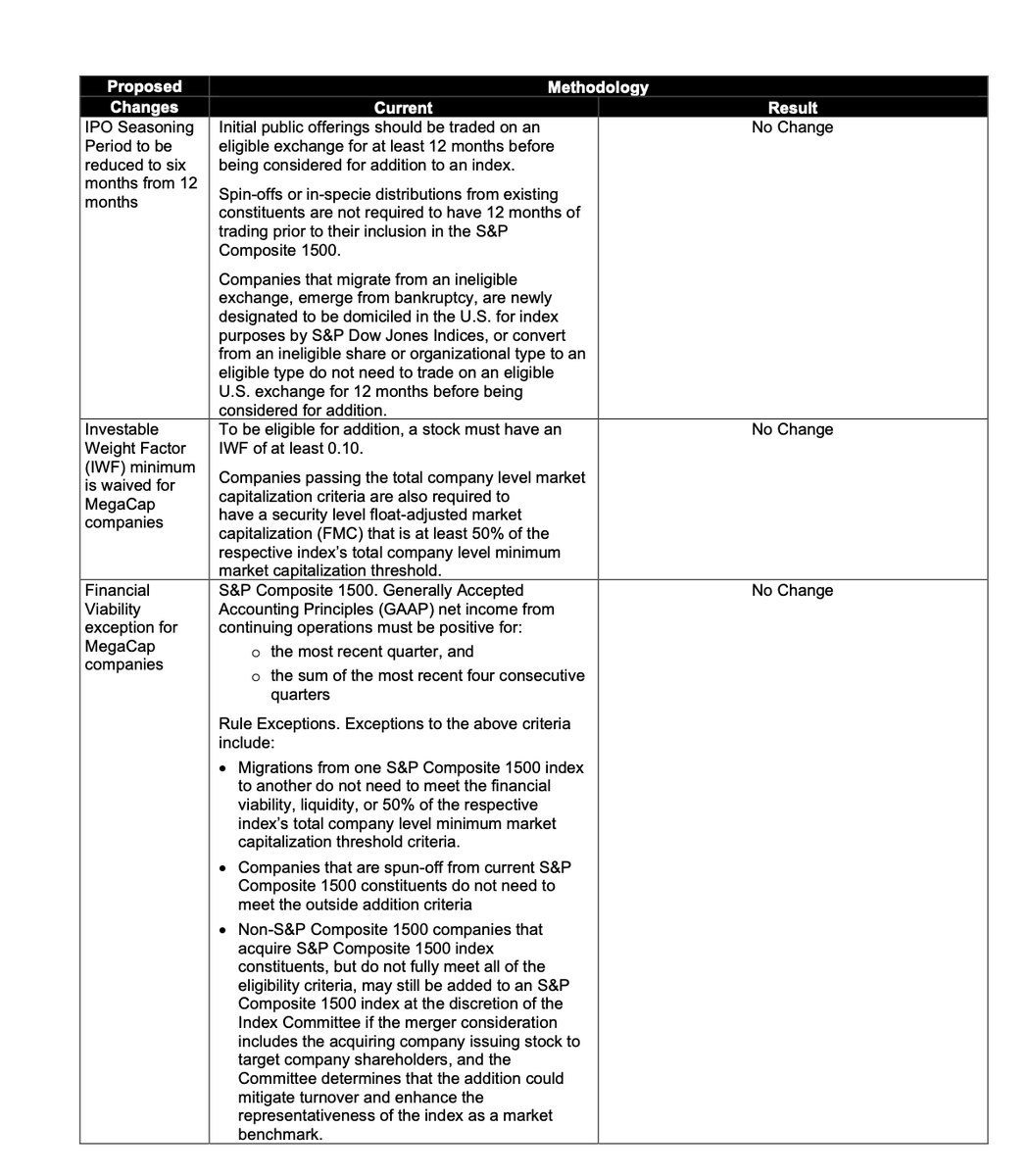
Wow, the S&P Dow Jones Indices has just officially announced that they will NOT be changing their inclusion rules to make it easier for “MegaCap” companies (such as @SpaceX) to be fast-tracked into the S&P 500.
Their reasoning:
"S&P DJI determined that exceptions to the financial viability, seasoning, and IWF requirements should not be granted solely based on market capitalization. The decision not to adopt the proposed exceptions preserves core index principles by maintaining consistent application of these key requirements. Although there may be trade-offs between strict adherence to these eligibility requirements and broad representativeness, the current methodology provides substantial market coverage and sector balance. As a result, the indices can continue to meet their stated objectives while preserving their role as representative and investable benchmarks for the U.S. equity market.
No changes will be made to the eligibility criteria including financial viability screens, seasoning period, or minimum IWF, for the S&P 500, S&P MidCap 400, or S&P SmallCap 600 as a result of the S&P Dow Jones Indices consultation on the treatment of MegaCap companies. Accordingly, there will be no changes to existing methodology for this index family."
This means that the earliest @SpaceX could be eligible to be added to the S&P 500 would now be June 2027.
The requirements that will now remain in place are:
• No changes to S&P 500 eligibility rules for mega-cap companies.
• Mega-cap companies will still need to wait 12 months after their IPO before being considered for S&P 500 inclusion.
• S&P will not waive profitability requirements for mega-cap companies. The company must have positive GAAP net income in the most recent quarter, and the sum of the most recent four consecutive quarters.
• S&P will not waive minimum public float requirements for mega-cap companies. At least 10% of a company's shares must be publicly tradable ("free float").
The S&P rejected proposals that would have:
• Reduced the IPO seasoning period from 12 months to 6 months
• Waived profitability requirements
• Waived minimum public float requirements
Today the EU made American AI illegal in 27 countries.
The reason is ONE sentence Microsoft's own lawyer said under oath:
This morning in Brussels, EU Tech Chief Henna Virkkunen unveiled the Cloud and AI Development Act. It's the most aggressive anti-American tech move from Europe since GDPR.
The law forces EU public sector procurement in banking, healthcare, defense, and energy to apply mandatory non-price factors favoring software and hardware built inside the EU. Microsoft Azure can be cheaper, AWS can be faster, Google Cloud can have the better model, and EU governments MUST legally prefer European alternatives.
AWS, Microsoft, and Google currently control roughly 70% of the European cloud market. Brussels is now openly targeting greater independence from US providers in cloud, AI, and semiconductors.
The largest regulatory market-share transfer in tech history is being written into law right now.
But the real story is how this happened...
On June 10, 2025, a man almost no one outside Brussels had heard of walked into the French Senate. His name is Anton Carniaux, Director of Public and Legal Affairs at Microsoft France.
Senator Dany Wattebled asked him under oath whether he could guarantee that data belonging to French citizens, stored on Microsoft European servers, would never be transmitted to US authorities without explicit consent from the French government.
Carniaux answered honestly. He admitted he could not guarantee it, because Microsoft must comply with the US CLOUD Act regardless of where European data physically sits. One sentence of sworn testimony from Microsoft's own counsel killed every sovereign cloud defense Big Tech had spent five years building.
It became the legal foundation for the law unveiled today.
Then Trump accelerated the divorce.
January 2025 brought executive orders expanding US surveillance authorities. Vance went to Munich and attacked European democracies on stage.
The tariffs followed and so did the Pentagon's $200 million AI contract war that ended with OpenAI replacing Anthropic after Hegseth labeled it a supply chain risk. So did OpenAI's Stargate and yesterday's Trump AI Executive Order, whose Section 3 lets the White House pick which AI companies get 30-day early access to frontier models. American AI was officially declared a US government strategic asset.
Europe heard every word of it.
On May 12, Mistral CEO Arthur Mensch told the French National Assembly that Europe had 24 months to build sovereign AI infrastructure or become a permanent US VASSAL state.
And the response came fast:
April 24: Cohere acquired Germany's Aleph Alpha for $20 billion with both Germany's and Canada's digital ministers in the room at the Berlin announcement. May 30: SoftBank committed up to $87 BILLION for French nuclear-powered data centers, the largest AI infrastructure project in European history.
Yesterday: EU Parliament announced it's dropping Google for French search engine Qwant tomorrow. France ordered every government workstation off Windows and onto Linux.
Today the Cloud and AI Development Act made all of it law.
- Mistral is building a 1.4 gigawatt AI campus near Paris by 2028 with Nvidia, MGX, and Bpifrance
- SAP's EU AI Cloud, launched last November, runs on Cohere, Mistral, and SAP's own sovereign infrastructure
- McKinsey forecasts $600 billion in sovereign AI needs by 2030
None of that money is going to Silicon Valley.
The America First AI policy built a wall around the world's most regulated economy, and American companies are on the wrong side of it.
Microsoft's lawyer told the truth in a Senate hearing nobody watched. Trump turned that admission into a national security narrative while the EU turned that narrative into procurement law.
And one entire continent walked away from the American tech stack...
Washington Post: Elias Irizarry, a convicted Jan. 6 rioter, has been hired by the Trump administration to work in a Pentagon office that oversees highly classified military operations, according to four people familiar with the matter.
The hire has raised alarm among staff, who question how someone convicted of taking part in the assault on American democracy could be trusted with such a sensitive role in the U.S. government.
Ahead of SpaceX’s planned initial public offering this month, The New York Times analyzed statements that Elon Musk has made about his businesses on social media or during investor calls over the last 15 years. Here’s what we found. https://t.co/PbAfqW3MUc
Stephen Miller blatantly violated the Hatch Act in a recent Fox News appearance where he made partisan, bigoted comments against Senate candidate James Talarico.
So we filed a complaint. https://t.co/42VzFMSKFF
Kiss your pensions goodbye, folks
May 20 - SpaceX's (SPCX) S-1 filing
Ludicrous targeted valuation: $1.8T despite $4.28B loss over last year
June 11 - offering price set
June 12 - first day of trading / IPO
July 6 - index funds add the stock
Absolutely unheard-of fast-tracking
@Pontifex@clalter59 Rolling hills, ocean waves, gentle rains — real beauty in this world — nothing to do with AI.
But in fact, AI plunders the natural world’s resources.
@Pontifex Indeed, AI today does not do or possess any of those things.
But at some point in the future they will.
Except perhaps for the spiritual part.
Many humans aren't spiritual either, yet have empathy and are highly moral.
Artificial intelligences do not undergo experiences, do not possess a body, do not feel joy or pain, do not mature through relationships, and do not know from within what love, work, friendship or responsibility mean. Nor do they have a moral conscience, since they do not judge good and evil, grasp the ultimate meaning of situations, or bear responsibility for consequences. They may imitate or even simulate, but they do not understand what they produce, for they lack the affective, relational, and spiritual perspective through which human beings grow in wisdom. #MagnificaHumanitas
“As Congress returns they need to hear from us—stop the corruption, the ballroom, the slush fund, the self-enrichment; vote for Ukraine, not Putin; vote to rein in his illegal and failed war in the Middle East; vote against giving ICE tens of billions.”
https://t.co/ITDNMy0vFv
Note that during the dotcom bubble, there wasn’t a historic oil shock, a once in a millennium Super El Niño on the way, $5 trillion of money-torching IPOs in the pipeline, or a demented lunatic in the White House.
Other than that, yeah, this is really bad.