Military Weapons Intelligence. Speed Metal and EBM keep me creative. Except for cooking, wine is mostly pointless, Coca Cola never had a bad year. Comics.
This video, which has a million views and counting, is an example of AI-generated slop. There are several clues in the video, including the military patch and the US flag.
But this specific genre of video has been a prolific source of AI slop videos for engagement farmers for some time. Simply look for phrases such as "child soldier salute" or "respect has no age" on platforms like Facebook, YouTube or TikTok, and see the litany of similar AI clips and their sizeable view counts.
A Japanese immunologist spent 20 years proving that the chemicals trees release into the air walk into your bloodstream, hunt down your stress hormones, and arm your immune system in ways no therapist or pharmaceutical has ever matched, and most of the data has been sitting in Japanese medical journals for two decades waiting to be translated.
His name is Qing Li.
He is a clinical professor at Nippon Medical School in Tokyo and the president of the Japanese Society of Forest Medicine. The Japanese government has been funding his research since 2004, and the body of work he has produced is the reason forest bathing is now an officially prescribed clinical therapy in Japan and Korea.
The story actually starts in 1982, when the Japanese Ministry of Agriculture, Forestry and Fisheries coined the term shinrin-yoku to describe the practice of slow, mindful walking in a forest. They did it for a practical reason.
Japan was urbanizing fast, stress-related illness was climbing, and the country had thousands of square kilometers of forest sitting unused. The idea was to give people a reason to walk into the trees... They had no idea what was actually happening to the human body during those walks until Qing Li ran the first proper experiment in 2005.
He took twelve healthy adult men on a three-day, two-night trip to a forest park. They walked for a few hours each day. Nothing strenuous. No prescribed routes or breathing exercises. They simply walked slowly through the trees, breathing the air, looking at the forest.
Li drew blood and urine samples before the trip, on the second day, on the third day, on day seven after returning home, and again on day thirty.
The numbers that came back from the lab were not what anyone expected.
The activity of a specific type of immune cell called the natural killer cell, which is the cell your body uses to hunt down cancer cells and virus-infected cells before they can spread, had jumped by roughly 50 percent during the forest trip. The actual number of natural killer cells circulating in the bloodstream had increased significantly.
Three different anti-cancer proteins that those cells produce, called perforin, granzymes, and granulysin, had all risen sharply. And the effect did not disappear when the men went home. The immune boost was still measurable on day seven and was still partially present on day thirty.
Two hours a day in a forest had upgraded the immune system for a full month.
Li ran the same experiment with women a year later and found nearly identical results. Then he ran it with a control group who took a three-day trip through an urban area with the same amount of walking, the same hotel quality, and the same diet.
The urban group showed no measurable change in natural killer cell activity at all. The forest was doing the work, not the vacation.
The mechanism turned out to be a class of airborne molecules called phytoncides. Trees produce these compounds to defend themselves against insects, bacteria, and fungi. Pine, cedar, oak, and cypress trees release them in particularly large amounts, especially in warmer weather and after rainfall.
When you walk through a forest, you are inhaling those molecules into your lungs and absorbing them through your skin, and once inside your body they appear to directly stimulate the production and activity of the very immune cells Li was measuring in his lab.
Roughly 50 percent of the health benefit of a forest walk, according to Li's data, comes from the chemistry of the air itself. The other half comes from what the forest is doing to your nervous system.
This is where it stops being only about the immune system and starts being about stress.
A separate Japanese research team measured cortisol, the body's main stress hormone, in 84 participants across 35 different forest sites. They drew samples before and after a 30-minute walk in each forest and compared them to control walks in matched urban environments. The cortisol levels of the people who walked in the forest were lower than the cortisol levels of the people who walked in the city by a significant margin. Their heart rates were lower. Their blood pressure was lower.
The activity of their parasympathetic nervous system, which is the part responsible for rest and recovery, had gone up. The activity of their sympathetic nervous system, which is the part that drives fight or flight, had gone down.
Then a researcher at the University of Michigan named MaryCarol Hunter ran the cleanest version of this experiment ever done. She recruited participants from a city and told them to take a nature pill three times a week for eight weeks.
They were free to choose the time, the place, and the duration of the nature experience, as long as it was outside, in daylight, and free of phones, conversations, and aerobic exercise. They sent her saliva samples before and after each session so she could measure cortisol changes accurately and rule out the normal daily drop in stress hormones that happens to everyone.
The result was that participants experienced a 21.3 percent drop in cortisol per hour spent in nature, with the biggest payoff happening between minutes 20 and 30 of the walk.
After that, the cortisol kept dropping, but more slowly. The threshold dose for measurable stress relief was just 20 minutes outside in something that looked and felt like nature.
What none of this means is that nature is a substitute for therapy or for medication when someone genuinely needs them. Therapy treats different things than a walk does, and Li himself has been careful in interviews to call forest bathing a complementary intervention rather than a replacement for clinical care.
But what the research has settled is that the human body has a physiological response to being among trees that operates on the same biological systems modern medicine is trying to reach with drugs and clinical protocols, and that response is fast, measurable, and free.
The strangest part of Li's work is the implication he keeps repeating in interviews. The average person now spends more than 90 percent of their life indoors. Their cortisol stays elevated. Their natural killer cells stay sluggish.
Their parasympathetic nervous system rarely gets a chance to take over. The system that was tuned by millions of years of life under a canopy of trees is being asked to run permanently inside a box made of drywall and screens.
Your body has not forgotten what it is supposed to do in a forest. It is waiting for you to walk into one.
Today is the 82nd anniversary of D-Day – the Allied landings in Normandy, which significantly hastened the countdown to the Nazis' collapse in World War II. It is one of the most important moments of unity among the defenders of life in human history, and it was less than a year until the peoples’ aspiration for freedom and the hope of peace prevailed in May 1945. It happened then. We are working to make it happen again today.
And although yesterday in Petersburg another cynical order to continue killing was issued for the army trying to destroy our freedom, history has seen this before. The Nazis also had their own hopes after D-Day. But freedom still wins. And even in the darkest circumstances, people find ways to come together to protect life.
I thank all those who are now helping to protect the values that prevailed in World War II. I thank everyone who is defending life. Glory to Ukraine!
A bricklayer in East Yorkshire has spent 35 years putting up barn owl nest boxes on weekends. This year, the region saw 308 owlets hatch.
His name is Robert Salter. He's 56 and does bricklaying full time. In 1990, he saw a piece on the news about a man in Lincolnshire installing barn owl boxes, and decided he'd do the same. He started with five.
He now has more than 350 boxes scattered across fields, farms, outbuildings, and trees in East Yorkshire. Every June, he takes four weeks off from bricklaying and visits them with his wife Sue. Scrambling up ladders, ringing chicks, cleaning boxes, repairing the ones the weather got to. He's a licensed bird ringer for the British Trust for Ornithology.
In 2024, the region ringed 95 owlets. In 2025, the count was 308. The Barn Owl Trust says that nationally, this year was "pretty poor" for barn owl breeding, but east Yorkshire is the exception, and it's the exception because of one man with a ladder.
The barn owl population in the UK was estimated at 4,000 pairs in the mid-2000s and crashed to roughly 1,000 by the early 2010s. The species is still recovering.
Most of conservation is one person who refuses to give up.
Artificial intelligences do not undergo experiences, do not possess a body, do not feel joy or pain, do not mature through relationships, and do not know from within what love, work, friendship or responsibility mean. Nor do they have a moral conscience, since they do not judge good and evil, grasp the ultimate meaning of situations, or bear responsibility for consequences. They may imitate or even simulate, but they do not understand what they produce, for they lack the affective, relational, and spiritual perspective through which human beings grow in wisdom. #MagnificaHumanitas
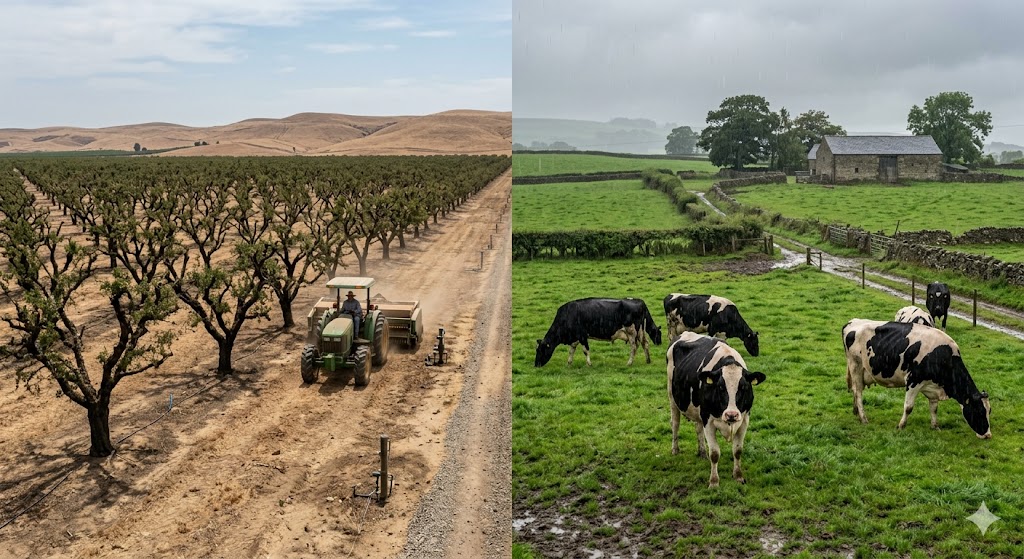
The funniest maths in modern environmentalism.
One almond requires 12 litres of irrigated water to produce. Peer-reviewed, ScienceDirect, 2017. A glass of almond milk contains roughly 50 of them. 600 litres of water before the carton is filled.
The water comes from the San Joaquin Valley in California, which sits over one of the most over-extracted aquifers on earth. The valley floor has subsided by up to nine metres in places due to groundwater depletion. The carton is then refrigerated, sailed across the Atlantic, refrigerated again, lorried to a Manchester Tesco, and bought by someone who is concerned about the environmental impact of dairy.
Meanwhile, in Cheshire.
A British dairy cow drinks roughly 70 to 100 litres of water a day and produces around 28 litres of milk. That's about 3.5 litres of water per litre of milk. The water is rainwater that fell on her field or came from a local stream fed by the same rainwater. The rain was going to fall on the field whether the cow stood in it or not. 80% of her moisture intake comes from the grass itself, which is also rain.
She converts the grass, free of charge, into a litre of milk containing seven times the protein and four times the calcium of almond milk, and shipped roughly 18 miles to the same Tesco.
To recap.
600 litres of stolen aquifer, flown halfway round the world for nutritionally worthless beige water.
Or 3.5 litres of rain that was already falling, converted by an animal you can pet, into actual food.
The shopper picks the almond.
She has been told this is the ethical position.
The aquifer would like a word.
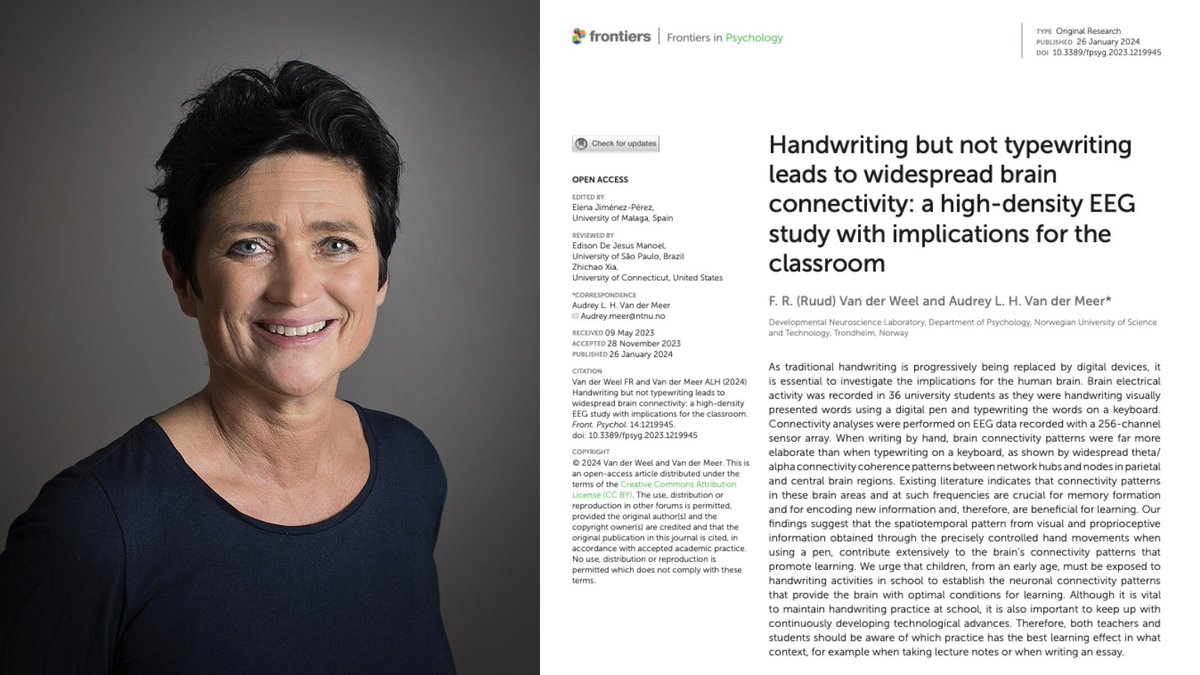
A Norwegian neuroscientist spent 20 years proving that the act of writing by hand changes the human brain in ways typing physically cannot, and almost nobody outside her field has read the paper.
Her name is Audrey van der Meer.
She runs a brain research lab in Trondheim, and the paper that closed the argument was published in 2024 in a journal called Frontiers in Psychology. The finding is brutal enough that it should have changed every classroom on Earth.
The experiment was simple. She recruited 36 university students and put each one in a cap with 256 sensors pressed against their scalp to record brain activity. Words flashed on a screen one at a time.
Sometimes the students wrote the word by hand on a touchscreen using a digital pen, and sometimes they typed the same word on a keyboard. Every neural response was recorded for the full five seconds the word stayed on screen.
Then her team looked at the part of the data most researchers had ignored for years, which is how different parts of the brain were communicating with each other during the task.
When the students wrote by hand, the brain lit up everywhere at once.
The regions responsible for memory, sensory integration, and the encoding of new information were all firing together in a coordinated pattern that spread across the entire cortex. The whole network was awake and connected.
When the same students typed the same word, that pattern collapsed almost completely.
Most of the brain went quiet, and the connections between regions that had been alive seconds earlier were nowhere to be found on the EEG.
Same word, same brain, same person, and two completely different neurological events.
The reason turned out to be something nobody had really paid attention to before her work. Writing by hand is not one motion but a sequence of thousands of tiny micro-movements coordinated with your eyes in real time, where each letter is a different shape that requires the brain to solve a slightly different spatial problem.
Your fingers, wrist, vision, and the parts of your brain that track position in space are all working together to produce one letter, then the next, then the next.
Typing throws all of that away. Every key on a keyboard requires the exact same finger motion regardless of which letter you are pressing, which means the brain has almost nothing to integrate and almost no problem to solve.
Van der Meer said it plainly in her interviews.
Pressing the same key with the same finger over and over does not stimulate the brain in any meaningful way, and she pointed out something that should scare every parent who handed their kid an iPad.
Children who learn to read and write on tablets often cannot tell letters like b and d apart, because they have never physically felt with their bodies what it takes to actually produce those letters on a page.
A decade before her, two researchers at Princeton ran the same fight using a completely different method and ended up at the same answer. Pam Mueller and Daniel Oppenheimer tested 327 students across three experiments, where half took notes on laptops with the internet disabled and half took notes by hand, before testing everyone on what they actually understood from the lectures they had watched.
The handwriting group won by a wide margin on every question that required real understanding rather than surface recall.
The reason was hiding in the transcripts of what the two groups had actually written down.
The laptop students typed almost word for word, capturing more total content but processing almost none of it as they went, while the handwriting students physically could not write fast enough to transcribe a lecture in real time, which forced them to listen carefully, decide what actually mattered, and put it in their own words on the page.
That single act of choosing what to keep was the learning itself, and the keyboard had quietly skipped the choosing and skipped the learning along with it.
Two studies. Two countries. Same answer.
Handwriting makes the brain work. Typing lets it coast.
Every note you have ever typed instead of written went into your brain through a thinner pipe. Every meeting, every book highlight, every idea you captured on your phone instead of on paper was processed at half depth.
You did not forget those things because your memory is bad. You forgot them because typing never woke the part of the brain that would have made them stick.
The fix is the thing your grandmother already knew.
Pick up a pen. Write the thing down. The slower road is the faster one.
First of all, crematorium IV was not blown up during the Sonderkommando revolt at Auschwitz II-Birkenau. It was set on fire by prisoners who barricated inside.
451 victims is the number of the Sonderkommando members killed during and after the revolt, yet not all of them participated in it. Yet, some prisoners were kept alive, as the SS needed them to continue their work.
You can learn about the uprising here: https://t.co/QHXBn4JOGZ
---
The image illustrating the story is sadly an AI-fabrication.
By failing to respond to the spread of fake, AI-generated images and videos of Auschwitz and other Holocaust-related sites, social platforms are contributing to the spread of historical distortion.
We believe platforms should take responsibility by actively moderating such content and clearly flagging fabricated images and videos. Memory and historical truth deserve stronger protection. This matters because such content does not merely falsify history.
IT ACTIVELY HARASSES THE MEMORY OF VICTIMS.
Today, when users search for “Auschwitz”, mainly on Facebook, an increasing number of results consist of fabricated, AI-generated videos rather than authentic historical documentation.
By allowing these distortions to surface, circulate, and gain visibility, Meta directly contributes to the erosion of factual understanding of the complex history of Auschwitz, which we try to protect.
This is the problem, people wanting to join the Defence Force because they want a job. Wrong. You join because you have the passion to serve, to sacrifice for your fellow citizens. Not because you want a job. The SANDF should not be a social crutch for the failings of Govt.
Here are some of the law enforcement agency officials arrested over the past few months -
a development that has raised serious concerns…
• General Fannie Masemola
• Lt-General Dumisani Khumalo
• Major-General Philani Lushaba
• Major-General Nosipho Precious Madondo
• Major-General Josias Lekalakala
• Major-General Zwelithini Gabela
• Brigadier Phindile Ncube
• Brigadier Dineo Mokwele
• Major-General Busisiwe Temba
• Brigadier Rachel Matjeng
• Brigadier Onicca Ofentse Tlhoaele
• Brigadier Kirsty Jonker
• Brigadier Thembinkosi
• Brigadier Alpheus Ngema
• Brigadier Patrick Nthengwe
• Colonel Nehemiah Maleka
• Colonel Johannes Monyai
• Colonel Nonjobulo Mngadi
• Captain Brian Cartwright
• Retired Brigadier Petunia Lenono
• Retired Colonel Anton Paulsen
• Sgt Fannie Nkosi
• Major-General Firoz Khan
• Major-General Ebrahim Kadwa
• Deputy EMPD chief Julius Mkhwanazi
COMMENTS:
The growing list of senior law enforcement officials facing arrest, investigation or criminal allegations paints a deeply troubling picture for South Africa’s policing and criminal justice structures.
Many of these cases involve allegations linked to corruption, organised crime, precious metals syndicates and abuse of state resources and interference in investigations.
The arrests have intensified public concern over the extent to which criminal networks may have infiltrated sections of law enforcement agencies.
While arrests do not amount to guilt and all accused remain innocent until proven guilty in court, the repeated implication of senior-ranking officials continues to erode public trust in institutions tasked with fighting crime and corruption.
The developments also place renewed focus on the work of oversight bodies and commissions investigating corruption and political interference within the criminal justice system.
Sources say more arrests are likely over the coming weeks.
@pule_jones
Two top SA Army Foundation's officials were barred and fined R44.7m for irregularities and paying themselves. The FSCA withdrew the Foundation's licence. That means it can no longer manage members funds. This statement totally ignores that and who will now manage those funds.
A baby elephant named Ellie was discovered alone in the wild in South Africa, having been rejected by his herd due to a severe umbilical abscess and hernia.
Ellie remained lethargic and deeply depressed, showing no will to live. Recognizing that elephants are intensely social creatures, the team introduced him to Duma, a retired service and sniffer dog residing at the sanctuary.
The effect was instantaneous. As soon as they met at the sand pile, Ellie’s demeanor shifted from despair to curiosity. The two became inseparable, with Duma’s playful energy teaching Ellie how to be a joyful calf again. She finally had a chance to heal and enjoy life.
[📹 Earth Touch News]
[📍 Thula Thula Rhino Orphanage]
The Man Nobody Is Talking About. His Name Is Sir Philip Barton.
Buried inside Tuesday's committee testimony, beneath the headlines about constant pressure, bullying and secret job searches, is the detail that may prove the most consequential of this entire affair. It concerns not Olly Robbins, not Morgan McSweeney, not even Keir Starmer. It concerns the man who was there before all of them. The man who said no. The man who then left his post eight months early.
Sir Philip Barton was the Permanent Under-Secretary at the Foreign Office when Peter Mandelson's appointment was announced in December 2024. He was, in other words, the most senior civil servant in the building at the precise moment the machinery of state was being directed to place a man with documented links to Russia and China into the most sensitive diplomatic posting in the Western alliance.
What Robbins told the committee on Tuesday is this. Barton pushed back. When the Cabinet Office argued that vetting Mandelson was unnecessary, that a peer and Privy Councillor did not require developed vetting, Barton refused to accept it. He insisted that vetting was a requirement. He had to be, in Robbins's own words, very firm in person. He also voiced reservations about the appointment to Jonathan Powell, the National Security Adviser, reservations that were noted and not acted upon. He was worried, Robbins suggested, about exactly the same reputational risks that had been detailed to the Prime Minister before the appointment was announced.
Then Sir Philip Barton left his post. Eight months before his tenure would otherwise have concluded.
The question Richard Foord put to Robbins on Tuesday was the right one. Why did Barton's tenure end early? Robbins said he did not know. He suggested ministers may have felt it was time for a change. That answer is not an answer. It is the absence of one.
Consider what the timeline now shows. A senior civil servant pushes back against the appointment, insists on vetting when the Cabinet Office wants to bypass it, raises reservations with the National Security Adviser, and departs eight months ahead of schedule. His replacement arrives to find the appointment already treated as a fait accompli, the vetting process under constant pressure from Downing Street, and the question of outcome entirely subordinate to the question of speed.
If Barton was removed because he stood in the way of this appointment, then Robbins was not the first civil servant sacrificed to protect it. He was the second. And the question of who else was moved aside, overruled or silenced in the months between December 2024 and the moment the security services finally said no, becomes the most important question this affair has yet produced.
Starmer sacked Robbins for following the rules. The Foreign Affairs Committee will now call Barton to give evidence. What he says will either confirm what the timeline already suggests or provide an alternative explanation that the evidence does not currently support.
There is a pattern here that goes beyond process failure. Process failures are random. They point in different directions. What this affair has produced is a series of events that point consistently in one direction. Officials who comply are retained. Officials who push back depart. The security services are bypassed. The vetting is treated as an administrative inconvenience. And the one question nobody at the top of this government will answer is why this appointment, this man, this post, mattered so much that every obstacle was removed to make it happen.
Barton apparently asked that question. He left eight months early. The country deserves to know why.