The math on this project should mass-humble every AI lab on the planet.
1 cubic millimeter. One-millionth of a human brain. Harvard and Google spent 10 years mapping it. The imaging alone took 326 days. They sliced the tissue into 5,000 wafers each 30 nanometers thick, ran them through a $6 million electron microscope, then needed Google’s ML models to stitch the 3D reconstruction because no human team could process the output.
The result: 57,000 cells, 150 million synapses, 230 millimeters of blood vessels, compressed into 1.4 petabytes of raw data. For context, 1.4 petabytes is roughly 1.4 million gigabytes. From a speck smaller than a grain of rice.
Now scale that. The full human brain is one million times larger. Mapping the whole thing at this resolution would produce approximately 1.4 zettabytes of data. That’s roughly equal to all the data generated on Earth in a single year. The storage alone would cost an estimated $50 billion and require a 140-acre data center, which would make it the largest on the planet.
And they found things textbooks don’t contain. One neuron had over 5,000 connection points. Some axons had coiled themselves into tight whorls for completely unknown reasons. Pairs of cell clusters grew in mirror images of each other. Jeff Lichtman, the Harvard lead, said there’s “a chasm between what we already know and what we need to know.”
This is why the next step isn’t a human brain. It’s a mouse hippocampus, 10 cubic millimeters, over the next five years. Because even a mouse brain is 1,000x larger than what they just mapped, and the full mouse connectome is the proof of concept before anyone attempts the human one.
We’re building AI systems that loosely mimic neural networks while still unable to fully read the wiring diagram of a single cubic millimeter of the thing we’re trying to imitate. The original is 1.4 petabytes per millionth of its volume. Every AI model on Earth fits in a fraction of that.
The brain runs on 20 watts and fits in your skull. The data center required to merely describe one-millionth of it would span 140 acres.
The American Woodcock bobs and dances on the soil with babies in tow - this behavior creates vibrations in the ground, causing earthworms to move and reveal themselves to the hungry birds
Left side is a human lung. Right side is a tree.
The tree breathes in what the lung breathes out. The lung breathes in what the tree breathes out.
God's design is incredible.
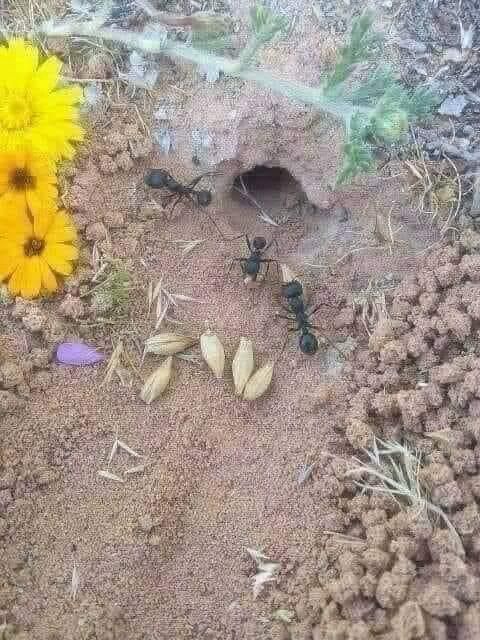
Scientists have discovered that ants, after collecting grains and seeds which they need to store for the winter, actually break them into halves before storing in their nests. This is because by breaking the seeds into half, it stops them from germinating despite the most perfect conditions.
But here comes the even more interesting part.
Scientists were stunned when they discovered that coriander seeds stored in the ant nest were always broken down into 4 pieces instead of 2 pieces.
After some lab research, scientists discovered that a coriander seed is the only seed that can germinate even after being divided into two, but can not germinate after it’s divided into four parts.
Holy sh*t… nobody’s talking about JSON prompting
but it’s the cheat code to unlock God-tier outputs from GPT-4, Claude, and Gemini.
Here’s how it works (with copy-paste templates): 👇