Less than 12 hours later and Euler is the largest lending protocol on Unichain with $22m in total deposits.
Just a light sprinkling of Euler incentives and a first class product.
Euler is growing quickly.
We’re hiring cracked web3 devs into smart contracts, dev rel, integrations, full stack, front-end.
If you're ambitious and want to build the best in DeFi, drop us a line: [email protected]
Deep DeFi lending/DEX knowledge required.
.@lmount_ just reminded me how we first touched crypto in 2014 thanks to @delitzer, @JeremyRubin and @medialab
every @MIT student got 0.33 BTC ($100 then ➡️ $33,000 today)
@blockworks just wrote a nice history piece 🧵
Today we welcome the launch of @eulerfinance V2 on @avax!
In <3 hours since launch, there's already more than $30M TVL deposited into the protocol 🔺
What's different about Euler and what does this mean for the broader DeFi ecosystem? Let's dive in 👇
Unless you have a small position, you are very likely much better off getting liquidated on Euler on days like today compared to other major lending protocols.
Numbers below 👇
That's because on Euler a quasi-Dutch auction ensures that the bonus for liquidators is only ever as big as is needed to make a liquidation profitable. And there are zero protocol fees for liquidation.
This results in decreasing liquidation bonuses as the size of a liquidated position grows, because there is usually a fixed cost to liquidate, which becomes small relative to the size of the position as borrowing increases.
This trend can clearly be seen on the last 5 liquidations on $ETH/USD pairs on Euler ordered by collateral amount :
- 0.008 ETH => 17.66% bonus
- 0.69 ETH => 1.75% bonus
- 20.035 ETH => 0.16% bonus
- 20.66 ETH => 0.25% bonus
- 37.19 ETH => 0.15% bonus
The smallest liquidation bonus I could find on Euler for an ETH long was for:
- 1460.67 ETH => 0.04% bonus
See how this compares to other protocols:
- Aave Core market has 5% bonus for WETH.
- Morpho doesn't have any ETH/USD long pools at all on mainnet interestingly (is this right!? I couldn't see any on mainnet, which is very strange if true), but on their biggest pool on Base it is 4.38%.
- Fluid has a more efficient liquidation mechanism, but even they have a 1% bonus.
Even for modest position sizes, therefore, Euler is around an order of magnitude, or even greater, more efficient than other protocols.
Smaller bonuses for liquidators are not just good for borrowers, especially when they are leveraged (meaning a multiplied bonus comes off their principle = fully rekt if not on Euler).
They also help protect lenders against bad debt. The more of a borrower's collateral gets wasted paying liquidation bonuses, the less there is to over-collateralise their position.
As Euler approaches $1B total deposits, I can't stress how much harder it has been to achieve the growth it has had with an illiquid almost fully diluted token compared to a shiny new low float, high FDV, one.
Just imagine if Euler had the $100m+ budgets others have had to spend over the past year on paying people to build on them, token incentives for LPs, private liquidity deals, and so on. Chance would be a fine thing.
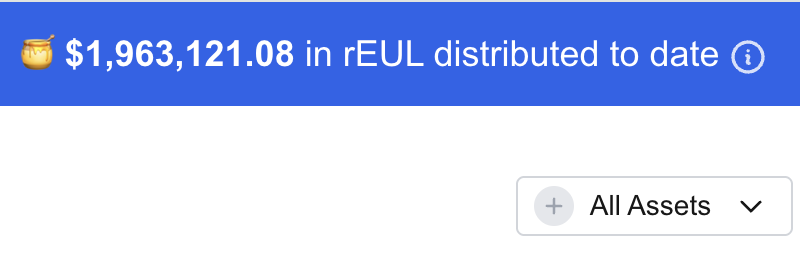
But Euler didn't have that luxury. Our devs took a look and calculated that less than $2m has been spent on public campaigns using rEUL so far (dev link below). Any success the project can claim to have achieved to date was achieved on hard mode.
There have been two main factors:
1) Euler is genuinely an innovative product with greater efficiency than other products that need incentives to get off the ground and remain competitive; and
2) the fantastic organic community support we've had from all across the ecosystem. People built on Euler and Euler built for them.
There's much more to come.
I posted on the Compound governance forum just now to pitch Euler as a flexible alternative to its existing tech.
Lots of things you might want to build are only possible on Euler.
Let's make Compound great again!