"Is trading hard?"
The mental toughness of a pro athlete, patience of a monk, precision of a brain surgeon, pattern recognition of a chess grandmaster
All at the same time. Under pressure. While managing fear greed ego in real time with your own money on the line
@investingluc
So, I read this online and found it interesting. Iceland is 94% white. Despite having one of the highest gun ownership rates in the world, only 5 people have been shot dead in the last 25 years.
Why is that?
Interesting that kids used to be able to bring shot guns in the back of their pickup trucks to school.
Again, why is that?
Charles Dickens fought his depression by walking through London at night. One October he set out at 2 in the morning and walked 30 miles, all the way to his country home in Kent. In 1860 he wrote about why it worked. It took psychology another 150 years to catch up.
Dickens called his bad spells "spectres." They came back every time he started a new novel and sometimes hung on for months. His mood would fall apart, his sleep would collapse, and the only thing that pulled him out was walking.
He explained his method in an essay called "Night Walks," published on July 21, 1860 in his weekly magazine All the Year Round. He had tried fighting his insomnia from bed and lost. So he changed the plan. The fix, he wrote, was "getting up directly after lying down, and going out, and coming home tired at sunrise." A worried mind cannot fix itself by worrying more in bed. You have to get up and move.
Most nights he walked 12 to 20 miles. A friend called it "violent walking." Dickens wrote that on these walks his wandering self had "many miles upon miles of streets in which it could, and did, have its own solitary way."
Today, walking is one of the most powerful tools doctors have against depression. In 2012 a team of researchers pulled together eight high-quality studies of walking as a depression treatment. The effect was as strong as the antidepressants doctors actually prescribe.
The biggest test came from Duke University. The SMILE study took 202 adults with serious depression and split them into four groups: supervised exercise, home exercise, the drug Zoloft, or a placebo pill. After 16 weeks, the people who exercised did just as well as the people on Zoloft. A 2024 review of 75 studies covering 8,636 patients confirmed it. Walking should be one of the first things doctors try.
The reason is the thing Dickens stumbled onto in the dark. Depression runs on rumination, the looping bad thoughts that grind people down during the worst stretches. In 2015 Stanford researchers scanned people's brains before and after a 90-minute walk in a quiet park. The walkers had less activity in a part of the brain called the subgenual prefrontal cortex. That spot, deep behind your forehead, is the brain's worry loop. After the walk, the worry loop got quieter. The walkers said they felt less stuck inside their own heads. The brain scans agreed.
A walking body shuts up a noisy mind. The street takes attention, the walking rhythm fills the head, and the dark spells lose their grip. Dickens called the streets his cure because they gave his brain somewhere else to be. The science 150 years later says he had it right. Depression hates a brain that is moving.
The most dangerous pandemic of this century may not be a virus.
It is the “One Child Pandemic.”
One child carrying the pressure of two parents, four grandparents, and an entire bloodline’s expectations.
One child growing up in silent homes instead of noisy childhoods.
No sibling fights.
No shared secrets.
No built-in best friend for life.
Just screens, perfection pressure, loneliness, and emotional isolation dressed up as “modern comfort.”
Earlier generations grew up with less money but more people.
Today’s generation grows up with more gadgets but fewer human bonds.
A single child becomes the family’s hope, retirement plan, emotional support system, and legacy all at once.
And when that child breaks mentally, the whole house collapses quietly.
Human beings were never designed to grow up emotionally alone.
A society survives not only on economy and technology.
It survives on cousins, siblings, chaos at dinner tables, shared responsibilities, and people who stay after the parents are gone.
The real tragedy is not declining birth rates.
It is declining human connection.
We are slowly creating generations who know how to use every device…
but do not know how to share grief, tolerate differences, protect relationships, or carry family together.
A crowded house was never poverty.
Sometimes, it was civilization itself.
The Upanishadic teaching method of "Neti Neti" (Not this, Not that) might be the way we study Dark Matter today. We know a lot about what dark matter does (provides extra gravity), but we still do not know exactly what it is made of. We have ruled out many possibilities like ordinary matter/neutrinos.
The ancient seers used Neti Neti to describe the ultimate reality (Brahman) which is invisible yet holds everything together.
Someone praying for you in another building can change your brain in real time. There is a study that proves it.
Researchers at North Hawaii Community Hospital placed 11 people inside fMRI scanners, fully isolated. In a separate building, spiritual leaders who knew them personally sent focused intentions toward them at random two-minute intervals. The receivers had no way to know when. Their brains lit up at the exact moments the senders focused on them. Specific regions associated with attention and awareness activated on cue. The odds of this happening by chance were less than one in seven thousand.
Most people have never heard of this. Here are three more.
Hand-holding and pain. Researchers placed 22 couples under EEG caps. When the woman was in pain and her partner held her hand, their brain waves synchronized. The more empathy he felt for her, the more their brains coupled. The more their brains coupled, the more her pain decreased. Touch combined with focused care produced a measurable analgesic effect. The lead researcher got the idea while holding his wife's hand during the birth of their daughter.
Two brains in shielded rooms. A Mexican neuroscientist named Jacobo Grinberg ran a series of experiments at the National Autonomous University of Mexico. Two participants meditated together for 20 minutes. Then they were placed in separate electromagnetically shielded rooms more than 14 meters apart. One participant was shown 100 random flashes of light. The other, hooked to an EEG with no sensory contact of any kind, registered matching brain-wave responses one out of every four flashes. Pairs who had not bonded showed nothing.
Group prayer. Andrew Newberg at Thomas Jefferson University has spent more than two decades scanning the brains of praying nuns, meditating monks, and chanting Sikhs. His imaging work shows a consistent pattern. The frontal lobes activate. The parietal lobes quiet. The effect amplifies in groups. Brains in shared prayer entrain to one another the way two pendulums swinging in the same room eventually fall into the same rhythm.
These studies measure what physically happens to the human nervous system when people focus caring attention on each other, in the same room or at a distance. The findings are consistent across labs, methods, and decades.
The basic finding, that human brains synchronize during empathic connection, is now mainstream neuroscience. Newberg alone has published more than 250 peer-reviewed papers.
People have been doing this for thousands of years and calling it prayer. Christians alone offer a window into the variety. Latter-day Saints kneel as families. Catholics pray the rosary. Protestants join hands in prayer circles.
What is actually happening when you pray? On the imaging, something measurable. On the EEG, something synchronized. On the pain scale, something diminished.
Prayer works.
A nurse in Australia named Bronnie Ware spent 8 years sitting with people in their final weeks of life. She'd ask each patient what they regretted most. Across thousands of conversations, the same answer kept coming back.
The number one regret was this: "I wish I'd had the courage to live a life true to myself, not the life others expected of me." Her notes became a book that has been read by millions of people in 32 languages.
Cornell psychologist Tom Gilovich found the same pattern in the lab. In the short run, action regrets sting harder. People replay the drunk text they sent, the wrong job they took, the fight they started, and the words they couldn't take back. Over years, the pattern flips. In American samples, two thirds of long-term regrets were chances people never took. The same pattern showed up in the US, China, Japan, and Russia.
Around 43% of what you do in a typical day is running on automatic. You aren't really deciding to do those things. That figure comes from Wendy Wood, a social psychologist at USC. Once a routine sets in, a small region deep in your brain called the basal ganglia takes over and runs it on autopilot. Ann Graybiel, a neuroscientist at MIT, found that the basal ganglia handles your morning coffee the same way it handles your worst habit. It doesn't care what the routine is. It just rewards repetition.
In a 1978 study, researchers compared 22 lottery winners against people who had been paralyzed in accidents. The lottery winners were no happier than ordinary people. They got less pleasure from small daily things, because nothing felt special after that high. The people who became paralyzed had adapted. Their daily mood had returned close to normal. Both groups had drifted back toward where they started, despite the magnitude of what had happened to them. Your mood works like a thermostat. Life events are just weather passing over the setting.
The tweet is describing how the human brain works under the hood. You build a routine, your basal ganglia learns it, your mood adjusts to it, and your sense of "this is fine" creeps in over months and years. By the time you notice you have been coasting, your brain has already adapted to the coasting. The discomfort that would have warned you is gone. And the bill arrives at the end, when there is no time left to live the life you keep telling yourself you'll start one day.
The Roman Emperor who made Christianity the official religion of the empire had his own son executed, his wife boiled alive in her bath, and killed his father-in-law, brother-in-law, and nephew before he died — and the Church made him a saint.
Constantine I, known to history as Constantine the Great, ruled the Roman Empire from 306 to 337 AD and issued the Edict of Milan in 313, granting religious tolerance across the empire, and subsequently convened the First Council of Nicaea in 325, which established the foundational doctrinal framework of Christian orthodoxy. His support for Christianity transformed the religion from a persecuted minority sect into the favored faith of the Roman imperial system, a transformation whose consequences for European and world history are incalculable. He was baptized a Christian on his deathbed and was subsequently venerated as a saint by the Eastern Orthodox Church and as equal to the apostles — isapostolos — a designation that placed him in the highest category of Christian sanctity.
The domestic record of his reign, documented by contemporaries including the historian Zosimus and the biographer Eusebius of Caesarea, included the execution of his eldest son and designated heir Crispus in 326 AD on charges whose precise nature ancient sources do not fully explain, though later accounts suggested the accusation involved a sexual relationship with Constantine's wife Fausta. Shortly after Crispus's execution, Fausta herself died — ancient sources described her death as suffocation in an overheated bath, understood by contemporaries as an imperial execution. Constantine's mother Helena reportedly revealed to him that Fausta had fabricated the accusations against Crispus. Constantine had already killed his father-in-law Maximian in 310, his brother-in-law Licinius in 325 after defeating him in civil war and promising to spare his life, and Licinius's young son in the same period. The Church's canonization of Constantine has been defended by theologians on the grounds that his role in establishing Christianity's institutional foundations outweighs his personal moral record and critiqued by historians on the grounds that it represents a selective reading of one of the ancient world's most thoroughly documented reigns.
#archaeohistories
This is not the IDF. There are no Israeli soldiers in this video. It’s Hamas killing their own people. Hamas hoarded all the food aid and sold it at inflated prices. Anyone who tried to take it was killed. That’s what is actually happening here.
In 1964, a 17 year old from San Diego conducted the most dangerous psychology experiment ever attempted by a teenager.
Randy Gardner stayed awake for 264 hours (11 days) with:
• No stimulants
• No caffeine
• No medical suppressants
And Stanford sleep researchers realized too late they couldn't stop him.
What happened inside his brain during those 264 hours rewrote everything we thought we knew about consciousness.
By day three, Randy's short term memory had completely collapsed. He couldn't remember starting a sentence by the time he reached the end of it. Researchers would ask him to count backward from 100, and he'd stop at 65, staring blankly, having forgotten the entire concept of numbers.
But the terrifying part wasn't the memory loss.
Randy's brain began creating a second reality that ran parallel to the real one.
He'd have full conversations with people who weren't there. He'd walk to locations that didn't exist. His eyes stayed open, his body kept moving, but his mind was living inside elaborate hallucinations that felt completely real to him.
Sleep researchers had predicted cognitive decline. They hadn't predicted that the sleep deprived brain would start *manufacturing* an alternate conscious experience to fill the gap.
Dr. William Dement, the Stanford researcher monitoring Randy, discovered something that changed sleep science forever. The hallucinations weren't random. They followed the exact same patterns as REM sleep dreams, complete with narrative arcs, emotional themes, and symbolic imagery. Randy's brain was dreaming while awake, projecting dream content directly onto his waking perception.
The boundary between sleep and consciousness was more than binary. It was fluid, and without sleep to maintain the separation, the two states began bleeding into each other.
By day nine, Randy couldn't distinguish between his hallucinations and reality. He became convinced that Dr. Dement was plotting against him. He accused the researchers of being imposters. His paranoid delusions were so convincing that even the people documenting his mental breakdown began questioning their own perceptions.
Randy's EEG readings showed something unprecedented. His brain waves were cycling through all four stages of sleep while he remained physically awake and mobile. His neurons were firing in sleep patterns, but his motor cortex kept his body upright and functioning. He had become a walking sleeper, a conscious dreamer, a person experiencing two incompatible states of being simultaneously.
When Randy finally slept after 264 hours, he didn't collapse into a coma. He slept for 14 hours and 40 minutes, then woke up completely normal. The hallucinations vanished. The paranoia disappeared. His memory returned.
But the Stanford team realized they had documented something extraordinary about human consciousness that nobody talks about.
Your brain doesn't need sleep to *function*. Randy proved the human body can operate for weeks without it. What your brain needs sleep for is to maintain the distinction between internal mental reality and external physical reality. Sleep isn't rest for your body. Sleep is a firewall for your mind.
Without that firewall, the dream world and waking world merge into a single, indistinguishable experience where hallucinations become as real as the room you're sitting in.
Randy recovered completely, but sleep researchers never attempted the experiment again. The ethical implications were too severe. They had accidentally discovered that consciousness is far more fragile than anyone suspected, held together by nothing more than eight hours of unconsciousness every night.
Every time you go to sleep, your brain is performing the most critical maintenance operation in human biology.
It's rebuilding the wall between dreams and reality.
And without that wall, there is no difference.
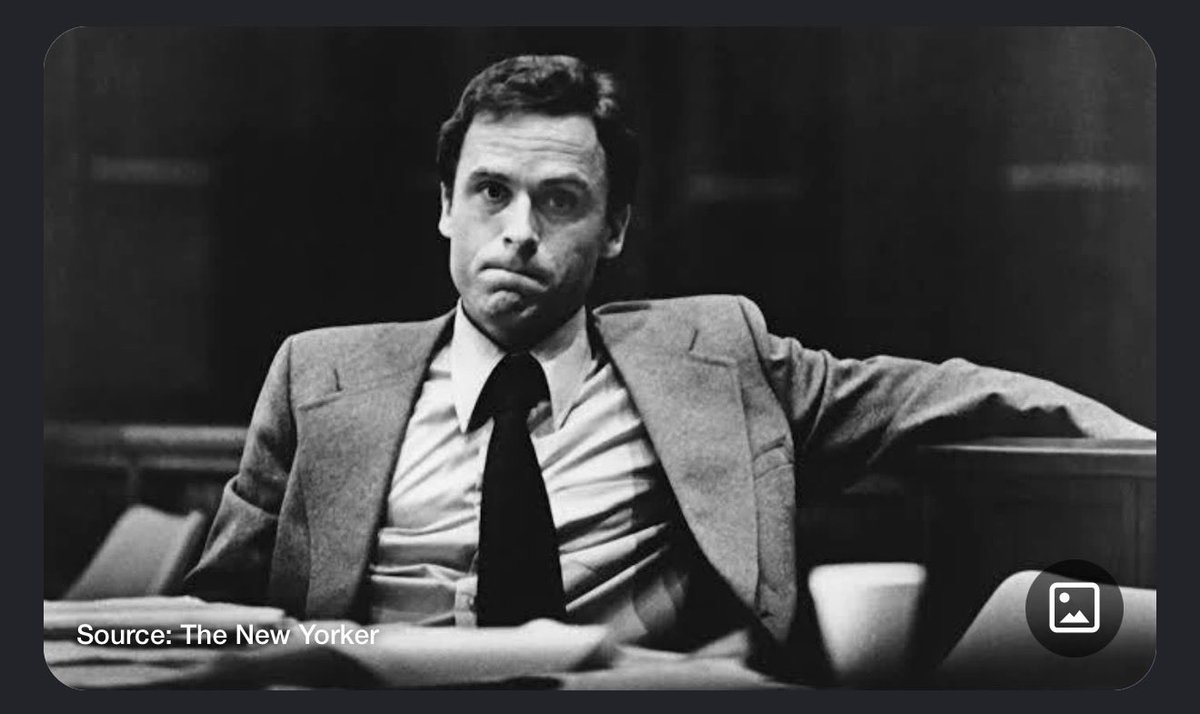
This man raped and killed over 40 women.
He married one of his biggest fans in the middle of his court proceedings.
During his trial,
hundreds of women dressed like his victims to show support for him.
Some women stood outside the courtroom with banners, chanting about their love for him.
He received marriage proposals while in custody.
He also received thousands of nude pictures, along with thousands of flowers, letters, and money from women all over the world not just from America.
Mind you, This was during the era when women were widely seen as innocent.
ये जाटव समाज के पंडित जी ने सनातन पद्धति से कराया विवाह सम्पन्न। इन पंडित जी का कहना है कि मैं 10 साल से लोगों की शादी करवा रहा हू। जनेऊ धारण
भी करता हु। स्वमं को मनुस्मृति वाला ब्राह्मण बताया ।
दलित समाज अब जाग रहा है। आंबेडकरवाद के नाम पर हिन्दुओं को तोड़ने वाला षडयंत्र जो रचा गया था वो आने वाले 10 वर्षों में समाप्त हो जाएगा।
जय श्री राम
देखिए, 16-17 साल की लड़की है। पहले इसको किसी और से फिजिकल कराएंगे। इसके बाद आप जिसे बताओगे, फंसा देंगे। सीधा जेल जाएगा, जमानत भी नहीं मिलेगी। इसके 20 लाख लगेंगे। अगर बालिग लड़की से रेप में फंसवाएंगे तो 2-3 लाख कम हो जाएंगे।’
ये कहना है महिला सरगना का, जो यूपी में फर्जी FIR की गैंग चला रही है। गैंग में दर्जनों लड़कियां हैं। इनमें से कई पढ़ी-लिखी भी हैं। ये लड़कियां सरगना के एक इशारे पर किसी को भी रेप के आरोप में फंसा देती हैं। यूपी के सभी 75 जिलों में इनका नेटवर्क है।
देश में रेप के फर्जी केसों से कई जिंदगियां तबाह हो गईं। कुछ दिन पहले गोंडा के युवा इंजीनियर अभिषेक श्रीवास्तव को शादीशुदा गर्लफ्रेंड ने झूठे रेप केस में फंसाकर लाखों रुपए वसूले। 10 दिन जेल में रहने के बाद उसने सुसाइड कर लिया और दीवारों पर चिपका गए अपनी बेगुनाही के सबूत।
भास्कर पर पूरी स्टिंग देखिए: https://t.co/7zwlXKhxX2
A 94-year-old Nobel laureate spent his career proving the Big Bang created our universe. Now he is arguing that the Big Bang was the death of the universe before ours.
Roger Penrose won half the 2020 Nobel Prize for a 1965 paper. He showed that any star big enough, when it collapses under its own weight, has to form a black hole. It is still considered the most important work on Einstein's theory of gravity since Einstein himself. The same math says our universe began at a singularity, a single point so dense that physics breaks down inside it. Stephen Hawking later joined him to extend the proof to the universe itself.
Then in 2010, at 79, he proposed something stranger. The Big Bang was a handoff between universes. One universe ended at the moment ours began.
His theory is called Conformal Cyclic Cosmology. Space keeps expanding forever, pushed apart by dark energy, a force scientists cannot fully explain. Eventually stars die, galaxies drift apart, and all matter falls into supermassive black holes, some as heavy as a hundred trillion suns. Those black holes then slowly evaporate through Hawking radiation, where particles slip out from the edge until nothing is left. The process takes about 10^106 years, a 1 followed by 106 zeros. Our universe is only 13.8 billion years old.
Only massless particles remain, mostly photons of light. Penrose noticed that particles with no mass cannot experience time, because nothing inside them can tick like a clock. Without time, the difference between infinitely big and infinitely small disappears. A vast empty universe, stretched out forever, ends up looking identical to a new Big Bang. Penrose argued they are the same thing.
In 2018, he and three other physicists published a paper in the Monthly Notices of the Royal Astronomical Society. They claimed to find about 30 bright dots in the cosmic microwave background, the Big Bang's faint afterglow. They called the dots Hawking points, each the dying glow of a supermassive black hole from the universe before ours, leaking through the seam between worlds.
When other astronomers reanalyzed the data in 2020, the dots could be explained by ordinary physics. A 2022 machine learning search could not confirm the patterns. Penrose has not backed down.
If he is right, every black hole, including the giant one at the center of our galaxy, is quietly weaving the next universe. Heat death becomes inheritance. The man who proved beginnings have to exist is spending his last years trying to prove there is no such thing as a beginning.
Neuroscience explains why most people cannot execute a long-term strategy. The prefrontal cortex can only process future rewards very abstractly and diffusely. The limbic system processes present discomfort severely. So when the current cost is perceived as very real, but the payoff is only theoretical, the brain overweights the pain. And that's not a character flaw. It's how the system is engineered to work by default. The people who succeed managed to make their future feel more present. Your nervous system is the enemy, not your character.
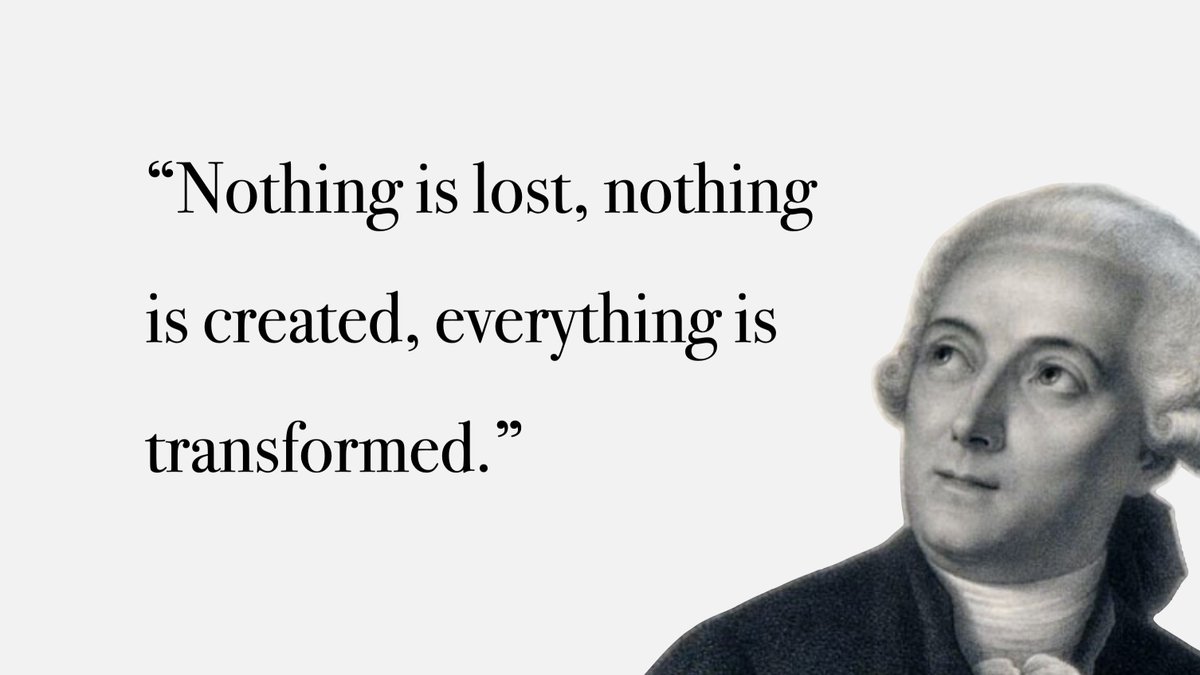
On this day in 1794 the French Republic guillotined Antoine Lavoisier. He had named oxygen, formulated the law of conservation of mass and founded modern chemistry.
Appeals were rejected with the line "the Republic has no need of scientists."
The next day Lagrange said: "It took only a moment to cause this head to fall, and a hundred years will not suffice to produce its like."
Dear Parents,
Teach your daughters to get a job, pay their own bills, buy their own house, and take responsibilities. If you think husbands exist as ATMs to pay your bills, you don't need marriage - you need a sugar daddy.
Why Some People Feel Everything So Much More Deeply Than Others:
1. Some people are simply built differently from birth. A psychologist named Elaine Aron spent years researching this and found that roughly 1 in 5 people have a nervous system that processes everything more deeply than the rest. Not more dramatically. More deeply. There is a difference.
2. The part of the brain that handles emotional reactions is genuinely more active in these people. It does not just react more strongly, it takes longer to settle back down. Someone else shakes off a difficult moment in an hour. A deeply feeling person is still sitting with it the next morning wondering why they cannot just move on.
3. How you grew up has a lasting effect on how intensely you feel things as an adult. A child who never quite knew what mood they would walk home to learns to read every room, every tone of voice, every silence. That skill does not switch off when the childhood ends.
4. There is a popular idea that empaths have more active mirror neurons that physically make them feel what others feel. It is a beautiful explanation and people love it. The problem is that mirror neuron research in humans is still genuinely unsettled science. The experience of absorbing other people's emotions is absolutely real. That particular explanation for why it happens is not proven yet.
5. Stress hormones linger longer in people who feel things intensely. Their system takes more time to return to calm after something difficult. It is not overthinking. It is biology doing what it does, just on a slower dial.
6. The same quality that makes a person feel music in their chest, cry at a stranger's kindness, or lie awake replaying a conversation is the exact same quality that produces extraordinary creative work. It is one trait with two faces. You rarely get the art without the ache.
7. People who went through difficult or unpredictable things early in life often develop what you might call a permanently sensitive alarm system. It was useful once. It kept them safe. The trouble is the alarm does not always know when the danger has passed.
8. People who turn inward tend to feel more intensely. Not because introverts are more emotional but because they process experience more thoroughly before releasing it. Things get examined from every angle before being let go. Sometimes they never fully get let go.
9. Some people have what psychologists call thin boundaries between themselves and the world around them. They walk into a tense room and feel it in their body before anyone has said a word. They carry other people's moods home with them without meaning to. It is exhausting and it is real.
10. Feeling things deeply and being emotionally unstable are two completely different things that get confused constantly. Intensity means you feel everything fully. Instability means your emotions are running the show without any regulation. One is a depth. The other is a disruption. They are not the same.
11. A lot of what people blame on their personality is actually sleep deprivation. Research shows that a sleep deprived brain reacts to emotional triggers significantly harder than a rested one. Some people who believe they are just very emotional are partly living with a nervous system that has not had enough rest in a very long time.
12. Men are not less emotional than women. They are just taught from a very young age that showing it is a problem. So the emotion goes somewhere else. It becomes irritability, withdrawal, physical tension, or a short fuse. Women were taught to name feelings. Men were taught to route them underground. Neither approach is biology. Both are training.
13. The people who feel the most have usually also paid the most attention to life. They noticed things others walked past. They loved people fully. They took losses seriously. Feeling deeply is not a random affliction. It is often what happens to someone who has been genuinely present for their own life.
Most of you know the Delphic maxim "ΓΝΩΘΙ ΣΑΥΤΟΝ" (Know Thyself). In the grammar of the Greek language, the verb is in a tense no longer used today: the Aorist (past) Imperative (and on 2nd person singular, active voice). The question now is: how is it possible to command someone in the aorist (past) tense?
Commanding someone in the aorist is very powerful, yet quite common in "Ancient" Greek. It is a deliberate choice that changes the very nature of the exhortation.
In Greek Philosophy, the Delphic maxims are considered "commands of Apollo." Through these maxims, the philosophers demand that you, the student, become better.
So when it commands you to know yourself:
1. It is not interested in duration, but in the result or the beginning of the action.
2. "Begin to know" - "Come and know."
3. Do it. Now. Do not postpone it.
They did not want a mild, philosophical piece of advice like "try to know yourself a little every day." The Delphic maxim commands you and says:
"Wake up. Finally realize who you really are YESTERDAY."
Proclus writes:
"Just as the inscription at the entrance to the Eleusinian sanctuary announced that the uninitiated and the unperfected should not enter the inner sanctum, so too the inscribed ‘Know Thyself’ at the entrance of the Delphic temple declared the way of the upward journey toward the Divine and the most beneficial and effective path that leads to purification. It says, almost plainly to those who can understand, that the one who knows himself, beginning from his own hearth, can come into contact with the god who reveals the whole truth and is the leader of the purifying life. On the contrary, the one who is ignorant of who he is, being uninitiated and unperfected, is unfit to partake in the providence of Apollo."
- Proclus, Commentary on Plato’s First Alcibiades, Book I, 5.3–5.12
And we also have this passage from Xenophon, where Socrates, the main teacher of the maxim "Know Thyself", says the following:
SOCRATES:
Tell me, Euthydemus, have you ever visited the Oracle at Delphi?
EUTHYDEMUS:
Yes, by Zeus, I have visited it twice.
SOCRATES:
So when you entered the temple, you had the opportunity to see the inscription "Know Thyself"?
EUTHYDEMUS:
Of course I saw it.
SOCRATES:
And after that, what did you do? Did you take care to follow the command of the inscription, or did you make no attempt at all to approach yourself, so as to see who you really are?
EUTHYDEMUS:
By Zeus, not at all. For I am not so childish or ignorant as to not know who I am. I assumed that I knew myself. I mean, is it possible not to know oneself?
SOCRATES:
But perhaps what you know is only the name of yourself, that is, your external characteristics, while you remain ignorant of your real abilities (those hidden in your soul). Shouldn’t you examine yourself in the same way one does when wanting to buy a horse? Besides its external appearance, one must also be interested in a series of particular traits and qualities: whether it is obedient and disciplined or disobedient and unruly; whether it is strong and manageable or weak and difficult to control; and also whether it can run fast or tires easily. For just as one would want to learn all these qualities of a horse, in the same way one must want to learn the corresponding expected qualities of one’s own self. Do we really know, then, what our own worth and power are?
EUTHYDEMUS:
It seems, Socrates, that whoever does not proceed to apply "Know Thyself" will necessarily remain ignorant of his own inner powers as well.
- Xenophon, Memorabilia, Book IV, 24
Thanks for reading me,
Homer Pavlos
Toothpaste needs 30 minutes to do its job. You rinse it off after 2.
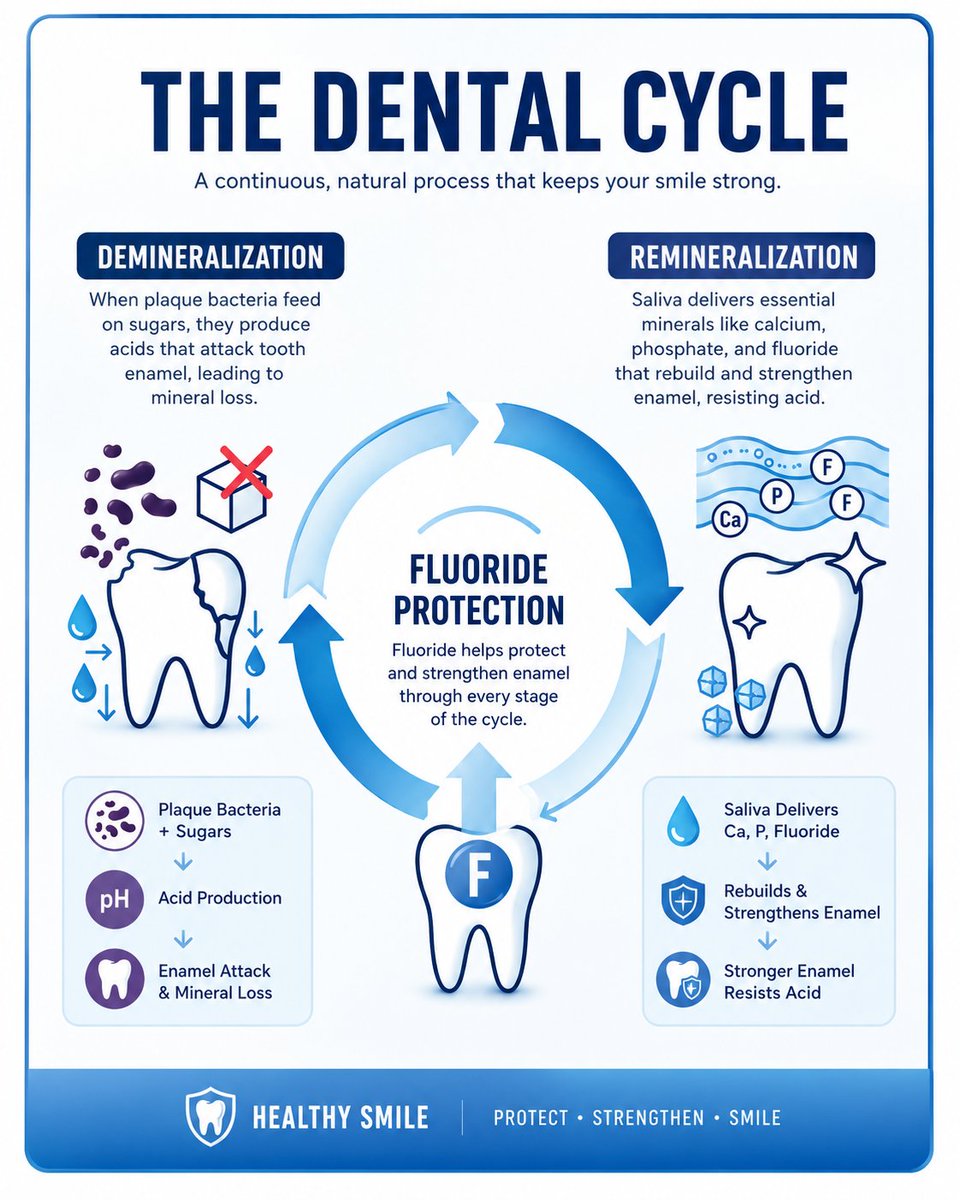
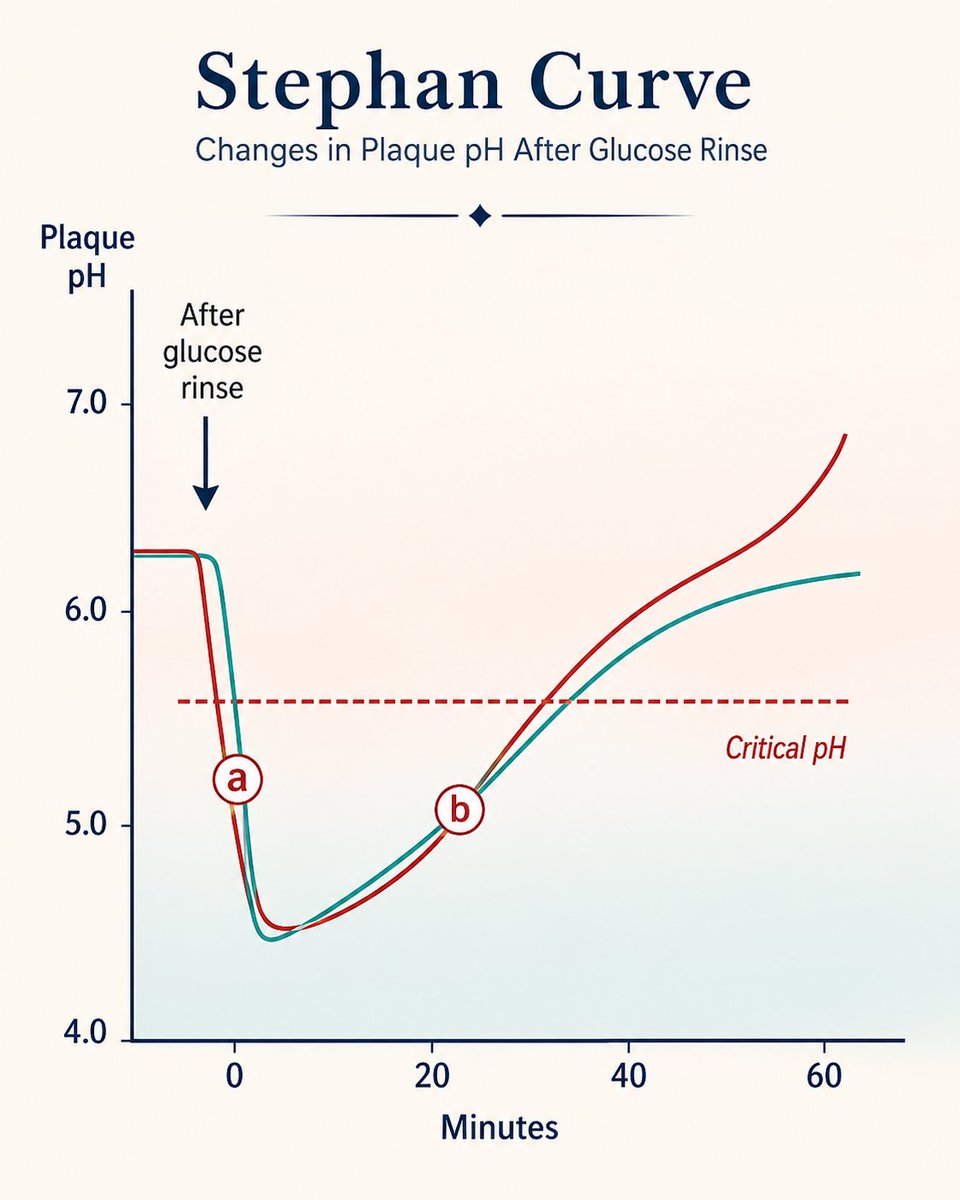
Your enamel is made of a mineral called hydroxyapatite. It dissolves whenever the pH in your mouth drops below 5.5, which happens every time you eat or drink anything acidic. Coffee, citrus, soda, bread, even the bacterial fermentation from last night's dinner. Calcium and phosphate ions leach out into your saliva. Your mouth is in active demineralization right now if you ate breakfast.
Saliva pulls those minerals back over the next 30-60 minutes. That's normal repair. It rebuilds the same hydroxyapatite that just dissolved at pH 5.5.
Fluoride changes the chemistry. When fluoride ions sit on the enamel surface during the rebuild window, they swap into the crystal lattice in place of a hydroxyl group. The new mineral is called fluorapatite. Critical pH drops from 5.5 to 4.5. Solubility is roughly 10x lower. The tooth that grows back is harder than the one that was there.
Adult toothpaste sits at 1,450 ppm fluoride. The instant you rinse with water, salivary fluoride drops by roughly 2.5x. The 30-minute substitution window collapses to a few minutes. The active ingredient goes down the drain.
The UK's official dental guidance is "spit, don't rinse." Pediatric dentistry researchers attribute up to 25% less decay to the habit change.
Spit. Walk away. The chemistry runs without you.