i actually built something fun + free to use
i added up my subscriptions
$464.31/mo, $5,572/yr, $15.27 every single day 💀
thats 3 weeks in bali, gone
so i built track my subscriptions
> 217+ services with real prices
> see what you pay per month, year and day
> get your tier (im a "subscription royalty" )
> share a receipt-style page at /@kalashvasaniya
> get renewal, free trial + price increase alerts
> upload a bank statement to find every subscription (it never leaves your browser)
> mcp server, openapi + llms.txt so ai agents can use it too
live now: https://t.co/veq5bg1Gob
Local AI is quietly becoming one of the biggest shifts in tech.
Models now run on laptops.
Voice cloning happens on-device.
Meeting notes stay private.
Coding agents work without sending every file to the cloud.
The next major AI product may run on hardware you already own.
You become a good mentor by remembering what it felt like to be lost.
You become a good architect by remembering what it felt like to write your first broken function.
Everyone starts out as the one with questions, not the answers.
Era 1 (Autocomplete): it finished your line. You typed, it guessed the next few words, keystroke by keystroke.
Era 2 (Prompting): it finished your prompt. You asked, it answered, one exchange at a time, staying in the loop for every step.
Memory is the reason:something that keeps track of what the last 5 tasks taught it, so the fleet doesn't relearn the codebase every time out. One internal Cursor case reportedly runs at 20-100 pull requests a day, on a single migration with no one reviewing each diff line by line
Prompt engineering. Context engineering. Harness engineering. Loop engineering. Now graph engineering.
Is this a new layer of engineering, or just this year's rename?
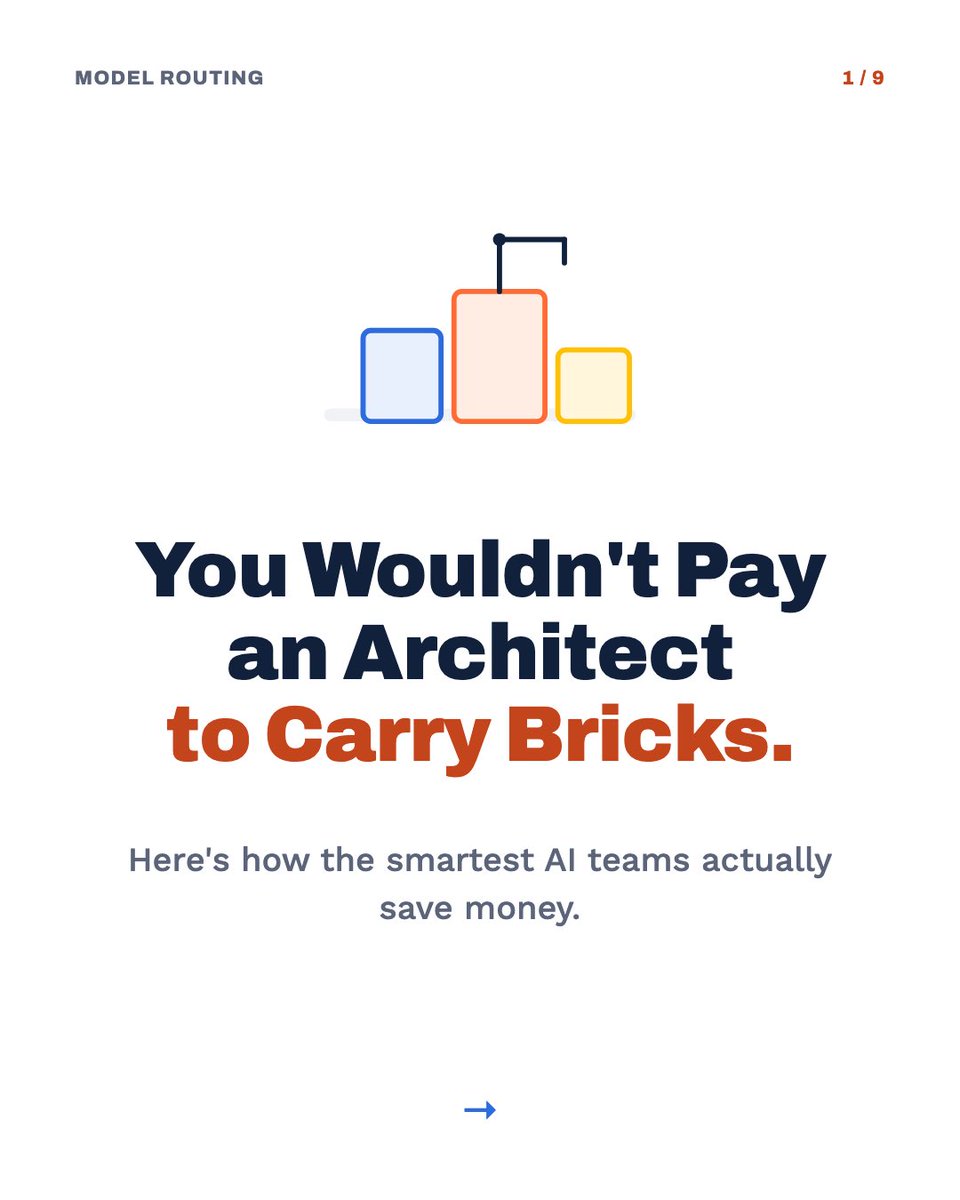
You wouldn’t pay an architect to carry bricks.
But that’s what happens when one AI model does every job, genius pricing even for the routine stuff.
Cursor ran the test. Splitting the work by how hard it actually is fixes most of it.
You wouldn’t pay an architect to carry bricks.
But that’s what happens when one AI model does every job, genius pricing even for the routine stuff.
Cursor ran the test. Splitting the work by how hard it actually is fixes most of it.
Beads is a persistent memory system for coding agents, and it's already at 26k+ stars on GitHub.
It's a distributed graph issue tracker powered by Dolt. Instead of messy markdown plans, agents get a dependency-aware graph where work can be claimed, closed, and blockers released. That makes long-horizon planning and work discovery much easier without losing context.
The CLI is bd, and it runs on macOS, Linux and Windows. If you need shared state across machines and agents, it supports push and pull through Dolt.
https://t.co/Y1y6Pd5IV1
Eventually, you stop reading every line a new developer writes.
Not because they became perfect, but because they learned what "done" means on your team. Tests pass, edge cases are handled, and they check their own work.
That's the shift we're now seeing with AI agents: 𝗹𝗼𝗼𝗽 𝗲𝗻𝗴𝗶𝗻𝗲𝗲𝗿𝗶𝗻𝗴.
The idea has been gaining attention as engineers at companies like Anthropic and OpenAI have been moving from manually prompting agents toward designing systems where agents can work, evaluate, and iterate on their own.
For the last couple of years, we've been the reviewer: prompt, read the output, judge it, prompt again.
Loop engineering changes that. Define what "done" means, build the checks into the system, and let the agent iterate until it meets the standard.
But you can only step back once you've explained what good looks like.
Developers learn that through experience and code reviews. Agents only know what you define.
The real work isn't just making agents autonomous. It's making "good" explicit enough for them to work without us.
Firecrawl open-sourced a fast Rust library that classifies any PDF in ~20ms and extracts clean Markdown locally. No OCR needed for text-based PDFs. https://t.co/yqQ2PPAmCL