@io_tilia I was working on this this time last year and it was deprioritised at the time. I still don't think it's not to be honest. Let me get back to you.
Claude:
---
It was partly decentralised, and the price feed is the part that wasn't. I haven't checked this against the deployed scripts.
- Decentralised: the rules. Anyone can check them, and the reserve and the mint and redeem logic sit in on-chain contracts that no company holds custody of. The issuer can't freeze your coins or change the formula. That is what people meant by "decentralised" in the marketing.
- Not decentralised, as far as I know: the ADA/USD price that every mint and redeem depends on. As I understand Djed on Cardano, that price comes from an oracle signed by the operator's key, so the operator can stop the system by no longer signing. The same weak point usually covers redemption fees and any upgrade or admin keys.
So the honest label is non-custodial but not unstoppable. It is fair to say it was never fully decentralised, and the oracle is exactly where.
That is common rather than unusual. Most "decentralised" stablecoins have a similar choke point: an oracle, an admin key or a front-end. The one you can actually test is whether the system keeps working if the original team disappears. From this announcement, Djed apparently doesn't. If the oracle key can be handed over or replaced, it could, and the deployed scripts would settle that. I can look them up if you want certainty rather than my reading.
---
@adamKDean No it doesn't because there's no such thing as wisdom of the masses. You're comparing the behaviour of a leader with bad character, something that can exist, to something that can't and doesn't exist. Unskilled decision making and pure chaos are not equivalent.
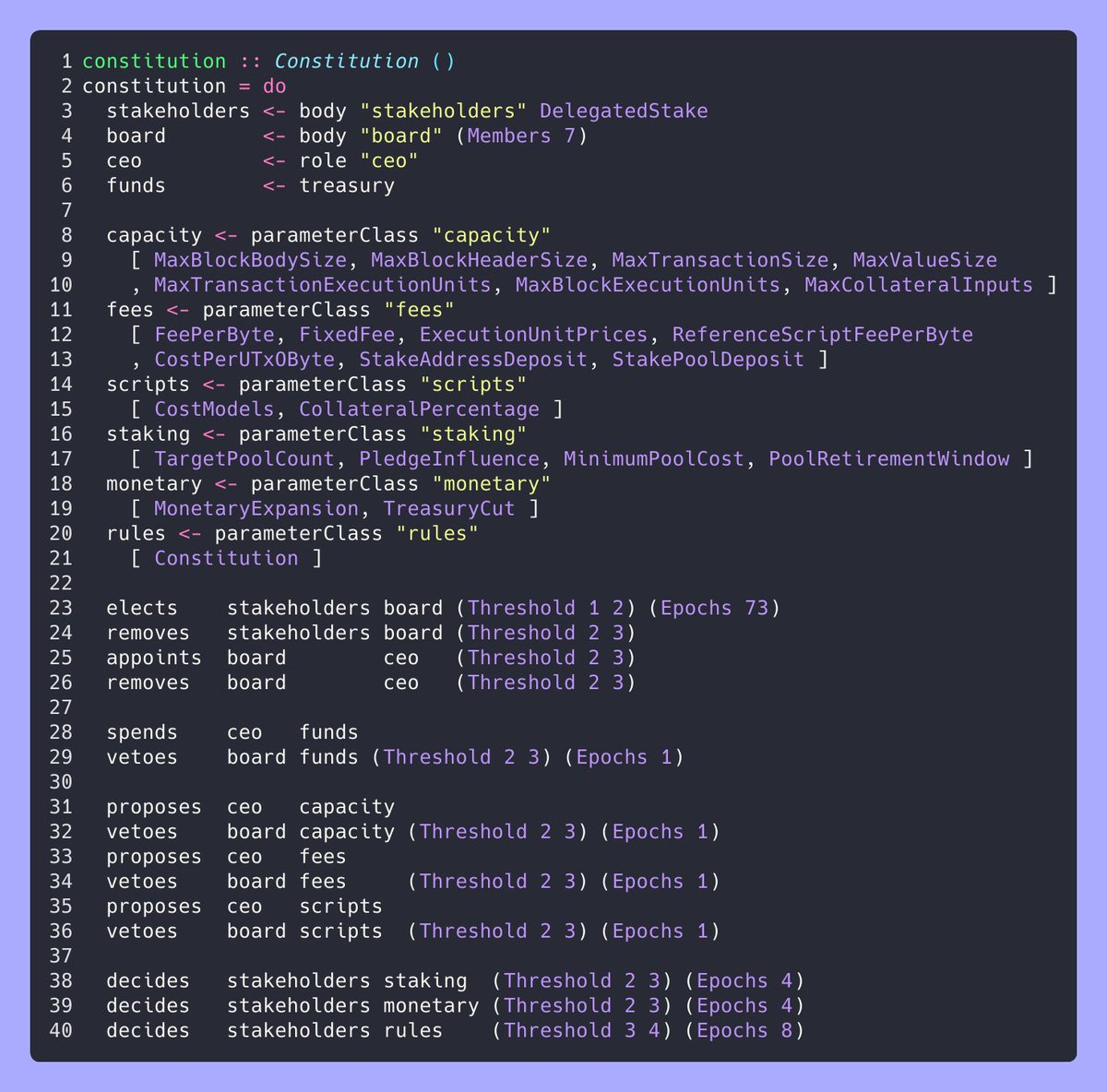
@therealdisasm@TotalWarKing Sure. The books would have to be onchain. In my encoding the only action the CEO can do is propose moving X amount of treasury funds to an address. The only thing the board can do is veto it or fire him and reappoint. TreasuryCap/TreasuryBudget can be a in a parameter class.
Crowds are fundamentally incapable of making long term decisions that support the price. Democracy is a looting function on the treasury. Cardano's leaderlessness is why the price is depressed. Making long term decisions is what CEOs are for.
In my encoding, the CEO has unilateral control over treasury spending proposals that can be vetoed by a board majority. The board can fire the CEO with a majority. Stakeholders can fire the board, and also flip the table over by rewriting the constitution. This keeps the CEO accountable for the price but maintaining overwhelming directive control day to day.
Here's my proposal for fixing Cardano's governance. This is valid Vortex code for a toy blockchain. This makes the governing bodies logic updateable by protocol parameter change rather than a hard fork. The monad itself is a protocol parameter.
Crowds are fundamentally incapable of making long term decisions that support the price. Democracy is a looting function on the treasury. Cardano's leaderlessness is why the price is depressed. Making long term decisions is what CEOs are for.
In my encoding, the CEO has unilateral control over treasury spending proposals that can be vetoed by a board majority. The board can fire the CEO with a majority. Stakeholders can fire the board, and also flip the table over by rewriting the constitution. This keeps the CEO accountable for the price but maintaining overwhelming directive control day to day.
@TotalWarKing@therealdisasm You could even encode that the constitution can only be changed by overwhelming consensus from stakeholders, board and CEO.
@TotalWarKing@therealdisasm The conditions of changing the constitution is encoded in the constitution.
That last line reads that the constitution can only be changed at 3/4 stake signalling for 8 epochs. But that can read as whatever you want.