I'm building a motion curve editor beyond your wildest fantasies.
I've been head down solving new easing equations for the last 13 months.
I promise nothing less than a quantum leap in easing technology.
After testing Figma Motion, I'd say it's a great start. But if Figma wants Motion to be more than just a UI animation tool, a full Graph Editor should be at the top of the roadmap. Motion lives and dies by timing and easing.
Since it seems that formal verification is going viral again, I might as well drop what I have been working on the side-ish for the past 2.5 weeks over weekends. here is Janus: a Lean 4 framework that formally verifies compiled Go machine code. Not the Go source, the actual arm64 and amd64 bytes the CPU runs.
I already ran on a target successfully: holiman/uint256, the 256-bit math library under go-ethereum. All 146 exported functions are proven correct on both arm64 and amd64: 293 machine-checked theorems covering arithmetic, modular math, Exp, Sqrt, parsing and JSON/SSZ/RLP encoding. Each one says: for every valid input, this machine code returns exactly what the spec says.
How it works:
1. Compile the Go code and pull the function's machine code out of the real binary.
2. Write a short, readable spec in Lean, e.g. "z = x + y mod 2^256".
3. Prove the machine code meets it, instruction by instruction, on a Lean model of the CPU.
4. Lean's kernel checks every step of the proof.
Incredibly enough it found real bugs in the library's latest releast. e.g uint256's Float64() truncates instead of rounding to the nearest value, as its documentation promises. It also turned up several places where the docs/expected behaviour and the ACTUAL behaviour disagreed.
Janus can also prove things about performance: uint256's Add executes exactly 17 instructions on both arm64 and amd64, on every call and that has an upper-bound proof/spec.
Every uint256 spec (plain Lean, one file per function): https://t.co/MH4pVjruUD
Full list of findings: https://t.co/XwDP8LV9D0
Code: https://t.co/t79iftEXtQ
Proofs: https://t.co/swALy8ynFH
I had Opus 5.5 formalize CPython in Lean: 613,318 lines of Lean that copy Python's internals line by line, tested against the real interpreter and checked by Lean.
On the way it found real bugs in Python, including crashes from plain Python code. 🧵
Is your code up to code?
Architects can design extraordinary buildings, but every structure must meet building codes. In agentic software development, code can be generated and rebuilt without detailed blueprints.
With AI-assisted formal verification, we can establish the code for the code: laws every implementation must obey, and proof they did.
Then you can let agents tear down walls, rebuild foundations, and construct entirely new architectures. Give them room to innovate.
Just make sure they build to code.
The state machine renaissance
There's a renaissance happening for state machines in software development.
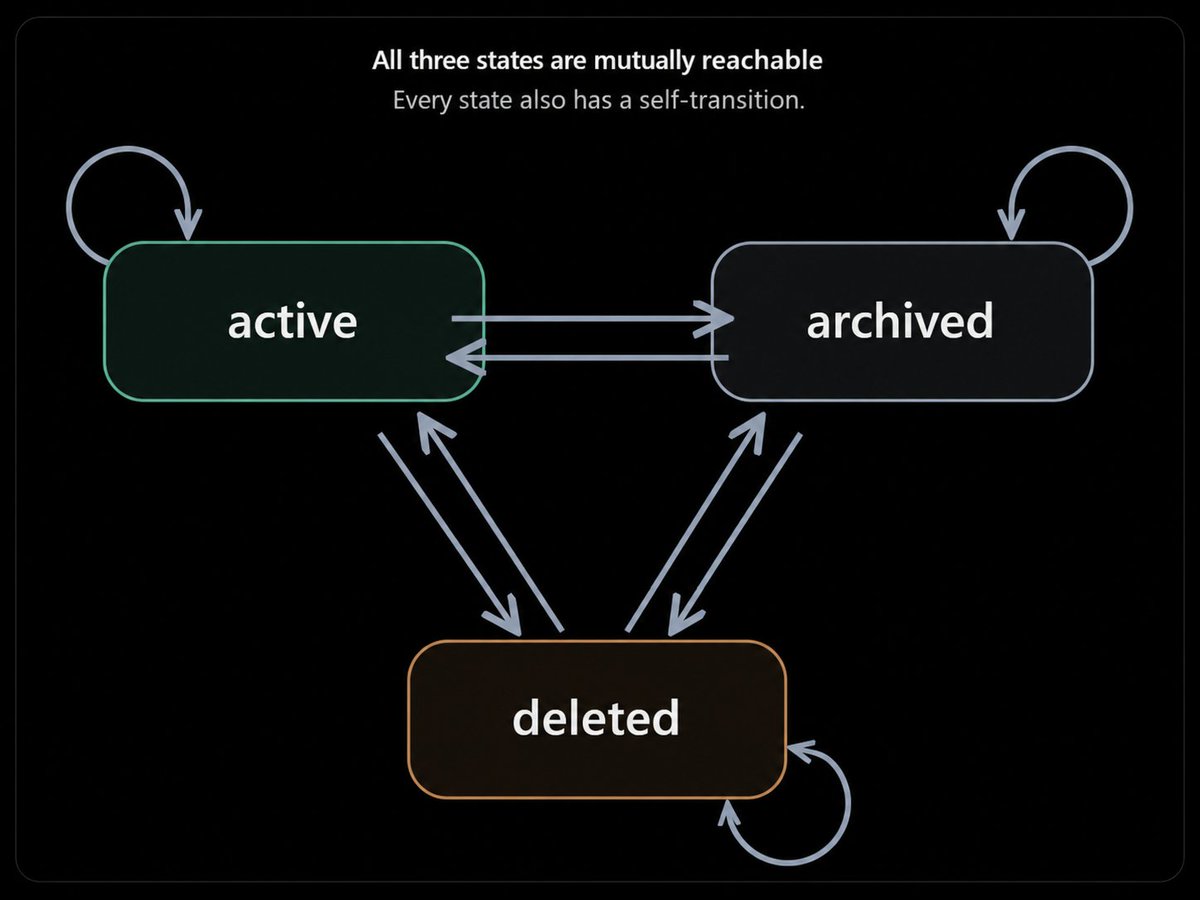
A prompt circulating on X this week tells coding agents to find all the implicit state machines lurking in a codebase. It's like a magic spell that brings submerged structures to the surface.
Suddenly, scattered booleans, conditional branches, and ad hoc state transitions are revealed as parts of state machines.
Once you've identified them, you can model them explicitly, constrain their transitions and eliminate entire classes of bugs.
For JavaScript and web development, XState is an excellent tool for wrangling your state into a disciplined and diagrammable structure.
From code monkeys to lawmakers
"Who am I? Why am I here?"
AI agents have largely conquered the tactics of coding. Now they're climbing the ladder of strategic decision-making. Where does that leave us software engineers?
We're actually being promoted: from code monkeys to lawmakers. Your new mission, if you choose to accept it:
Write the constitution of your codebase.
What must always be true? What must never happen? What are the inviolable laws governing this little universe we've created?
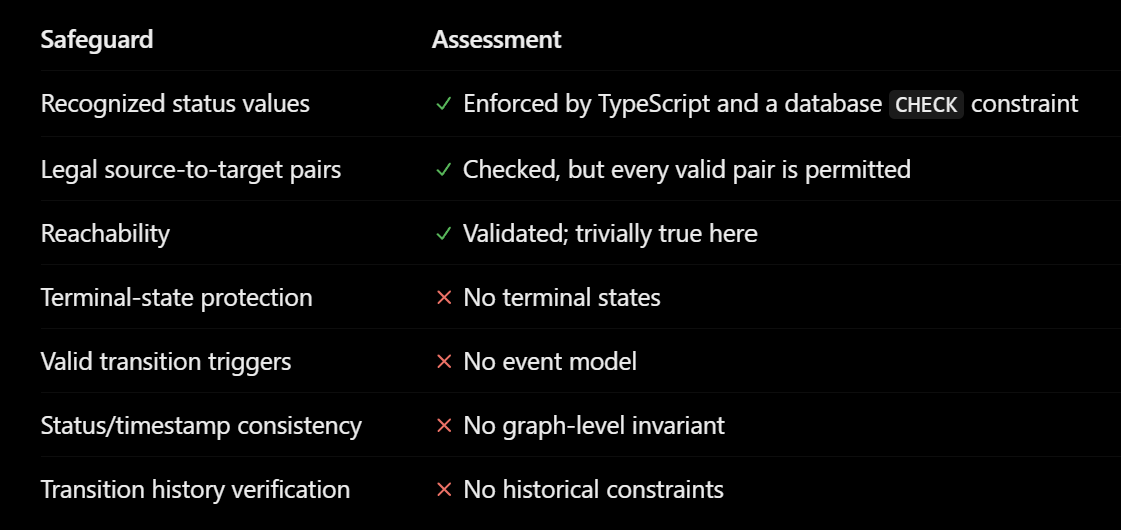
You're right that it's a transitory step, and I know you've been using XState for years.
But people just learning about state machines, they're not going to get that impression when they read your PR. The PR description pats itself on the back and leads people to think the job is done.
How cultures sound on a violin.
It's fascinating how different intervals can instantly evoke a whole culture.
Julia Kim plays 5 scales 🎻
Egyptian, Celtic, Chinese, Japanese, Sundanese.