We connect local publishers with trusted topic experts—enhancing content quality while giving experts the recognition they deserve. Founder: @DaniOwensSEO
We looked at the most linked-to URLs across 100s of domains. What content types earned the most links?
Spoiler alert: It was (almost) never blog posts or guides.
As SEOs, we know generic blog posts are mostly dead. So what should you produce instead?
Turns out, writers and journalists like linking to the same types of content that AI answers like to cite: original data, reference material, and unique facts
In short, you're likely to get more bang for your buck making data easier for people + AI to digest than explaining simple things that AI can probably do better anyway.
You don't even need your own original data for many of these content types, as long as you add new insights or make the information easier to understand and digest.
For inspiration, we've identified 20 strong content formats that continue to perform well in 2026 and beyond:
1. Original Measurement & Tracking 📏
2. Reference Tables 📋
3. Ranked Benchmarks 🏆
4. Location Fact Pages 📍
5. Original Surveys & Experiments 🧪
6. Product Tests & Comparisons ⚖️
7. Industry Data & Trends 📈
8. Best-of Lists & Annual Rankings 🥇
9. Statistics Roundups 📊
10. Research Reviews 🔬
11. Expert Explainers 🎓
12. How-To Guides 🛠️
13. Historical Timelines 🕰️
14. Glossaries & Definitions 📖
15. Checklists & Printable Assets ✅
16. Tools & Calculators 🧮
17. Free Design Assets & Templates 🎨
18. Financial & Contract Data 💰
19. Software & Code Assets 💻
20. Interactive Maps 🗺️
Happy link earning!
Google's new model Gemini 4 Hydrogen changes how Search works.
Google calls it "the biggest model improvement to Search yet."
▪️Better at understanding user intent.
▪️Improved query fan-out with a broader range of helpful links to the web.
▪️More visual responses. One of the examples shows it creating images of restaurant dishes. It can also make charts and graphs.
This is available for all searchers, not just paid Gemini users.
What does this mean for websites? I think in some cases websites with original helpful information might be more likely to be surfaced.
But also, there's less need for searchers to click through to websites if Search can now produce charts and images. More questions will likely be answered directly with AI right on the Search results.
No word yet on whether the core update and this model upgrade are connected. Either way, there's likely to be significant changes in traffic for quite a few websites.
https://t.co/JatA7t9I9v
AI is killing SEO traffic is not completely wrong, but definitely not completely right.
I a new analysis of Similarweb data (10k domains, US + France, 3 years), I found Organic Search fell -13.2% in the US and 24.4% in France over the last 2 years.
HOWEVER, not all of that is due to AI (Overviews). Paid Search has grown strongly over the same time horizon, probably due to more real estate in the SERPs and harder differentiation from organic results.
Also, organic traffic losses are more concentrated in industries like publishing, which lost lost 41.5% in the US and 42.5% in France over the last 2 years.
Lastly, Google's updates are aggressive and often reduce rank performance that can be, at least somewhat, recovered.
So, as much as I see AI reducing clicks left and right, we should not throw the baby out with the bath water.
Full analysis in the new Growth Memo.
While everyone is talking about Gemini 4 Carbon today, Google just announced something even bigger for Search Marketers:
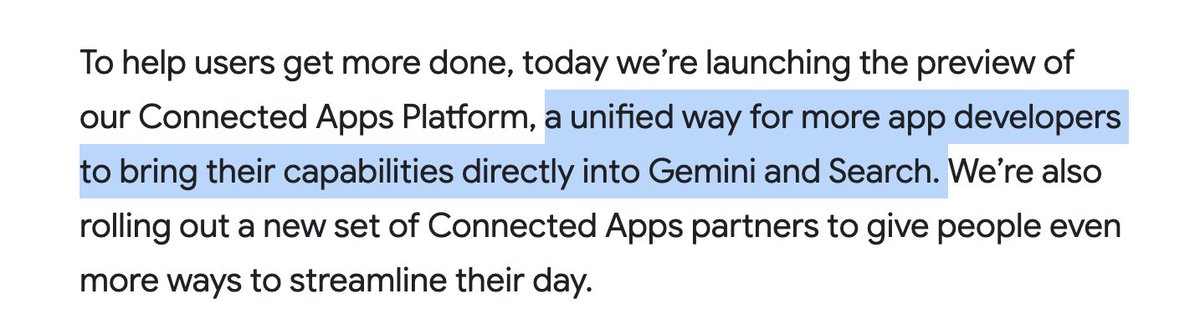
You can now build apps (using MCP) that can be used directly inside Google Search and Gemini.
Google announced the Connected Apps Platform. When approved, users link your app once and can access their data and take actions in your service seamlessly from Google's products.
Remember when Sundar Pichai said that Search will become an agent manager? This is it!
For 25 years, Search was a place where people connected with websites for information. In this new era, it's functionality that matters. Your business will be found on Search if it helps people (and their agents) get things done.
https://t.co/RQaYtCDTt7
BTW, just thinking out loud, but Google already has powerful Navboost data for understanding the user experience across sites, but layering these ad metrics on would be very smart. That may be why they are rolling out those metrics, the ability to test them, view trending over time, etc. Again, just thinking out loud. :)
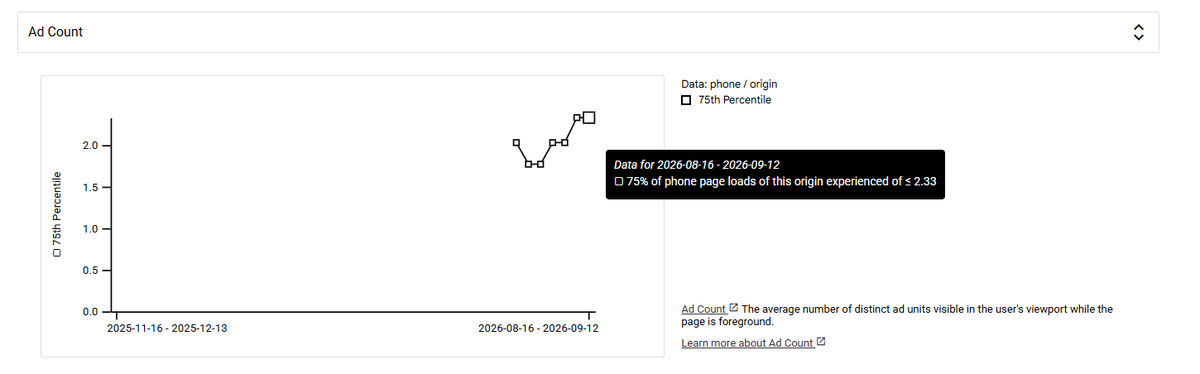
Tested a site with crazy aggressive ads using the new CrUX ad detection tool. BTW, you should learn how the metrics are calculated to understand the numbers. E.g. For an ad count of 2.33, that's a pretty bad user experience. That's how many ads a typical user is seeing *at once* on the site.
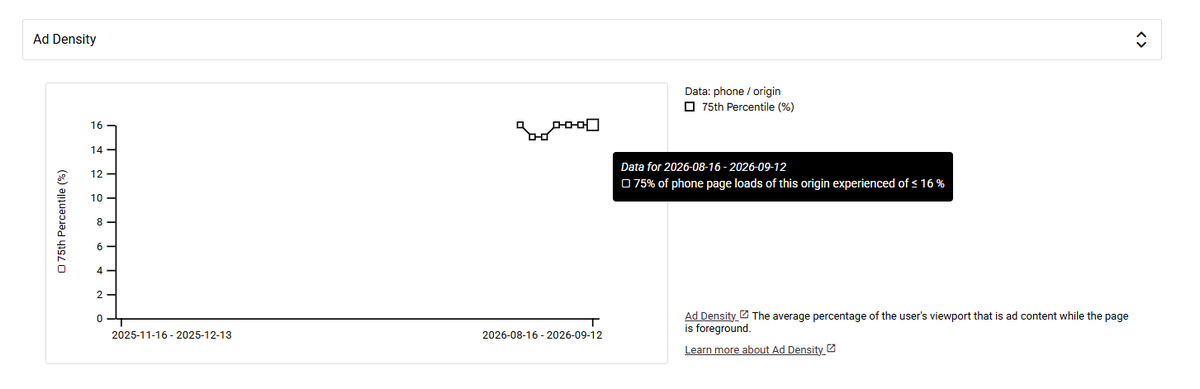
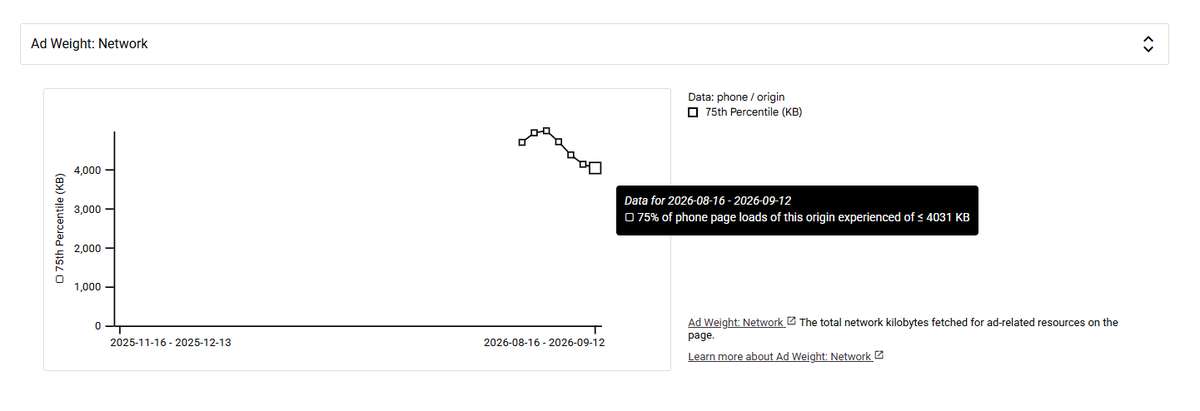
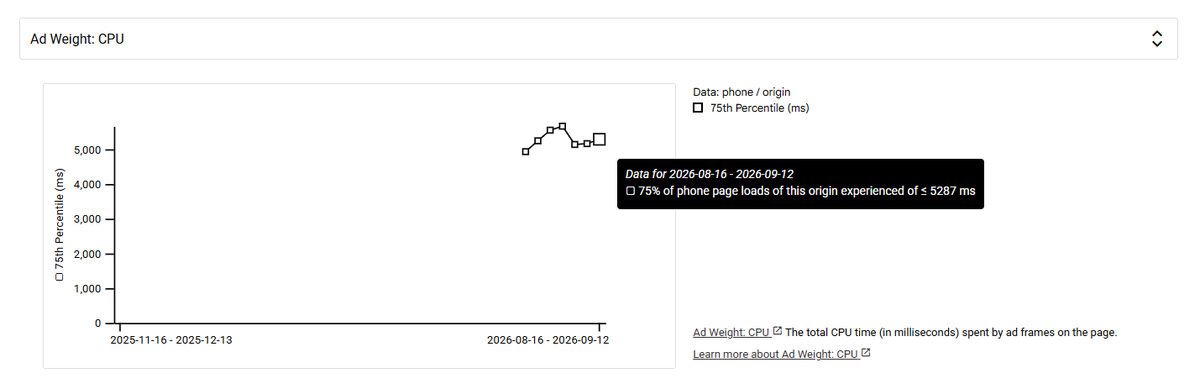
Ad density of 16% is the highest I have seen while testing different sites. Ad Weight CPU and Network aren't great either (although I saw sites with worse so far).
https://t.co/cBeGACuCdd
Recommended reading if you want to understand the very likely future of Google's Generative Search Results
@VeryWellVersed even included a tool to show you what your search results may look like in the future
Google announced that AI Overviews and AI Mode are going to do more when it comes to linking out to websites.
1. More inline links in AI answers. Plus they will be shown higher up in responses more frequently.
2. Displaying official websites up high in AI answers if they are the place where people usually go to complete a specific tasks.
3. New prominent carousels for timely news articles that will appear within the AI answers. These will highlight your Preferred Sources.
4. More links to websites at the end of AI answers, along with image thumbnails and a more clickable design.
5. Clickable creator and publisher names on video results that take you to their Search Profile.
https://t.co/dbcVGcnGqv
"Search traffic is under pressure..." Or... you've been impacted by algorithm updates over time and your search visibility has tanked. USA Today can address this and recover btw. This is not just about AI Overviews eating clicks... This is a visibility drop too. See screenshots below.
Memo: USA Today is cutting staff and reorganizing its audience team as search traffic falls: “our current structure was built for a different media landscape”
https://t.co/IG4ue1Ky2d
Nice little demo how AI watermarking works:
• Discretely influences word selection
• Only detectable with the right key
• Editing preserves the pattern
• Only a full rewrite erases it
📹 How to optimize your content for AI Search? We go through it in the latest episode of Crawling Monday's AI search roadmap series with @Suzzicks@gfiorelli1@yourfavoriteseo :
* Top errors when optimizing content for AI search
* Steps to optimize your content for AI search
* Favorite content optimization tools for AI search
* A last content optimization tip for AI search
Watch in full now here: https://t.co/KA3euffwJF
Yelp is finally becoming relevant for the first time since 2010 when you found it useful to find out what resturants sucked
Yelp licensed its whole library to OpenAI. 330 million reviews, 8 million business listings, feeding ChatGPT's answers on local service request prompts
Non exclusive deal, so expect the same thing with other AI companies soon too. Their "Request a Quote" flow is coming to the chatbot too, meaning someone can ask ChatGPT for HVAC quotes and reach you without ever seeing your website or your Google profile. Read that last part again. There's now a lead channel you can't track in Analytics.
What you should do right now: Go claim and finish your Yelp profile even if you've ignored it for five years. Hours, service area, every service you offer spelled out, photos of actual jobs
The model can only repeat what's in there. Turn on Request a Quote and answer fast. Let your office staff know. Have them use AI to learn about this
Yelp already ranks by response time and this makes that scoring matter a lot more. Change how you ask for reviews. A model summarizing 40 reviews reports the pattern, and "great service, highly recommend" gives it nothing to work with. You want customers naming the job and the town. "Replaced our condenser in Alamo Heights, same day in July." That's the sentence that gets you quoted back to a homeowner when theyre searching
One thing to keep in perspective: Morning Consult has 65% of Americans using AI search but only 15% trusting it much. So this isn't replacing google any time soon but it is becoming more and more a part of homeowners vetting potential companies so you need to optimize for it now!
Is "Information Gain" a Google Ranking Factor?
Excellent study via @ericlancheres: how much *new information* a URL has vs its rankings
New info didn't move the needle much (but the top 3 results contained more than the rest)
Biggest ranking predictor? # of unique data points
We run marketing for 500+ home service businesses. We track every dollar spent and every lead that comes in.
Here is every marketing channel ranked based on real data that we have collected over the last 4 years 🧵🦍
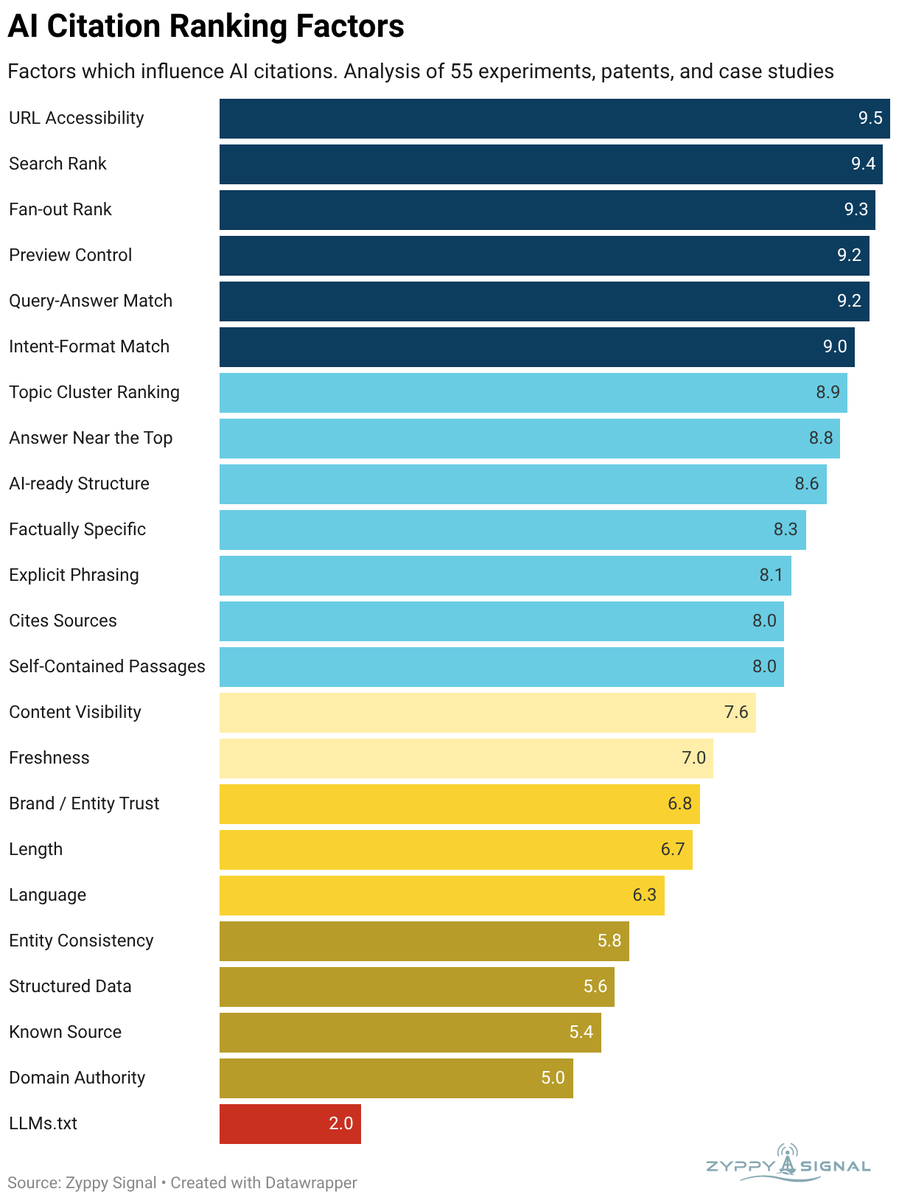
New: AI Citation Ranking Factors
Everyone talks about AI Citations as a way to boost visibility + traffic, but what works?
To find out, I gathered every study/experiment from the past 2 years, and scored the biggest wins
22 Ranking Factors associated with earning AI citations
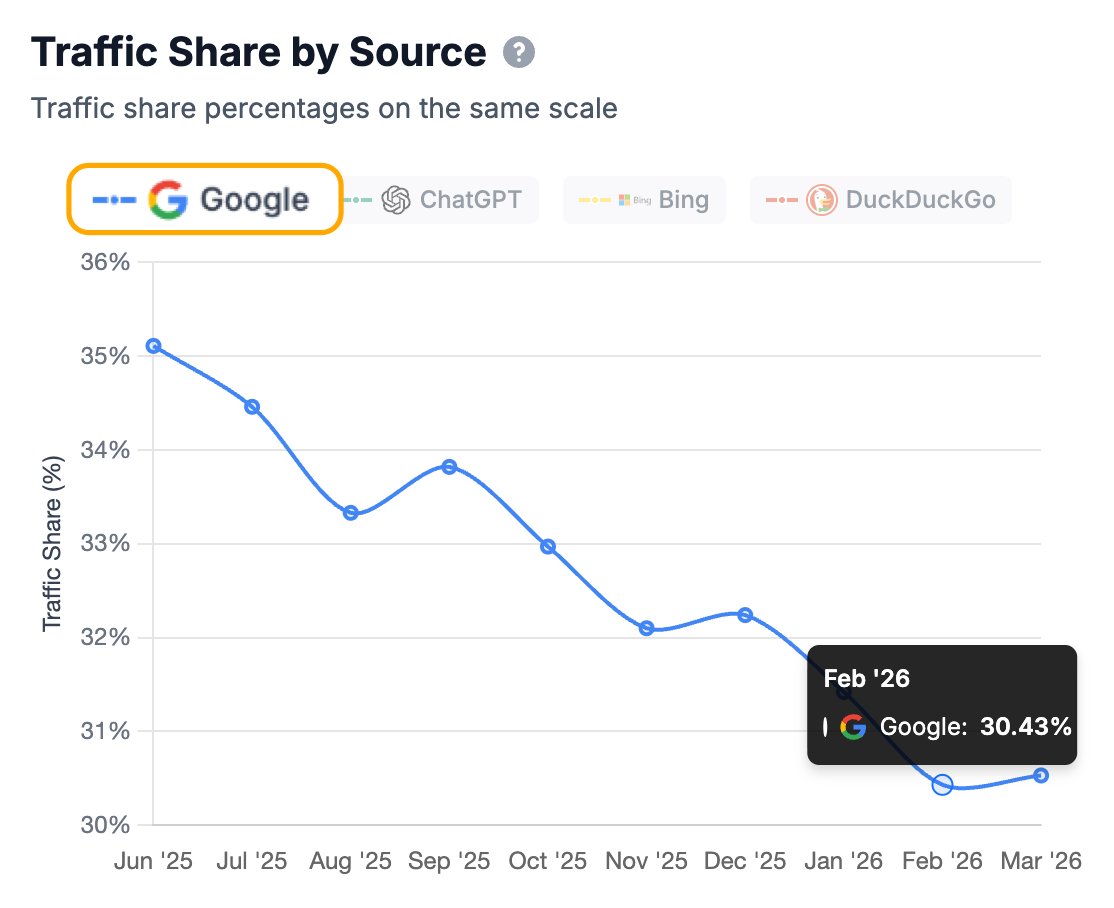
Google lost ~5% of traffic share in the past 10 months (35.11% → 30.53%).
Everyone thinks AI search ate it.
Well…
▪️ AI search: 0.22% → 0.26% (+0.04pp)
▪️ Social: 7.67% → 8.24% (+0.6pp)
▪️ Paid: 13.99% → 17.15% (+3.2pp)
^ that’s across ~75k websites in @Ahrefs’ panel.
(HINT: visit chatgpt-vs-google(DOT)com to see more data)
...
AI search gained almost no traffic share. And it makes sense. AI search is zero-click by nature. It answers questions, it doesn't send traffic.
The real winner? Paid.
Businesses are losing organic clicks from Google and compensating with ad spend. They have no choice. They still need customers on their websites.
So Google pushes AI Overviews, organic traffic drops... and businesses respond by giving Google more money for ads.
..or at least that's my read on the situation.
What's yours?