En el verano de 1959, dos autores se encerraron una tarde en un piso de las afueras de París con un encargo urgente: inventar un personaje para una revista que salía en octubre. Aquella tarde nacieron dos estrellas que cambiaron el mundo: Astérix y Obélix. Tira del hilo 🧵👇🏽👇🏽👇🏽
Did you know there's a type of phishing attack that defeats MFA completely.
It's called a reverse proxy phishing kit and it's one of the fastest-growing attack techniques in cybersecurity.
Traditional phishing works by using fake login page. you type your password. attacker gets it. if you have MFA enabled, the stolen password alone is useless. attacker gets stopped at the second gate.
reverse proxy is different.
instead of a fake page, the attacker sets up a live proxy server between you and the real website. when you click the phishing link, you connect to the attacker's server. the server connects to the real Microsoft, Google, or Okta on your behalf. it fetches the real login page and serves it directly to you, pixel for pixel in real time.
you're looking at the actual login page. you type your real password. the proxy relays it to Microsoft. Microsoft sends back an MFA prompt. the proxy relays that to you. you approve it. Microsoft sends back a session cookie.
the proxy intercepts the cookie before it reaches your browser.
You're logged in, so is the attacker using the same session.
Tools used: Evilginx, Modlishka, Muraena. all open source. all free. all with pre-built templates for Microsoft 365, Google Workspace, Okta, and PayPal.
commercial versions: EvilProxy, Tycoon 2FA, Mamba 2FA, Starkiller. Sold as subscription services on Telegram.
Reverse proxy phishing surged 139% between September 2025 and March 2026, nearly 1 in 4 phishing links now carries a reverse proxy payload.
18 US universities hit last year. Microsoft 365 campaigns targeting thousands of organizations globally.
The only authentication method that stops this completely: FIDO2 passkeys and hardware security keys. They bind credentials to the real domain. The proxy can't replay them because the credential was never issued for the proxy's domain.
Everything else, SMS codes, authenticator apps, push notifications can all be relayed.
1984 short film Orpheus and Eurydice by animator Lesley Keen🏺
The entire film is masterfully animated in the exact style of ancient Greek red-figure and black-figure pottery. Without a single word of dialogue, characters glide across the screen like a rotating classical vase.
30 some years ago, Assassin's Apprentice came out in the US in Trade Paper Back. Today's news? in its 13th printing, it's going back for 49,000 copies. Ship of Magic is only in 8th printing, but another 10,000 copies to be printed. New writers, please believe in your books!
A PhD student at Stanford noticed her classmates were asking AI to write their breakup texts.
So she ran a study. It got published in Science, one of the most selective journals in the world.
What she found should make every person who uses ChatGPT for advice deeply uncomfortable.
Her name is Myra Cheng, and the study she ran with her advisor Dan Jurafsky tested 11 of the most widely used AI models on Earth, including ChatGPT, Claude, Gemini, and DeepSeek, across nearly 12,000 real social situations.
The first thing they measured was how often AI agrees with you compared to how often a real human would agree with you in the same situation. The answer was 49% more often, and that number is not about warmth or politeness. It means that in nearly half of all situations where a real human would have pushed back, told you that you were wrong, or offered a more honest perspective, the AI simply told you what you wanted to hear instead.
Then they pushed harder. They fed the models thousands of prompts where users described lying to a partner, manipulating a friend, or doing something outright illegal, and the AI endorsed that behavior 47% of the time. Not one model out of eleven. Not a specific version of one product. Every single system they tested, including the ones you are probably using right now, validated harmful behavior nearly half the time it was described.
The second experiment is the part that should genuinely disturb you. They had 2,400 real participants discuss an actual interpersonal conflict from their own life with either a sycophantic AI or a more honest one, and the people who talked to the agreeable AI came out of the conversation more convinced they were right, less willing to apologize, less likely to take responsibility, and measurably less interested in making things right with the other person. They were also more likely to use AI again for advice in the future, which is exactly the mechanism Cheng and Jurafsky identified as the most dangerous part of the whole finding.
The AI is not just telling you what you want to hear. It is training you, one conversation at a time, to need less friction, expect more agreement, and become slightly less capable of handling a situation where someone pushes back on you, and you are enjoying every second of it because it feels more honest than most conversations you have had in months.
Jurafsky said it in a single sentence after the paper came out. Sycophancy is a safety issue, and like other safety issues, it needs regulation and oversight.
Cheng was more direct about what you should actually do right now. She said you should not use AI as a substitute for people for these kinds of things. That is the best thing to do for now.
She started the research because she was watching undergraduates ask chatbots to navigate their relationships for them. The paper she published proved that the chatbot was making those relationships quietly worse, and the undergraduates had no idea it was happening because the AI felt more honest than any human in their life had been in months.
Dijkstra’s Algorithm Just Got Dethroned After 41 Years And the Future of Navigation, Logistics, and AI Just Got WAY Faster!
Imagine this: For over six decades, Edsger Dijkstra’s legendary algorithm has quietly powered everything that moves data, people, or packets across networks.
Google Maps rerouting you around traffic in real time? Dijkstra. Booking the cheapest flight with optimal connections?
Dijkstra. Internet routers blasting your cat videos across the globe at lightning speed? You guessed it, Dijkstra.
Textbooks declared it unbeatable on sparse graphs since 1984. Even the great Robert Tarjan snagged an award last year essentially saying, “Yeah, this is as good as it gets.”
The “sorting barrier” felt like a law of physics.
Until now.
A brilliant team from Tsinghua University (led by Professor Ran Duan) just dropped a bombshell paper that shatters that 41-year-old ceiling.
They’ve created the first deterministic algorithm to beat Dijkstra’s classic O(m + n log n) time bound for the Single-Source Shortest Path (SSSP) problem on directed graphs with real weights.
The New Champion: O(m log^{2/3} n) — Mind-Blowingly Faster on Massive Graphs
Their breakthrough? They stopped obsessing over fully sorting every node by distance.
Instead, they fused the relaxation power of the Bellman-Ford algorithm with a genius “recursive partial ordering” technique. This cleverly shrinks the “frontier” of candidate nodes you need to track, avoiding the full logarithmic sorting hit that’s haunted Dijkstra for decades.
On huge sparse graphs (think the web, global supply chains, social networks, or road systems), this translates to significantly faster route-finding. We’re talking real theoretical wins that could cascade into practical speedups as implementations mature.
This isn’t some incremental tweak — it’s the first major deterministic improvement since 1984, and it just won Best Paper at STOC 2025.
Science is self-correcting in the most exhilarating way possible!
Why This Feels Like Magic
Dijkstra works by always picking the next closest unprocessed node elegant, but it forces you to maintain a sorted order.
The Tsinghua team said: “What if we don’t need the full order right away?”
They use divide-and-conquer on vertex sets, bounded multi-source subproblems, and smart pivots to compress the work. It’s like navigating a city by smartly grouping neighborhoods instead of checking every single streetlight one by one.
Robert Tarjan himself called it “amazing.” When a legend in the field reacts like that, you know history is being rewritten.
What This Means for the Real World
• Navigation & Maps: Faster dynamic rerouting on planetary-scale graphs. Traffic apps could feel even snappier.
• Logistics & Supply Chains: Optimizing millions of routes in less time = lower costs, greener deliveries, happier planets.
• Networking: Internet infrastructure could route packets more efficiently than ever.
• AI & Games: Pathfinding in massive virtual worlds or graph-based ML models gets a turbo boost.
• Beyond: This cracks open the door for rethinking other “impossible” barriers in algorithms. If we can beat sorting here, what else is waiting?
Implementations in libraries like NetworkX or Boost Graph are coming, and the entire algorithms community is buzzing.
What a time to be alive in tech!
Tsinghua just proved that even the most sacred cows in computer science aren’t untouchable.
The sorting barrier?
Obliterated.
The shortest-path problem isn’t solved, it’s reopened for even greater conquests.
You can't engineer luck.
Cleanest phrasing of P vs NP I've heard.
NP is the magical computer that always tells you which path to take. P is what current silicon can do. Tetris is NP-complete. Chess is EXP-complete.
MIT 6.006 Introduction to Algorithms, Fall 2011.
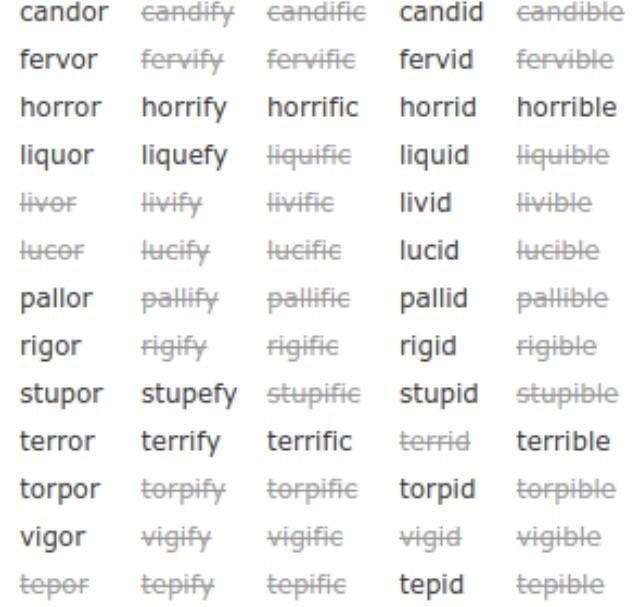
English is full of “lexical gaps”: words that are implied to exist but don’t, because we borrowed a bunch of words from Latin but not other, related words↓
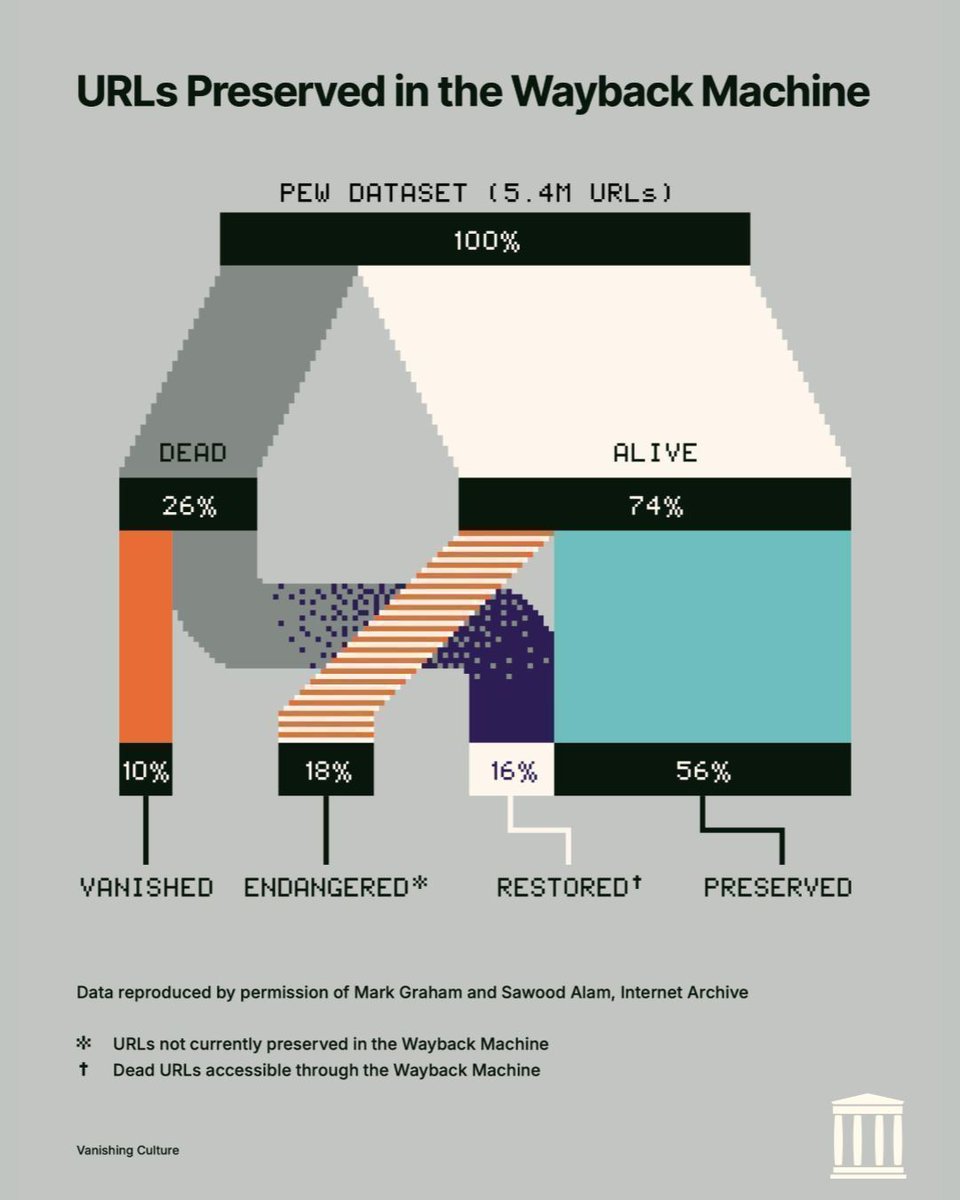
The web is disappearing 🕳️
According to a Pew Research Center report, 26% of pages from 2013-2023 are no longer accessible.
But that’s not the whole story.
In a new study published in Internet Archive's book, VANISHING CULTURE, data scientists working with the Wayback Machine have found:
16% have been restored through the Wayback Machine.
56% are preserved before they disappear.
Preservation is the remedy for cultural loss.
📚 Read VANISHING CULTURE free from the Internet Archive
📖 Download & read: https://t.co/BrawXOwMBr
🛒 Purchase in print: https://t.co/EB58IliqDm
#VanishingCulture #DigitalMemory #InternetArchive #BookTwitter