@Sacramentshow If the magisterium is the final authority, why do sincere Catholics reach opposite conclusions from the same magisterial pronouncements while all claiming the Holy Spirit guided them?
Happy Thanksgiving!
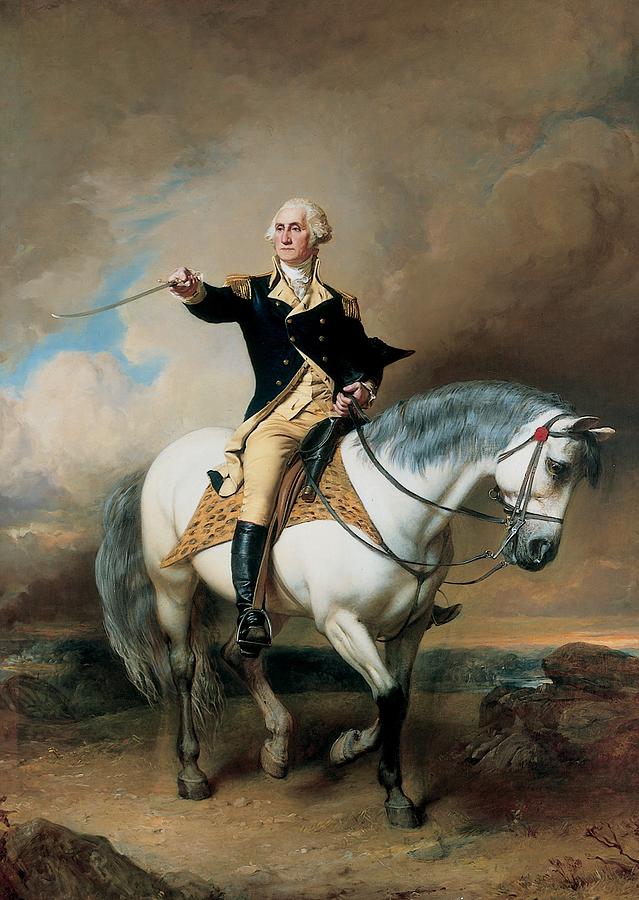
Enjoy these fitting words from President George Washington, a proclamation issued on the 3rd of October, 1789 to this Christian nation we call the United States of America:
"By the President of the United States of America. A Proclamation.
Whereas it is the duty of all Nations to acknowledge the providence of Almighty God, to obey his will, to be grateful for his benefits, and humbly to implore his protection and favor—and whereas both Houses of Congress have by their joint Committee requested me “to recommend to the People of the United States a day of public thanksgiving and prayer to be observed by acknowledging with grateful hearts the many signal favors of Almighty God especially by affording them an opportunity peaceably to establish a form of government for their safety and happiness.”
Now therefore I do recommend and assign Thursday the 26th day of November next to be devoted by the People of these States to the service of that great and glorious Being, who is the beneficent Author of all the good that was, that is, or that will be—That we may then all unite in rendering unto him our sincere and humble thanks—for his kind care and protection of the People of this Country previous to their becoming a Nation—for the signal and manifold mercies, and the favorable interpositions of his Providence which we experienced in the course and conclusion of the late war—for the great degree of tranquillity, union, and plenty, which we have since enjoyed—for the peaceable and rational manner, in which we have been enabled to establish constitutions of government for our safety and happiness, and particularly the national One now lately instituted—for the civil and religious liberty with which we are blessed; and the means we have of acquiring and diffusing useful knowledge; and in general for all the great and various favors which he hath been pleased to confer upon us.
And also that we may then unite in most humbly offering our prayers and supplications to the great Lord and Ruler of Nations and beseech him to pardon our national and other transgressions—to enable us all, whether in public or private stations, to perform our several and relative duties properly and punctually—to render our national government a blessing to all the people, by constantly being a Government of wise, just, and constitutional laws, discreetly and faithfully executed and obeyed—to protect and guide all Sovereigns and Nations (especially such as have shewn kindness unto us) and to bless them with good government, peace, and concord���To promote the knowledge and practice of true religion and virtue, and the encrease of science among them and us—and generally to grant unto all Mankind such a degree of temporal prosperity as he alone knows to be best.
Given under my hand at the City of New-York the third day of October in the year of our Lord 1789."
—George Washington
Head covering fact:
Our rejection of the head covering today arises not from a proper understanding of Greco-Roman culture, but from our own culture successfully discipling us to fear women rather than God.
So we look for a reason to ascribe Paul's teaching to "culture."
There are several reasons why John 6 ought not be taken literally, e.g.,
1) the bread of life narrative (John 6:27) is based on Isaiah 55:1-4 in which true food that satisfies is the preached Word of God, figuratively described as food and drink;
2) the bread that came down from heaven is His flesh (John 6:51), but Jesus did not literally bring His flesh down from heaven. He came down from heaven in order to put on flesh (John 1:19; Heb 10:5), so it can't be referring to His literal flesh;
3) when the Jews murmur about "How can He say, ‘I have come down from heaven’?" (John 6:42), He responds by citing Isaiah 54:13, clarifying that the life-giving bread He brought down from Heaven is in fact the teachings He brought down from His Father in heaven (John 6:44);
4) the Gospel of John is about how the light came to the world and the world did not understand it (John 1:5), and what follows is a series of conversations in which His hearers repeatedly and incorrectly take His figurative teachings literally.
All these point to a figurative interpretation, and thus did the early writers understand the passage.
BUT my favorite reason for not taking it literally is:
5) whenever the Jews ask Him for a sign from heaven, He refuses, and instead gives a cryptic reference to His resurrection: "no sign will be given to it except the sign of the prophet Jonah" (See Matt 12:39, 16:4; Luke 11:29). And of course, not one person in His audience understood what on earth He was talking about. No, not even the apostles, for the meaning "was hidden from them" (Mark 9:10, John 20:9, Luke 18:34). And that's important because in John 6, the Jews again had arrived, seeking a sign from heaven "that we may see and believe" (John 6:30).
The typical Roman Catholic approach to John 6, of course, is to assume that THIS TIME when they asked for a sign—in a stark departure from His cryptic responses in the synoptic Gospels—Jesus answered with a crystal clear reference to the miracle of transubstantiation, and that every person in His audience understood exactly what He was talking about. That makes no sense, especially in the Gospel of John which focuses on the chronic tendency of His listeners to misunderstand Him by taking Him literally.
If you read the John 6 narrative, you'll find four promises that we will participate in the resurrection on the last day (vv. 39, 40, 44, 54), but nary a word about the power by which our own resurrection would be brought about. That was a mystery to them at the time, and would not be clear even to the Apostles until after His resurrection (John 20:9). Our resurrection is guaranteed only because of the power of His (Philippians 3:10).
We of course are not left wondering whether Jesus had really responded in John 6 with a cryptic reference to His own resurrection. In fact, the foundational construct upon which His bread of life narrative in John 6 is built—Isaiah 55:1-4—itself contains a cryptic reference to His resurrection: "the sure mercies of David" (Isaiah 54:3). The Lord's promise to us is that if we eat the true bread from heaven—that is, if we believe the teachings He brought down from Heaven from His Father—then He will grant to us "the sure mercies of David," which is just a cryptic phrase meaning "that he raised him up from the dead, now no more to return to corruption" and will do the same for us (Acts 13:34).
Jesus' standard response to those who ask for a sign from Heaven (as in John 6) is a cryptic reference to the power of His own resurrection, by which we will be raised from the dead on the last day, a gift available to us by belief in His preached word, the true bread from Heaven, the only bread that truly satisfies. Yes, the whole narrative about "eat my flesh and drink my blood" is a figurative reference to belief in His preached word, and in particular, hearkening to the good news of His resurrection.
If you miss that cryptic reference and take Him literally there, you are no better off than the Jews who thought Jesus would rebuild the literal temple in three days, wanted Nicodemas to return literally to his mother's womb to be born again, and saved the Samaritan woman any further trips to the well with an endless supply of literal water.
Taylor could and should but can’t and won’t admit he’s wrong, even if he doesn’t yet know why he’s wrong.
According to Joe Heschmeyer, if the Catholic Church’s claims are true, “your objections to its teachings are wrong, even if you don’t yet know why they’re wrong” and even if the Church’s teaching “contradicts your personal reading of scripture” (Pope Peter, ch 1).
Roman Catholicism officially teaches that the death penalty is inadmissible. Taylor objects, based on his personal reading.
According to Joe, Taylor needs to accept that he’s wrong. But according to Taylor, the Pope should have accepted that he was wrong, and Catholics should accept that the catechism is wrong. Because the official RCC teaching on the death penalty contradicts Marshall’s “biblical implementation of the death penalty.”
Which serves to illustrate that unity under the magisterium doesn’t work unless Catholics can agree on what the Magisterium teaches. They can’t.
Maybe Taylor Marshall and Tim Gordon @timotheeology can finally reconcile, since Taylor has essentially (albeit unwittingly) embraced Gordon’s dictum that “nobody even knows what’s in the magisterium.”
Join us for worship at Puritan Reformed Church in Phoenix, Arizona.
Learn the Bible.
Hear it as the serious thing it is - the Word of God.
We are preaching from the very start of the Bible - Genesis 1.
Owen with the fire... Papists have pejoratively been referring to the Reformed as Biblicists since the 17th Century. Now it's other Reformed folks tossing grenades into their own trenches.
Remember that line from iRobot? Spooner, after blowing away a robot, says, "You know, somehow, 'I told you so' just doesn't quite say it."
I have known for a long time that many of the "Reformed" would say the "right words" when it came to Rome, but they really did not understand how important the issues really were. Many had never sat and plead with a former church member who was swimming the Tiber, exchanging the imputed righteousness of Christ for the treadmill of endless penances. Vast majority would be torn to shreds by a trained Roman apologist. But they mouthed the words. I could see where the sacralism, the neo-integralism (not a term I used to use, but it is properly descriptive) would lead these folks. And when the gospel itself isn't the answer to all the real questions, it is easy to see how this kind of attitude develops (and quickly!). No, Rome is not the be-all and end-all of opposition, but the true fool is the one who does not see that the answers to Rome are the answers to Mecca and to the secular assault on the faith, etc.
Church fathers who believed Mary had other Children:
1. Simon (Peter)
2. Andrew
3. James (son of Zebedee)
4. John
5. Philip
6. Bartholomew
7. Thomas
8. Matthew
9. James (son of Alphaeus)
10. Thaddaeus (also called Judas, son of James)
11. Simon (the Zealot)
12. Matthias
🚨 JUST IN - PRESIDENT TRUMP: "I want to try and get to heaven if possible. I hear I'm not doing well. I hear I'm really at the bottom of the totem pole. But if I can get to heaven, this [war ending] will be one of the reasons."
Protestantism didn't arrive in 1517. Celtic Christians were already saying "The Pope of Rome hath no jurisdiction in this realm" in the 6th century.
St Columbanus in a letter to Boniface IV: